Bob Schwartz

Putin’s Moldovan Invasion v. Dynasty’s Moldavian Massacre

Dynasty Royal Wedding
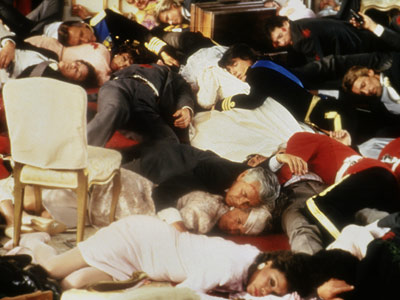
A cliffhanger is a cliffhanger. Russia may be about to invade its neighbor Moldova, based on troop buildup along the border. Almost thirty years ago, on May 15, 1985, the ABC series Dynasty ended Season 5 by leaving the world hanging, as terrorists invaded and shot up the royal wedding of Prince Michael of Moldavia and Amanda Carrington.

(Note: To clarify the Moldavia/Moldova confusion. Moldavia is a traditional region that now straddles the nations of Romania and Moldova. The language of Moldova is Romanian, and the Romanian name for Moldavia is Moldova. The producers of Dynasty may or may not have been aware of this, or that Moldova was at the time a part of the Soviet empire, or much else geographic. Dynasty was not a documentary or reality series. “Prince Michael of Moldavia” just sounded so cool and romantic, as was the fake country.)

Who would survive this now infamous Moldavian Massacre (you can watch it here)? Viewers of Dynasty, then #1 in the ratings, would have to wait all summer to find out. Meanwhile, that season-ending episode reportedly attracted 60 million viewers.

Will Putin invade Moldova, claiming that just as with Crimea, Moldovans are pleading to join up with their Russian friend and neighbor (and former ruler)? How will the world respond? How will Putin respond to that? That’s a real cliffhanger. And even though Putin seems to be playing a part in a costume epic, in which he is the royal hero, a sort of Putin’s Dynasty, this is no television series. Perhaps Czar Vladimir of Russia will wake up and see that.

Turkey Goes Radioactive

Erdogan and Twitter
Turkish Prime Minister Tayip Erdogan tried to close down Twitter in Turkey yesterday. Instead it exploded in his face, like a digital trick cigar.

Erdogan is miffed because Twitter is being used to disclose details about corruption, including the broadcast of phone conversations. “Twitter, mwitter,” he ranted as he blocked access.

The world noticed and, of course, tweeted. So did those in Turkey, who circumvented the ban by using an SMS text-based version.

As previous posts point out, Turkey is unlike any country in the world. Its path to modern democracy is unique and apparently unfinished. More than a bridge between east and west, it is a bridge between ancient and very modern. No nation, except perhaps for Israel, has experimented so creatively with making the past present, the past future, and the present and future past.

And, without any particular personal or filial or ancestral connection, it was for me love at first visit.

Also, even if you have no other feeling for it or reason to watch it, watch carefully. Turkey is a bellwether. If democracy and modernism proceed hand-in-hand there, there is great hope for the world, if not necessarily a replicable model. If Turkey cannot pull off that trick, we should all be concerned. Very concerned.

Erdogan has no plans to give up. But when I heard this morning’s score—Twitter 1, Erdogan 0—the song that came to mind was Radioactive by Imagine Dragons:

I’m waking up
I feel it in my bones
Enough to make my systems blow
Welcome to the new age, to the new age
I’m radioactive, radioactive

Thor Gives Birth to Twins

Thor
Nobody wants to hear from word nerds. They just stifle creativity and block linguistic evolution with their definitions and rules. Humpty Dumpty from Alice in Wonderland is the man (or eggman): words mean exactly what anybody says they mean.

Except they don’t, or they can’t or shouldn’t. If you tell a doctor you have a pain in your leg, and she examines and treats your arm, because leg now means arm, everybody has a problem.

Here’s the TMZ story that’s been widely picked up:

Chris Hemsworth and Elsa Pataky — Give Birth to Twins
Thor’s Got Twins Now!

3/20/2014 4:14 PM PDT BY TMZ STAFF
EXCLUSIVE

Chris Hemsworth and his wife are at Cedars Sinai Medical Center right now giving birth to twins … TMZ has learned.

It’s ultra-high security in their hospital suite … we’re told 2 security guards are standing at the door.  Chris is strolling the hallway and is being escorted with a guard.

Chris and his wife Elsa Pataky already have one baby — India Rose Hemsworth who is now 22 months old.  She’s about to have a couple new siblings.

Chris and Elsa were married in 2010.

This led to headlines like this one in the New York Daily News:

Chris Hemsworth, wife Elsa Pataky giving birth to twins

Nobody may care, except for mothers, doctors, and Mrs. Chris Hemsworth, but “giving birth” is not the same as parents having a baby. “Birth” is variously defined as “The emergence and separation of offspring from the body of the mother” or “The event of being born, the entry of a new person out of its mother into the world.”

Chris Hemsworth can be a proud and involved daddy. So can Thor. But neither of them can give birth, no matter what TMZ or the Daily News say.

It’s Spring. It’s Snowing.

Spring Snow
It’s spring. It’s snowing.

It is the most beautiful snow of the year. No wind, big flakes dropping so slowly that it seems like suspended animation. Like being in a snow globe.

But it is spring. Maybe this is saving the last for best.

Spring: Flowers in the Sky

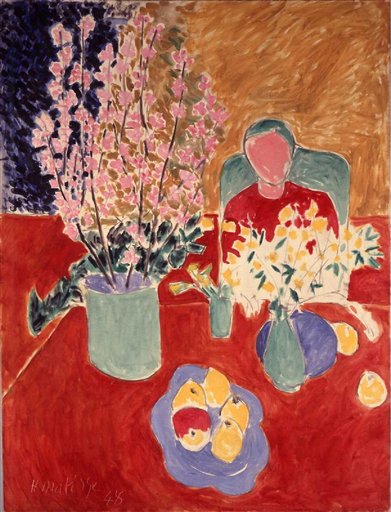
The Plum Blossoms - Henri Matisse
This message for the start of spring comes from the masterpiece Treasury of the True Dharma Eye (Shobo Genzo) by Dogen, the founder of Soto Zen.

The passage is taken from Fascicle 44, Flowers in the Sky, written in 1243:

Thus, when the time comes, flowers open. This is the moment of flowers, the arrival of flowers. At this very moment of flowers arriving, there is no other way. Plum and willow flowers unfailingly bloom on plum and willow trees. You see the flowers and know plum and willow trees. You understand flowers by looking at plum and willow trees. Peach and apricot flowers have never bloomed on plum and willow trees. Plum and willow flowers bloom on plum and willow trees. Peach and apricot flowers bloom on peach and apricot trees. Flowers in the sky bloom in the sky in just this way. They do not bloom on other grasses or trees.

Seeing the colors of flowers in the sky, you fathom the limitlessness of fruit in the sky. Seeing the opening and falling of flowers in the sky, study the spring and autumn of flowers in the sky. The spring of flowers in the sky and the spring of other flowers should be the same. Just as there are a variety of flowers in the sky, there should be a variety of springtimes. This being so, there are springs and autumns in the past and present.

Those who assume that flowers in the sky are not real and other flowers are real have not seen or heard the Buddha’s teaching. To hear the words that the sky originally had no flowers and assume that the flowers in the sky that did not exist do exist now is a lesser view based on shallow thinking. Step forward and think deeply.

Ukraine: Adolf Hitler and William Faulkner

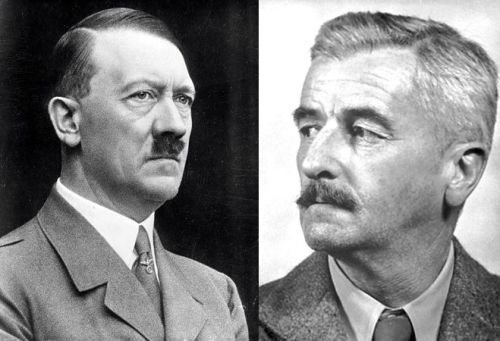
Adolf Hitler - William Faulkner
The term lingua franca means a language that is understood across cultures. It literally means “Frankish language,” referring to a hybrid language that was used for commerce and diplomacy during the Renaissance. Today, one might call English a lingua franca, since unofficially and officially (as in air transport), it is the one universally used and understood.

In contemporary history, the person who comes up most often as an historical analogy is Adolf Hitler. For good reason. Others may have killed more. Others may have conquered more territory. But Hitler did it all, ignited world war, and did it in our times, in living memory, and in ways that shaped the world—and thus shaped our thinking and conversation now and for generations to come. He is the historical persona franca.

A previous post pointed out that Putin’s post-Olympics invasion of Ukraine bested Hitler’s annexation of Austria in March 1938. Hitler waited almost two years after his self-promotional 1936 Berlin Olympics before the Anschluss; somewhat bizarrely, even though Putin politely waited for two days after the Paralympics in Sochi closed, the annexation of Crimea was effectively done while the Olympics were still being held.

When Hillary Clinton mentioned in a speech that Putin’s actions were reminiscent of Hitler, she was shushed up by her supporters and her detractors. Talk like that was deemed premature, alarmist, undiplomatic, and, in Hillary’s case, unpresidential. And yet as events have sped along, the mentions increase. Just today, the former U.S. Ambassador to Russia had to admit that we have not seen an event like the annexation of Crimea since…the 1930s. And whether Hitler is a persona franca or a trump card, Putin uses it himself, claiming that the Ukrainian ouster of Yanakovych was orchestrated by Nazi thugs who are now in power.

History matters, and Hitler matters in history, whatever use he may be in thinking about the critical issues developing in Ukraine. This year is the centennial of World War I (also known as THE World War and the War to End All Wars, before there was a second one). So maybe take a little time to learn a little more about Europe in the period from 1914 to 1945—a mere thirty years or so in which there were two world wars, one of the most evil men in history, an attempt to eliminate an entire people from the earth, and the development of an apocalyptic weapon that gives God a run for his money.

Why learn this history? Because literally everything that is in the news about Russia and the Ukraine is joined with it. Because history never goes away, particularly in Europe. Or anywhere. As William Faulkner wrote, having lived in the American South where history never goes away, where understanding history is the only way to understand today, “The past is never dead. It’s not even past.”

Anschluss 1938

Anschluss
History doesn’t have to be analogical, though that is often tempting. Instead, it can just be generally informative, not predictive about how particular parties may act and should react, but just as lessons in the variety of global experience.

In March 1938—the anniversary just passed last week—Hitler annexed Austria, an event now known as the Anschluss. Here, for general information, and not necessarily for comparison, are excerpts from the BBC Bitesize site:


Hitler wanted all German-speaking nations in Europe to be a part of Germany. To this end, he had designs on re-uniting Germany with his native homeland, Austria. Under the terms of the Treaty of Versailles, however, Germany and Austria were forbidden to be unified.

Hitler also wanted control of the largely German-speaking area within Czechoslovakia, called the Sudetenland. Importantly, Austria shared a border with this area.

In an attempt to realise his goals, Hitler was determined to destabilise Austria and undermine its independence. His ultimate goal was anschluss (union) with Austria…

The new Austrian Chancellor, Schuschnigg tried to preserve the country from German invasion by trying not to give Hitler an excuse for aggression. He tried to co-operate with Hitler as much as possible…

Hitler ordered Austrian Nazis to create as much trouble and destruction as possible in order to put pressure on Schuschnigg. If Hitler could claim that Austrian law and order had broken down he could justify marching German troops into Vienna to restore peace – despite the fact that he was responsible for the chaos in the first place.

Four days in March

Wednesday 9th March 1938

On the 9 March 1938, in a desperate act, Schuschnigg announced a referendum whereby the Austrian people would decide for themselves if they wanted to be a part of Hitler’s Germany. Hitler was furious. If the Austrians voted against joining Germany his excuse for invasion would be ruined.

Thursday 10th March 1938

Hitler told his generals to prepare for the invasion of Austria. He ordered Schuschnigg to call off the referendum. Knowing he would receive no help from Italy, and that France and Britain would not interfere in Hitler’s plans, Schuschnigg conceded. He called off the referendum and resigned.

The Nazi Austrian Interior Minister, Seyss-Inquart, was ordered by Hitler to ask for German help in restoring order in Austria.

Friday 11th March 1938

Hitler reassured Czechoslovakia that they had nothing to fear.

Saturday 12th March 1938

German troops marched into Austria unopposed. Hitler now had control of Austria. A month later, Hitler held a rigged referendum. The results showed that the Austrian people approved of German control of their country.


Note: Czechoslovakia indeed had something to fear. That same year, Germany invaded the German-speaking Czech region, the Sudetenland, and ultimately conquered the entire nation. It was that invasion that prompted the intervention of British Prime Minister Neville Chamberlain, who tried to “make peace” with Hitler at the infamous Munich conference.

In 1968, exactly thirty years later, the Prague Spring of political and cultural liberalization led to an invasion of Czechoslovakia by the Soviet Union. Fortunately, the spirit of that spring was never fully crushed, and inspired a flowering of sometimes secret creativity and rebellion.

Ukraine: What’s Happening on the Weak Side?

Basketball
The weak side in basketball does not suggest weakness. It is the part of the court away from the ball. This doesn’t mean that the players there are weak or that the action there is unimportant. On the best teams, there can be almost as much happening on the weak side as there is on the strong side. Players may be running around, positioning themselves to take advantage, either by scoring or by taking away the ball. On the lesser teams, weak side players sometimes seem to drift aimlessly, or just stand around, depending on someone else to somehow work it out. If you don’t have the ball, what else is there to do?

We know exactly where the ball is in the current Ukraine crisis. And we know exactly who has the ball. The question is what the players on the weak side are doing. Are there plays carefully diagramed by the coach, practiced for just such a situation? Is there a player away from the ball, away from the basket, just waiting to heroically steal and drive all the way down court? Or are the weak side players drifting, trying to remember plays they once learned or improvise new ones?

The shot clock is running.

Ukraine Sanctions: Who Is Poking Which Bear

Bear
The most interesting message about this morning’s U.S. sanctions to protest Russian actions came from one of those sanctioned. The travel bans and freezing of U.S. assets are aimed at a handful of Putin advisers and others complicit in the Crimean takeover, but not at the highest level (including Putin) or at any businesspeople.

Russian Deputy Prime Minister Dmitry Rogozin, who is being sanctioned, tweeted this:

“Comrade Obama, and what will you do with those who have neither accounts nor property abroad? Or didn’t you think of that?”

On this day when a prominent Russian television journalist, with an atomic mushroom cloud as background, pointed out—correctly—that Russia is the only country that can reduce the U.S. to “radioactive ash,” the tweet from Comrade Rogozin is most telling.

The U.S., even more than our allies, is being poked. Taunted. “Is that the best you’ve got? You can do better than that!” The U.S. and Europe can of course do better (meaning: more severe) than that, from big business sanctions to military intervention, all of which threaten global instability.

This is the point in every fight when power has to be harnessed in the service of strategy. Russia wants nothing more than any excuse to throw away the rulebook they don’t believe in anyway. They aren’t so much bringing guns to a knife fight as brandishing guns to bring out the other guns and look like the victim. The aggressor victim.

Let’s hope or pray for our leaders to be strong, wise, unselfish, non-partisan, and honest (with us and with themselves), who can interpret the language of pokes, and can act appropriately.

Beyond Anger: How to Hold On to Your Heart and Your Humanity in the Midst of Injustice

Beyond Anger
The crisis in Ukraine is deepening, and with that lots of thought, opinion, and calls for action. It may seem like the wrong time for self-awareness and contemplation. Enough talk. This is a Nike world, so let’s just do it.

Whether it is about the Russian invasion of Ukraine or about unfairness in our own nation, our desire for justice and aversion to injustice is a good thing. But it can be so powerful and overwhelming that we easily get lost. It isn’t that we shouldn’t act decisively; it’s that in our zeal, we can be confused or overly certain about what the right decision is.

Last summer, in the face of terrible killings in India that had profound implications for Buddhist communities, Shambhala Publications published a free book you can get, Beyond Anger: How to Hold On to Your Heart and Your Humanity in the Midst of Injustice.

The publisher explains:

In July 2013, multiple bombs exploded in Bodh Gaya, India, in and around the holiest Buddhist pilgrimage site, the Mahabodhi temple that marks the spot where the Buddha attained enlightenment. In response, Shambhala Publications offers this free eBook consisting of excerpts from some of our books from a variety of Buddhist traditions that encapsulate values of love and nonviolence, which we can all practice ourselves.

You may not be a Buddhist, or care about Buddhist philosophy. You may or may not be angry about what is going on around the world, or about what some people say about how to solve the problems. You may believe that you have a better way, and you may be right. It’s just that no matter what, a different perspective can always be helpful.

In a section of the book called Conflict Resolution: Anger Is the Problem, The Karmapa, Ogyen Trinley Dorje talks about Global Conflicts, Global Solutions:

When bigger and more powerful nations step in to offer guidance to other nations, many of the same principles apply as when individuals intervene to resolve interpersonal conflicts. A sincere motivation is absolutely key, and on top of that, the intervention must be done with sensitivity and skill.

In this small world we live in, nations coexist interdependently. The actions of one country affect others deeply. Countries with more power have the potential to influence others more. I believe that with this power comes a great deal of responsibility, and that includes the responsibility not to exercise one’s power over others in pursuit of the private interests of one’s own nation….

Before you approve the actions proposed, you should be confident that they are in the best interest not only of your country, but of the world as a whole. To be a responsible, conscious citizen, it is important that you think for yourself, and take universal peace, stability, and well-being into account. Use your discernment and take a stand that serves the whole world, not just one corner of it.

Even when we are sure that the motivation to contribute positively to the well-being of the world is sincere, we also have to scrutinize the means used to pursue that aim. For example, in the name of bringing freedom to other countries, weapons are produced and wars are waged. As powerful countries themselves expand their arsenals and wage more war, the peace and stability of their own country and of the world are both placed at risk.

Again, a pure motivation needs to be applied with wisdom. I feel very strongly that war and fighting are not an effective means to bring about peace or prosperity, stability or freedom. I am certain that history will demonstrate war to be ineffective and counterproductive in the long run.

I have met many people from powerful countries who are deeply unhappy with how their leaders wield their power internationally. This seems especially common when people have failed in their efforts to urge the decision makers to pursue a more compassionate and skillful course. Some of these people become angry at their own governments. In other cases, people direct their anger at the governments of other countries.

If you find yourself angry at any government, please recollect how harmful anger is to yourself and others, and steady yourself with a firm resolve. Make an unwavering commitment to yourself that you will not allow your mind to become perturbed. Be immovable—unshakable from a peaceful state of mind.