God of Moses God of Jesus God of Mohammed God of infinite names Sitting by the desert sea Pained and grieved. This is madness. These people Every inclination Is only evil All the time.* They take our names In vile vain.** There is the water Let us drive them in And start again Just like days of old Do better next time. But how would they learn? Hard hearts may soften Dissolved in blood and tears. We won’t abandon We don’t approve.
I am astonished to find that I have had ten years to recommend The Good Place, which ran on NBC for four seasons from 2016 to 2020 (currently streaming on Prime), and I haven’t. This makes up for that.
The very general premise, as explained in the trailer below, is that good people live an afterlife in a Good Place. You will recognize this as the premise offered to billions of followers of various religious traditions.
What happens next in the series is summarized and detailed in many places, but not here. I will mention that the show is sometimes described as a “philosophical comedy”. This hardly does it justice, though it does involve entertaining questions of moral philosophy and is definitely funny.
Lots of twists, as in comedy, as in philosophy, as in life and, possibly, afterlife. No spoilers here. Just watch.
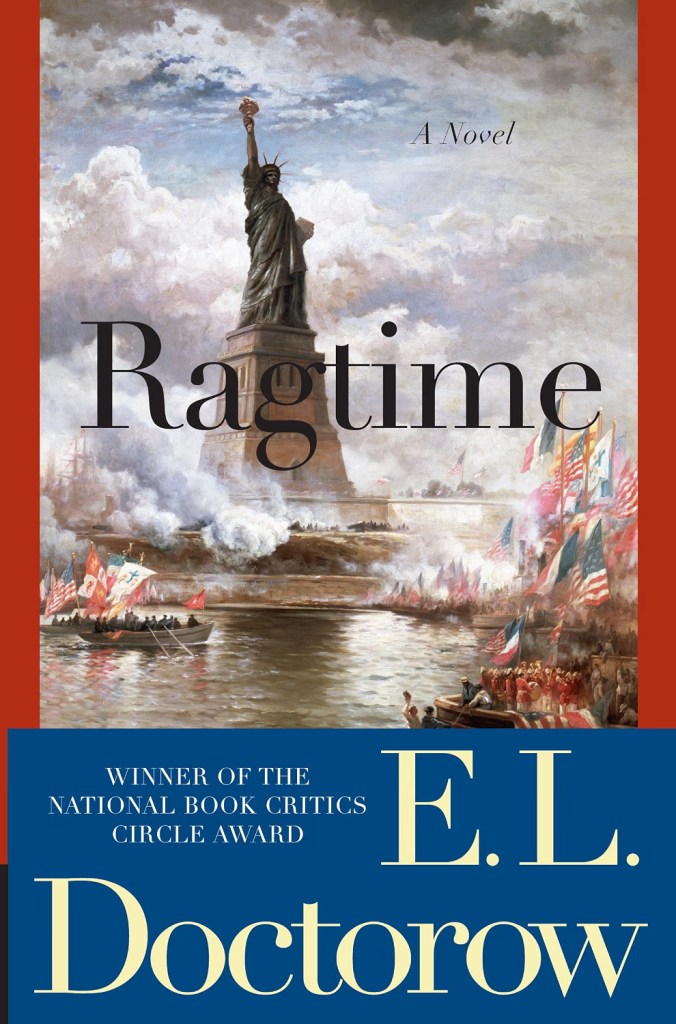
Selected by the Modern Library and The Guardian as one of the 100 best novels of all time
I’ve read Ragtime by E. L Doctorow, published in 1975, multiple times, but not for many years. I started reading it again last night.
Over more than fifty years, there have been plenty of astute and appreciative reviews and analyses, to which I won’t add much of anything.
There are at least two kinds of great novels. Those that have a lot to say and are challenging to read, a challenge worth taking. Those like this one that have a lot to say and are not just unchallenging but are so smooth, compelling and irresistible to read that, as the cliché goes, “You had me at hello” or in this case, “You had me at ‘In 1902 Father built a house at the crest of the Broadview Avenue hill in New Rochelle, New York.’”
As I said, there has been plenty said and written about Ragtime, and more generally, about how good Doctorow is. While you are paying attention to that, take a moment to read Ragtime.
Nov 17 (Reuters) – Membership-only retailer Costco is seeing a brief surge in demand as shoppers stock up on essentials after a spate of outages in the US, analysts at brokerage Mizuho said in a note.
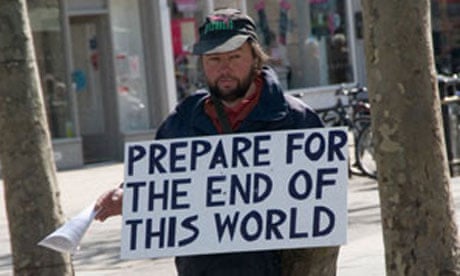
Numbers of us have lived through disruptions. Maybe we lived in a place of regular shortages. Then there was covid, of course, or natural disasters, or gas shortages, or blackouts, etc. We may have been prepared, or maybe we just hoped for the best.
There have been plenty of popular end-of-the-world books and movies (see, for example, the Book of Revelation). One of the universal things we learn is that it is not only about material things or about the temporary, or in some cases chronic, suffering. We, and those in the stories, do want to have enough to get by and get through. But how we get by and get through also depends on who and how we are in the face of whatever we are facing.
So whether you are a committed long-term apocalypticist, having already built and stocked a bunker, or are a situational apocalypticist, stocking up now that outages may be more common, consider how you are and how you can be in all this. Even if it turns out not to be the apocalypse.
My morning playlist includes tracks that ease into the day, tracks that jump start the day, and tracks in between.
Intro by The xx is a smooth and strong cup of coffee that won’t put you back to sleep and won’t startle you. Plus, it is only two minutes long. What have you got to lose?
Consider: Good, me, them, us. Individually and in combination and connection.
These are at the center of much of our lives, if not all. They are the stuff of religion and philosophy, the stuff of study, practice and belief, the stuff of government and business, the stuff of our lives.
Good for me. Good for them. Good for us.
Good, me, them, us.
You will find that how you define these and how these are balanced applies in our situations and circumstances.
In the case of measles vaccines, we see this in effect.
As with covid, a recent notable opportunity to consider these definitions and balances, some may believe that the measures mandated or suggested don’t work for the common good. That closing businesses, schools and social life would do everyone more harm than good, even if the price was increased illness and death. We did have some limited prior experience with a novel virus, but we did have experience with pandemics, so we knew some things. There is some question whether the skeptics, resisters and refusers were not fully thoughtful and informed, and what drove their belief was what was predominately good for them and consistent with their ideology.
Good, me, them, us.
With measles, as with so much else these days, the same questions arise. There is scant evidence, if any, that these vaccines cause the sorts of harms the resisters and refusers claim. On the other hand, if your ideology is that no one, government or otherwise, is going to tell you what to do, that sort of evidence doesn’t mean much of anything. In a free society you are free to harm yourself as much as you choose. But what about being free to harm others?
Good, me, them, us.
We don’t have to look far to see a focus on the common good. It’s in the Constitution, empowering Congress to “provide for the general welfare”, that is, the common good. It’s in religions, religious leaders, and holy texts, again and again.
Infectious disease is now continually spreading after being eliminated for 26 years, with more than 5,400 US cases
Jessica Glenza Tue 17 Nov 2026 17.18 EST
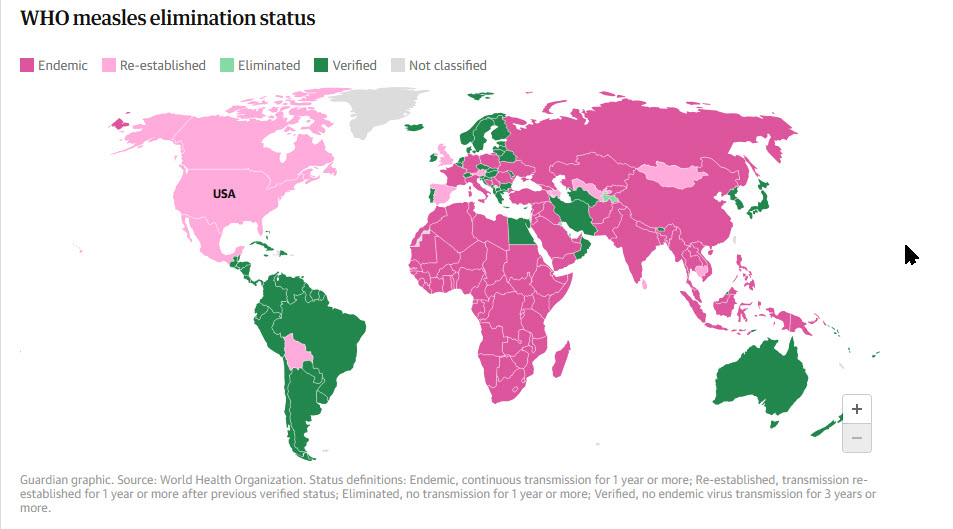
The US has lost its measles elimination status, global health authorities announced, an official recognition that the infectious disease is endemic in the US after being eliminated for 26 years.
The announcement comes as the US endures the worst measles outbreak since 1991, with more than 5,400 cases and eight deaths in 2026.
“Measles is resurging globally amid the persistent gaps in vaccination coverage, and this global trend is also affecting the Americas,” said Dr Jarbas Barbosa da Silva Jr, the director of the Pan American Health Organization, a regional branch of the World Health Organization. “The endemic measles transmission has now been re-established in Bolivia, Mexico and United States.” Silva made the final decision on US elimination status….
Measles is one of the most contagious viruses known to medicine and requires 95% of the community to be vaccinated to prevent outbreaks. The measles vaccine is safe and highly effective. However, pockets of low vaccination have grown in the US following pandemic-era disruptions and widespread misinformation.
The loss of measles-free status comes after Donald Trump and his health secretary, Robert F Kennedy Jr, spent nearly two years sowing confusion about the safety of vaccines. In just one recent example, Trump called for the measles, mumps and rubella (MMR) combination vaccine to be split into separate shots, arguing without evidence that “together, there could be a possibility they’re quite lethal”….
“There is a profound problem with measles in all three North American countries,” said Noel Brewer, a behavioral scientist at the University of North Carolina at Chapel Hill who studies vaccination behaviors, and specifically measles. He chairs a committee that considers evidence on US measles elimination status, and contributed to the scientific work that underpinned Pan American Health Organization’s decision.
“The US has had large outbreaks and exported those to Canada and Mexico, and those cases have come back again to the US,” said Brewer….
Although measles elimination status is an official designation, it carries real consequences for Americans. Where measles cases were once typically imported by international travelers, endemic measles transmission means Americans face new risks of infection, and are being asked to dig up decades-old vaccination certificates and possibly quarantine for 21 days.
“Now is the time to go and find that evidence, because now this is a real day-to-day life thing that could happen to you,” Margolius said earlier in November.
Re-establishing elimination status will require “a national plan to eliminate measles again”, said Brewer, “an integrated plan that’s publicly communicated with specific tasks assigned to named parties”. He added that the Centers for Disease Control and Prevention (CDC) and the president should speak out “forcefully” in favor of vaccination, and Congress should allocate more funding.
My continuing reaction to the Israeli war in Gaza has been that it does not reflect the Jewish principles of justice, morality and compassion that I associate with our faith.
Jorge Luis Borges (1899-1986) has been widely acclaimed as one of the most important writers of the 20th century—if not the most important. Like other great creatives, he had a singular vision that he was able to express in singular ways.
The Ilan Stavans writes:
Borges, the Jew highlights an aspect dear to me—his relentless desire (not to be confused with envy) to claim, as part of his self, a Jewishness he found in books, in idols such as Baruch Spinoza, in an overall attitude, at once reverential and subversive, toward God, life, and the intellect. By his account, none of that Jewishness was in his blood; he desperately sought to trace it in genealogical terms yet failed in the endeavor. In response, he simply imagined himself a Jew….
Is character fate? Borges didn’t endorse this ancient Greek principle, on which entire tragedies were built. His character wasn’t defiant; instead, he approached reality rationally, by which I also mean cautiously. Life, in his view, was a series of accidents. In “A History of the Echoes of a Name” (1955), he quotes Martin Buber, in his book Between Man and Man (1948), as saying that “to live is to enter the strange house of the spirit, whose floor is the chessboard on which we play an unknown and unavoidable game against a changing and sometimes frightening opponent.”
I don’t know if there is a Jewish approach to life but it does strike me that, if there is such a thing, it would indeed be a game played against a mysterious, out-of-this-world opponent: oneself.
Borges, like many of the real or imagined Jewish visionaries, was an outsider and considered himself an outsider. An inspired and compelling outsider. Nothing proves this more than the decades of relative ignorance of his towering work. In the literary community, the failure to award him a Nobel Prize is still considered a miss and mistake.
What does any of this have to do with Gaza?
I was thinking about what else Israel might have done in response to the tragedy of October 7. It is true that some situations seem to require and demand a particular response, or a limited range of responses. Those responses depend on numerous factors: what you are willing to do, what you are able to do, what the complex of consequences is or might be to what you do.
That is where creativity comes in. You can of course say that God directs a particular course of action, that anything else or less is, literally, ungodly. Or you can envision Buber’s chessboard, and Borges’ chessboard, and conceive almost infinite possibilities.
Those who study Judaism know that it is a tradition that encourages possibilities. Even casual exposure to the Talmud and other exegesis quickly reveals that. And, to put it in another context, anyone who has seen and heard the wealth of Jewish comedy realizes that. Anything is possible as a premise, which makes anything possible as a punchline.
Borges was not a comedy writer, let alone a Jewish comedy writer, but the conceits of his stories explore the absurd. As does great comedy.
Gaza did not have to go this way. It is not that the option Israel chose is unjustified and excessive, which it is. It is that of all the possibilities, it reflects a lack of creativity and creative freedom. This is one reason Borges thought he was a Jew, spiritually. He was not afraid of the road not taken, since he had been on that road for his entire life. Just like the Jews.
For those who haven’t heard about NAZA, this Gaza documentary has already been seen by more than 1.5 million people, and will be released in full on the Guardian’s website for free in early December.
Following is the Explainer from the Guardian, which produced the film.
NAZA: how and where to watch the Guardian’s acclaimed Gaza documentary
Film features testimony from 24 Israeli officials involved in surveillance and remote killing of Palestinian civilians
Where can I watch the film?
NAZA will be released in full on the Guardian’s website for free in early December. Sign up here to be notified of the exact streaming date and to be sent a link to the film when it is live.
NAZA is currently screening in cinemas all over the world. It has been shown by cinemas in 47 countries and seen by more than 1.5 million people since its release last month, making it one of the most-watched documentary films with a theatrical release in 2026. The film has been offered to a number of distributors and cinemas in Israel but has not been screened there yet.
NAZA is a documentary featuring testimony from 24 Israeli military intelligence officers and soldiers involved in the surveillance and remote killing of Palestinian civilians during the war in Gaza. The film’s title comes from an Israeli military acronym used euphemistically to refer to civilians expected to be killed in a military attack.
The interviewees detail the methods used by the Israeli military in Gaza, including AI-based systems built to identify large numbers of potential Hamas operatives, who were then bombed in their homes at night, in the knowledge that the attacks would also kill their families.
Interviews were filmed at night on rooftops in Tel Aviv, on the condition of anonymity, because of the risks involved in speaking publicly. The appearance and voices of participants in the film have been digitally altered to disguise their identities.
Who is behind the film?
The film was directed by the Oscar-winning Israeli directors Yuval Abraham and Rachel Szor and produced by the Guardian. It builds on revelations first published by the Israeli-Palestinian magazine +972, the Hebrew-language news outlet Local Call and the Guardian newspaper between 2023 and 2025.
Abraham and Szor were two of the four co-directors – with the Palestinians Basel Adra and Hamdan Ballal – of No Other Land, which documents the destruction of Masafer Yatta, a village in the occupied West Bank targeted by Israeli forces. It won the Oscar for best documentary in 2025.
How has it been received?
NAZA has received widespread critical acclaim and is selling out in cinemas across the world. The New York Times says it is “tough to watch and impossible to ignore”, while New York Magazine describes it as “one of the most important films of our time”. In a five-star review, the Financial Times says that “journalism and film-making brilliantly entwine”. British Vogue calls NAZA a “brilliant and harrowing film”.
The film won the special jury prize at the Venice film festival in September, where its premiere had a 25-minute ovation – a festival record. In November, it won the best political documentary from the Critics Choice Association.
Why has there been an Israeli backlash?
The film, its directors and their confidential sources have faced fierce attacks from the Israeli government and military. The prime minister, Benjamin Netanyahu, has ordered the attorney general and the head of the Shin Bet security service to reveal the identities of sources interviewed and prosecute them for causing “harm to Israel’s diplomatic and security interests”.
Netanyahu also threatened to strip Abraham and Szor of their citizenship, accusing them of treason. The Israeli military’s chief of staff, Eyal Zamir, said the military would “not allow soldiers to be made targets through lies and blood libels” and would use “every tool at our disposal” against the film.
Far-right groups have vowed to hound the film-makers on their return to Israel and picketed Szor’s family home. Some of the messages included explicit calls for violence, with one protester demanding the “death penalty for traitors”.
The Israeli military claimed there were “substantial errors” in the film and that it had relied on sources who had only a partial picture of the target approval process. It said that while AI was used to help identify targets in Gaza, final decisions on strikes, and the risk of civilian casualties, were signed off by officers.
In response, the team behind the film have revealed they spoke to more than 100 sources with knowledge of the military systems used in the war.
What is NAZA: The Real Story?
The Israeli government is promoting an online film project, called NAZA: The Real Story, which mimics the style of the genuine NAZA film and is hosted on a website called nazadocumentary.com. It is not the real NAZA documentary and has been misleading some viewers.
Initially, the rival film’s website falsely presented itself as a promotional page for NAZA itself, naming Abraham and Szor as the directors, and listing film festivals where the documentary was to be screened. The site now appears as a platform for the rival film, which has been promoted by Israeli embassies.
Ariel Averbuch, an Israeli attorney and army reservist who co-created NAZA: The Real Story, describes it as an “offensive move” to shift the world’s focus from allegations about the Israeli military’s killing of civilians.
Szor and Abraham have addressed the backlash to their documentary. “Our country is doing so much to hide these systems,” Szor said.
NAZA is in cinemas worldwide and will screen for free on the Guardian’s website from early December.
Not everything. Mostly we don’t keep horses and carriages in our garages. Though many are still using car(riage) engines, a technology more than a century old.
As someone who grew up on vinyl records but has long embraced the evolution of digital audio, it was interesting to watch vinyl become a popular format again, along with the record players for it. Now I hear that audio CDs are also regaining popularity.
Above is an ad from 1977 for the Columbia House record club. Record club subscriptions from major companies like Columbia and RCA were popular, especially with young people. The inducement was an initial bunch of records for a ridiculously low price—maybe 99 cents—followed by regular monthly shipments that would keep coming at higher prices, whether you wanted them or not.
The ad above educated me about something I didn’t realize. I knew you could choose from vinyl, eight-track or cassettes. But I never knew that as late as 1977, or ever, you could order a reel-to-reel tape of an album. In one way I shouldn’t be surprised, because in the 1960s and even in the 1970s, some audio aficionados considered reel-to-reel the ultimate audio experience. Interestingly, some audio experts continue to consider vinyl truer audio than digital.
This all makes me wonder if any of the other formats will enjoy a renaissance. Will we see eight-track and cassette players popular again, installed in our still gas-guzzling cars? If everything old is new again, just maybe.
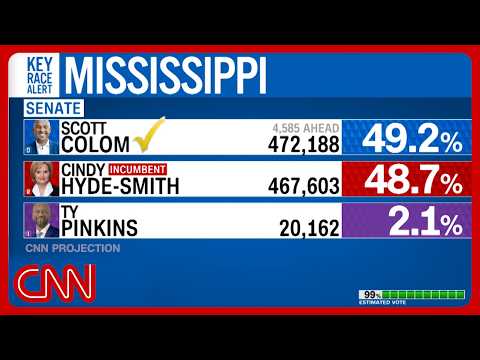
Of the many victories in the midterm elections, this one is the sweetest. Scott Colom has won the U.S. Senate seat in Mississippi, the first black person in that seat since 1874.
You don’t have to be from Mississippi to appreciate this. Plenty of those who are students of American history, society and geography recognize this is special.
But for those of us who have lived in and love Mississippi, this is astonishing. This may not be a final step on the road to making America even greater, but it is a remarkable milestone.