Bob Schwartz

Category: Poetry

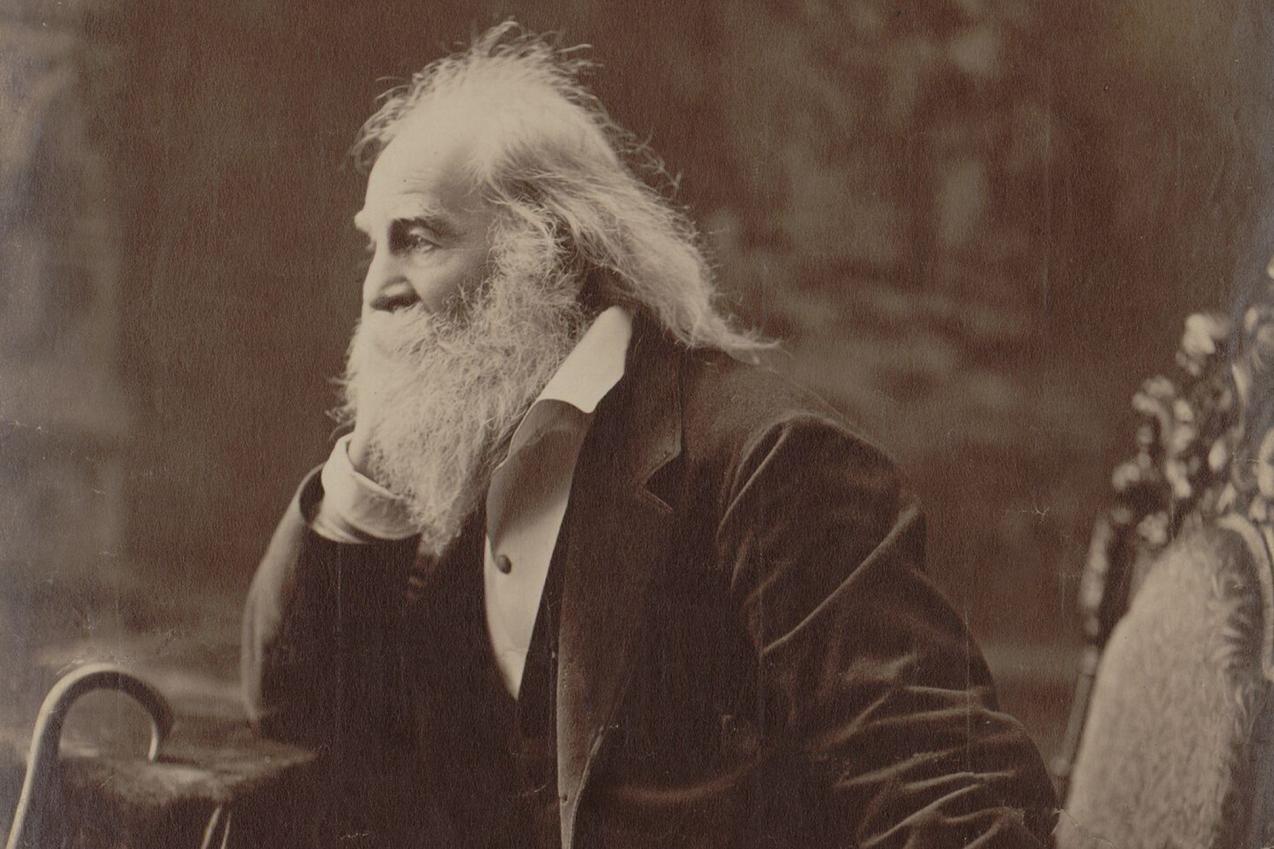
Walt Whitman

Do I contradict myself?
Very well then I contradict myself,
(I am large, I contain multitudes.)

It is hard to love America if you don’t love Walt Whitman. It is hard to love poetry if you don’t. It is hard to love American poetry if you don’t.

If you find people among America’s least enlightened leaders and talkers who don’t love him, or attack him, maybe because of his unbridled exuberance for people and sexuality and life and freedom and America and Americans, and all the inherent unresolved contradictions and challenges, you may question their understanding and love of America (which you might already).

We would still be America without Walt Whitman. But we would be missing our most perfect and poetic narrator.


From Song of Myself (1892 version)

1

I celebrate myself, and sing myself,
And what I assume you shall assume,
For every atom belonging to me as good belongs to you.

I loafe and invite my soul,
I lean and loafe at my ease observing a spear of summer grass.

My tongue, every atom of my blood, form’d from this soil, this air,
Born here of parents born here from parents the same, and their parents the same,
I, now thirty-seven years old in perfect health begin,
Hoping to cease not till death.

Creeds and schools in abeyance,
Retiring back a while sufficed at what they are, but never forgotten,
I harbor for good or bad, I permit to speak at every hazard,
Nature without check with original energy.

16

I am of old and young, of the foolish as much as the wise,
Regardless of others, ever regardful of others,
Maternal as well as paternal, a child as well as a man,
Stuff’d with the stuff that is coarse and stuff’d with the stuff that is fine,
One of the Nation of many nations, the smallest the same and the largest the same,
A Southerner soon as a Northerner, a planter nonchalant and hospitable down by the Oconee I live,
A Yankee bound my own way ready for trade, my joints the limberest joints on earth and the sternest joints on earth,
A Kentuckian walking the vale of the Elkhorn in my deer-skin leggings, a Louisianian or Georgian,
A boatman over lakes or bays or along coasts, a Hoosier, Badger, Buckeye;
At home on Kanadian snow-shoes or up in the bush, or with fishermen off Newfoundland,
At home in the fleet of ice-boats, sailing with the rest and tacking,
At home on the hills of Vermont or in the woods of Maine, or the Texan ranch,
Comrade of Californians, comrade of free North-Westerners, (loving their big proportions,)
Comrade of raftsmen and coalmen, comrade of all who shake hands and welcome to drink and meat,
A learner with the simplest, a teacher of the thoughtfullest,
A novice beginning yet experient of myriads of seasons,
Of every hue and caste am I, of every rank and religion,
A farmer, mechanic, artist, gentleman, sailor, quaker,
Prisoner, fancy-man, rowdy, lawyer, physician, priest.

I resist any thing better than my own diversity,
Breathe the air but leave plenty after me,
And am not stuck up, and am in my place.

(The moth and the fish-eggs are in their place,
The bright suns I see and the dark suns I cannot see are in their place,
The palpable is in its place and the impalpable is in its place.)

51

The past and present wilt—I have fill’d them, emptied them,
And proceed to fill my next fold of the future.

Listener up there! what have you to confide to me?
Look in my face while I snuff the sidle of evening,
Talk honestly, no one else hears you, and I stay only a minute longer.)

Do I contradict myself?
Very well then I contradict myself,
(I am large, I contain multitudes.)

I concentrate toward them that are nigh, I wait on the door-slab.

Who has done his day’s work? who will soonest be through with his supper?
Who wishes to walk with me?

Will you speak before I am gone? will you prove already too late?

The People, Yes: Where to? what next?

Time is a great teacher.
Who can live without hope?
–Carl Sandburg, The People, Yes


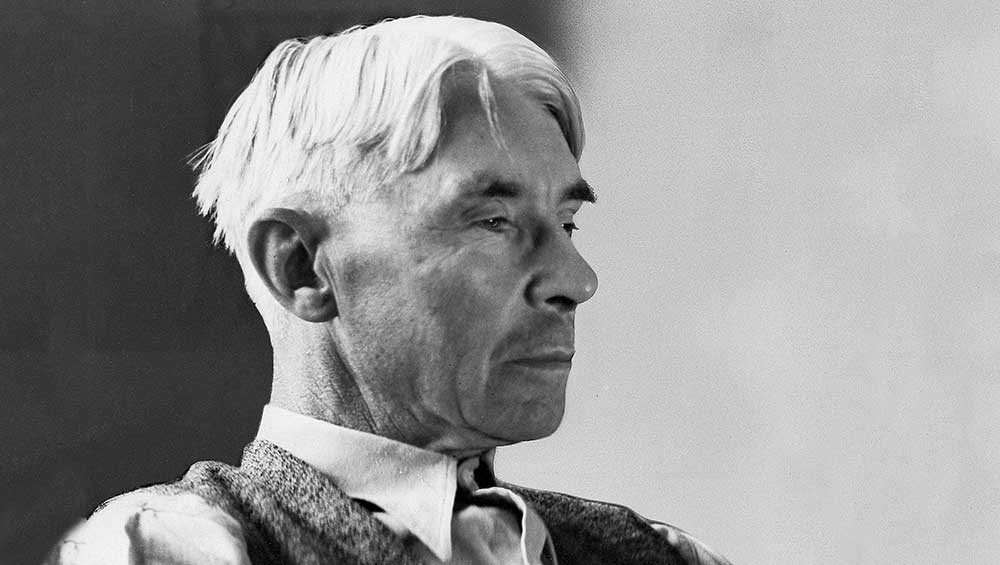
“The People, Yes, an epic prose-poem, is in many ways the culmination of Carl Sandburg’s work as a poet and is believed by Lilian Sandburg to be his favorite work. He crafted it over an eight-year period, fusing the American vernacular with the details of history and contemporary events….Believing that economic inequity lay at the root of all social injustice, from labor conflict to racial and civil strife, he responded to the economic and social upheavals of the 1930s with The People, Yes.”
–Carl Sandburg Home, National Parks Service

“Sandburg had a subject—and the subject was belief in man.”
–Archibald MacLeish at the Carl Sandburg Memorial


The People, Yes

107

The people will live on.
The learning and blundering people will live on.
They will be tricked and sold and again sold
And go back to the nourishing earth for rootholds,
The people so peculiar in renewal and comeback.
You can’t laugh off their capacity to take it.
The mammoth rests between his cyclonic dramas.

The people so often sleepy, weary, enigmatic,
is a vast huddle with many units saying:
“I earn my living.
I make enough to get by
and it takes all my time.
If I had more time
I could do more for myself
and maybe for others.
I could read and study
and talk things over
and find out about things.
It takes time.
I wish I had the time.”

The people is a tragic and comic two-face:
hero and hoodlum: phantom and gorilla twisting
to moan with a gargoyle mouth: “They
buy me and sell me . . . it’s a game . . .
sometime I’ll break loose . . .”
Once having marched
Over the margins of animal necessity,
Over the grim line of sheer subsistence
Then man came
To the deeper rituals of his bones,
To the lights lighter than any bones,
To the time for thinking things over,
To the dance, the song, the story,
Or the hours given over to dreaming,
Once having so marched

Between the finite limitations of the five senses
and the endless yearnings of man for the beyond
the people hold to the humdrum bidding of work and food
while reaching out when it comes their way
for lights beyond the prisms of the five senses,
for keepsakes lasting beyond any hunger or death.
This reaching is alive.
The panderers and liars have violated and smutted it.
Yet this reaching is alive yet
for lights and keepsakes.

The people know the salt of the sea
and the strength of the winds
lashing the corners of the earth.
The people take the earth
as a tomb of rest and a cradle of hope.
Who else speaks for the Family of Man?
They are in tune and step
with constellations of universal law.
The people is a polychrome,
spectrum and a prism
held in a moving monolith,
a console organ of changing themes,
a clavilux of color poems
wherein the sea offers fog
and the fog moves off in rain
and the labrador sunset shortens
to a nocturne of clear stars
serene over the shot spray
of northern lights.

The steel mill sky is alive.
The fire breaks white and zigzag
shot on a gun-metal gloaming.
Man is a long time coming.
Man will yet win.
Brother may yet line up with brother:

This old anvil laughs at many broken hammers.
There are men who can’t be bought.
The fireborn are at home in fire.
The stars make no noise.
You can’t hinder the wind from blowing.
Time is a great teacher.
Who can live without hope?

In the darkness with a great bundle of grief
the people march.
In the night, and overhead a shovel of stars for
keeps, the people march:
“Where to? what next?”

The People, Yes
–Carl Sandburg (1878-1967)


Wrestling with Judaism

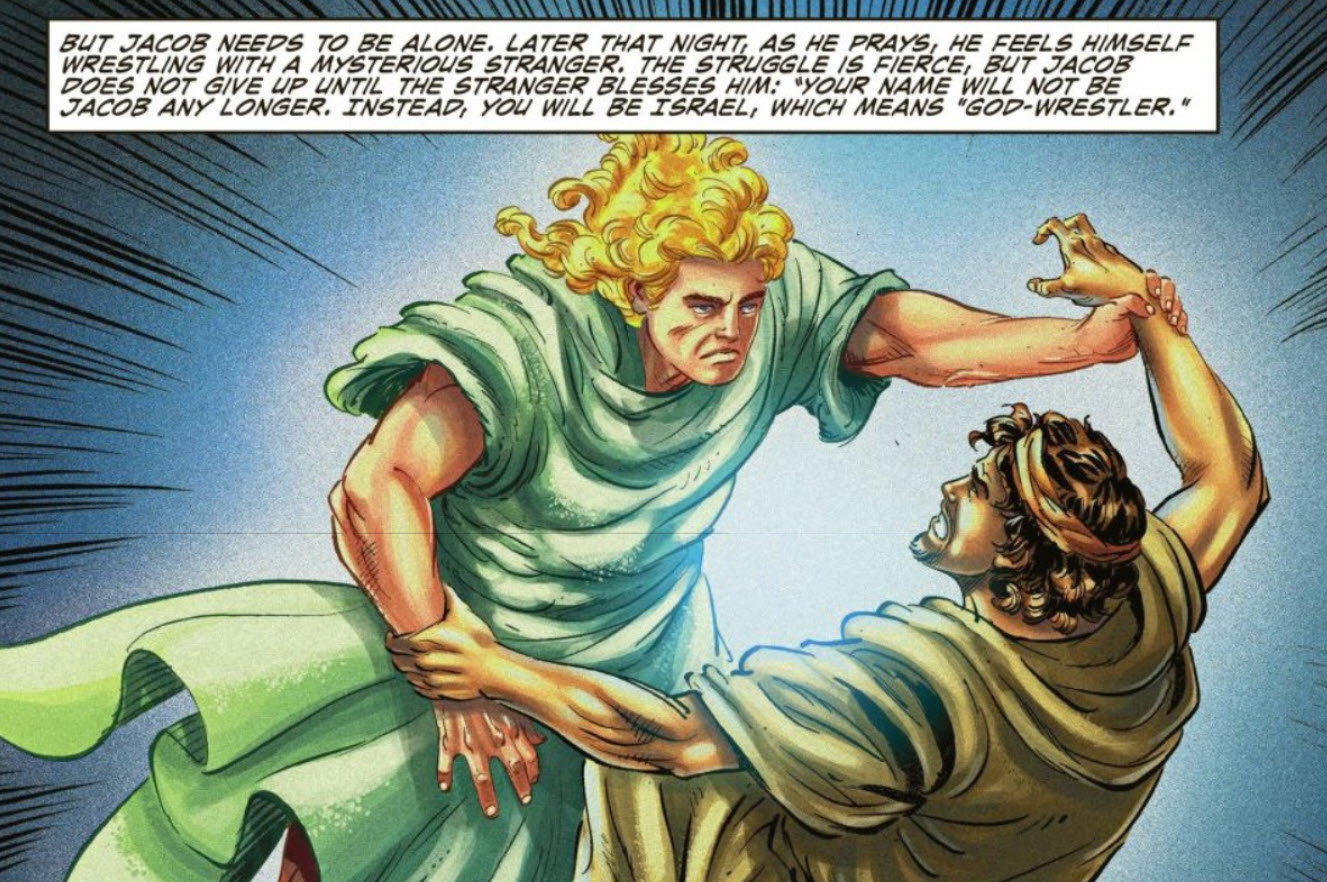
It is one of the most famous and dramatic scenes in the Hebrew Bible.

Jacob belongs to a family on a mission. In that family saga, there are a series of rationalizations and lies. Abraham lies about his wife, saying she is his sister. Isaac lies about his wife, saying she is his sister. Jacob lies to his father Isaac, with a plan devised by his mother, saying he is his brother and stealing his brother’s blessing. Later, after this wrestling episode, Jacob’s sons will lie to him, saying their brother is dead, while in fact they have left him to be taken into slavery.

No wonder Jacob is conflicted. No wonder he finds himself wrestling with an ish, a man, or perhaps an angel or God.

The wrestling match ends in a tie. Jacob refuses to give up, even though he is injured. Hurt and pained, ultimately changed.

No wonder some of us are conflicted. No wonder some of us are wrestling with Judaism right now, injured and hurt. And ultimately changed.


Jacob Wrestles All Night with an Angel or with God

Yaakov is left alone, and a man wrestles
With him until daybreak.
When the man sees he has not won against Yaakov,

He strikes him on the hip socket,
And as he wrestles with him
Yaakov’s hip comes out of joint.

Then he says, “Let me go. Dawn is breaking.”
But Yaakov says, “I will not let you go unless you bless me.”
So he tells him, “What is your name?”

And he answers, “Yaakov.”
And he says, “You shall no longer be called Yaakov, but Yisrael,
For you have fought with God and men

And you have won.”
And Yaakov tells him, saying, “Please tell me your name.”
But he says, “Why are you after my name?”

And there he blesses him.
And Yaakov names the place Penuel, saying,
“I have seen God face to face and I am alive.”

The sun rises over them
But Yaakov is limping because of his hip.
Therefore, the children of Yisrael

Do not eat the thigh muscle of the hip
Because he (the nameless) struck Yaakov
On the socket of his hip.

Willis Barnstone, Poets of the Bible


Richard Brautigan

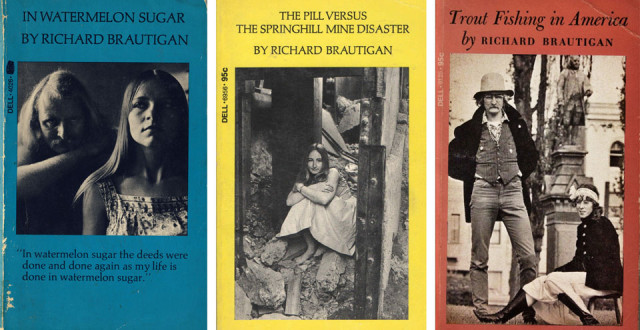
Read this collection of three books by Richard Brautigan (Trout Fishing in America/The Pill Versus the Springhill Mine Disaster/In Watermelon Sugar). Published in 1967 and 1968, one is poetry, the other two are prose so lyrical that they might as well be.

The Poetry Foundation offers a lengthy summary of critical views about Brautigan, including:


Certainly Brautigan’s work, perhaps due in part to his association with West Coast youth movements, generated a multitude of critical comment. Robert Novak wrote in Dictionary of Literary Biography that “Brautigan is commonly seen as the bridge between the Beat Movement of the 1950s and the youth revolution of the 1960s.” A so-called guru of the sixties counterculture, Brautigan wrote of nature, life, and emotion; his unique imagination provided the unusual settings for his themes. Critics frequently compared his work to that of such writers as Thoreau, Hemingway, Barthelme, and Twain.


If you’re one who doesn’t need to hear what others think, just try these books. But you might want to know how the Brautigan story ends:


Brautigan’s critical and commercial success peaked with Trout Fishing in America and began to decline following the 1971 publication of The Abortion: An Historical Romance 1966. Brautigan’s close friend novelist Tom McGuane succinctly summarized the collapse of Brautigan’s career with the observation that “when the 1960’s ended, he was the baby thrown out with the bath water.” Brautigan continued writing throughout the 1970’s, producing such books as Sombrero Fallout and Dreaming of Babylon: A Private Eye Novel 1942, but friends of the author reported he had grown increasingly withdrawn and depressed over his fading career. He apparently committed suicide in September of 1984, but his body was not discovered until October 25th of that year.


There’s a kind of serious creative playfulness that is gravity and yet is anti-gravity. This is that.


The Galilee Hitch-Hiker
Part 1

Baudelaire was
driving a Model A
across Galilee.
He picked up a
hitch-hiker named
Jesus who had
been standing among
a school of fish,
feeding them
pieces of bread.
“Where are you
going?” asked
Jesus, getting
into the front
seat.
“Anywhere, anywhere
out of this world!”
shouted
Baudelaire.
“I’ll go with you
as far as
Golgotha,”
said Jesus.
“I have a
concession
at the carnival
there, and I
must not be
late.”

The American Hotel
Part 2

Baudelaire was sitting
in a doorway with a wino
on San Francisco’s skidrow.
The wino was a million
years old and could remember
dinosaurs.
Baudelaire and the wino
were drinking Petri Muscatel.
“One must always be drunk,”
said Baudelaire.
“I live in the American Hotel,”
said the wino. “And I can
remember dinosaurs.”
“Be you drunken ceaselessly,”
said Baudelaire.

1939
Part 3

Baudelaire used to come
to our house and watch
me grind coffee.
That was in 1939
and we lived in the slums
of Tacoma.
My mother would put
the coffee beans in the grinder.
I was a child
and would turn the handle,
pretending that it was
a hurdy-gurdy,
and Baudelaire would pretend
that he was a monkey,
hopping up and down
and holding out
a tin cup.

The Flowerburgers
Part 4

Baudelaire opened
up a hamburger stand
in San Francisco,
but he put flowers
between the buns.
People would come in
and say, “Give me a
hamburger with plenty
of onions on it.”
Baudelaire would give
them a flowerburger
instead and the people
would say, “What kind
of a hamburger stand
is this?”

The Hour of Eternity
Part 5

“The Chinese
read the time
in the eyes
of cats,”
said Baudelaire
and went into
a jewelry store
on Market Street.
He came out
a few moments
later carrying
a twenty-one
jewel Siamese
cat that he
wore on the
end of a
golden chain.

Salvador Dali
Part 6

“Are you
or aren’t you
going to eat
your soup,
you bloody old
cloud merchant?”
Jeanne Duval
shouted,
hitting Baudelaire
on the back
as he sat
daydreaming
out the window.
Baudelaire was
startled.
Then he laughed
like hell,
waving his spoon
in the air
like a wand
changing the room
into a painting
by Salvador
Dali, changing
the room
into a painting
by Van Gogh.

A Baseball Game
Part 7

Baudelaire went
to a baseball game
and bought a hot dog
and lit up a pipe
of opium.
The New York Yankees
were playing
the Detroit Tigers.
In the fourth inning
an angel committed
suicide by jumping
off a low cloud.
The angel landed
on second base,
causing the
whole infield
to crack like
a huge mirror.
The game was
called on
account of
fear.

Richard Brautigan


The Buddha on Route 66

The Buddha on Route 66

The Buddha said to Todd and Buzz
The route is wide and useful
Now a bit neglected
All things die
Even highways
Lend me your Vette
Then walk down the road
To the Blue Swallow Motel
Sleep if you must
But be sure
To wake up


This year is the centennial of Route 66. Whether that is more or less significant than the 250th anniversary of the Declaration of Independence is something to consider. We can speculate about which of the freewheeling founders would have reveled in rolling across the continent they could only dream of in a vehicle they could only dream of.

Route 66 is a once great American highway passed over by the Interstates, but not surpassed. Some motels and other businesses catering to travelers are gone. The Blue Swallow Motel remains, and is not mere nostalgia. It is a place that allows the past to be present, not because the past is better but because it is different.

Todd and Buzz are also past, heroes of the 1960s TV show Route 66, in which they drove around the country in their Corvette, having dramatic American adventures.

The Buddha is the Buddha, never in Tucumcari, never drove a Corvette, though the route is the way.

© 2026 Bob Schwartz

Mystic Maps

Maps

Mystic Maps

Before the journey
The maps were few,
Colorful, promising.
Destination uncertain
Roads to travel
Randomly real.
More maps
Until there was no room
To hold them
No time
To study them.
The map makers,
Had they seen these roads
Visited these towns
Or are these conjectures
Visions, fantasies
Conjured up?
Map makers or magicians
Directions or tricks,
Now I see where they took me
Where I stop and sit.
Time and joy
For the maps
And the trip.

© 2016 Bob Schwartz

Garbage Disposal of the Mind

Garbage Disposal

Garbage Disposal of the Mind

Sinkhole for waste
From things
Expensive and cheap
Raw and cooked
No longer
Useful or needed.
Very noisy


Rabindranath Tagore

Rabindranath Tagore


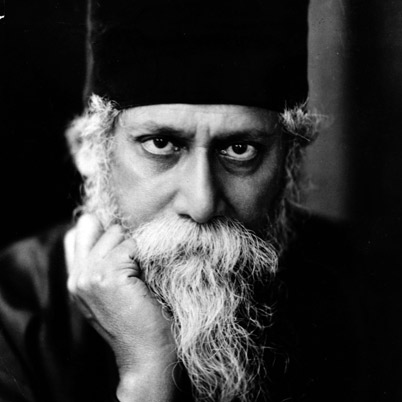
Take a break with Rabindranath Tagore (1861-1941).

He was a Bengali poet, essayist, dramatist, composer and philosopher, and is the most esteemed creative artist of modern India. He was the first non-European to win the Nobel Prize in Literature in 1913.

A brief introduction is Stray Birds (1916), which consists of 326 very short verses—each one usually one or two sentences. Below is a selection of them. Among the many online items by and about Tagore there is a 1961 documentary about Tagore by Satyajit Ray, India’s most celebrated film director.

These literary stray birds may seem at first glance to be mere poetic aphorisms. Taken together, though, this is a worldview of inspired simplicity.

From Stray Birds by Rabindranath Tagore

1
Stray birds of summer come to my window to sing and fly away.
And yellow leaves of autumn, which have no songs, flutter and fall there with a sigh.

2
O troupe of little vagrants of the world, leave your footprints in my words.

6
If you shed tears when you miss the sun, you also miss the stars.

28
O Beauty, find thyself in love, not in the flattery of thy mirror.

35
The bird wishes it were a cloud. The cloud wishes it were a bird.

36
The waterfall sings, “I find my song, when I find my freedom.”

40
Do not blame your food because you have no appetite.

43
The fish in the water is silent, the animal on the earth is noisy, the bird in the air is singing,
But Man has in him the silence of the sea, the noise of the earth and the music of the air.

45
He has made his weapons his gods. When his weapons win he is defeated himself.

48
The stars are not afraid to appear like fireflies.

52
Man does not reveal himself in his history, he struggles up through it.

58
The sparrow is sorry for the peacock at the burden of its tail.

62
The Perfect decks itself in beauty for the love of the Imperfect.

75
We read the world wrong and say that it deceives us.

88
He who wants to do good knocks at the gate; he who loves finds the gate open.

121
I carry in my world that flourishes the worlds that have failed.

123
The bird thinks it is an act of kindness to give the fish a lift in the air.

128
To be outspoken is easy when you do not wait to speak the complete truth.

130
If you shut your door to all errors truth will be shut out.

141
When I travelled to here and to there, I was tired of thee, O Road, but now when thou leadest me to everywhere I am wedded to thee in love.

146
I have my stars in the sky,
But oh for my little lamp unlit in my house.

156
The Great walks with the Small without fear.
The Middling keeps aloof.

158
Power takes as ingratitude the writhings of its victims.

161
The cobweb pretends to catch dew-drops and catches flies.

166
The canal loves to think that rivers exist solely to supply it with water.

169
Thought feeds itself with its own words and grows.

178
It is the little things that I leave behind for my loved ones, –great things are for everyone.

184
He who is too busy doing good finds no time to be good.

193
A mind all logic is like a knife all blade.
It makes the hand bleed that uses it.

207
Praise shames me, for I secretly beg for it.

208
Let my doing nothing when I have nothing to do become untroubled in its depth of peace like the evening in the seashore when the water is silent.

210
The best does not come alone. It comes with the company of the all.

235
Do not say, “It is morning,” and dismiss it with a name of yesterday. See it for the first time as a new-born child that has no name.

243
The stream of truth flows through its channels of mistakes.

248
Man is worse than an animal when he is an animal.

258
The false can never grow into truth by growing in power.

280
Let the dead have the immortality of fame, but the living the immortality of love.

296
Blessed is he whose fame does not outshine his truth.

317
Man’s history is waiting in patience for the triumph of the insulted man.

319
I long for the Island of Songs across this heaving Sea of Shouts.

323
I have suffered and despaired and known death and I am glad that I am in this great world.

Buddhist Anarchism

“No one today can afford to be innocent, or indulge himself in ignorance of the nature of contemporary governments, politics and social orders. The national polities of the modern world maintain their existence by deliberately fostered craving and fear: monstrous protection rackets.”

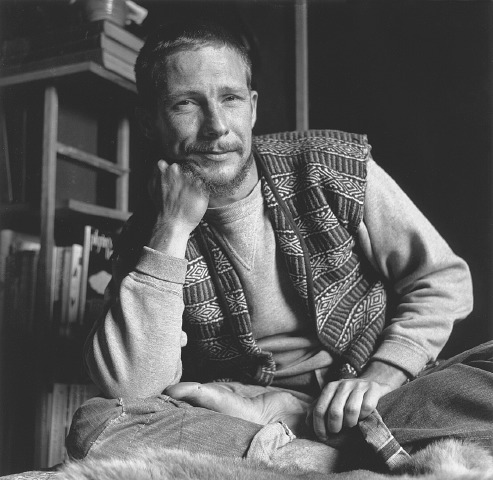
Celebrated poet Gary Snyder has been a master swimmer in the cultural and spiritual currents of our times. His biography from the Poetry Foundation notes:


Gary Snyder began his career in the 1950s as a noted member of the “Beat Generation,” though he has since explored a wide range of social and spiritual matters in both poetry and prose. Snyder’s work blends physical reality and precise observations of nature with inner insight received primarily through the practice of Zen Buddhism. While Snyder has gained attention as a spokesman for the preservation of the natural world and its earth-conscious cultures, he is not simply a “back-to-nature” poet with a facile message….

Snyder’s emphasis on metaphysics and his celebration of the natural order remove his work from the general tenor of Beat writing—and in fact Snyder is also identified as a poet of the San Francisco Renaissance along with Jack Spicer, Robert Duncan and Robin Blaser. Snyder has looked to the Orient and to the beliefs of American Indians for positive responses to the world, and he has tempered his studies with stints of hard physical labor as a logger and trail builder. Altieri believed that Snyder’s “articulation of a possible religious faith” independent of Western culture has greatly enhanced his popularity. In his study of the poet, Bob Steuding described how Snyder’s accessible style, drawn from the examples of Japanese haiku and Chinese verse, “has created a new kind of poetry that is direct, concrete, non-Romantic, and ecological. . . . Snyder’s work will be remembered in its own right as the example of a new direction taken in American literature.” Nation contributor Richard Tillinghast wrote: “In Snyder the stuff of the world ‘content’—has always shone with a wonderful sense of earthiness and health. He has always had things to tell us, experiences to relate, a set of values to expound. . . . He has influenced a generation.”


In 1961, Snyder published an essay entitled Buddhist Anarchism. Anarchism is a slippery term, though a call to turn things upside down, or an observation of our heading there, probably qualifies. The Buddhist part is definite here. Yes, it is radical, and pragmatic history may seem to demonstrate that the vision is idealistic, impractical and impossible. Even quaint in the face of the 21st century real world and real life. But without the idealistic, impractical and impossible, where is the fun and the future?


BUDDHIST ANARCHISM

Buddhism holds that the universe and all creatures in it are intrinsically in a state of complete wisdom, love and compassion; acting in natural response and mutual interdependence. The personal realization of this from-the-beginning state cannot be had for and by one-“self” — because it is not fully realized unless one has given the self up; and away.

In the Buddhist view, that which obstructs the effortless manifestation of this is Ignorance, which projects into fear and needless craving. Historically, Buddhist philosophers have failed to analyze out the degree to which ignorance and suffering are caused or encouraged by social factors, considering fear-and-desire to be given facts of the human condition. Consequently the major concern of Buddhist philosophy is epistemology and “psychology” with no attention paid to historical or sociological problems. Although Mahayana Buddhism has a grand vision of universal salvation, the actual achievement of Buddhism has been the development of practical systems of meditation toward the end of liberating a few dedicated individuals from psychological hangups and cultural conditionings. Institutional Buddhism has been conspicuously ready to accept or ignore the inequalities and tyrannies of whatever political system it found itself under. This can be death to Buddhism, because it is death to any meaningful function of compassion. Wisdom without compassion feels no pain.

No one today can afford to be innocent, or indulge himself in ignorance of the nature of contemporary governments, politics and social orders. The national polities of the modern world maintain their existence by deliberately fostered craving and fear: monstrous protection rackets. The “free world” has become economically dependent on a fantastic system of stimulation of greed which cannot be fulfilled, sexual desire which cannot be satiated and hatred which has no outlet except against oneself, the persons one is supposed to love, or the revolutionary aspirations of pitiful, poverty-stricken marginal societies like Cuba or Vietnam. The conditions of the Cold War have turned all modern societies — Communist included — into vicious distorters of man’s true potential. They create populations of “preta” — hungry ghosts, with giant appetites and throats no bigger than needles. The soil, the forests and all animal life are being consumed by these cancerous collectivities; the air and water of the planet is being fouled by them.

There is nothing in human nature or the requirements of human social organization which intrinsically requires that a culture be contradictory, repressive and productive of violent and frustrated personalities. Recent findings in anthropology and psychology make this more and more evident. One can prove it for himself by taking a good look at his own nature through meditation. Once a person has this much faith and insight, he must be led to a deep concern with the need for radical social change through a variety of hopefully non-violent means.

The joyous and voluntary poverty of Buddhism becomes a positive force. The traditional harmlessness and refusal to take life in any form has nation-shaking implications. The practice of meditation, for which one needs only “the ground beneath one’s feet,” wipes out mountains of junk being pumped into the mind by the mass media and supermarket universities. The belief in a serene and generous fulfillment of natural loving desires destroys ideologies which blind, maim and repress — and points the way to a kind of community which would amaze “moralists” and transform armies of men who are fighters because they cannot be lovers.

Avatamsaka (Kegon) Buddhist philosophy sees the world as a vast interrelated network in which all objects and creatures are necessary and illuminated. From one standpoint, governments, wars, or all that we consider “evil” are uncompromisingly contained in this totalistic realm. The hawk, the swoop and the hare are one. From the “human” standpoint we cannot live in those terms unless all beings see with the same enlightened eye. The Bodhisattva lives by the sufferer’s standard, and he must be effective in aiding those who suffer.

The mercy of the West has been social revolution; the mercy of the East has been individual insight into the basic self/void. We need both. They are both contained in the traditional three aspects of the Dharma path: wisdom (prajna), meditation (dhyana), and morality (sila). Wisdom is intuitive knowledge of the mind of love and clarity that lies beneath one’s ego-driven anxieties and aggressions. Meditation is going into the mind to see this for yourself — over and over again, until it becomes the mind you live in. Morality is bringing it back out in the way you live, through personal example and responsible action, ultimately toward the true community (sangha) of “all beings.”

This last aspect means, for me, supporting any cultural and economic revolution that moves clearly toward a free, international, classless world. It means using such means as civil disobedience, outspoken criticism, protest, pacifism, voluntary poverty and even gentle violence if it comes to a matter of restraining some impetuous redneck. It means affirming the widest possible spectrum of non-harmful individual behavior — defending the right of individuals to smoke hemp, eat peyote, be polygynous, polyandrous or homosexual. Worlds of behavior and custom long banned by the Judaeo-Capitalist-Christian-Marxist West. It means respecting intelligence and learning, but not as greed or means to personal power. Working on one’s own responsibility, but willing to work with a group. “Forming the new society within the shell of the old” — the IWW slogan of fifty years ago.

The traditional cultures are in any case doomed, and rather than cling to their good aspects hopelessly it should be remembered that whatever is or ever was in any other culture can be reconstructed from the unconscious, through meditation. In fact, it is my own view that the coming revolution will close the circle and link us in many ways with the most creative aspects of our archaic past. If we are lucky we may eventually arrive at a totally integrated world culture with matrilineal descent, free-form marriage, natural-credit communist economy, less industry, far less population and lots more national parks.

GARY SNYDER
1961


The Magi

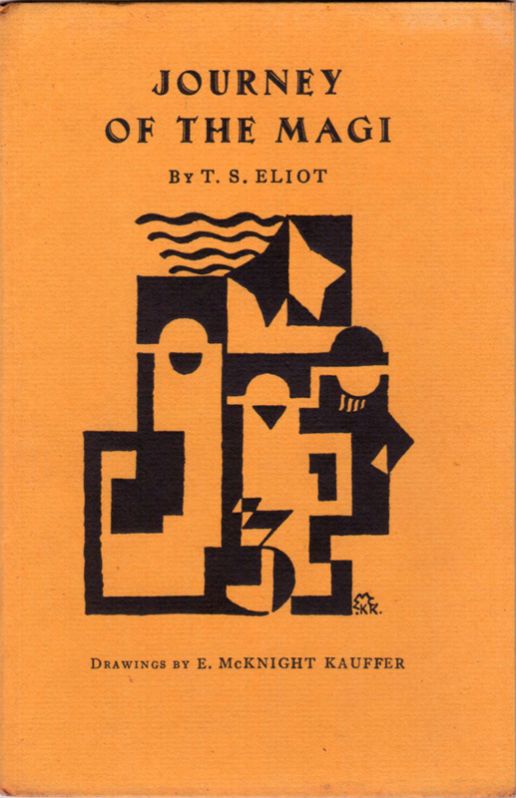
Journey of the Magi
The magi are for everyone, whatever your beliefs.

These three figures in the Christmas tradition appear in only one of the four Christian gospels, and even that role in Matthew is sketchy. They are foreigners bringing gifts for the infant Jesus and they return home by a different route to evade Herod. That’s it.

Translations and interpretations of what they brought vary, and even less clear is exactly who these foreigners were supposed to be in the story. They may be kings, wise men, astrologers or, as some have it, Zoroastrian priests from Persia.

This is why the particulars don’t matter much at all: the story is so basic and illuminating that it has captured the imagination of millions in its various retellings. Christian faithful have one view of it, and the more literal vision is that of concrete history. But for those who lean away from that, there is much to be gotten out of this compelling story:

  • Some people of discernment—in terms of wisdom, astrology or otherwise—had a sense that something special was going on outside of their ordinary sphere. Maybe they saw a light.
  • They travelled a long way to discover what was going on, and having found out, expressed their gratitude humbly and generously.

Again, that’s it. Some may want to think about theology. Others may want to think about other sorts of lights they’ve glimpsed, journeys they’ve made or haven’t made, and about possibilities. Christmas or just winter solstice and New Year, there is no better time to think about possibilities and all the rest.

T.S. Eliot wrote a brief but cinematic poem about the magi. It is written from a believer’s perspective, as the magi suffer twice, once on the journey, once again when they return home and find themselves so spiritually transformed by the experience that they feel like strangers in their own land. This is certainly a Christian view of the holiday, but non-Christians may just as well consider the more general phenomenon of all sorts of enlightenment, sitting between the way you have been and the way you discover you could be or already are. The magi say they would be glad of another death like that.

© 2025 Bob Schwartz


The Journey of the Magi
T.S. Eliot

‘A cold coming we had of it,
Just the worst time of the year
For a journey, and such a long journey:
The ways deep and the weather sharp,
The very dead of winter.’
And the camels galled, sorefooted, refractory,
Lying down in the melting snow.
There were times we regretted
The summer palaces on slopes, the terraces,
And the silken girls bringing sherbet.
Then the camel men cursing and grumbling
and running away, and wanting their liquor and women,
And the night-fires going out, and the lack of shelters,
And the cities hostile and the towns unfriendly
And the villages dirty and charging high prices:
A hard time we had of it.
At the end we preferred to travel all night,
Sleeping in snatches,
With the voices singing in our ears, saying
That this was all folly.

Then at dawn we came down to a temperate valley,
Wet, below the snow line, smelling of vegetation;
With a running stream and a water-mill beating the darkness,
And three trees on the low sky,
And an old white horse galloped away in the meadow.
Then we came to a tavern with vine-leaves over the lintel,
Six hands at an open door dicing for pieces of silver,
And feet kicking the empty wine-skins.
But there was no information, and so we continued
And arriving at evening, not a moment too soon
Finding the place; it was (you might say) satisfactory.

All this was a long time ago, I remember,
And I would do it again, but set down
This set down
This: were we led all that way for
Birth or Death? There was a Birth, certainly
We had evidence and no doubt. I had seen birth and death,
But had thought they were different; this Birth was
Hard and bitter agony for us, like Death, our death.
We returned to our places, these Kingdoms,
But no longer at ease here, in the old dispensation,
With an alien people clutching their gods.
I should be glad of another death.