Bob Schwartz

Category: Elections

No Photos of Donald Trump Standing with or Hugging Republican Women Governors, Senators and House Members (2016)

Women for Trump

This was originally posted a month before the 2016 presidential election. The point then was that Republican women officials would have trouble hugging or standing with Trump. When I look back now, I see the photo above and read the final line from the Trump campaign website, “these are very form fitting shirts”, and it resonates even more loudly ten years later. Practically screams and shouts.


This was supposed to be a post containing photos of Donald Trump hugging, or just standing with, Republican women Governors, Senators and House Members. The point is that these women will have to hug, or just stand with, Donald Trump if he becomes President, because he will be the leader of their party.

I can’t, however, because I was unable to find almost any such photos. Why do you think that is?

Note: The photo above is from the Trump campaign website. The page for these Women for Trump shirts includes this:

Please refer to Fitting Guide when ordering; these are very form fitting shirts.

19 things Donald Trump knows better than anyone else, according to Donald Trump (2016)

I don’t know whether rerunning this post from ten years ago, a month before the 2016 presidential election, is funny. I ran it then because the Trump phenomenon was newly astonishing and frightening, and maybe funny. We didn’t know exactly what the future would be, but we might have guessed. One thing we now know is that he is still better than anyone about anything, according to him. As for fun, it appears for the moment that the fun’s over. It will be back.


Normally, I would quote a little bit of an article, and provide a link to the whole thing.

19 things Donald Trump knows better than anyone else, according to Donald Trump by Aaron Blake at the Washington Post today is simply too amazing for that. So the link is above, but here it is in its entirety:


I understand the tax laws better than almost anyone, which is why I’m the one who can truly fix them,” Donald Trump claimed Monday in Colorado.

It is one of many issues on which Trump is one of the world’s foremost experts, according to Trump. In fact, you might say he’s the best at being a self-proclaimed expert.

Below is a list of the many things about which Trump says he knows more than just about anybody. Even for a guy who’s fond of hyperbole, it’s a lot to take in.

1) Renewables

“I know more about renewables than any human being on Earth.” — April 2016

2) Social media

“I understand social media. I understand the power of Twitter. I understand the power of Facebook maybe better than almost anybody, based on my results, right?” — November 2015

3) Debt

“Nobody knows more about debt. I’m like the king. I love debt.” — May 2016

4) Taxes, again

“I think nobody knows more about taxes than I do, maybe in the history of the world. Nobody knows more about taxes.” — May 2016

Donald J. Trump ✔ @realDonaldTrump
I know our complex tax laws better than anyone who has ever run for president and am the only one who can fix them. #failing@nytimes
7:22 AM – 2 Oct 2016
15,459 15,459 Retweets   41,208 41,208 likes

“Nobody knows more about taxes than I do — and income than I do.” — May 2016

5) Banking

“Nobody knows banking better than I do” — February 2016

6) Wall Street bankers

MATT LAUER: You’re a guy who said you know the Wall Street bankers better than anyone.

TRUMP: Better than anyone.

— April 2016 on NBC’s “Today” show

7) Money

“I understand money better than anybody. I understand it far better than Hillary, and I’m way up on the economy when it comes to questions on the economy.” — June 2016

8) The U.S. system of government

“I think nobody knows the system better than I do.” — August 2016

“I am a person that used to be establishment when I’d give them hundreds of thousands of dollars. But when I decided to run, I became very anti-establishment, because I understand the system than anybody else.” — July 2016

“Nobody knows the system better than I do.” — April 2016

9) Campaign contributions

“I used to be, George, the fair-haired boy — you know, when I was a contributor. I know more about contributions than anybody.” — November 2015

10) Politicians

“Nobody knows politicians better than Donald Trump.” — February 2016 rally

11) Sen. Cory Booker

Donald J. Trump ✔ @realDonaldTrump
If Cory Booker is the future of the Democratic Party, they have no future! I know more about Cory than he knows about himself.
10:14 PM – 25 Jul 2016
10,079 10,079 Retweets   34,725 34,725 likes

(We’re putting this on the list assuming that nobody ELSE knows more about Booker than Booker, which would make Trump the world’s foremost non-Cory Booker expert on Cory Booker.)

12) Trade

“Nobody knows more about trade than me.” — March 2016

13) Jobs

Donald J. Trump ✔ @realDonaldTrump
I hope all workers demand that their @Teamsters reps endorse Donald J. Trump. Nobody knows jobs like I do! Don’t let them sell you out!
5:03 PM – 8 Jan 2016
2,170 2,170 Retweets   5,972 5,972 likes

14) Infrastructure

“Nobody in the history of this country has ever known so much about infrastructure as Donald Trump.” — July 2016

15) The military

“There’s nobody bigger or better at the military than I am.” — June 2015 Fox News interview

16) ISIS

“I know more about ISIS [the Islamic State militant group] than the generals do. Believe me.” — November 2015

17) Defense — and offense

“So a general gets on, sent obviously by Obama, and he said, ‘Mr. Trump doesn’t understand. He knows nothing about defense.’ I know more about offense and defense than they will ever understand, believe me. Believe me. Than they will ever understand. Than they will ever understand.” — July 2016

18) The ‘horror of nuclear’

“There is nobody who understands the horror of nuclear more than me.” — June 2016

19) The visa system

“Because nobody knows the system better than me. I know the H1B. I know the H2B. Nobody knows it better than me.” — March 2016

Aaron Blake
The Washington Post
October 4, 2016


Ebola Stress Test (2014)

Kaci Hickox

Quietly, where no one can hear, some leaders and citizens are probably worried that if this was a real Ebola outbreak in the U.S., and not the thankfully tiny and so far isolated problem it is, we would fall apart. Utterly fail the test. (2014)

The post below was published on October 27, 2014. It comes to mind today for a couple of reasons. There is a current Ebola outbreak in the Democratic Republic of Congo. And various recent public health developments, including a sea change in how the federal government looks at disease and vaccines, has prompted scientists to shout that we are not ready for the next pandemic, just as we weren’t ready for the last one. Remember that?


Stress tests. We see them in medicine, in banking, in construction.

How well will the patient’s heart perform when he is on a treadmill? How sound are a bank’s finances in the worst case scenario? How will building materials stand up under maximum pressure?

Public crises are stress tests. So far, Ebola is the latest demonstration of the tendency for our civic infrastructure to crack—or show signs of it—under pressure.

Quietly, where no one can hear, some leaders and citizens are probably worried that if this was a real Ebola outbreak in the U.S., and not the thankfully tiny and so far isolated problem it is, we would fall apart. Utterly fail the test.

The latest episode concerns this weekend’s rapid response by multiple states to Craig Spencer, a doctor returning from West Africa and becoming sick with Ebola in New York City last week. In addition to New York and New Jersey, other states are now or may be requiring returning health care workers to be quarantined.

There is a problem: none of these states appear to have thought through any of it—most especially the practical aspects of whisking someone coming home from a heroic medical mission into isolation that is supposed to be comfortable, suitable, sensible, and sensitive under the circumstances. It now seems the scenario is act first, plan later.

Nurse Kaci Hickox is the first one caught in this trap. She is not sick and is showing no symptoms. Arriving at Newark Airport Friday night, she was taken to a tent behind a hospital, with a portable toilet, no shower, no television, and little cellphone reception. She castigated all involved, particularly Governor Chris Christie, who said she had symptoms and was sick, when she hadn’t and wasn’t. She plans a federal lawsuit challenging the quarantine.

“I also want to be treated with compassion and humanity, and I don’t feel I’ve been treated that way in the past three days. I think this is an extreme that is really unacceptable. I feel like my basic human rights have been violated.”

(Update: Governor Christie has relented, allowing her to return home to Maine, where, if you read between the lines, the message is that it will then be Maine’s problem to monitor her and where, if something goes wrong, it will be on their head.)

We seem to have forgotten how to solve problems, enthralled by our own voice either positing solutions, making points, or complaining. Or maybe it is that this is America, with a history of being bigger, stronger, smarter, and most of all, righter, in all circumstances. Even if that was ever true, politics—in the big sense of privileging positions over effective and thoughtful answers—has poisoned that well. Worthy questions and deliberate solutions are rejected out of hand because of the source, because they don’t fit some preconceived notion or program, or simply because they won’t help win or not lose elections.

Whether or not quarantine of heroic Ebola care givers returning from West Africa is a good idea, it is certainly a good idea to evaluate and plan exactly how you are going to practically handle it. Maybe, though, we shouldn’t be at all surprised. In recent years we did, after all, send hundreds of thousands of troops abroad, and when the promised rewards for their heroic service came due, we seemed unable to fulfill and, worse, were suddenly unenthusiastic about keeping the promise anyway.

If this is a war on Ebola, we better make sure we are committed to those who are sacrificing, part of which is actual planning and resourcing, not ignorant and reflexive pontificating and politicking. So far, this is looking too much like some of our other recent wars. Maybe we can use this as an opportunity to get better and be better at it.

© 2014 Bob Schwartz


The Year America Gets Politically Sober (from February 2016)

Note: When I reread this post ten years later, I am trying to remember precisely what “mess” and “political chaos” it refers to. We were still a long way from the political conventions of summer and the election in November. Thinking about it now, Trump was already in the mix (his rivals seemed to hate him, though that changed), Hillary was promised the nomination (Bernie had something to say about that, and thankfully he’s still talking), along with a whole lot of other bad signs. It closes with a thought of hope, probably left over from an Obama poster. But as the post said, “maybe as we near bottom, or hit bottom, we will change our ways.”


There are endless stories about people whose wild and self-destructive behaviors, addictions and obsessions careen out of control. Some of those stories are in books and movies. A lot more of them, millions of them, are in real life.

The stories sometimes end very badly. But sometimes, after a lost weekend, or a lost year, or a lost decade, something happens. Nearing bottom, or hitting bottom, people wake up. They realize that the path they are on—or the lack of a path—can only lead to bad times getting worse. And so they ask for help. Or they find the help within themselves. They recover. They get sober.

All the talking heads have explanations of how “we” got into this political chaos, with many people not particularly pleased with the choices they have, many people appalled at the choices other people are making, and a government—which is after all the point of politics—basically frozen and irrational.

“We” are not the victims. “We” created this mess ourselves. The forms of behaviors, addictions and obsessions are too many to list here. Let’s just say that if we choose not to be broadly informed, choose not to vote, choose to leave it up to other people, choose to be more interested in style than in substance, choose to be selfish, choose to divide by identity, choose to overlook serious problems, and make many other questionable choices, what do you expect?

All hope is not lost.

Just as with addicts and others who find themselves out of control, maybe this is our lost election, and maybe we are going to have to suffer its consequences, but maybe as we near bottom, or hit bottom, we will change our ways.

That’s a happy thought.

A year of staggering and stupefying realizations. Again.

Church

Black Church Burned, With ‘Vote Trump’ Scrawled on Side (2016)

“This has been a year of staggering, stupefying realizations.”

I published a post five days before the 2016 election, writing that “This has been a year of staggering, stupefying realizations.” The post wasn’t really about Trump, who seemed unlikely to be our next president. It was about America and us in America, whatever the results of the election.

I did not yet know what a year of staggering, stupefying realizations could be. The Talking Heads sang “Say it once/Why say it again?”, and this is mostly right. Even so, below is that post from four years ago, which is just as pertinent now.


After 70 Years of Progress, America Must Face Itself Again

In 1945 America helped defeat Nazi Germany, a global force that threatened to engulf the world in virulent hate and tyranny. In the aftermath of a brutal but noble victory, and despite deserved self-congratulation, America was forced to look at itself. It was not immune to or unfamiliar with similar levels and types of hate within—in certain places, among certain people.

We worked at identifying and eliminating that sort of hate, institutionally and individually, to the extent that is ever possible. There were missteps and resistance, along with denials and rationalizations. Progress was made, sometimes in fits and starts, and the work goes on.

This has been a year of staggering, stupefying realizations. Among the things we know better, as if we weren’t aware, is that there are plenty of people with hate in their hearts who for a long while have felt marginalized and silenced by a degree of public decency. Another thing we learned, and should know, is that once public decency is called into question or invalidated, those same people will be encouraged and emboldened.

Like it or not, these are our countrymen. Pretending they are not has never worked, nor has giving up because there’s nothing to be done. Progress has been made, and though it would be comfortable to believe things inevitably move forward, they don’t. Backwards happens, but not if we start by facing up again to who we are and hope to be. And then get back to work.

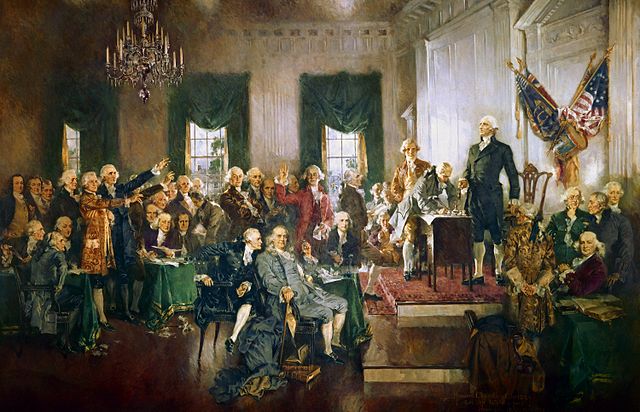
“A Republic, if you can keep it.”

Possibly the most famous and prophetic quote from the American Constitutional Convention is attributed to Benjamin Franklin. America was not just a new nation; it was a new kind of nation, so naturally people wondered just what kind of a nation it was to be:

As Benjamin Franklin left the Constitutional Convention, on September 18, 1787, a certain Mrs. Powel shouted out to him: “Well, doctor, what have we got?,” and Franklin responded: “A Republic, if you can keep it.”

America has voted, there will be a Democratic-led House, and it appears that the Republic, which has been under serious internal siege for the past two years, is a little closer to again being kept.

It is just one step toward having an effective check on a leader and a ruling party intent on subverting virtually all of the principles that Franklin and friends embodied in the new nation. But a step in the right direction it is.

Franklin and friends are cautiously relieved. They, more than any, know how hard this is. So they are smiling a little. And so are many Americans.

Time for Billionaires and Companies to Spend Money to Protect Democracy and Make Elections Secure

Washington Post :

House GOP refuses to renew election security funding

House Republicans on Thursday approved a spending bill that excludes new money for election security grants to states, provoking a furious reaction from Democrats amid a national controversy over Russian election interference.

The spending bill passed 217-199. Democrats’ bid to add hundreds of millions more in election spending was rejected 182-232 — as Republicans were unmoved by Democrats floor speeches decrying the funding changes and chanting “USA! USA!”

At issue is a grants program overseen by the federal Election Assistance Commission and aimed at helping states administer their elections and improve voting systems; Democrats want to continue grant funding through 2019, while Republicans say the program already has been fully funded.

A number of Republicans, especially in Congress, no longer seem to believe in democracy, because they do not want to risk losing on a level playing field. That is precisely the reason that Trump accepted (or solicited) Putin’s help in winning his election, and why Republicans now worry about helping states make elections fair and secure.

That’s why American billionaires and companies should step in and fund state election security, since the Trump-run government apparently won’t. This isn’t a controversial or partisan matter; it is an American matter. These billionaires and companies can and should offer assistance in many ways—all of which require millions of dollars, all of which these people and companies have.

How could any American billionaire or company find the funding of secure and fair elections objectionable? Even if it sometimes seems that some do.

President John Barron

Things happened so fast in this campaign that it is hard to remember everything. I had forgotten, and was just reminded by a previous post of mine, that Donald Trump reportedly had called up journalists pretending to be a publicist for Trump named John Miller or John Barron (Barron is the name of Trump’s youngest son).

This gave me an idea, to help those who are still having trouble with the election results, and may have trouble for a while to come. Consider identifying the next President as either John Miller or John Barron. (Between the two, President John Barron has a very presidential, almost royal, sound to it.)

The news about the next administration may not be easy for some people to accept. But if you think of it as the administration of President John Barron, that might make things just a little bit easier.

By a Captain You’re No Captain

child-captain

There’s an old comedy bit that appears on a bestselling comedy album from 1965, You Don’t Have To Be Jewish. My Son, The Captain is about a rich guy who’s proudly showing of his new yacht and his captain’s outfit to his parents. His father puts him in his place.

Son: Well, Mama, Papa, how do you like my new yacht? Cost me $84,000, with the twin diesel engines, top speed 35 knots. And here we are on the open sea, with the sea and the sun and the wind in our hair. It’s a little different than the Bronx, huh, Mama, Papa?

Papa: Yeah.

Mama: That’s right.

Son: And look at this uniform I’m wearing. Custom made, from Abercrombie and Fitch. How about it, Papa. Your son is a regular captain, huh?

Papa: Listen, sonny. I don’t have to tell you, by Mama you’re a captain, by me you’re a captain, and by you you’re a captain. But by a captain you’re no captain.

After the Election: No Path Without Guidance

Feelings are magnified about the election right now. They will remain strong for a while, and may get more pronounced as the actuality sets in.

These strong feelings can be a motivator in trying to move things in a direction you view as better. You will think about what that direction is, and you will think about what actions can contribute. This can be all good.

But strong feelings and well-meaning thought and action can be ineffective, counterproductive, and even harmful, if we don’t seek guidance. However bad you feel, however smart you are, you need to look outside yourself for that guidance.

The kind and source of guidance depends on which voices and principles have served you in the past. And if you haven’t spent much time with such voices and principles, you might take this opportunity to try it.

This doesn’t at all mean just religious, spiritual or philosophical voices to listen to. In a political situation, you will find plenty of great political thinkers, some ancient, some contemporary, who offer sound and principled advice.

The point is not to listen just to yourself, and not just to individuals in your circle of like-minded people, who may be just as passionately unsettled as you. You may have good ideas and approaches, they may have good ideas and approaches. But hard as it is to believe right now, there is nothing new under the sun, even in politics and governing, and people have been refining their thinking about this not just for decades or centuries, but for thousands of years.

When it seems dark, politically or personally, we may think we can find a path solely by our own lights. Almost always, we are wrong.