Bob Schwartz

Category: Movies

Donald Trump Jr. and the Happy Smiling Poor of India (2018)
“The poor know all about poverty and only the morbid rich would find the topic glamorous.”
Sullivan’s Travels

Washington Post:


Donald Trump Jr. says he admires India’s poor people because of their spirit and smiles

Donald Trump Jr., the president’s eldest son, is in India this week to promote his family’s real estate empire and more than $1 billion worth of luxury Trump Tower projects in four cities, but he still had time to praise India’s poor for their smiles.

“I don’t mean to be glib about it, but you can see the poorest of the poor and there is still a smile on a face. It’s a different spirit that you don’t see in other parts of the world … and I think there’s something unique about that. I know some of the most successful people in the world, and some of them are the most miserable people in the world.”


You can draw your own conclusions about what this says about Don Jr. and others in the Trump family and circle. You can guess who the miserable successful people might be.

As for the happy smiling poor he admires, I quote from the movie Sullivan’s Travels  by Preston Sturges. A successful Hollywood director of nonsensical comedies, John L. Sullivan, wants to confront the grim reality of the Great Depression, and so plans to travel in disguise as a tramp. His butler Burrows sets him straight:


Burrows: I have never been sympathetic to the caricaturing of the poor and needy, sir.

John L. Sullivan: Who’s caricaturing? I’m going out on the road to find out what it’s like to be poor and needy and then I’m going to make a picture about it.

Burrows: If you’ll permit me to say so, sir, the subject is not an interesting one. The poor know all about poverty and only the morbid rich would find the topic glamorous.

John L. Sullivan: But I’m doing it for the poor. Don’t you understand?

Burrows: I doubt if they would appreciate it, sir.

And:

Burrows: You see, sir, rich people and theorists – who are usually rich people – think of poverty in the negative, as the lack of riches – as disease might be called the lack of health. But it isn’t, sir. Poverty is not the lack of anything, but a positive plague, virulent in itself, contagious as cholera, with filth, criminality, vice and despair as only a few of its symptoms.
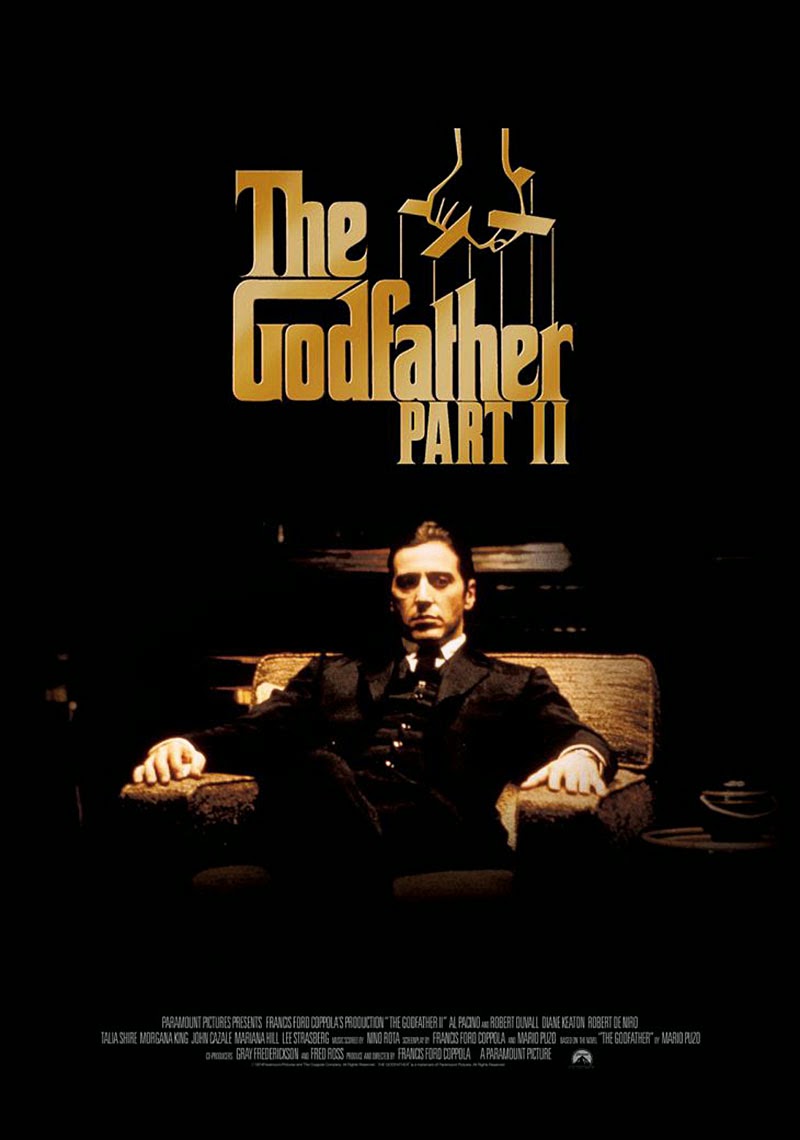


The Godfather Part II Presages the Trump Presidency

“All my people are businessmen; their loyalty is based on that…and on that basis, anything is possible.”

“Free to make our profits without the Justice Department, the FBI…looking for a man who desperately wants to be President of the United States.”

The Godfather Part II

The Godfather Part I and Part II are more than near-perfect movies, two of the most critically-acclaimed films of all time. They are compelling pictures of the unrestrained grab for power and money, fueled by mutual self-interest and governed by no other values.

These two quotes from The Godfather Part II (1974), more than forty years old, encapsulate where America finds itself today:

MICHAEL CORLEONE
“All my people are businessmen; their loyalty is based on that. One thing I learned from my father is to try to think as the people around you think…and on that basis, anything is possible.”

HYMAN ROTH
“If only I could live to see it, kid; to be there with you. How beautifully we’ve done it, step by step. Here, protected, free to make our profits without the Justice Department, the FBI; ninety miles away in partnership with a friendly government. Ninety miles, just a small step, looking for a man who desperately wants to be President of the United States, and having the cash to make it possible.”

Only one commandment: Be a good boy or girl


How many commandments are there in the Decalogue? Do you know them by number? That’s a trick question, because different religious traditions divide and number the Hebrew text differently.

This will make it easy. There is only one commandment, even though it doesn’t appear in the “official” list.

To explain, I turn to the movie A Serious Man (2009) (playlist of clips) by Joel and Ethan Coen, nominated for two major Academy Awards, Best Picture and Best Original Screenplay.

Larry Gopnick, a physics professor in the 1960s, is up for tenure. Even as he lectures on Heisenberg’s Uncertainty Principle, there is a sense that he really doesn’t understand uncertainty at all. His professional and personal life seem to be falling apart. A student tries to bribe him for a passing grade. His wife is having an affair with his friend, his dentist espouses weird mystical tooth theories, and there is a question whether Larry may have a serious health problem. Larry looks for answers in Judaism. His attempts to see Rabbi Marshak, elder spiritual head of the congregation, fail.

Larry’s son Danny is about the be bar mitzvah. At Hebrew School, the transistor radio Danny was listening to in class is taken away by the teacher. Danny is sent to see Rabbi Marshak. Rabbi Marshak proceeds to discuss the situation through the lyrics of the Jefferson Airplane’s song Somebody to Love and with a simple piece of advice:


Rabbi Marshak stares at Danny from behind a bare desktop. His look, eyes magnified by thick glasses, is impossible to read.

Danny creeps to the chair facing the desk. He gingerly sits on the squeaking leather upholstery, self-conscious under Marshak’s stare.

Marshak’s slow rmouth-breathing is the only sound in the room. The two stare at each other.

Marshak smacks his lips a couple of times, wetting surfaces in preparation for speech.

Finally:

MARSHAK
When the truth is found. To be lies.

He pauses. He clears his throat.

. . . And all the hope. Within you dies.

Another beat. Danny waits. Marshak stares. He smacks his lips again. He thinks.

. . . Then what?

Danny doesn’t answer. It is unclear whether answer is expected. Quiet.

Marshak clears his throat with a loud and thorough hawking. The hawking abates. Marshak sniffs.

. . . Grace Slick. Marty Balin. Paul Kanta. Jorma. . .somethin.
These are the members of the Airplane.

He nods a couple of times.

. . . Interesting.

He reaches up and slowly opens his desk drawer. He withdraws something. He lays it on the bare desk and pushes it across.

. . . Here.

It is Danny’s radio.

. . . Be a good boy.


And that is the one commandment. Be a good boy or girl. Thousands of years of wisdom have developed directives, guidelines and practices to get us there. There is even a concise list of ten. But if you forget or ignore them, as we do sometimes, this will be your quick reminder.

The Ides of March (March 15)

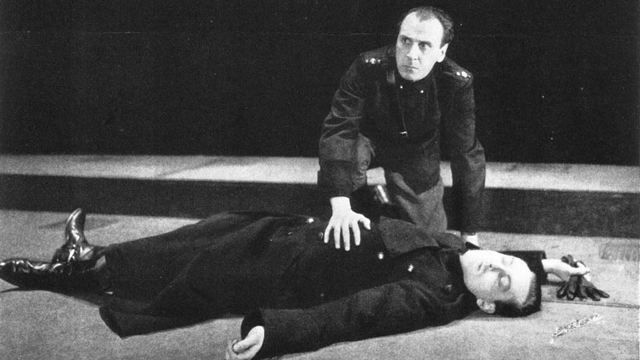
Julius Caesar - Mercury Theater


Today is the Ides of March, the 15th of March on the Roman calendar. (The Ides are a monthly mid-point, between the Nones early in the month and the Kalends on the first day.)

It is the day of Julius Caesar’s assassination in 44 BCE, made forever famous by Shakespeare’s play Julius Caesar, where the Soothsayer warns him (twice) to “beware the ides of March”. It did turn out to be a bad day.

Above is a scene from the Mercury Theater’s legendary 1937 presentation of the play in modern dress and sensibility, set by director Orson Welles in Fascist Italy. The theater company was organized by Welles and John Houseman, and this was their first play. In the photo above, Marc Antony (George Coulouris) kneels over the lifeless body of Julius Caesar (Joseph Holland).

Welles was only 22 at the time, but already a rising star. The Mercury Theater, intended as an independent answer to the restrictions placed on Welles by the Federal Theater Project, was really the launch pad for his fame and infamy as a world class artistic genius and iconoclast.

Richard Linklater’s Me and Orson Welles (2008) takes place during that production. The movie is underrated and did very poorly at the box office–as did most Welles films. It is a charming fictionalization of a real cultural milestone, including recreated scenes from the Julius Caesar production

There is no special Roman designation for the 16th of March, so enjoy the ides while you can.

Beautiful Quantum Scribbles


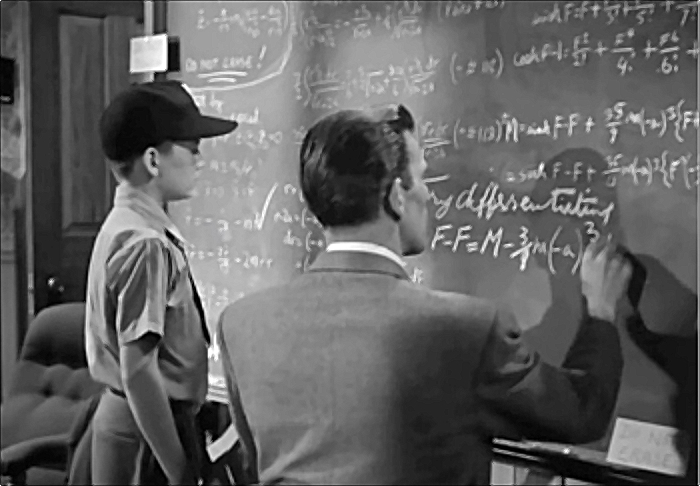
In Robert Wise’s classic sci-fi movie The Day The Earth Stood Still (1951), Klaatu (Michael Rennie), a visitor from distant space, has come to earth to warn world leaders that their conflicts endanger universal order and must end. To enlist the help of the smartest scientist, Dr. Barnhardt (a fictionalized Albert Einstein played by Sam Jaffe), Klaatu visits the professor’s house. He finds an unsolved problem in celestial mechanics on the blackboard, and quickly corrects the equations. He is interrupted by the housekeeper Hilda:


HILDA
How dare you write on that blackboard! Do you realize the Professor has been working on that problem for weeks?

KLAATU
He’ll catch on to it in no time now.

HILDA
How did you get in here? And what do you want?

KLAATU
We came to see Professor Barnhardt.

HILDA
Well, he’s not here. And he won’t be back till this evening.
(Klaatu scribbles a note and hands it to Hilda.)

KLAATU
You might keep this. I think the professor will want to get in touch with me.

Hilda’s glance wanders to the blackboard and she picks up an eraser, debating whether to erase Klaatu’s corrections.

KLAATU
I wouldn’t erase that. The Professor needs it very badly.


Even if you are not a physicist, and are simply intrigued by the arcana that only geniuses and space aliens understand, this is a memorable moment.

People who are comfortable living in the old high school classroom picture of a determinate universe full of atoms and their constituent protons, neutrons and electrons have another think coming. In the quantum world beyond simple particles, anything is possible and nothing is certain, if certainty itself exists. In the view of some, in quantum physics are hints of rough sketches of the face of God, as well solutions to practical matters such as how to teleport information across the universe beyond light speed. Those of us of lesser minds struggle to grasp even the most basic concepts, while the greater minds solve puzzles beautiful in their incomprehensibility.

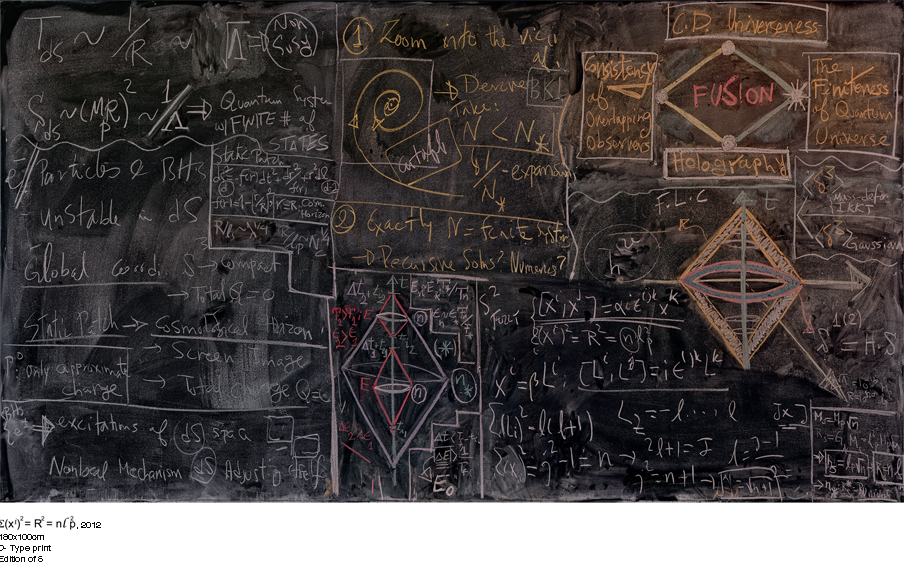
Spanish artist Alejandro Guijarro has combined two things at polar ends of research and education. On one end he has taken detailed photos of blackboards, a thinking and teaching tool so primitive that some are surprised to find them still around, and others have never seen one. On the far end, these particular blackboards belong to some of the world’s leading quantum thinkers. Guijarro traveled to institutes and laboratories around the world to record the smudged, chalk-streaked evidence of some of the world’s most sublime calculations…and erasures.

Movies: Force of Evil


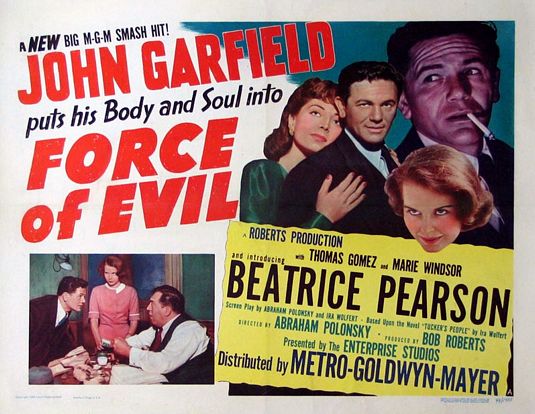
The overlooked movie Force of Evil (1948)  is one of the most striking creative critiques of big business in any medium. It was produced by the major, decidedly capitalistic studio MGM, and it featured one of Hollywood’s biggest stars at the time, John Garfield, in what many consider his greatest performance. A standout of intelligent film noir, it has a brilliant and poetic script, written and directed by Abraham Polonsky.

Garfield is still a celebrated name in movies. Polonsky is more narrowly known, mostly among film historians. Shortly after Force of Evil, both Polonsky and Garfield were blacklisted in the craze of anti-Communist McCarthyism that swept the movie industry. Polonsky would not work again for twenty-one years.

There are two kinds of political movies. One is expressly and directly about political issues. The other kind—the one that so worried Commie-hunters—are films that look entertaining on the surface, but have a subversive and counter-cultural subtext. Force of Evil is a sort of third wave. You can watch it as a well-acted and engaging melodrama, which it is. But at some points, the politics explicitly but gracefully rises above subtext, in a way that is mostly undidactic, so it doesn’t get in the way of enjoying and appreciating the movie. It is quite a trick that Polonsky pulls off.

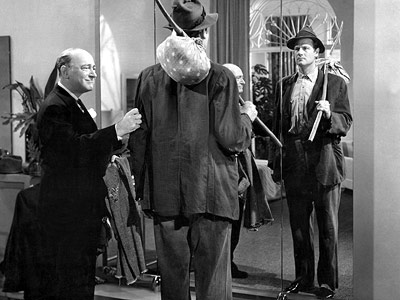
One of the archetypes of storytelling is the two brothers who end up on opposite sides of the law—Cain and Abel, the cop and the gangster. In this movie, both brothers are on the wrong side, just on a different scale. Leo is small-time, running a modest numbers betting business. (Numbers, sometimes called the policy racket, is an illegal lottery, long popular in low-income neighborhoods. Small bets are placed on the last three digits of the daily betting take at a race track; the odds are thus 1000 to 1.)  Joe (John Garfield), the younger brother who Leo helped put through Harvard Law, works for Ben, one of the biggest racketeers in New York.

Joe wants to make his first million, and he believes he will thanks to an ingenious plan to rig the outcome of the numbers on the Fourth of July. Since bettors often pick the numbers 776 on Independence Day, when that number comes up, the bettors will win for a change, but all the small-time numbers operators will go out of business, and be taken over by Ben. It is a strategy of forced, one-sided, underhanded mergers. (That’s right, the corrupt big business will play its dirty tricks on the slightly less corrupt small businesses—and on the innocent poor people—on the Fourth of July.)

Joe tries to save his brother by bringing him over to the bigger, richer and slightly darker side. But there are few heroes here. Events overtake characters, and in the end everyone, including a rival boss, is dead—except for Joe and the young woman he loves. While not exactly a happy ending, this outcome led some to complain that this sort of redemption was inconsistent with the rest of the movie. Maybe so, but this was made by one of the world’s biggest movie studios, and anyway, we all deserve a break in the face of this bleakness.

Bleak it may be, but Force of Evil is not some sort of dull lesson in ideology. It is a great, entertaining and rarely-seen film that deserves attention, whatever your politics.

Watch Force of Evil on YouTube

American Pandemic: “There’s a way to lose more slowly.”

Out of the Past (1947) is the best of all American film noir movies. It contains dozens of lines memorable and quotable, dialogue suffused with fatalistic wisdom.

Jeff and Kathie are at a roulette table. She is losing.

JEFF: That isn’t the way to play it.

KATHIE: Why not?

JEFF: Because it isn’t the way to win.

KATHIE: Is there a way to win?

JEFF: Well, there’s a way to lose more slowly.

The lives of Americans are in the hands of a loser. At this point in response to the pandemic, it isn’t clear exactly what “winning” means, but it is for the moment out of reach. What remains is for the man at the roulette table to figure out is how to lose more slowly.

Spoiler alert: At the end of Out of the Past, both Jeff and Kathie are dead. It is after all film noir.

Music: O-o-h Child (things are gonna get easier), The Five Stairsteps

O-o-h Child

Ooh child
Things are gonna get easier
Ooh child
Things’ll get brighter
Ooh child
Things are gonna get easier
Ooh child
Things’ll get brighter

Some day
We’ll put it together and we’ll get it undone
Some day
When your head is much lighter
Some day
We’ll walk in the rays of a beautiful sun
Some day
When the world is much brighter

A Face in the Crowd: A Media Star Demagogue Takes Himself Down

“Those morons out there? Shucks, I could take chicken fertilizer and sell it to them as caviar. I could make them eat dog food and think it was steak.”

“This whole country’s just like my flock of sheep! They’re mine! I own ’em! They think like I do. Only they’re even more stupid than I am, so I gotta think for ’em.”

“Good night you stupid idiots. Good night, you miserable slobs. They’re a lot of trained seals. I toss them a dead fish and they’ll flap their flippers.”

A Face in the Crowd (1957) is a movie about an unlikely backwoods media star, a drifter named Lonesome Rhodes, who becomes a national populist icon. He believes he can sell his followers on anything, including who the next president should be.

The demagogic scheme falls apart when his real beliefs are broadcast on an open microphone.

***

ACTOR ON RHODES’ SHOW: You really sell that stiff [Senator Fuller] as a man among men?

LONESOME RHODES: Those morons out there? Shucks, I could take chicken fertilizer and sell it to them as caviar. I could make them eat dog food and think it was steak. Sure, I got ’em like this… You know what the public’s like? A cage of guinea pigs. Good night you stupid idiots. Good night, you miserable slobs. They’re a lot of trained seals. I toss them a dead fish and they’ll flap their flippers.

***

LONESOME RHODES: This whole country’s just like my flock of sheep!

MARCIA JEFFRIES: Sheep?

LONESOME RHODES: Rednecks, crackers, hillbillies, hausfraus, shut-ins, pea-pickers – everybody that’s got to jump when somebody else blows the whistle. They don’t know it yet, but they’re all gonna be ‘Fighters for Fuller’. They’re mine! I own ’em! They think like I do. Only they’re even more stupid than I am, so I gotta think for ’em.

***

Clearing the Chessboard

Searching for Bobby Fischer is a movie about a real life chess prodigy. In a memorable scene, his teacher sweeps the pieces off the chessboard, so the child can better concentrate on the actual state of play, undistracted by the apparent state of play.

Meditation and related attention practices are all about clearing the chessboard. What comes next depends on the context, whether it’s a way to relax or a search for enlightenment. The point is that the apparent state of play, the pieces on the chessboard, are distractions and may become obsessions. Only by focusing on the empty chessboard can you see the game for what it is.