Star Trek Koan

Captain Kirk faced a crisis on the Enterprise. He summoned his ship’s doctor and his ship’s engineer. Bones says, “Damn it Jim, I’m a doctor, not an engineer.” Scotty says, “I’m an engineer, Captain, not a doctor.” Who is right?
Captain Kirk faced a crisis on the Enterprise. He summoned his ship’s doctor and his ship’s engineer. Bones says, “Damn it Jim, I’m a doctor, not an engineer.” Scotty says, “I’m an engineer, Captain, not a doctor.” Who is right?
Whatever your politics, it was TV history last night on The Late Show. Joe Biden and Stephen Colbert talking, just two great guys leaning in and getting real, while millions watched, and many teared up.
It starts with Colbert. The question has been whether and how he would progress from being a character on The Colbert Report to a different character that is more himself. There was that moment on the final Daily Show when Colbert exposed his most sincere and unironic thanks to Jon Stewart, the man who gave him his chance.
But last night’s Late Show interview skipped all the midpoints of developing a Colbert talk show persona to transcending any idea of what a late-night host might be. Beyond showing himself as a man of faith, Colbert served almost as a therapist and priest. He didn’t stay away from the pain. He compassionately went right for it, not for spectacle, but for the healing truth, and to reveal the depths of Biden’s quandary.
Reflecting their shared history of family tragedy, it was like a reunion of two old souls. On top of that, Colbert wore not only his faith but his politics on his sleeve, something that just isn’t done in his position. It was clear that he was urging Biden to run not because it was a good idea, but because Colbert and the Nation needed him.
It doesn’t take much to get Biden to speak from his soul. Hello will usually do. But Colbert brought out an extra dimension of that. Where certain candidates now running make us cringe, Biden made me and plenty of others cry. Where certain candidates make us want to run the other direction, listening to Joe just made me want to be a better person.
In the moment, it didn’t matter that Colbert was in only the third show of his widely-covered new TV venture. Or that Biden was in the final weeks of the will-he-or-won’t-he candidacy drama. It just was what it was, and what it was was good and human, so humbly and nobly human. Something we don’t see much on TV. Or in politics.

This is the way the world ends
This is the way the world ends
This is the way the world ends
Not with a bang but a whimper.
T.S. Eliot
The Hollow Men
Readers and viewers know whether they like or are satisfied with the way a novel or movie ends. But they may not recognize the burden of creating those endings, not just to short forms, but to sagas and epics, where possibilities are exponential, and where those dutifully following the tale and trail may be looking for those elusive treasures: resolution and meaning.
It is not surprising that the final episode of Mad Men was written and directed by the show’s creator Matthew Weiner. How could it have been otherwise?
Mad Men is a work of literature disguised as a television show. There are a number of hallmarks of literature and art, including the engagement of those who see and hear. But maybe even above that is coherence, holding together as a work, from one corner of the canvas to another, from the first to last note of the symphony.
Mad Men doesn’t fit it into any particular artistic category: impressionistic or expressionistic, realistic or fantastic, Freudian or Jungian. If anything, it delves into magical realism, where ghosts are real and real people are ghosts and anything can happen and make sense.
Or not make sense. The story of Mad Men in essence begins with the death of the original Don Draper in Korea. Over time, others die, couples come together and apart, people have sex, families are raised, business are started and bought and sold, jobs are lost and found, money is made and spent, some are miserable while others are happy, some grow and all just grow older.
All of it makes just enough sense to be a story. None of it makes enough sense to defy reality, gravity, or time. What more could you ask for? Meaning? What more were you expecting? It’s just the real thing.
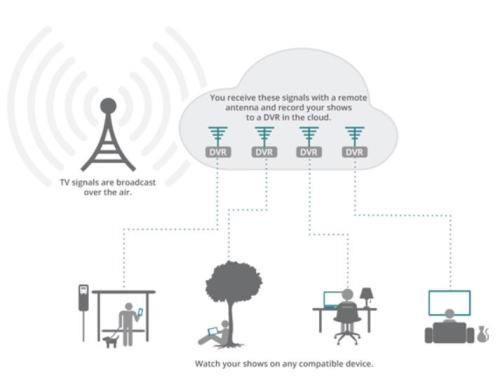
Today the Supreme Court hears arguments in the case of ABC, et al. v. Aereo. Some characterize it as the most important media case in decades, one which could destroy broadcasting as we know it.
That is both overstated and understated. The big broadcasters who claim this is the apocalypse won’t go out of business; they will continue, though they might make a little less money or have to work a little harder for it. On the other hand, nothing less than the nature of modern reality is being considered, which is what makes the case so interesting and ultimately so hard to decide.
In a nutshell, this is what Aereo does:
Aereo sets up lots of tiny (thumbnail) antennas in your locality.
The antennas pick up the same over-the-air (OTR) TV signals you would if you had an antenna at your home (but you probably don’t).
You subscribe to Aereo for as little as $8 a month.
When you want to watch something from the stations that are on the air in your locality, Aereo assigns you an antenna, collects and records the signal from that antenna in its cloud, and streams that signal the way you want to the device you want, now or later.
The question is whether Aereo is retransmitting copyrighted content to subscribers, cleverly skirting retransmission fees that cable systems and others must pay, which would be stealing. Or whether Aereo is simply enabling you to do something you are legally entitled to do: receive OTR TV and then watch it, record it, or redistribute it to your own devices for your own personal use.
The Second Circuit Court of Appeal decided in favor of Aereo, with a vigorous dissent and with other Circuit Courts disagreeing, and now the Supreme Court will decide. If you read the briefs you can get an idea of the difficulty and the possible impacts.
One can say, as the big broadcasters do, that Aereo may be trying to fit through a loophole in the law, but that isn’t quite right. Aereo is taking advantage of a reality so profoundly new and so newly understood that every medium and every media business is just barely beginning to come to grips.
When you reduce things to information and can move that information around infinitely and frictionlessly and at relatively low cost, the processes and regulations meant to handle grosser things are of limited value.
First a book was a thing made of paper, then there was a copier which could copy pages on paper, then there was a scanner that could turn paper pages into digital images and, with OCR, characters, then there were entire books that never had anything to do with paper, ever, just pure arranged information. The same goes, with slightly different details, for every medium. The solution for the producers who wanted to control things (often with legitimate interests, such as creators being compensated), was to put the information in some kind of box, which to some looked like an information jail. It was and is this simple: once it gets out of the box, catching it and catching up with it is quite a chore. Because, as Stewart Brand famously said, information wants to be free.
If you had to characterize the actors in this case as good guys or bad guys, it does look like ossified old school versus new school, mega-corporations versus insurgents, or as one of the briefs says, David versus Goliath. Any way you put it though, and wherever your opinion lies, this is a hard case, and the maxim is that hard cases make bad law. In this case, bad law would mean that even if progressive principles are maintained, more looking forward than back, we are still in an astonishing mess when it comes to dealing with all this. One case at a time won’t do, and the expectation that Congress will seize the reins and lead us boldly into an enlightened future on digital intellectual property is, at least for the moment, not in the cards or the cloud.

