I was wrong about the Israeli war in Gaza. It’s not about Jewish justice and compassion. It’s about Jewish creativity. Ask Borges.
by Bob Schwartz
My continuing reaction to the Israeli war in Gaza has been that it does not reflect the Jewish principles of justice, morality and compassion that I associate with our faith.
I was, somewhat, wrong.
I am reading the book, Borges, the Jew, by Ilan Stavans.
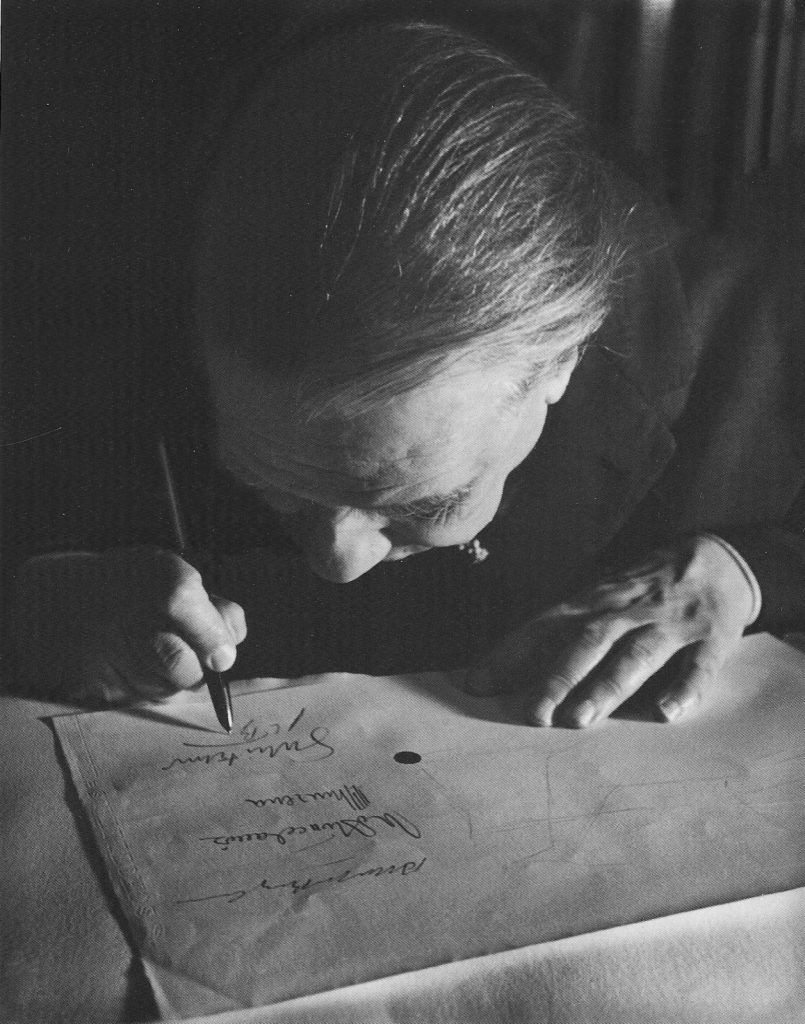
Jorge Luis Borges (1899-1986) has been widely acclaimed as one of the most important writers of the 20th century—if not the most important. Like other great creatives, he had a singular vision that he was able to express in singular ways.
The Ilan Stavans writes:
Borges, the Jew highlights an aspect dear to me—his relentless desire (not to be confused with envy) to claim, as part of his self, a Jewishness he found in books, in idols such as Baruch Spinoza, in an overall attitude, at once reverential and subversive, toward God, life, and the intellect. By his account, none of that Jewishness was in his blood; he desperately sought to trace it in genealogical terms yet failed in the endeavor. In response, he simply imagined himself a Jew….
Is character fate? Borges didn’t endorse this ancient Greek principle, on which entire tragedies were built. His character wasn’t defiant; instead, he approached reality rationally, by which I also mean cautiously. Life, in his view, was a series of accidents. In “A History of the Echoes of a Name” (1955), he quotes Martin Buber, in his book Between Man and Man (1948), as saying that “to live is to enter the strange house of the spirit, whose floor is the chessboard on which we play an unknown and unavoidable game against a changing and sometimes frightening opponent.”
I don’t know if there is a Jewish approach to life but it does strike me that, if there is such a thing, it would indeed be a game played against a mysterious, out-of-this-world opponent: oneself.
Borges, like many of the real or imagined Jewish visionaries, was an outsider and considered himself an outsider. An inspired and compelling outsider. Nothing proves this more than the decades of relative ignorance of his towering work. In the literary community, the failure to award him a Nobel Prize is still considered a miss and mistake.
What does any of this have to do with Gaza?
I was thinking about what else Israel might have done in response to the tragedy of October 7. It is true that some situations seem to require and demand a particular response, or a limited range of responses. Those responses depend on numerous factors: what you are willing to do, what you are able to do, what the complex of consequences is or might be to what you do.
That is where creativity comes in. You can of course say that God directs a particular course of action, that anything else or less is, literally, ungodly. Or you can envision Buber’s chessboard, and Borges’ chessboard, and conceive almost infinite possibilities.
Those who study Judaism know that it is a tradition that encourages possibilities. Even casual exposure to the Talmud and other exegesis quickly reveals that. And, to put it in another context, anyone who has seen and heard the wealth of Jewish comedy realizes that. Anything is possible as a premise, which makes anything possible as a punchline.
Borges was not a comedy writer, let alone a Jewish comedy writer, but the conceits of his stories explore the absurd. As does great comedy.
Gaza did not have to go this way. It is not that the option Israel chose is unjustified and excessive, which it is. It is that of all the possibilities, it reflects a lack of creativity and creative freedom. This is one reason Borges thought he was a Jew, spiritually. He was not afraid of the road not taken, since he had been on that road for his entire life. Just like the Jews.

