Bob Schwartz

Tag: Christianity

The Furniture of Religion

When I look at the religions I practice or have a studied interest in—Judaism, Buddhism, and Christianity among them—I see empty houses and furniture.

Some religions seem to begin with emptying the previously stuffed house, or at least minimizing the furniture. Buddhism and Christianity look like this, at least in the beginning. But the nature of religious evolution is to buy, borrow or build furnishings to fill the rooms, because it seems an improvement and because it is what people seem to like in their homes. And so, thousands of years later, you find plenty of variety in the Buddhist and Christian neighborhoods—some very grand constructions spiritually, intellectually, and physically, that seem a long way from the original simple houses.

Judaism, which like Hinduism harks back to a more ancient world where more is more, begins overstuffed (or in the Yiddish expression, ongeshtopt, meaning overstuffed). There have been continuing movements to strip down the Jewish furniture to basics and barer floors and walls, the most powerful of which has been the Hasidic stream, flowing from the Baal Shem Tov in the 18th century. (But in the spirit of exponential furnishing, the Hasidic movement became more and more overstuffed over the next few hundred years, leaving the Besht’s house barely recognizable.)

Regular readers know my appreciation for religion and my practice of Zen, which for me remains the best (but not only) way to clear out the furniture, or at least see through it to the basic house, or even to see through the house itself to where it sits in the universe. Once there, you can bring in the furniture you really need, whatever the period or the style.

 

St. Anthony of Padua

You don’t have to be religious, Christian or Catholic to appreciate saints. Every tradition recognizes those whose lives, thoughts, or actions are worthy of attention. The particulars may not suit your sense or sensibilities, but these people represent the possibilities of being human—possibilities to which we may not personally aspire, but possibilities that still may inspire.

Today is the feast day of St. Anthony of Padua. The reasons for his sainthood involve his devotion and his preaching of the faith (he is often pictured with the baby Jesus and a book). His preaching was reportedly not limited to people:

Once, when St. Anthony of Padua attempted to preach the true Gospel of the Catholic Church to heretics who would not listen to him, he went out and preached his message to the fish. This was not, as liberals and naturalists have tried to say, for the instruction of the fish, but rather for the glory of God, the delight of the angels, and the easing of his own heart. When critics saw the fish begin to gather, they realized they should also listen to what Anthony had to say. (Catholic Online: Saints & Angels)

St. Anthony is the patron saint of the poor and of travelers, but is best known in popular Catholic culture as the patron saint of lost things. Though some have invoked him—successfully and unsuccessfully—with a simple childlike verse (“Dear St. Anthony look around/Something’s lost that can’t be found”), the story and meaning is explained more fully by others:

Since the seventeenth century Anthony has been frequently invoked as the finder of lost articles. When a novice took his Psalter without permission, Anthony prayed for its return. After a frightening apparition, the novice rushed to restore the book to its rightful owner. (Lives of the Saints: From Mary and St. Francis of Assisi to John XXIII and Mother Teresa)

In 1224, Francis entrusted his friars’ pursuits of studies to Anthony. Anthony had a book of psalms that contained notes and comments to help when teaching students and, in a time when a printing press was not yet invented, he greatly valued it. When a novice decided to leave the hermitage, he stole Anthony’s valuable book. When Anthony discovered it was missing, he prayed it would be found or returned to him. The thief did return the book and in an extra step returned to the Order as well. (Catholic Online: Saints & Angels)

Anthony should be the patron of those who find their lives completely uprooted and set in a new and unexpected direction….God did with Anthony as God pleased—and what God pleased was a life of spiritual power and brilliance that still attracts admiration today. He whom popular devotion has nominated as finder of lost objects found himself by losing himself totally to the providence of God. (Franciscan Media)

From the National Shrine of St. Anthony:

Prayer to Find What Is Lost

St. Anthony, when you prayed, your stolen book of prayers was given back to you. Pray now for all of us who have lost things precious and dear. Pray for all who have lost faith, hope or the friendship of God. Pray for us who have lost friends or relatives by death. Pray for all who have lost peace of mind or spirit. Pray that we may be given new hope, new faith, new love. Pray that lost things, needful and helpful to us, may be returned to our keeping.

Feeding the poor. Preaching to fishes. Finding lost things. Sounds like a full feast day.

A Day for Job

In the Orthodox Church, today is officially a day for the marvelous and mysterious biblical character Job, who is called by that church Righteous Job the Long-Suffering. While the Book of Job is certainly read, used and debated in other Jewish and Christian traditions, this is the only official recognition he gets.

I’ve written before about Job (Yom Kippur and Job, The Radical Book of Job) because there is nothing like it in the Bible, not even close. Robert Alter writes in his enlightening translation and commentary:

The Book of Job is in several ways the most mysterious book of the Hebrew Bible. Formally, as a sustained debate in poetry, it resembles no other text in the canon. Theologically, as a radical challenge to the doctrine of reward for the righteous and punishment for the wicked, it dissents from a consensus view of biblical writers—a dissent compounded by its equally radical rejection of the anthropocentric conception of creation that is expressed in biblical texts from Genesis onward. Its astounding poetry eclipses all other biblical poetry, working in the same formal system but in a style that is often distinct both lexically and imagistically from its biblical counterparts.

“The patience of Job” is the way the story is frequently summarized, suggesting that even in the face of undeserved suffering, Job is a model of how unwavering faith will carry us through the worst times. Once you have read the Book of Job carefully, along with some of the many excellent interpretations, you find that this is not the case. The Book of Job does not solve any mysteries or answer any questions. All it does is deepen mysteries and ask more questions. This isn’t what we might want, but if you’ve lived a life, you know that is what you get. Which is precisely what makes the Book of Job so irreplaceably essential, even if not particularly comforting.

The Mountain and the Cross

The Mountain and the Cross

How is the view
From up there?

Can you see
How you got there?
Others look
At every act you took
Word you spoke
Song you sang
Pull them apart
Put them together
A journey
That never seems to end.

For you it ends here
For a time
On the mountain and the cross.

A privileged child
A prince
A prodigy
A champion of the people
An enemy
A wise man
A miracle worker embarrassing mere magicians
A leader
A rebel
How did that rebellion go
How is it now?

One mistake after another
Has cost you everything
Won you something
But what in the end
Did it all mean?

(Jesus wonders
If he might have lived longer
Not one hundred twenty
But more than thirty three.
Moses has no complaint
About the number
And would not trade places
Sitting on a mountain
Not hanging from a cross
But regrets having to survey
An unreachable destination.)

You were just infants
Too young to remember
How it began.
Leave it to others
To imagine that past
And future.
You have no choice
But to let them see and speak for you
As you saw and spoke for others.
Now your eyes and mouth are closed
In dark silence from a height.

© Bob Schwartz 2017

The Pope and the Dalai Lama: How Did We Get So Lucky?

In a newly published interview with Die Zeit, Pope Francis talks about many matters. Including his own faith. Asked about whether he ever doubts the existence of God, he said:

“I too know moments of emptiness.”

The current Pope shows us the honesty, humility, humor, wisdom and spirit we would like to see in all our traditions and in all our leaders—and in ourselves. The same can be said about the current Dalai Lama.

You don’t have to be a Roman Catholic or a Tibetan Buddhist to be inspired by these people. And just people they are, according to them, as the Pope reminds us in the same interview:

“I am a sinner and I am fallible. When I am idealized, I feel attacked.”

Pope Francis is 80. The Dalai Lama is 81. They will not live and serve forever, as much as we would be benefited by that gift. It is possible that both will be succeeded by their equal, but we can’t know that.

So let’s enjoy them and be inspired by them while they are here, wondering what we did to deserve this.

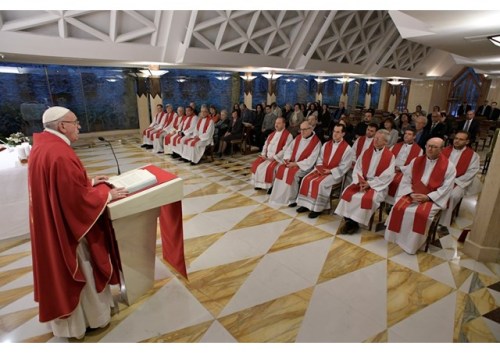
Pope: The Scandal of Christian Hypocrisy

Pope Francis

Scandal is saying one thing and doing another; it is a double life, a double life. A totally double life: ‘I am very Catholic, I always go to Mass, I belong to this association and that one; but my life is not Christian, I don’t pay my workers a just wage, I exploit people, I am dirty in my business, I launder money…’

In a homily yesterday morning, Pope Francis said this:

“But what is scandal? Scandal is saying one thing and doing another; it is a double life, a double life. A totally double life: ‘I am very Catholic, I always go to Mass, I belong to this association and that one; but my life is not Christian, I don’t pay my workers a just wage, I exploit people, I am dirty in my business, I launder money…’ A double life. And so many Christians are like this, and these people scandalize others. How many times have we heard – all of us, around the neighborhood and elsewhere – ‘but to be a Catholic like that, it’s better to be an atheist.’ It is that, scandal. You destroy. You beat down. And this happens every day, it’s enough to see the news on TV, or to read the papers. In the papers there are so many scandals, and there is also the great publicity of the scandals. And with the scandals there is destruction….

“[Y]ou will arrive in heaven and you will knock at the gate: ‘Here I am, Lord!’ – ‘But don’t you remember? I went to Church, I was close to you, I belong to this association, I did this… Don’t you remember all the offerings I made?’ ‘Yes, I remember. The offerings, I remember them: All dirty. All stolen from the poor. I don’t know you.’ That will be Jesus’ response to these scandalous people who live a double life….

“It would be good for all of us, each one of us, today, to consider if there is something of a double life within us, of appearing just, of seeming to be good believers, good Catholics, but underneath doing something else; if there is something of a double life, if there is an excessive confidence: ‘But, sure, the Lord will eventually forgive everything, but I’ll keep going as I have been…’

Revelation of the Magi

Magi

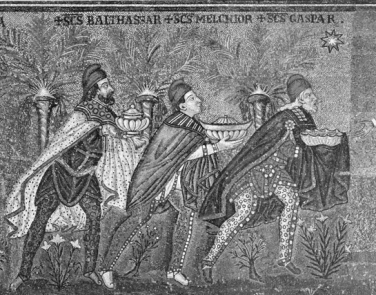
An excerpt from the story of the magi as told by the magi:

And (something) like the hand of a small person drew near in our eyes from the pillar and the star, at which we could not look, and it comforted us. And we saw the star enter the Cave of Treasures of Hidden Mysteries, and the cave shone beyond measure. And a humble and kind voice made itself heard by us, which called out and said to us: “Enter inside without doubt, in love, and see a great and amazing vision.” And we were encouraged and comforted by the message of the voice. And we entered, being afraid, and we bowed our knees at the mouth of the cave because of the very abundance of the light. And when we rose at its command, we lifted our eyes and saw that light, which is unspeakable by the mouth of human beings.

And when it had concentrated itself, it appeared to us in the bodily form of a small and humble human, and he said to us: “Peace to you, sons of my hidden mysteries.” And again, we were astonished by the vision, and he said to us: “Do not doubt the vision that you have seen, that there has appeared to you that ineffable light of the voice of the hidden Father of heavenly majesty.”

Revelation of the Magi 12:4-13:1

Revelation of the Magi is written as a first-person account of the visit of the Wise Men, though that is unlikely. The available text is written in Syriac, with the story originating possibly as early as the 3rd century. Long forgotten, an English translation of it can now be found in Revelation of the Magi: The Lost Tale of the Wise Men’s Journey to Bethlehem (2010) by Brent Landau.

Only Candles Only Stars


Stars

Only Candles Only Stars

Let there be lights (מארת) in the vault of the heavens … and they shall be lights (מאורת) in the vault of the heavens (Genesis 1:14-16)

All of the lights
On the candles, trees, houses
Beneficial artifice
The best we can do.
Even the stars
Awakening guiding
Are incomplete.

The light that eludes
In the dark cold of winter
Hiding in plain sight.

Light the Icicle

icicles

Happy Hanukkah. Happy Christmas.


The Icicle

A zaddik told:

“On a winter’s day, I went to the bath with the master. It was so cold that icicles hung from the roofs. We entered and as soon as he did the Unification, the bath grew warm. He stood in the water for a very long time, until the candle began to drip and gutter. ‘Rabbi,’ I said, ‘the candle is guttering and going out.’

‘Fool,’ he answered, ‘take an icicle from the roof and light it! He who spoke to the oil and it leaped into flame, will speak to this too, and it will kindle.’ The icicle burned brightly for a good while, until I went home, and when I got home there was a little water in my hand.”

Martin Buber,  Tales of the Hasidim


“People ask, ‘What is the Buddha?’ An icicle forming in fire.”

Dogen Zenji

Healing and Magic: We Are Not Alone

White Tara

All of our religious traditions—Judaism, Buddhism, Christianity, and all others—include an element of healing. Healing of body, heart and mind. The Gospels, for example, contain many important stories about healing, from curing chronic illness to reversing death itself.

We invoke the power to heal in various ways. In Judaism, the Mi Shebeirach is recited:

May the one who blessed our ancestors, Abraham, Isaac and Jacob, Sarah, Rebecca, Rachel and Leah, bless and heal those who are ill. May the Blessed Holy One be filled with compassion for their health to be restored and their strength to be revived. May God swiftly send them a complete renewal of body and spirit, and let us say, Amen.

In Buddhism, White Tara, an important embodiment of compassion, is invoked:

The liberator of suffering shines light upon me to create an abundance of merit and wisdom for long life and happiness.

Is this magic we are engaged in? If you take magic to be a call to illegitimate and evil powers, as some traditions do, then this might have to be classified as something else. If you take magic to be the recognition of a seeming powerlessness in the face of things as they are and an attempt to borrow and employ the power we believe in, then magic it is.

This invocation of the power to heal—by ourselves, in a family, in a community—is a way of practicing that we are not alone. When healing is needed, that is something we want to know.

For JRK.