Bob Schwartz

Istanbul Spring

Today's Zaman
O Istanbul. Crown jewel and epicenter of Turkey. Literal crossroad of the world, east and west. Beloved city of many world travelers, who find themselves immersed in a multi-millennial mix of cultures. In Istanbul, you are simultaneously located and dislocated in geography and time.

The hours of coverage of the clashes in Taksim Square will not make this quite clear. Protests against the demolition of Gezi Park, one of the last green spaces in modern growing Istanbul, ripened into broader complaint about the direction of the democratically-elected government of Prime Minister Recip Tayyip Erdogan.

Today in Taksim, Erdogan acted on his threatend lost patience, setting the police on occupying protestors, whom he believes to have been infiltrated by violent political activists and radicals. Tear gas, water cannons, and other dispersal techniques followed.

Turkey—and particularly its world-class city Istanbul—does not fit easily in any of the usual boxes. The anomaly is the work of a single man, a visionary autocrat who managed to give autocracy a good name, who took one of the most culturally rich but tradition-bound countries in the world and pushed/dragged it into the twentieth century.

Mustafa Kemal Ataturk (1881-1938) disrupted and redirected a country’s trajectory as few have ever done. First President of the Republic of Turkey, and still almost a god-like presence, he was determined to see Turkey regain its former glory not by looking backward but by moving forward and becoming a modern, secular, European-style democracy. Along with universal education and changing the way that people dressed (he banned the fez, for example), he literally changed the language, reformatting Turkish with a Roman alphabet.

It worked for the most part, though with sporadic gaps. The old and the new live comfortably and excitingly with each other, as a visit to Istanbul demonstrates. Turkey is thriving. Those whose image of Islam is informed by skewed sketches find one of the world’s most Muslim countries defying stereotypes.

Democracy has been an on-again, off-again phenomenon in Turkey. As the twentieth century crept into the twenty-first, the progress that Ataturk enabled led to expectations that would not be denied. The rise of Islamism and traditionalism under the current leadership, even as Erdogan pushed important reform, does not sit well with a generation—again particularly in Istanbul—that takes secularism, modern culture and principles of freedom very seriously.

That is how we get here today. Even as Prime Minister Erdogan was intent on ending the occupation of Taksim Square, dozens of lawyers joined in and were arrested at the courthouse. These tensions are nothing new for Turkey; the military has been in charge more than once, and was then turned out. What is new is how much of the world is watching.

This isn’t about whether a little city park in Istanbul should make way for a shopping center, or whether drinking alcohol should be restricted in Turkey (another issue that has seeped into the discussion). It isn’t the same as other “springs”, Prague or Arab, about moving from dictatorship to democracy. This is a democracy already, one of the most interesting in the world. We are watching the kind of challenges that twenty-first century democracies will be facing, and seeing whether purportedly enlightened leaders can find appropriate ways of meeting them. For the sake of Turkey, and especially for the sake of glorious Istanbul, let’s hope so.


Istanbul

A Food Breakthrough on National Donut Day

Glazed Donut Breakfast Sandwich

Updated to include Donut Burger.

Today is National Donut Day. Celebrated on the first Friday in June, it was begun in 1938 to celebrate the Salvation Army’s distribution of donuts to soldiers in World War I.

Donuts, particularly glazed donuts, are quite possibly the world’s most perfect food—provided you are not concerned about health. (Bananas, which use that “perfect food” slogan, are also great, and are much healthier, but bananas are obviously not quite donuts.)

There are plenty of special deals on National Donut Day, including free donuts with or without a purchase. But something has happened to make this NDD even more special.

Today Dunkin’ Donuts rolls out its Glazed Donut Breakfast Sandwich:

Going Where No Breakfast Has Gone

We’ve gone and changed breakfast forever. Again. Bite into this smorgasbord of bacon slices and pepper fried egg, sandwiched by a Glazed Donut.

Let’s talk about bacon. Bacon is quite possibly both the world’s most perfect (taste) food and least perfect (health) food. The stunning brilliance of combining bacon with a glazed donut can’t be overstated. A Nobel Food Prize can’t be far behind.

On the practical side, you have a choice. You can eat glazed donuts or Glazed Donut Breakfast Sandwiches once a year on National Donut Day. Or you can eat them every day. Or something in between.

Aristotle advised moderation in all things. With all the temptations he did face in ancient Greece, he still never had to withstand the allure of a Dunkin’ Donuts Glazed Donut Breakfast Sandwich. So as Aristotle would suggest on National Donut Day: go on, live a little.

Update:

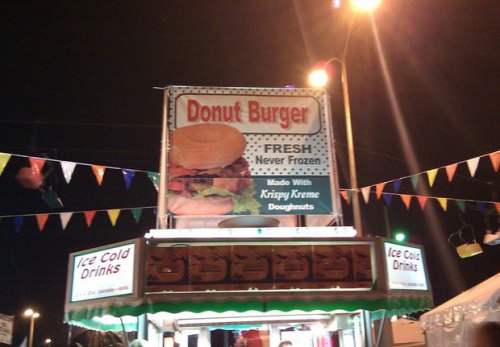
Donut Burger

Many thanks to the reader who clued me in to Donut Burgers. Not only am I not eating enough donuts, I am also not keeping up with donut cuisine. As with all cutting-edge dishes, the origins of the donut burger are controversial. It is generally attributed to singer and producer Luther Vandross, who ran short of hamburger buns and substituted Krispy Kreme donuts, to create what is sometimes called the Luther Burger. It is now a staple of state fairs and other places where eating unusual things is essential to the experience. In all honesty, though, I’m not sure I get it, or want to get it. On the other hand, they say don’t knock it till you’ve tried it.

The Next Civil War: Religion

Lincoln Penny
A few years ago, I proposed that the American divide over abortion might one day reach the dangerous depths of a much earlier conflict over slavery. Not since slavery—not even with still-festering questions about racial and other inequalities—has an issue had such a basic and visceral impact.

The poll numbers on abortion have shifted, the judicial context may be stable (for the moment), but the legislative activity is still a battlefield: among the initiatives, just today Pennsylvania Governor Tom Corbett signed a law prohibiting insurers that offer abortion coverage from participating in the state’s exchange under the Affordable Care Act.

Yet even with that, abortion will not be the biggest issue that cleaves America in the next few years. It will be, much more than it is now, religion.

Not one religion against another, or one religion-based position against another. We are approaching the point where half of America has an explicit or implicit affinity with some organized religious denomination or belief, and half does not. The not includes a wide range from atheists, agnostics, areligionists or anti-religionists to those who are “spiritual but not religious.”

America is not a theocracy or, officially, a theocratic democracy. But “theocratic democracy” (see Israel) is the way a number of Americans see it approvingly. Our conventions, traditions and even our money support this, and when they didn’t support it sufficiently, it was enhanced—as when during the Cold War against godless Communism, “under God” was added to the Pledge of Allegiance.

The dynamic between religious and secular has long played out in America in just about every official sphere. But in the past, those who fought for the secular and even succeeded (prayer in schools) were considered an aberrant and weird fringe. The fringe is now a minority, but still in some eyes, aberrant and weird. What happens when that fringe turned minority becomes an equal partner in American civics, citizens who are guided by bright moral lights, just not those that emanate from lamps they don’t believe in and refuse to support—or allow to rule their lives? What then?

Abraham Lincoln said we could not survive half-slave and half-free. The nineteenth century would not have hinted at it. but the American twenty-first may be half-God, half-not. What might Lincoln say then?

Mountains or Molehills: How to Unflatten the News

Mt Everest - Justin Bieber
Digital access has made the news world flat. Flat as in if you use a news aggregator, there is some attempt on the site to stack the most important stories within a category, but since all categories have the same dignity, you really wouldn’t know, being from another planet, whether the civil war in Syria is more or less significant than Justin Bieber racing his Maserati through his exclusive California neighborhood (hint: it’s not Bieber).

Just as digital has created this unsortable mess and mass of news, such that Hamlet, who insane or not could tell a hawk from a handsaw/heron, would have trouble telling an important story from an inconsequential one (hint: your uncle killing your father to marry your mother is an important story).

Here is a solution. Since it is very easy to adjust type size digitally, stories that aggregators, editors or writers are willing to admit are not earthshaking might be presented in a smaller font, while those that are vital could use a larger one. This was always a convention of print news, and there is no reason that the capabilities of digital information shouldn’t be used to bring this approach up to date. As in:

Top Stories

Civil war in Syria threatens regional and global stability and peace.

Justin Bieber continues to race his Maserati around his neighborhood, despite complaints from neighbors.

Getting and Giving a Break


Everyone is someone else’s pain, or at least pain in the ass. We don’t always know this or acknowledge it about ourselves, thinking how we are put upon or suffering at the hands of others, yet unwilling to see how others are overlooking our own silliness or meanness.

We are constantly getting breaks from family, friends and particularly from those in loving relationships. Since we can’t actually count the number of breaks we get—most are silently and even unconsciously given—the best path to balance is to give breaks to others as infinitely as possible. This can seem painful, because we are convinced it is our duty to make the world or someone we know and love “better.” Except that more than we realize, others are making the world better by allowing us to be who we are without comment or critique. Compassionate criticism has its place, but so does giving breaks, more often than we do.

Moral Mondays

Moral Mondays

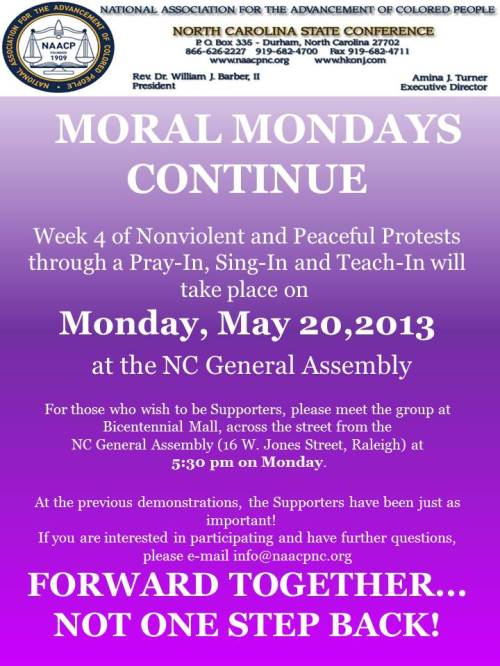
Today, Monday, June 3, is another Moral Monday in North Carolina. A Mega Moral Monday. Small and local right now, Moral Mondays have the potential to be the kind of broad movement that in recent years progressives have wanted but so far been unable to achieve.

In May, the North Carolina NAACP began peaceful protests each Monday at the General Assembly. The civil disobedience is meant to bring attention to legislative curbs on Medicaid expansion, workers’ rights and voting rights, and to the lack of legislative progress on gun control and public education funding. There have been an increasing number of arrests of activists, 153 so far. This week, the protests are expanding across the state.

All movements are more likely to fall flat than catch fire. The Occupy movement reflected real dissatisfaction and outrage, but never sufficiently articulated the underlying principles that would galvanize people to commit and to connect with each other in big numbers.

Moral Monday is built on a foundation that is at the heart of what bothers so many Americans. As is apparent from many of our political controversies, some of those who claim the moral high ground sometimes seem to ignore possible moral shortcomings in their policies, e.g., a Christian imperative to lift the poor and heal the damaged may be at odds with extreme cuts in government support and programs. (In this regard, see questions about Ayn Rand that arose in the most recent election.)

Moral Monday simplifies what is admittedly a set of very complex issues to a very basic baseline: If you claim, by the light of faith or by a sense of enlightened humanity, to believe in moral action, then your idea of morality must be your primary guide. You are free to choose that morality; no constitution, no set of laws, nothing can or should move it. But once you have chosen, and especially after you say it loudly every Friday, Saturday, or Sunday, or on whatever days you proclaim your core beliefs, your duty is to act on it. If you don’t act morally, or if you try to rationalize around that morality for some supposed greater cause, you are only human, but should investigate and consider your action, and even your possible hypocrisy.

Moral Mondays may not make it beyond North Carolina. But it is possible that in a little while, all around the country, more and more people will start the week by taking a stand and, if necessary, getting arrested for it. There is a global and historic tradition for this sort of action, and great change has been made.

Thank you North Carolina NAACP. Mondays will never be the same.

The Voice: “I Hate This Country”

Adam Levine - The Voice
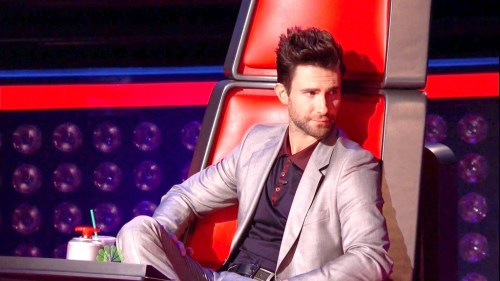
Adam Levine is a popular musical artist with Maroon 5 and a coach on NBC’s singing competition The Voice.

Last night was an elimination round for two of the remaining eight contestants. Each of the four coaches (including Shakira, Usher and Blake Shelton) has members of their respective teams in the competition.

After the typical tense triage, three contestants remained. Only one would survive. Of those, two were from Team Adam, and one was a talented singer named Judith Hill. She may not have been destined to win, but she was a solid performer who had already had a career as a backup singer for Michael Jackson, and might yet get a chance on her own. The two other singers remaining were not in her league.

The camera was on those three as host Carson Daly pronounced the obligatory nail-biting “America has voted” spiel. In the background, you could hear a simple comment from Coach Adam, as he likely sensed that the most worthy of the three was about to be eliminated:

“I hate this country.”

Meaning, one presumes: I hate these stupid popularity contests, even one that I am a part of, where merit matters less than the judgment of numbers and the crowd. I don’t hate America, but I hate it when America speaks like this.

And then, Judith Hill was gone.

Every one of the artist-coaches has built a successful career, and knows that entertainment, like every other field, is not entirely a meritocracy. Still, even accounting for differences in taste, a few minutes of singing can reveal those with consistent control, those who can find and hit all the notes, those who can put power and style in what they sing—and those who can’t.

So Adam, and everybody else who gets frustrated by singing competitions that don’t always give us the best, or political systems that don’t either, embrace your frustration. At least it means that you haven’t given up, that you still have standards, that you still have hope and expectations that the competitions and elections will give us winners who really can sing—even if we lose some worthy ones along the way.

Go Silent on Memorial Day

Go Silent
Iraq and Afghanistan Veterans of America (IAVA) this week launched a new campaign asking all Americans to “Go Silent” this Memorial Day in honor of all those who have made the ultimate sacrifice. The “Go Silent” campaign encourages Americans to pledge at IAVA.org to pause and be silent for a full minute at 12:01 p.m. EDT on Memorial Day, Monday, May 27.

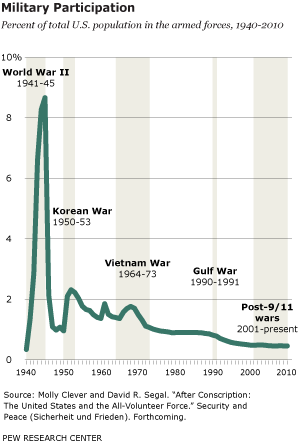
The Pew Research Center has reported extensively on the Military-Civilian Gap:

America’s post-9/11 wars mark the longest period of sustained combat in the nation’s history – and never before has America waged war with so small a share of its population carrying the fight.

Military Participation

For more about IAVA.

To donate to IAVA.

Speed Men

Don Draper on Speed
Definition of Phantasmagoria
1. An exhibition of optical effects and illusions
2. A constantly shifting complex succession of things seen or imagined
3. A bizarre or fantastic combination, collection, or assemblage

The latest episode of Mad Men, Crash, is not the first to involve a car crash or the use of drugs. But it does use both as a device and as prefiguring of what is down the road for Don Draper and company.

Previously on Mad Men, besides the limitless consumption of alcohol and tobacco, in this late 1960s era there has been the increasing use of marijuana, and a few LSD experiments. This time, though, the drug of choice is speed.

Chevy is the agency’s new and prized client. Ken takes the Chevy guys out for a booze-fueled night, and drunken speeding results in a crash that leave’s Ken’s leg injured. Chevy is placing impossible demands on the agency, and so a weekend of work is ahead for the creatives and the account people. A sort-of doctor is brought in to inject the senior staff with a sort-of “stimulant”—a combination of vitamins and speed.

Speed heaven and speed hell break out. People are racing each other down office aisles and over desks, playing William Tell by throwing sharpened pencils at each other, wanting sex, talking nonstop. Don has two distinctive reactions. On the mental side, he seems  on the brink of a breakdown. His mind flows back to his growing up in a whorehouse, where we learn the possible origins of his sex addiction and other problems. He loses track of time, something that has happened before.

On the creative side, he has a breakthrough, the kind that speed can convince you (often falsely) that you are having. Don is obsessed by an old agency campaign for soup that he is sure holds the key to Chevy. He ultimately finds the ad, though it is for oatmeal; the soup is from his memory of a prostitute who nursed him back to health and was his first sexual experience. The headline says, “She Knows What You Want”.

But when Don calls everybody in to announce his creative triumph, the speed speaks, pontificating that, no, he hasn’t solved the Chevy puzzle—he has solved the big puzzle of life itself.

Events in and out of the office keep spinning. The speed has apparently “cured” Ken’s injury, as he throws away his cane and starts tap dancing. Don has left his children alone in the apparent, and an older black lady who calls herself Don’s Grandma Ida breaks in, confronts Don’s daughter Sally, and steals some of Don’s watches. Sally doesn’t believe Ida is Don’s grandmother, but since Sally doesn’t really know anything about Don’s real background, anything is possible.

The speed crash comes on Monday, and it is different than any other of the post-drinking hangovers that Don has ever suffered through. We can’t tell exactly what has gone on in his head, or what combination of murky and clear is operating, or whether he has really figured anything out. But he does something he has never done before, because being creative—making things up—is what his adult life has been about. He relinquishes creating for the Chevy account, and says he will only serve as creative director, managing what others come up with.

At this point, as he has a few times before, Don is seeing that if he keeps moving the way he has, he will crash. But he thinks that if he stops moving, he is dead. Of course, Don Draper is dead, killed accidentally and indirectly in Korea by the young Dick Whitman. Just as Draper’s suicidal younger stepbrother Adam Whitman was killed indirectly by Don, as was Draper’s suicidal partner Lane Pryce.

If it doesn’t stop on its own, maybe the uncaring laws of life and physics will take over. Maybe there will be a much more serious crash.

Politics Usual or Unusual

Barack Obama
Most presidents, even the ones you love to hate, are idealists. At least at the start. For some, depending on the times, the makeup of Congress, and the skills of the national CEO , the presidency is where dreams go to die. Since the enemies of Obama–and he has bitter enemies in high places—have raised the ghost of Nixon, it is a good time to honestly set perspective.

The best way to measure the historic egregiousness of presidential misperformance is to count the friends who remained even as it was unfolding. There is a point at which that inchoate thing we might call the honor of the country is at stake, rather than just individual transgressions. Lying in office, either about sex or about phantom weapons, is apparently not enough to turn everybody against you. Killing the economy and then handing a near lifeless body to your successor isn’t either. Blowing up the Constitution is.

So what we have at this moment is not Nixonian by any stretch. What we have is the unpretty side of presidential pragmatism, the point at which feeling forced to play the game as it is played, rather than the way you had dreamed it could be played, is on unflattering display. Obama’s no good very bad week has led to a variety of dancing that no one should watch. There is Republican grave dancing, Obama supporter apologist dancing, and administration pretzel dancing. This last is exemplified by the Attorney General distancing himself from a possibly justifiable but absolutely controversial decision to monitor journalists to discover leaks, and at the same time pushing for a media shield law that would help make the particular investigation more difficult, less likely, or even impossible. That is, stop us before we kill again.

This all adds up to something not that spectacular, but for some a little disheartening in its plainness and obviousness. Politics is a life size business. Once in a while, some come along who stand taller, act more forthrightly, speak a little more inspiringly in ways that make us believe in the possible and in ourselves. We must have this because without vision, the people really do perish. Obama seems to be one of those. This week, though, he is stuck in a moment that is more usual, looking more usual. The unusual will be back, or at least it should, but right now, what it is is governing.