Bob Schwartz

Political Expediency and Conscience

Marcellus and Butch - Pulp Fiction

Now the night of the election, you may fell a slight sting, that’s conscience messin’ wit ya. Screw conscience! Conscience only hurts, it never helps.
Loosely adapted from Pulp Fiction

Political pragmatism is a messy business, especially when it looks like pure expediency. That goes for candidates who are not trusted or liked, and for supporters and enablers who overlook obvious shortcomings and transgressions for the sake of some higher goal. (For Democrats and Republicans who think this is only about the other, think again.)

The best movie moment about expediency comes from Pulp Fiction. Those who know this great movie may know the scene. Those who haven’t seen it should, for entertainment and for Tarantino’s willingness to take on interesting moral and ethical questions. Be advised that the movie is rough, as is the language in this scene.

Boss Marsellus Wallace (Ving Rhames) is bribing aging boxer Butch Coolidge (Bruce Willis) to take a dive:

MARSELLUS WALLACE:

I think you’re gonna find ­ when all this shit is over and done ­ I think you’re gonna find yourself one smilin’ motherfucker. Thing is Butch, right now you got ability. But painful as it may be, ability don’t last. Now that’s a hard motherfuckin’ fact of life, but it’s a fact of life your ass is gonna hafta git realistic about. This business is filled to the brim with unrealistic motherfuckers who thought their ass aged like wine. Besides, even if you went all the way, what would you be? Feather-weight champion of the world. Who gives a shit? I doubt you can even get a credit card based on that.

Now the night of the fight, you may fell a slight sting, that’s pride fuckin’ wit ya. Fuck pride! Pride only hurts, it never helps. Fight through that shit. ‘Cause a year from now, when you’re kickin’ it in the Caribbean you’re gonna say, “Marsellus Wallace was right.”

Poem: Between the Waters

Hexagram 29 - Theresa Blanding

Between the Waters

Let there be an expanse that it may separate water from water.
Genesis 1:6

It is a bottomless pit
The waters above
The waters below.
An abyss
A sea without boats.
No ground to stand.
Just falling.

If there is space between
How vast must it be
To contain hope?
Could it be so small
And still be heaven?

Poem: Garden

SoilGarden

Carry the soil
Dig the holes
Plant the seeds
Water the garden
Or just watch
And wait.
Which are you,
If you know?

Fiction: Bare Walls

White Wall

I want the walls to be bare. The way they were when I first moved in. For that, I would need a time machine. Or I could remove the framed pictures, move everything out, the desk, the bookshelves, the file cabinets. All of it could sit in other rooms and in the hallways.

The rug could stay. So could a chair, from which I could scan the room. One blinded window, two closet doors, one room door. And the white walls.

Maybe a lamp too. That depends on how natural I want it to be. Without the lamp, the walls could follow the daily cycle, lit a little or a lot, if the blinds were open or closed, if the sky was clear or cloudy. With a lamp, it wouldn’t matter. I could choose when to see the walls and when not. The same goes for the ceiling, if I got up off the chair and lay face up on the rug. Lamp or no lamp, eyes open or closed, day or night, I would know the walls were there and bare.

In the dark, it might be easier to imagine the time machine. Maybe that’s why I wanted the bare walls in the first place. To strip history bare. Not just my history, that delivered the pictures and the furniture, but all history ever. The walls would hum and thrum silently, harmonic to some time before the before, peaceful music that would only play when the walls were stripped bare.

It all seems so much work, the moving, the removing, the scanning, the imagining, eyes open and closed, blinds open and closed, the sun hiding behind clouds, coming out, going away and going to sleep. Returning tomorrow.

The walls will be here tomorrow. Ready to remain partly hidden, ready to be bared. Ready to sing.

A Zen Harvest: An Essential Zen No Zen Book for No Zen People

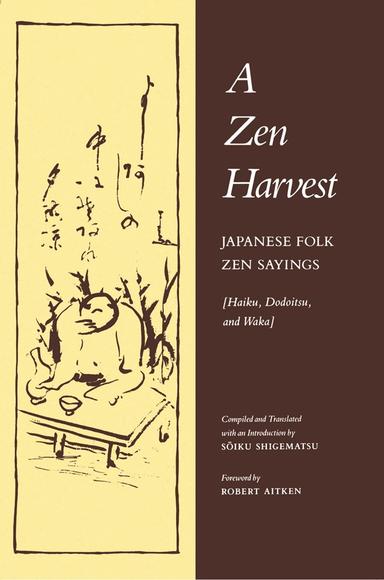
A Zen Harvest

While I often write about Zen and Buddhism in this blog, I have never suggested a “where to begin” book. There are a lot of reasons for this, but that’s for another time.

(For those who might be interested, a leading Buddhist publication did a survey of where its readers did get started, and the overwhelming first book was Shunryu Suzuki’s Zen Mind, Beginner’s Mind, pretty clearly the most popular book on Zen in English. It is also where I got started.)

A Zen Harvest: Japanese Folk Zen Sayings (1988), compiled and translated by Soiku Shigematsu, is something different and special. (His first book, A Zen Forest: Sayings of the Masters (1981), is sadly out of print, but you can find a PDF if you go fishing in the Web sea.)

Shigematsu does a lovely job of explaining the text in his excellent Introduction. I actually suggest you not read the Introduction, at least not at first. Robert Aitken Roshi (author of another popular introduction to Zen) offers an appreciative Foreword. You can initially skip that too.

Instead, just browse anywhere in this collection of nearly 800 poem-like sayings. Anywhere. Don’t think of these as Zen. Don’t even think of these as poems. Don’t care about who said it or wrote it.

I am not even going to offer a sample saying, because it would not do the collection justice. Just get it and read in it, a few seconds at a time. You may or may not learn or find out anything about yourself, your life, other people’s lives, the world, the universe, or Zen. Does that really matter?

Meeting of the Great Ones to Consider a Request

The great ones met to consider a request. God, Moses, Jesus, Mohammed, the Buddha. These were the ones who had been in his thoughts, prayers and wishes, to some degree, in recent days.

The agenda seemed simple enough, but was, as with most similar matters, far from it. A request like this had so many layers and dimensions.

There was the question of what could actually be done in answer to the request. Intervention may not be possible, and even then, the type may be limited.

Then there is availability and suitability. Maybe the circumstances indicate something should be done, maybe not. There is the size and nature of the request, the context of the request, and maybe above all, the form of the request and the faith and character of the asker.

He was unclear about all of this. He had more than one idea on form, some ideas about his faith, and a world and lifetime of questions about his character, especially as a worthy supplicant.

Intervention and decisions, his and theirs. Those already made, those from now on. Change and chance. There would be time, some time, to assess probabilities, to act and be acted upon, or for happenings to happen.

He did not address the meeting, and was not invited to. He sent formless thoughts, deep enough from heart and mind, he hoped, to make the request clear. He did not send a message, maybe except this one.

He did have one understanding that transcended the meeting, the circumstances, the request. It might be too vague, but in the moment the thought seemed as complete as any. The offer was love, the request was for love. If it went out sadly imperfectly, and came back seemingly incomplete, it had to be done. It was all that could be done. And was more than enough, and all.

Vesak: Buddha Day

Sakyamuni Buddha

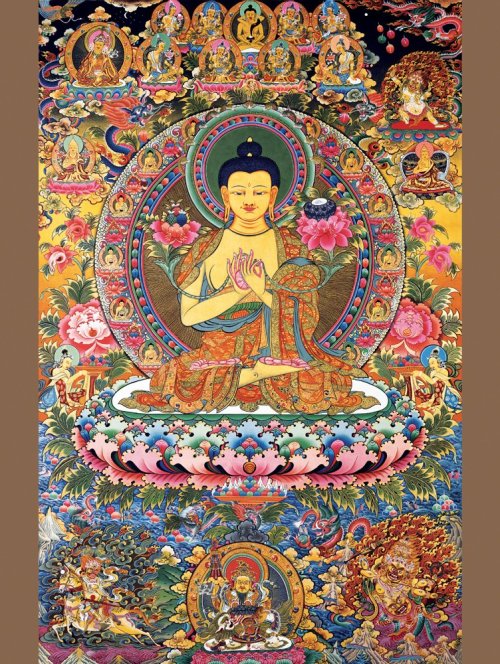
Today is Vesak, the holiday also known as Buddha Day.

Around the world, especially in Buddhist Asia, Vesak combines a celebration of the Buddha’s birth, enlightenment and passing. This year the holiday was noted by the UN, by President Obama, by Canadian Prime Minister Trudeau, and by many others. This is part of the growing recognition that the world might benefit from even a little bit of Buddhism added to our complex, crazy and chaotic affairs.

Here is the Mangala Sutta (The Sutra on Happiness), a wise and uplifting discourse of the Buddha that is one of the best-loved and most frequently recited texts in the Southeast Asian Buddhist world.  Only twelve verses long, it is a recital of auspicious things, and along with texts such as the Metta Sutta, is believed to bring happiness and good fortune when chanted or heard.

The Sutra on Happiness

I heard these words of the Buddha one time when the Lord was living in the vicinity of Savatthi at the Anathapindika Monastery in the Jeta Grove. Late at night, a deva appeared whose light and beauty made the whole Jeta Grove shine radiantly. After paying respects to the Buddha, the deva asked him a question in the form of a verse:

“Many gods and men are eager to know
what are the greatest blessings
which bring about a peaceful and happy life.
Please, Tathagata, will you teach us?”

(This is the Buddha’s answer):

“Not to be associated with the foolish ones,
To live in the company of wise people,
Honoring those who are worth honoring—
This is the greatest happiness.

“To live in a good environment,
To have planted good seeds
And to realize that you are on the right path—
This is the greatest happiness.

“To have a chance to learn and grow,
To be skillful in your profession or craft,
Practicing the precepts and loving speech—
This is the greatest happiness.

“To be able to serve and support your parents,
To cherish your own family,
To have a vocation that brings you joy—
This is the greatest happiness.

“To live honestly, generous in giving,
To offer support to relatives and friends,
Living a life of blameless conduct—
This is the greatest happiness.

“To avoid unwholesome actions,
Not caught by alcoholism or drugs,
And to be diligent in doing good things—
This is the greatest happiness.

“To be humble and polite in manner,
To be grateful and content with a simple life,
Not missing the occasion to learn the Dharma—
This is the greatest happiness.

“To persevere and be open to change,
To have regular contact with monks and nuns,
And to fully participate in Dharma discussions—
This is the greatest happiness.

“To live diligently and attentively,
To perceive the Noble Truths,
And to realize nirvana—
This is the greatest happiness.

“To live in the world
With your heart undisturbed by the world,
With all sorrows ended, dwelling in peace—
This is the greatest happiness.

“For the one who accomplishes this
Is unvanquished wherever she goes;
Always he is safe and happy—
Happiness lives within oneself.”

Translated by Thich Nhat Hahn

Be Stupid!

Bankei

You may think of yourself as clever. Or half-clever. Other people may think so too.

Be stupid!

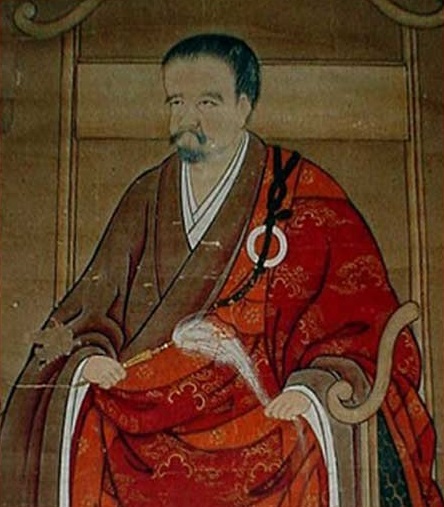
That’s the advice from Bankei (1622-1693), a Zen master I’ve written about before.

Thousands of people came from all over Japan to hear Bankei speak. Ordinary people who came to hear really extraordinary messages from a very wise man. Such as: Be stupid!

“I tell my students and those of you coming regularly here to the temple: ‘Be stupid!’ Because you’ve got the dynamic function of the marvelously illuminating Buddha Mind, even if you get rid of discriminative understanding, you won’t be foolish. So, all of you, from here on, be stupid! Even if you’re stupid, when you’re hungry, you’ll ask for something to eat, when you’re thirsty, you’ll ask for some tea; when it gets warm, you’ll put on thin, light clothes, and when it’s cold, you’ll put on more clothes. As far as your activities of today are concerned, you’re not lacking a thing!

“With people who are clever, there are sure to be a great many shortcomings. To have transcended those clever people whom all the world holds in great esteem is what’s meant by ‘stupidity.’ There’s really nothing wrong with being a blockhead!

“When people say that someone is a clever fellow, I ask to meet him, and when I do and we have a chance to talk, it looks to me as if people in the world are praising an awful lot of foolishness. The fact is that those clever people acclaimed by the world are, from the start, deluded by their own cleverness. . .The true man’s ideal is to show kindness to those who are foolish and help those who are evil. To be recognized as a good man by the people of the world is precisely what makes being born a human being worthwhile. How can it be any good to earn yourself the reputation of a wicked person?

“So when you go back to your homes and meet your old acquaintances, you should have them wondering about you all: ‘How did Bankei teach them Buddhism, anyway? Why, they’ve come back even more stupid than before they left!’

“What I’m talking about isn’t the stupidity of stupidity and understanding. That which transcends stupidity and understanding is what I mean by stupidity!

From Bankei Zen: Translations from the Record of Bankei, Peter Haskel

Also:

Unborn: The Life and Teachings of Zen Master Bankei, Norman Waddell

Bruce Wayne Is Batman, Donald Trump Is John Miller/John Barron

Bruce Wayne - Batman

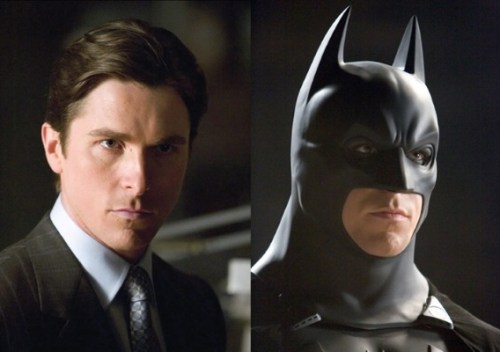
Millionaire Bruce Wayne never wanted it to be known that he was the crime fighter Batman because he didn’t want those close to him to be in danger.

Millionaire Donald Trump never wanted it to be known that he was publicist/executive John Miller/John Barron because…

This analysis leads to one conclusion. That Donald Trump actually wanted to be, or at least considered being, Batman. But Trump is no fool. He realized that calling up journalists and saying he was Batman, or John Batman, might not sound authentic—even if he knew intimate details of Trump’s life and loves. Which is how he ended up telling them he was John Miller or John Barron. So prosaic, so low energy, so small-handed.

But life is long. We may yet hear tapes of “John Batman” calling up reporters with the latest scoop on what Donald Trump is up to. Let’s pray for the day.

Music: Normal Person

Arcade Fire

Arcade Fire

Oh man
Do you like Rock and Roll music?
‘Cause I don’t know if I do

Arcade Fire is a great band. Wildly creative, musically and lyrically. Their fourth and latest album Reflektor (2013) was not quite as over-the-top praised as earlier ones, but it still got lots of deserved commendation and “best of” rankings. If you’ve never heard the band, take a chance and listen to them all.

Of all the songs I love on Reflektor, especially the title track, Normal Person always gets to me. First, because you can dance to it, even though it starts with the ironic epigraph above. Second, because the lyrics are awesome. Here they are, one diamond line after another. “If that’s what’s normal now/I don’t want to know.”

Is anything as strange as a normal person?
Is anyone as cruel as a normal person?
Waiting after school for you
They want to know if you
If you’re normal too
Well, are you?
Are you?

I’m so confused. Am I a normal person?
You know, I can’t tell if I’m a normal person
It’s true, I think I’m cool enough, but am I cruel enough?
Am I cruel enough for you?

And they will break you down
Till everything is normal now
I know
And they will break you down
Till everything is normal now
I know

They take their tea at two
All the normal people, they do
They burn the jungle down
While they were sleeping, it grew
You dream in English now
In proper English, look how
You’re just the same as me
It’s through

And they will break you down
Till everything is normal now
I know
And they will break you down
Till everyone is normal now
I know

If that’s what’s normal now
I don’t want to know
If that’s what’s normal now
Mama don’t make me go

When they get excited, they try to hide it
Look at those normals go
When they get excited, they try to hide it
Look at those normals go
When they get excited, they try to hide it
Look at those normals go
When they get excited, they try to hide it… No!

Maybe if you hang together
You can make the changes in our hearts
And if you hang together
You can change us, just where should you start?

I’ve never really ever met a normal person
I’ve never really ever met a normal person… like you!
How do you do?
How do you do?