Bob Schwartz

Umberto Eco: Ur-Fascism

Celebrated Italian author and scholar Umberto Eco (1932-2016)  published an article in 1995 entitled Ur-Fascism .

Eco grew up during the time of Mussolini. In the article, he jumps from memories of that experience to describe some varieties of fascism and other types of totalitarianism. Not all are well-defined fascism, he says, but he does identify the core characteristics of what he calls Ur-Fascism.

I think it is possible to outline a list of features that are typical of what I would like to call Ur-Fascism, or Eternal Fascism. These features cannot be organized into a system; many of them contradict each other, and are also typical of other kinds of despotism or fanaticism. But it is enough that one of them be present to allow fascism to coagulate around it.

Eco goes on to list 14 features of Ur-Fascism. This is the excerpted list; please read the article for an expanded explanation. And as you read it, please consider which of those features you might be seeing now.

1. The first feature of Ur-Fascism is the cult of tradition….As a consequence, there can be no advancement of learning.

2. Traditionalism implies the rejection of modernism….In this sense Ur-Fascism can be defined as irrationalism.

3. Irrationalism also depends on the cult of action for action’s sake. Action being beautiful in itself, it must be taken before, or without, any previous reflection.

4. No syncretistic faith can withstand analytical criticism. The critical spirit makes distinctions, and to distinguish is a sign of modernism.

5. Besides, disagreement is a sign of diversity. Ur-Fascism grows up and seeks for consensus by exploiting and exacerbating the natural fear of difference.

6. Ur-Fascism derives from individual or social frustration. That is why one of the most typical features of the historical fascism was the appeal to a frustrated middle class, a class suffering from an economic crisis or feelings of political humiliation, and frightened by the pressure of lower social groups.

7. To people who feel deprived of a clear social identity, Ur-Fascism says that their only privilege is the most common one, to be born in the same country. This is the origin of nationalism.

8. The followers must feel humiliated by the ostentatious wealth and force of their enemies….Thus, by a continuous shifting of rhetorical focus, the enemies are at the same time too strong and too weak.

9. For Ur-Fascism there is no struggle for life but, rather, life is lived for struggle.

10. Elitism is a typical aspect of any reactionary ideology, insofar as it is fundamentally aristocratic, and aristocratic and militaristic elitism cruelly implies contempt for the weak. Ur-Fascism can only advocate a popular elitism.

11. In such a perspective everybody is educated to become a hero. In every mythology the hero is an exceptional being, but in Ur-Fascist ideology, heroism is the norm.

12. Since both permanent war and heroism are difficult games to play, the Ur-Fascist transfers his will to power to sexual matters. This is the origin of machismo (which implies both disdain for women and intolerance and condemnation of nonstandard sexual habits, from chastity to homosexuality). Since even sex is a difficult game to play, the Ur-Fascist hero tends to play with weapons—doing so becomes an ersatz phallic exercise.

13. Ur-Fascism is based upon a selective populism, a qualitative populism, one might say. In a democracy, the citizens have individual rights, but the citizens in their entirety have a political impact only from a quantitative point of view—one follows the decisions of the majority. For Ur-Fascism, however, individuals as individuals have no rights, and the People is conceived as a quality, a monolithic entity expressing the Common Will. Since no large quantity of human beings can have a common will, the Leader pretends to be their interpreter….Because of its qualitative populism Ur-Fascism must be against “rotten” parliamentary governments.

14. Ur-Fascism speaks Newspeak.

Eco closes with this:

Ur-Fascism is still around us, sometimes in plainclothes. It would be so much easier, for us, if there appeared on the world scene somebody saying, “I want to reopen Auschwitz, I want the Black Shirts to parade again in the Italian squares.” Life is not that simple. Ur-Fascism can come back under the most innocent of disguises. Our duty is to uncover it and to point our finger at any of its new instances—every day, in every part of the world.

The Last Gift

Consider the gift you give to the one you love as the last one you will give.

What does it say?

“Even such a brief précis of the work that has been done on gift exchange should make it clear that we still lack a comprehensive theory of gifts….I touch on many issues, but I pass over many others in silence. With two or three brief exceptions I do not, for example, take up the negative side of gift exchange—gifts that leave an oppressive sense of obligation, gifts that manipulate or humiliate, gifts that establish and maintain hierarchies, and so forth and so on….I am not concerned with gifts given in spite or fear, nor those gifts we accept out of servility or obligation; my concern is the gift we long for, the gift that, when it comes, speaks commandingly to the soul and irresistibly moves us.”
Lewis Hyde, The Gift: Creativity and the Artist in the Modern World

Light On

Gyokusei Jikihara, Ten Ox-Herding Pictures, 4. Catching the Bull

Light On

As I lay waking in bed
Listening to the Zen poem
Verses on the Faith Mind by Sengcan
The reader said
“The illustrator Gyokusei Jikihara, sensei,
is a Japanese master of calligraphy and nanga painting.
Still painting and teaching at the age of ninety-nine,
he will celebrate his one-hundredth birthday on August 1, 2004.”
Then the ceiling light came on spontaneously
Like a sun rising
With no one at the switch.
Sengcan died in 606.
Jikihara died in 2005.
If I live to be one hundred
I will remember this.
Sengcan says
“Don’t waste your time in arguments and discussion
attempting to grasp the ungraspable.”
I don’t think
I will

©

Christmas Quiz: What’s Different About This Picture?

If you look closely at the painting above, you may notice something unusual about the adoring Magi.

The painting, Adoration of the Magi, is attributed to Vasco Fernandes (ca. 1480–ca. 1543). I’ve shown it to a number of people this Christmas, who all remarked that it is beautiful, but did not comment on anything else.

Can you see what it is unusual about it? If you know or think you do, don’t look first at the answer below.


Revelation of the Magi: The Lost Tale of the Wise Men’s Journey to Bethlehem (2010) by Brent Landau is the first-ever complete English translation of what purports to be a first-person account by the Magi themselves. Written sometime before the fifth century, it is not actually a chronicle by the Magi, but it is a spiritually fascinating addition to the usual Christmas story.

Landau writes:

The Revelation of the Magi, mostly narrated by the Magi in the first person, is a sweeping and imaginative work that begins in the Garden of Eden and ends with the Magi being baptized at the hands of the Apostle Thomas. These Magi are members of an ancient mystical order and reside in a semimythical land called Shir, located in the extreme east of the world, at the shore of the Great Ocean. The Revelation of the Magi says these individuals are called “Magi” in the language of their country because they pray in silence. The story implies that the name “Magi” is thus a play on the words silence and/or prayer, but that implication does not make sense in any of the most common languages spoken by early Christians. Despite this unsolved mystery, however, this description sharply distinguishes the Magi of this story from any of the most common ancient usages of the term magoi: these Magi are not magicians, astrologers, or even priests of the Iranian religion of Zoroastrianism.

These mystics, who live in a mysterious, far-off land, as the Revelation of the Magi depicts its Magi, are the descendants of Seth, the third son of Adam and Eve. Seth was believed by many early Jews and Christians to be extremely pious and virtuous, so it is very fitting for the Revelation of the Magi to trace the ancestry of the Magi back to such an illustrious founder. The Magi inherited from Seth a prophecy of supreme importance for the world: a star of indescribable brightness will someday appear, heralding the birth of God in human form. Seth himself had learned about this prophecy from his father, Adam, since the star originally had hovered over the Tree of Life, illumining all of Eden, before Adam’s sin caused the star to vanish.

Every month of every year, for thousands of years, the order of the Magi has carried out its ancient rituals in expectation of this star’s arrival. They ascend their country’s most sacred mountain, the Mountain of Victories, and pray in silence at the mouth of the Cave of Treasures of Hidden Mysteries, where Seth’s own prophetic books are housed and read by the Magi. Whenever one of the Magi dies, his son or one of his close relatives takes his place, and their order continues through the ages.

All of this lore about the origins of the Magi and their prophecy has been narrated, we are told, by the generation of the Magi that was alive to witness the coming of the star. They have gathered together to ascend the Mountain of Victories, as was their ancient custom, but suddenly the foretold star appears in the heavens. As promised, the star is indescribably bright, so bright that the sun becomes as faint as the daytime moon; yet because the Magi alone are worthy of guarding this prophecy, the star can be seen by no one but them. The star descends to the peak of the mountain and enters the Cave of Treasures, bidding the Magi to come inside. The Magi enter the cave and bow before the star, whose incredible light gradually dissipates to reveal a small, luminous human! This “star-child” reveals to the Magi that he is the Son of God, but—and this is of crucial importance—never calls himself by the familiar names Jesus or Christ. Nor do the Magi themselves ever call him by these names, and the absence of these designations will provide us with a critical clue about the central message of the Revelation of the Magi.

The star-child instructs the Magi to follow it to Jerusalem so that they may witness its birth and participate in the salvation God has planned for the entire world….

The Revelation of the Magi even influenced the way explorers of the New World understood the indigenous cultures they encountered. Two examples will suffice. First, there is the seventeenth-century Augustinian monk Antonio de la Calancha, who studied the Incan culture of Peru. He was impressed by the similarities between Andean traditional religion and Christianity, and he believed that the Apostle Thomas and the Magi must have missionized the region together, just as the Opus Imperfectum indicated. Second, the Franciscan missionary and historian Juan de Torquemada described the belief among some of the Aztecs that the conquistador Cortés was the god Quetzalcoatl with recourse to this legend. Just as the Magi had stood atop the Mountain of Victories awaiting the fulfillment of their prophecy, Torquemada notes, so, too, did the Aztecs anxiously await the foretold return of Quetzalcoatl, and were all too willing to accept Cortés as the returned Quetzalcoatl when Spanish ships appeared off the Mexican coast.

And that is the story of how, in this painting, one of the Magi appears as a Native American.

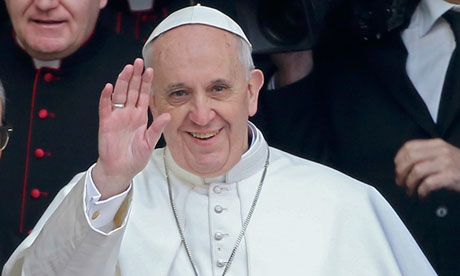
Pope Francis: Change the Rules of the Socio-Economic System

“We must work toward changing the rules of the game of the socio-economic system. Imitating the Good Samaritan of the Gospel is not enough. An entrepreneur who is only a Good Samaritan does half of his duty: he takes care of today’s victims, but does not curtail those of tomorrow. It is simple to give a part of the profits, without embracing and touching the people who receive those ‘crumbs’. This can never be said enough — capitalism continues to produce discarded people whom it would then like to care for. ”
Pope Francis

The news in America this Christmas is dominated by talk about taxes and the economy. So it is appropriate that my Christmas message come from a speech about economics given by Pope Francis on 1 April 2017.


Greed, which by no coincidence is a capital sin, is the sin of idolatry because the accumulation of money per se becomes the aim of one’s own actions.

When capitalism makes the seeking of profit its only purpose, it runs the risk of becoming an idolatrous framework, a form of worship. The ‘goddess of fortune’ is increasingly the new divinity of a certain finance and of the whole system of gambling which is destroying millions of the world’s families, and which you rightly oppose. This idolatrous worship is a surrogate for eternal life. Individual products (cars, telephones …) get old and wear out, but if I have money or credit I can immediately buy others, deluding myself of conquering death….

Today, many initiatives, public and private, are being carried out to combat poverty. All this, on the one hand, is a growth in humanity. In the Bible, the poor, orphans, widows, those ‘discarded’ by the society of those times, were aided by tithing and the gleaning of grain. But most of the people remained poor; that aid was not sufficient to feed and care for everyone. There were many ‘discarded’ by society. Today we have invented other ways to care for, to feed, to teach the poor, and some of the seeds of the Bible have blossomed into more effective institutions than those of the past. The rationale for taxes also lies in this solidarity, which is negated by tax avoidance and evasion which, before being illegal acts, are acts which deny the basic law of life: mutual care.

But — and this can never be said enough — capitalism continues to produce discarded people whom it would then like to care for. The principal ethical dilemma of this capitalism is the creation of discarded people, then trying to hide them or make sure they are no longer seen. A serious form of poverty in a civilization is when it is no longer able to see its poor, who are first discarded and then hidden.

Aircraft pollute the atmosphere, but, with a small part of the cost of the ticket, they will plant trees to compensate for part of the damage created. Gambling companies finance campaigns to care for the pathological gamblers that they create. And the day that the weapons industry finances hospitals to care for the children mutilated by their bombs, the system will have reached its pinnacle.

The economy of communion, if it wants to be faithful to its charism, must not only care for the victims, but build a system where there are ever fewer victims, where, possibly, there may no longer be any. As long as the economy still produces one victim and there is still a single discarded person, communion has not yet been realized; the celebration of universal fraternity is not full.

Therefore, we must work toward changing the rules of the game of the socio-economic system. Imitating the Good Samaritan of the Gospel is not enough. Of course, when an entrepreneur or any person happens upon a victim, he or she is called to take care of the victim and, perhaps like the Good Samaritan, also to enlist the fraternal action of the market (the innkeeper)….An entrepreneur who is only a Good Samaritan does half of his duty: he takes care of today’s victims, but does not curtail those of tomorrow….

Capitalism knows philanthropy, not communion. It is simple to give a part of the profits, without embracing and touching the people who receive those ‘crumbs’. Instead, even just five loaves and two fishes can feed the multitude if they are the sharing of all our life. In the logic of the Gospel, if one does not give all of himself, he never gives enough of himself.


Today’s Torah: Slavery Might Be Right Around the Corner

A section of this week’s Torah portion (Vayigash, Genesis 44:18-47:27) is described even by sympathetic commentators as “unusual”, “troubling”, and “brutal”, though one commentator admits it is “ironic or poetic justice.”

Joseph is the sharp CEO of Egypt. (Sharp dealing runs in the family; recall that his father Jacob cheated his uncle Esau out of the family birthright.) He has now brought not only his family but all the Jews down to Egypt.

The new arrivals enjoy a relatively good life, while the native Egyptians are suffering through a disastrous famine, the famine foretold by Joseph himself. To solve the dire situation, Joseph has the desperate Egyptians turn over all money and land to Egypt and the Pharaoh, and then gives them seed and assigns them land to farm so they don’t starve. The Egyptians, we are told, were grateful. This is most kindly characterized as serfdom, but is most commonly described as slavery. The poetic justice is that the Jews themselves were later trapped in the slavery plan that Joseph devised.

Are there any interesting lessons here?

If you are a regular reader of the Torah, you recognize that some of the most iconic figures are not depicted as paragons. Incidents of cheating and lying are found among the patriarchs. Then there’s Joseph’s enslavement of the Egyptians. Some commentators face this head on, while others are apologists, contextualizing the miscreant behavior as all part of a bigger, better plan. But cheating, lying and cruelty are still just that, no matter the actor.

Another lesson? In hard times for the common people, it’s good to be the Pharaoh, or the Pharaoh’s right hand man, or the family and friends of the Pharaoh or the Pharaoh’s right hand man. Otherwise, slavery might be right around the corner.

Christmas for Refugees

How could you say to me,
“Off to the hills like a bird!
For, look, the wicked bend back the bow,
they fix to the string their arrow
to shoot from the gloom at the upright.
The foundations destroyed,
what can a righteous man do?”
Psalms 11:1-2 (Robert Alter translation)

Now after they had left, an angel of the Lord appeared to Joseph in a dream and said, “Get up, take the child and his mother, and flee to Egypt, and remain there until I tell you; for Herod is about to search for the child, to destroy him.” Then Joseph got up, took the child and his mother by night, and went to Egypt,
Matthew 1:13-14 (NRSV)

The wicked bend back the bow. The innocent flee. Give this Christmas to the UNHCR.

Wings

Wings

The weight of the world
And my self
Stoop my shoulders
The wings
Pull them back

©

A Sense of Wonder: The Greatest Research Question Ever

“Never once in my life did I ask God for success or wisdom or power or fame. I asked for wonder, and he gave it to me.”
― Abraham Joshua Heschel

As part of its epic Religious Landscape Study, the Pew Research Center asked Americans what may be the greatest research question ever: How frequently do you feel a sense of wonder about the universe?

Possible responses were: At least once a week; Once or twice a month; Several times a year; Seldom/never; Don’t know. The results were analyzed and reported according to a variety of factors, including by religious group, generation, gender, race, ethnicity, immigrant status, income, education, marital status, belief in God, frequency of prayer, frequency of meditation, belief in heaven and hell, party affiliation, and many more. The results were also reported by state.

Within religious traditions, the highest percentage of those who feel a weekly sense of wonder about the universe are Jehovah’s Witness (62%), Muslim (56%) and Buddhist (55%). The highest percentage for seldom or never are Historically Black Protestant (29%), Catholic (27%) and Mainline Protestant (25%).

Among the states, the people of Nevada (54%) and Arizona (53%) lead the nation in weekly wonder, with Oregon (51%) and New Mexico (50%) not far behind. Delaware has the distinction of having the lowest percentage of people who feel a sense of wonder once a week (37%). The state with the highest percentage of people who seldom or never feel a sense of wonder is Alabama (34%).

This is just one of the many questions that Pew and other researchers ask about religious beliefs, attitudes and practices. What makes this one question so special?

It gets to the heart of what makes religion and spirituality so essential. Whatever your beliefs, whatever your status, and whatever your experience, this is what you should have learned by now—or eventually will: We are part of the universe, not masters of it, even if our ego, power and learning lead us to believe otherwise. Wonder is the acknowledgment and realization of that.

How frequently do you feel a sense of wonder about the universe?


Saints and Sinners: Balancing Faith, Policies and Character

Saints are in short supply—in your family, in your community, at work, in politics, in your mirror. So if the search for them is likely to come up empty, what’s the point of looking?

In the intersecting realm of faith, policies and character, it is balance we seek, not absolutes or perfection. You stand certain on a line, maybe informed by your god and your traditions, and believe that everything else stands closer or farther on that line, in one direction or another. You can measure the distance and decide when someone has gone too far.

In the case of faith, policies and character, there are at least three dimensions. Trying to evaluate people in that space is hard and uncertain. Some think this gets us creeping toward relativism, where suddenly everyone and everything is acceptable. But it is no such thing. It just means that we are asked to look at everyone and every circumstance on its own, for itself, eyes wide open, in our own well-considered light. That is a lot of work, and so we want a shortcut. We may think we are able to take shortcuts, but there are no shortcuts, only understandably lazy paths.

Saints are in short supply because even saints are not saints. That is the point. Go easy on yourself and others, or go hard. Do the work, if you have the time and inclination, and don’t depend simply on a bible verse, a rule or an ideology. You are gifted, so use those gifts wisely.