Bob Schwartz

Bobby Kennedy on the Assassination of Martin Luther King Jr.

Lorraine Motel, Memphis, April 4, 1968. The Lorraine is now the site of the National Civil Rights Museum.

And let’s dedicate ourselves to what the Greeks wrote so many years ago: to tame the savageness of man and make gentle the life of this world. Let us dedicate ourselves to that, and say a prayer for our country and for our people.
Robert F. Kennedy, April 4, 1968

On April 4, 1968, Bobby Kennedy was campaigning in Indiana for the Democratic presidential nomination. Heading to a rally in Indianapolis, he learned that Martin Luther King Jr. had been assassinated in Memphis. Kennedy attended the rally, but instead of a campaign speech, announced the tragic news to the crowd. Many had not yet heard about it. Kennedy’s speech is now considered one of the greatest in American history.

Two months later, on June 5, Bobby Kennedy was assassinated in Los Angeles.


Robert F. Kennedy
April 4, 1968
Indianapolis, Indiana

Ladies and Gentlemen,

I’m only going to talk to you just for a minute or so this evening, because I have some — some very sad news for all of you — Could you lower those signs, please? — I have some very sad news for all of you, and, I think, sad news for all of our fellow citizens, and people who love peace all over the world; and that is that Martin Luther King was shot and was killed tonight in Memphis, Tennessee.

Martin Luther King dedicated his life to love and to justice between fellow human beings. He died in the cause of that effort. In this difficult day, in this difficult time for the United States, it’s perhaps well to ask what kind of a nation we are and what direction we want to move in. For those of you who are black — considering the evidence evidently is that there were white people who were responsible — you can be filled with bitterness, and with hatred, and a desire for revenge.

We can move in that direction as a country, in greater polarization — black people amongst blacks, and white amongst whites, filled with hatred toward one another. Or we can make an effort, as Martin Luther King did, to understand, and to comprehend, and replace that violence, that stain of bloodshed that has spread across our land, with an effort to understand, compassion, and love.

For those of you who are black and are tempted to fill with — be filled with hatred and mistrust of the injustice of such an act, against all white people, I would only say that I can also feel in my own heart the same kind of feeling. I had a member of my family killed, but he was killed by a white man.

But we have to make an effort in the United States. We have to make an effort to understand, to get beyond, or go beyond these rather difficult times.

My favorite poem, my — my favorite poet was Aeschylus. And he once wrote:

Even in our sleep, pain which cannot forget
falls drop by drop upon the heart,
until, in our own despair,
against our will,
comes wisdom
through the awful grace of God.

What we need in the United States is not division; what we need in the United States is not hatred; what we need in the United States is not violence and lawlessness, but is love, and wisdom, and compassion toward one another; and a feeling of justice toward those who still suffer within our country, whether they be white or whether they be black.

So I ask you tonight to return home, to say a prayer for the family of Martin Luther King — yeah, it’s true — but more importantly to say a prayer for our own country, which all of us love — a prayer for understanding and that compassion of which I spoke.

We can do well in this country. We will have difficult times. We’ve had difficult times in the past, but we — and we will have difficult times in the future. It is not the end of violence; it is not the end of lawlessness; and it’s not the end of disorder.

But the vast majority of white people and the vast majority of black people in this country want to live together, want to improve the quality of our life, and want justice for all human beings that abide in our land.

And let’s dedicate ourselves to what the Greeks wrote so many years ago: to tame the savageness of man and make gentle the life of this world. Let us dedicate ourselves to that, and say a prayer for our country and for our people.

Thank you very much.
Trump’s Easter Tweet: Do Not Thrust Aside the Alien

It is April 1. Trump’s Easter tweet today is inspired by the Bible:

As it says in the Book of Malachi: “I will draw near to you for judgment; I will be swift to bear witness against those who thrust aside the alien, and do not fear me, says the Lord of hosts.”

No, no, not really. Trump did attend church on Easter, but his actual tweets were different than the one above:

Border Patrol Agents are not allowed to properly do their job at the Border because of ridiculous liberal (Democrat) laws like Catch & Release. Getting more dangerous. “Caravans” coming. Republicans must go to Nuclear Option to pass tough laws NOW. NO MORE DACA DEAL!
— Donald J. Trump (@realDonaldTrump) April 1, 2018

Mexico is doing very little, if not NOTHING, at stopping people from flowing into Mexico through their Southern Border, and then into the U.S. They laugh at our dumb immigration laws. They must stop the big drug and people flows, or I will stop their cash cow, NAFTA. NEED WALL!
— Donald J. Trump (@realDonaldTrump) April 1, 2018

These big flows of people are all trying to take advantage of DACA. They want in on the act!
— Donald J. Trump (@realDonaldTrump) April 1, 2018

The Gospel of Thomas

The Gospel of Thomas—sometimes referred to as the Fifth Gospel—is one of a number of ancient texts about the life and words of Jesus that did not become part of the New Testament canon. Many of these, including Thomas, can be found in Marvin Meyer’s volume The Gnostic Gospels of Jesus: The Definitive Collection of Mystical Gospels and Secret Books about Jesus of Nazareth. Meyer, a brilliant scholar and translator who was an eminent expert on these gospels, explains:

The Gospel according to Thomas is an ancient collection of sayings of Jesus said to have been recorded by Judas Thomas the Twin. Unlike other early Christian gospels, which typically consist of narrative accounts interpreting the life of Jesus of Nazareth and culminating in descriptions of his death, the Gospel of Thomas focuses specifically upon sayings of Jesus. The document claims that these sayings themselves, when properly understood, communicate salvation and life: “Whoever discovers the interpretation of these sayings will not taste death” (saying 1).

The Coptic text of the Gospel of Thomas came to light with the discovery of the Nag Hammadi library, within which the Gospel of Thomas is to be found as the second tractate, or document, of Codex II. According to Muhammad Ali of the al-Samman clan, who has told his story to James M. Robinson, this remarkable manuscript discovery took place around December 1945….

As a gospel of wisdom, the Gospel of Thomas proclaims a distinctive message. In contrast to the way in which he is portrayed in other gospels, particularly New Testament gospels, Jesus in the Gospel of Thomas performs no physical miracles, reveals no fulfillment of prophecy, announces no apocalyptic kingdom about to disrupt the world order, and dies for no one’s sins. Instead, Thomas’s Jesus dispenses insight from the bubbling spring of wisdom (saying 13), discounts the value of prophecy and its fulfillment (saying 52), critiques end-of-the-world, apocalyptic announcements (sayings 51, 113), and offers a way of salvation through an encounter with the sayings of “the living Jesus.”

The readers of the Gospel of Thomas are invited to join the quest for meaning in life by interpreting the oftentimes cryptic and enigmatic “hidden sayings” of Jesus. They are encouraged to read or hear the sayings, interact with them, and discover for themselves the interpretation and meaning. Saying 2 describes the vicissitudes of such a quest for insight: “Jesus said, ‘Let one who seeks not stop seeking until one finds. When one finds, one will be troubled. When one is troubled, one will marvel and will reign over all’”. That is to say, the quest for meaning is to be undertaken with commitment; and while the way taken may be upsetting, people will attain insight and rest if only they persevere. For it is in the quest and through the quest that people find themselves and God. Then, according to the Gospel of Thomas, they discover that God’s kingdom is not only outside them but also inside them, that they are “children of the living father” (saying 3), and that they are essentially one with the savior. Saying 108 makes this point by using mystical language: “Jesus said, ‘Whoever drinks from my mouth will become like me; I myself shall become that person, and the hidden things will be revealed to that person.’”

Following are a few of the sayings; spiritual explorers are urged to find and read them all. Some sayings will seem familiar, sounding much like famous sayings found in the canonical gospels. Others will be new, obscure and mysterious—as they are meant to be.


The Gospel of Thomas

(2)
Yeshua said,
Seek and do not stop seeking until you find.
When you find, you will be troubled.
When you are troubled,
you will marvel and rule over all.

(5)
Yeshua said,
Know what is in front of your face
and what is hidden from you will be disclosed.
There is nothing hidden that will not be revealed.

(7)
Yeshua said,
Blessings on the lion if a human eats it,
making the lion human.
Foul is the human if a lion eats it,
making the lion human.
[Meyer’s note: This obscure saying seems to appeal to the lion as a symbol of all that is passionate and bestial: the passions may either be consumed by a person or consume a person.]

(18)
The students said to Yeshua,
Tell us how our end will be.

Yeshua said,
Have you discovered the beginning and now are seeking the end?
Where the beginning is, the end will be.
Blessings on you who stand at the beginning.
You will know the end and not taste death.

(26)
Yeshua said,
You see the speck in your brother’s eye
but not the beam in your own eye.
When you take the beam out of your own eye,
then you will see clearly to take the speck out of your brother’s eye.

(31)
Yeshua said,
A prophet is not accepted in the hometown.
A doctor does not heal those who know the doctor.

(34)
Yeshua said,
If a blind person leads a blind person,
both will fall in a hole.

(42)
Yeshua said,
Be passersby.
[Meyer’s note: Or, “Be wanderers,” or, much less likely, “Come into being as you pass away” (Coptic shope etetenerparage). A parallel to this saying appears in an inscription from a mosque at Fatehpur Sikri, India: “Jesus said, ‘This world is a bridge. Pass over it, but do not build your dwelling there.’”]

(51)
His students said to him,
When will the dead rest?
When will the new world come?
He said to them,
What you look for has come
but you do not know it.

(52)
His students said to him,
Twenty-four prophets have spoken in Israel
and they all spoke of you.

He said to them,
You have disregarded the living one among you
and have spoken of the dead.

(54)
Yeshua said,
Blessings on you the poor,
for yours is the kingdom of heaven.

(70)
Yeshua said,
If you bring forth what is within you, what you have will save you.
If you have nothing within you,
what you do not have within you will kill you.

(113)
His students said to him,
When will the kingdom come?

Yeshua said,
It will not come because you are watching for it.
No one will announce, “Look, here it is,”
or “Look, there it is.”
The father’s kingdom is spread out upon the earth
and people do not see it.
 

Music for the Holidays: Redemption Song by Bob Marley

Emancipate yourselves from mental slavery
None but ourselves can free our minds
Bob Marley, Redemption Song

Passover. Easter. The 50th anniversary of the assassination of Martin Luther King Jr.

Bob Marley. Redemption Song.

Old pirates, yes, they rob I
Sold I to the merchant ships
Minutes after they took I
From the bottomless pit
But my hand was made strong
By the hand of the Almighty
We forward in this generation
Triumphantly

Emancipate yourselves from mental slavery
None but ourselves can free our minds
Have no fear for atomic energy
Cause none of them can stop the time
How long shall they kill our prophets
While we stand aside and look?
Some say it’s just a part of it
We’ve got to fulfill the Book

Won’t you help to sing
These songs of freedom?
Cause all I ever have
Redemption songs
Redemption songs
Redemption songs

Books for Passover and Easter

Passover

If you are celebrating Passover or just interested in it, you are familiar with the Haggadah—the book used as a roadmap for the seder meal and rituals that take place on the first couple of evenings of Passover.

There are widely adopted traditions for the seder that include the retelling of the Exodus story and the eating of symbolic foods. But the exact content and form of the seder have long been flexible, and this variety is reflected in different Haggadot. There are hundreds of versions.

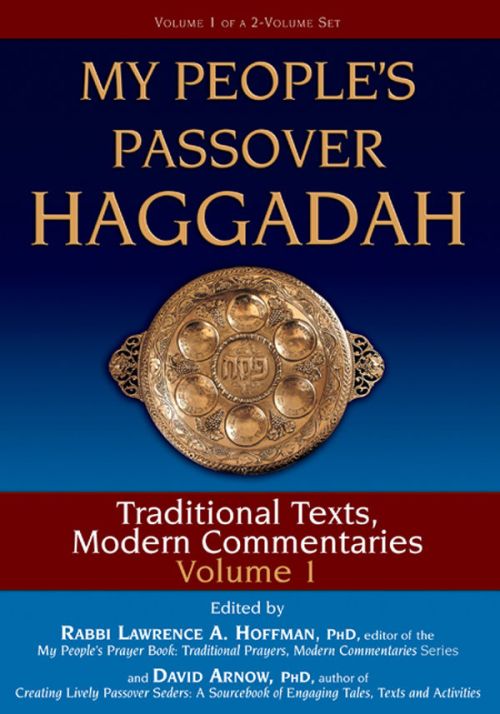
For the Passover observant and the P-curious, I recommend a deeper dive than the typical Haggadah—a set of books from Jewish Lights entitled My People’s Passover Haggadah: Traditional Texts, Modern Commentaries – Volume 1 and Volume 2.

From the editors:

In two volumes, this empowering resource for the spiritual revival of our times enables us to find deeper meaning in one of Judaism’s most beloved traditions, the Passover Seder. Rich Haggadah commentary adds layer upon layer of new insight to the age-old celebration of the journey from slavery to freedom—and makes its power accessible to all.

This diverse and exciting Passover resource features the traditional Haggadah Hebrew text with a new translation designed to let you know exactly what the Haggadah says. Introductory essays help you understand the historical roots of Passover, the development of the Haggadah, and how to make sense out of texts and customs that evolved from ancient times.

Framed with beautifully designed Talmud-style pages, My People’s Passover Haggadah features commentaries by scholars from all denominations of Judaism. You are treated to insights by experts in such fields as the Haggadah’s history; its biblical roots; its confrontation with modernity; and its relationship to rabbinic midrash and Jewish law, feminism, Chasidism, theology, and kabbalah.

No other resource provides such a wide-ranging exploration of the Haggadah, a reservoir of inspiration and information for creating meaningful Seders every year.

These are a bit bulky for the seder table itself. But they are the sort of books you would read if you wanted to understand why people are sitting at the seder table in the first place and why the traditions are so broad and sometimes so misunderstood. If Passover is just going through the motions, any seder and any Haggadah will do. If Passover is one piece of a much bigger picture to be investigated, these enlightening commentaries are what you need.

Easter

Close to each other. Very close. Passover begins tonight on Friday March 30. Easter is this Sunday April 1.

The calendar isn’t all that’s close. The Jewish story and the Christian story, in general and in the context of these particular holidays, are essentially and inextricably linked. The nature of those stories and those connections is the source of faith, enlightenment, misunderstanding, mistrust, even hatred and violence. Among Jews and Christians.

Any big moment on the Jewish and Christian calendars (and these holidays qualify) is an opportunity not just for ritual celebration but for study. How well do we—Jews, Christians, others—understand the texts and traditions outside the comfortable conventions of our belief and practice? Not just understanding that will confirm our faiths, allowing us to nod our heads and pat ourselves on our collective backs, but new and even startling understanding that might shake us and even make us uncomfortable. Everything we know about Judaism or Christianity, about the Bible, about history, may not be wrong, but maybe we could benefit from another open and learned perspective.

The second edition of the The Jewish Annotated New Testament was published last year; any and every Jew or Christian should read at least a little of it. So should everyone else who wants to know something about the foundations of this consequential moment in scripture, history and religion. Believers and nonbelievers may think they know what they’re dealing with. Many don’t.

The editors explain:

It is almost two millennia since the earliest texts incorporated into the New Testament were composed. For the most part, these centuries have seen a painful relationship between Jews and Christians. Although Jewish perceptions of Christians and Christian perceptions of Jews have improved markedly in recent decades, Jews and Christians still misunderstand many of each other’s texts and traditions. The landmark publication of this book is a witness to that improvement; ideally, it will serve to increase our knowledge of both our common histories and the reasons why we came to separate…

The Jewish Annotated New Testament represents the first time a gathering of Jewish scholars wrote a complete commentary on the New Testament. It reached a wide Jewish and Christian audience, and in doing so it has begun to increase both Jewish literacy of the New Testament and Christian awareness of the New Testament’s Jewish context. It has become widely used in colleges, universities and seminaries, as well as in Jewish, Christian, and joint Jewish-Christian study groups. Many Christian clergy and religious educators from different Christian denominations and church settings have told us that they have integrated the insights of this book into their preaching and devotion. Because of this volume, we have been told numerous times, sermons have been corrected, anti-Jewish teaching and preaching have been avoided, and Christians in churches and classrooms and Bible studies have learned more about Jesus and his followers. Jewish readers have told us how the volume has encouraged them to read the New Testament for the first time, to begin to consider the complex relationship between Judaism and Christianity, and how better to understand both their Christian neighbors and their own Jewish history….

For Christian readers The Jewish Annotated New Testament offers a window into the first-century world of Judaism from which the New Testament springs. There are explanations of Jewish concepts such as food laws and rabbinic argumentation. It also provides a much-needed corrective to many centuries of Christian misunderstandings of the Jewish religion.

For Jewish readers, this volume provides the chance to encounter the New Testament–a text of vast importance in Western European and American culture–with no religious agenda and with guidance from Jewish experts in theology, history, and Jewish and Christian thought. It also explains Christian practices, such as the Eucharist.

The Jewish Annotated New Testament, Second Edition is an essential volume that places the New Testament writings in a context that will enlighten readers of any faith or none.


More Likely Than Ever That Trump Will Fire Mueller and Use Presidential Pardons

Trump is finding it hard to enlist first-class legal talent to represent him. Some like John Dowd have resigned. There are daily reports now of expert lawyers refusing to join the legal team, something likely to continue indefinitely.

In his business life, Trump was able to get by with lawyers of moderate skill whose main attributes were toughness, meanness and loyalty. Trump loved instigating legal messes, and when threats of litigation didn’t work, he settled on settlements. Or, in some cases when matters actually went to trial, he just plain lost.

Even before the Mueller investigation is completed, the legal troubles are mounting. The tough, mean, threatening, loyal lawyers are not going to be enough. But he currently doesn’t have the caliber of lawyers who can extricate him, and he may never have them.

Which is why he may simply try to move the conflicts from legal battlefields to political ones. In law, he is just another unindicted co-conspirator or defendant. In politics, he is President of the United States.

The simplest way to move the battlefield is to exercise two powers he already has.

First, he has the power to cause Robert Mueller to be dismissed as Special Counsel. It could be a bit messy, as it was in Watergate’s Saturday Night Massacre. He could start by asking Rod Rosenstein to fire Mueller. If Rosenstein refused, he would then go down the line within the Justice Department until he found someone to do his bidding. Or on another track, Attorney General Jeff Sessions could resign/be fired, with a replacement AG who had not recused himself as Sessions had, and that replacement would fire Mueller. Any way it is accomplished, the consequence would be political, not legal. With his lifelong success as a politician (okay, only one election), Trump believes he will not lose that political fight.

Second, Trump has the power to protect anybody from federal criminal indictments or convictions, including himself, with presidential pardons. I have been saying for months the he is likely to do this (Trump Will Pardon Everybody (or Almost Everybody)) , and in recent weeks it has been the buzz around some conservative circles. Now it appears that Trump simply doesn’t have the legal army to fight on the law. So he is just going to have to blow away the law with his big pardon gun.

Past Passover Posts

Passover has crept up on me. This year it begins on the evening of Friday, March 30.

I usually write and publish at least one post a year for the holiday, and if the Moses muse visits, I still may. Just in case, though, here are links to some past Passover posts.

Moses on Krypton, Superman in Egypt

Passover and Freud

Four Freedoms Passover

A Heschel Haggadah

Matzo: Dealing with Eating the Bread of Affliction

American Freedom Seder 2017: Where There’s a Pharaoh There’s a Wilderness

Heschel for Passover

Refugees and the Bread of Affliction

Ship of Fools: Mnuchin, Santorum Aboard

This post was originally only about Treasury Secretary Steve Munchkin on a Sunday morning news show. Then former Republican Senator Rick Santorum spoke up, just begging for recognition.

Washington Post :

Mnuchin pitches line-item veto: ‘Congress could pass a rule’

Treasury Secretary Steven Mnuchin has urged lawmakers to give President Trump a line-item veto, saying on “Fox News Sunday” that it might prevent Democrats from stacking more nondefense discretionary spending into the next must-past budget bill.

But Mnuchin’s short exchange with Fox News anchor Chris Wallace also underlined the problem with the idea — a 20-year-old Supreme Court ruling that struck down the line-item veto, finding “no provision in the Constitution that authorizes the president to enact, to amend or to repeal statutes,” after President Bill Clinton used it 82 times.

“I think they should give the president a line-item veto,” said Mnuchin, echoing Trump’s comments after he signed last week’s omnibus budget bill.

“That’s been ruled unconstitutional by the Supreme Court,” Wallace said.

“Well, again, Congress could pass a rule, okay, that allows them to do it,” Mnuchin said.

“It would be a constitutional amendment,” Wallace said.

“Chris, we don’t need to get into a debate,” the treasury secretary said. “There’s different ways of doing this.”

New York Times :

Rick Santorum: Students Should Learn CPR, Not Seek Gun Laws

Former Pennsylvania Sen. Rick Santorum said Sunday that students who have rallied for gun control should instead learn CPR or find their own way to prevent a school shooting.

“How about kids instead of looking to someone else to solve their problem, do something about maybe taking CPR classes or trying to deal with situations that when there is a violent shooter that you can actually respond to that,” the Republican said on CNN’s “State of the Union.”

The 2012 and 2016 presidential candidate said students could work to stop bullying in their communities or respond themselves to a shooter instead of asking lawmakers to approve legislation to protect them.

Santorum’s comments prompted outrage on social media a day after hundreds of thousands of teenagers and their supporters rallied across the U.S. to push for tougher laws to fight gun violence.

The demonstrations Saturday were led by students from Marjory Stoneman Douglas High School in Parkland, Florida, where 17 people were killed last month.

Santorum said that if the rallies are about more than politics, then the country needs to have a broader discussion that doesn’t revolve around “phony gun laws” that don’t work.

“They took action to ask someone to pass a law,” he said of the demonstrators. “They didn’t take action to say, ‘How do I, as an individual, deal with this problem?

We Now Know What Trump Really Thinks of Lawyers

Ever wonder what kind of a lawyer Trump would be—assuming he could get into law school, graduate and pass the bar exam (questionable)? Today he tweeted about why any lawyer would be thrilled to join his dwindling legal team:

New York Times:

Earlier on Sunday, Mr. Trump took to Twitter from his Florida resort to insist that he faced no problems finding lawyers to represent him in the Russia investigation.

“Fame & fortune will never be turned down by a lawyer, though some are conflicted,” Mr. Trump said in a tweet.

That is, except for conflicts, any lawyer will come if you dangle fame and fortune in front of them. Particularly if Trump beckons.

It is true that plenty of lawyers are interested in clients and cases that promise fame and fortune. No one should mistake lawyers for saints.

On the other hand, many more also have a passing interest in justice and professional responsibility, in addition to the other rewards. That is something that never crosses Trump’s mind. In fact, Trump has described exactly the sort of lawyer he would be—again, if that were possible.

A couple of other things Trump misses, things that explain why he is unable to add many lawyers of quality and stature at this point.

First, Trump is accustomed to people around him putting up with anything just for the privilege of working for him. He would be astonished to learn that lawyers, even the most ambitious ones, have a limit to what they will put up with.

Second, Trump still does not recognize the difference between fame and notoriety—never has, never will. Lawyers may have no problem being famous. Notorious? Not so much.

March for Our Lives

And these children that you spit on
As they try to change their worlds
Are immune to your consultations
They’re quite aware of what they’re goin’ through
David Bowie, Changes

To the NRA, the politicians in their pocket, Fox News and all the others who bully and lie as a regular self-serving practice:

These astonishingly active and articulate children you dismiss as naïve pawns of special interests are anything but. They are smart and caring voters and voters-to-be, they are inspirational organizers, they are brave warriors for peace, common sense and truth.

They are the edge of a wave of American humanity that will wash you away. If you believe your own nonsense and are too stupid to be afraid of being sidelined and replaced, you should be very afraid. Nothing happens without struggle, and you may think this is a struggle that you are bound to win. But if you are students of American history, you know how this eventually goes. If you are students of history, watching (or more likely ignoring) this extraordinary moment, you would know that you are history. The arc of history is long, MLK said, but it bends toward justice.

And admit that the waters
Around you have grown
And accept it that soon
You’ll be drenched to the bone.
If your time to you
Is worth savin’
Then you better start swimmin’
Or you’ll sink like a stone
For the times they are a-changin’.
Bob Dylan, The Times They Are A Changin’