Bob Schwartz

Lesson for Trump Attorneys: The Lawyers of Watergate

“The Nixon White House initially dismissed the break-in as a “third-rate burglary,” but after a year of increasingly persistent media coverage, Congress initiated multiple investigations that exposed the involvement of more than 20 of the most powerful lawyers in the United States.”

This was going to open with a list of lawyers who are representing Trump and Trump-related enterprises—including the White House. But that list changes too fast; Trump’s chief attorney in the Mueller investigation, John Dowd, resigned just this week.

Whoever they are or will be, they have one thing in common. They are working for a client who almost certainly has engaged in unethical, if not illegal, practices—before and during his political life, including his presidency. A client who has asked others, including his attorneys, to help fix or cover-up those practices when they were in danger of coming to light. A client who is vindictive, willful, self-absorbed, not very smart, and possibly psychologically unstable. A client who will not listen to them.

All of which brings us to Nixon and the lawyers of Watergate. One difference between Nixon and Trump is that Nixon was smart, a lawyer himself and a long-time national politician who understood how government works. Nixon was also a patriot, and, at least at some point in his life, a brave man, having served with distinction in World War II.

Unfortunately, Nixon, like Trump, found himself engaged in practices that he eventually needed to hide. He enlisted a gang of henchmen to help him—and many of those men were lawyers. When they truth came out, many of those lawyers were no longer allowed to be lawyers (including Nixon), and Nixon was no longer president.

If you wonder why lawyers are leaving Trump right and left, the following suggests one of the reasons.

ABA Journal, June 2012

The Lawyers of Watergate: How a ‘3rd-Rate Burglary’ Provoked New Standards for Lawyer Ethics

The Nixon White House initially dismissed the break-in as a “third-rate burglary,” but after a year of increasingly persistent media coverage, Congress initiated multiple investigations that exposed the involvement of more than 20 of the most powerful lawyers in the United States.

At the top of the list was Nixon, the 37th president of the United States, who resigned on Aug. 8, 1974, as Congress was gearing up to conduct impeachment proceedings.

But the list also included two U.S. attorneys general, two White House counsels, an assistant attorney general and a chairman of the U.S. Securities and Exchange Commission.

John D. Ehrlichman
Disbarred in Washington State.

John W. Dean III
Disbarred in Virginia.

Spiro T. Agnew
Disbarred in Maryland.

Charles W. Colson
Disbarred in Virginia and the District of Columbia, license suspended in Massachusetts.

Herbert W. Kalmbach
Law license in California was suspended, but reinstated in 1977.

Richard G. Kleindienst
Law license in District of Columbia suspended for a month, and censured by Arizona disciplinary authorities.

Egil “Bud” Krogh Jr
Disbarred in 1975 by the Washington Supreme Court, but petition for reinstatement was granted in 1980.

Gordon Liddy
Disbarred in New York.

Robert C. Mardian
Law licenses suspended in California and by the U.S. Supreme Court, but later reinstated.

John N. Mitchell
Disbarred in New York and from the U.S. Supreme Court Bar.

Richard M. Nixon
Disbarred in New York.

Harry L. Sears
Law license suspended in New Jersey for three years.

Donald H. Segretti
Law license suspended in California for two years.

Bradford Cook
Nebraska law license was suspended for three years.

Perpetual Adoration

Perpetual Adoration

“It is with great sadness we had to make the decision to close our beautiful monastery in Tucson, Arizona as of February 26, 2018. Our sisters have relocated to the motherhouse in Clyde, Missouri.”

In hoc signo:
No Trespassing.
Benedictine Monastery of the
Sisters of Perpetual Adoration.
The sisters have left the building
St. Benedict Jesus God too.
The sisters to Missouri
The rest homeless for now.
Carved wooden doors locked
Bushes for the butterflies
Cut back and soon gone.
Who by fire
Who by water
Who by sledgehammer
Wrecking ball dynamite.
After the noisy dusty struggle
Mountains abide.

©

Note: For an earlier post about this building, sold to be replaced by something residential or commercial, see Houses of Worship As Reminders on the Street.

Dish of Dice

Dish of Dice

“I am going to build a church someday. It will have a holy of holies and a holy of holy of holies, and in that ultimate box will be a random number table.”
Gregory Bateson

Different dice
On the altar
Four six eight sides
Ten and twenty
Sleeping in the dish
Awake and rolling
Prophets with a message
Plan and prepare
To laugh cry and play
The numbers rise up
See their beauty and wisdom
Listen to
The last lesson you need

©

Trump and the Battle of Universes: Crisis on This Earth

It is painful to be reducing the future of America to a simplistic metaphor—or to a comic book concept. But here goes.

For Trump, reality is Trump. Trump Earth. Trump World. Trump Universe. Nothing else exists.

For everybody else, reality is everything else. Not-Trump Earth. Not-Trump World. Not-Trump Universe.

It is really that simple. A little practically complicated because Trump is president. But conceptually, just that simple.

The battle has already started and is likely to get worse before it gets better. For examples, see the various series in the comic book world, such as Crisis on Infinite Earths. Not pretty, with lots of collateral damage. The good news is that in the long run, the good guys and good gals win. We hope.

Normalizing Corruption: “Kushner Cos. filed false NYC housing paperwork”

Associated Press:

Kushner Cos. filed false NYC housing paperwork

NEW YORK (AP) — When the Kushner Cos. bought three apartment buildings in a gentrifying neighborhood of Queens in 2015, most of the tenants were protected by special rules that prevent developers from pushing them out, raising rents and turning a tidy profit.

But that’s exactly what the company then run by Jared Kushner did, and with remarkable speed. Two years later, it sold all three buildings for $60 million, nearly 50 percent more than it paid.

Now a clue has emerged as to how President Donald Trump’s son-in-law’s firm was able to move so fast: The Kushner Cos. routinely filed false paperwork with the city declaring it had zero rent-regulated tenants in dozens of buildings it owned across the city when, in fact, it had hundreds.

While none of the documents during a three-year period when Kushner was CEO bore his personal signature, they provide a window into the ethics of the business empire he ran before he went on to become one of the most trusted advisers to the president of the United States.

“It’s bare-faced greed,” said Aaron Carr, founder of Housing Rights Initiative, a tenants’ rights watchdog that compiled the work permit application documents and shared them with The Associated Press. “The fact that the company was falsifying all these applications with the government shows a sordid attempt to avert accountability and get a rapid return on its investment.”

Set aside the specifics of this particular corrupt practice. Ignore the fact that Jared Kushner’s father Charlie, founder of Kushner Cos., once pled guilty to 18 counts of illegal campaign contributions, tax evasion, and witness tampering, and served fourteen months in federal prison. Ignore the business, legal, political and personal practices of Donald Trump, Jared’s father-in-law and boss, and President of the United States.

Focus on this. When corruption is practiced within the context and four walls of a corrupt enterprise, corruption is normal. The only things wrong are any words or actions that brings any of those corrupt practices to light or causes an unfavorable light to shine on them. Everything else is okay, because within those four walls, corruption is normal.

Corruption is not normal. In business. In government. In politics. In the White House. It is as clear as ever that some people don’t know that, don’t believe that, and never will.

A Less Than Happy Country: American Binge Drinking

The World Happiness Report 2018—“a landmark survey of the state of global happiness [ranking] 156 countries by their happiness levels”—ranks the United States as having dropped to #18, between Luxembourg and the United Kingdom. The happiest place on earth is not Disneyland, but Finland, followed closely by Norway, Denmark and Iceland.

Besides legitimate use of opioids as pain killers, widespread opioid abuse is undoubtedly linked to unhappiness, dissatisfaction and other negative psychological states. Adding to this, we now have the latest study of American binge drinking, from the American Journal of Preventative Medicine.

Annual Total Binge Drinks Consumed by U.S. Adults, 2015

Timothy S. Naimi, MD, MPH
Yong Liu, MD, MS
Hua Lu, MS
Robert D. Brewer, MD, MSPH

Introduction

Binge drinking (four or more drinks for women, five or more drinks for men on an occasion) accounts for more than half of the 88,000 U.S. deaths resulting from excessive drinking annually. Adult binge drinkers do so frequently and at high intensity; however, there are known disparities in binge drinking that are not well characterized by any single binge-drinking measure. A new measure of total annual binge drinks was used to assess these disparities at the state and national levels.

Results

In 2015, a total of 17.1% of U.S. adults (37.4 million) reported an annual average of 53.1 binge-drinking episodes per binge drinker, at an average intensity of 7.0 drinks per binge episode, resulting in 17.5 billion total binge drinks, or 467.0 binge drinks per binge drinker. Although binge drinking was more common among young adults (aged 18–34 years), half of the total binge drinks were consumed by adults aged ≥35 years. Total binge drinks per binge drinker were substantially higher among those with lower educational levels and household incomes than among those with higher educational levels and household incomes.

Conclusions

U.S. adult binge drinkers consume about 17.5 billion total binge drinks annually, or about 470 binge drinks/binge drinker. Monitoring total binge drinks can help characterize disparities in binge drinking and help plan and evaluate effective prevention strategies.

[emphases added]

Without going into what exactly makes for a happy country, or why exactly 37 million Americans are drinking 7 drinks 53 times a year, and not mentioning the millions of opioid abusers (or the combination alcohol/opioid abusers), let’s just acknowledge that lots of Americans appear to be unhappy enough to seek an obliterative state of mind.

Even just starting to address the roots of those phenomena is beyond the scope of a post, a blog, or an encyclopedic analysis. Instead, just one thought.

Making tens of millions of people even marginally happier is a huge mission. What isn’t so hard is to ask that some high-profile, ever-present public figures not make other lives less happy by everything they say and do every single day. That is, please shut up and go away. It is a tiny step, but if it keeps the United States from dropping even further on the Happiness Index, and just a few million people are kept away from binge drinking and opioid abuse, it would be worth it.

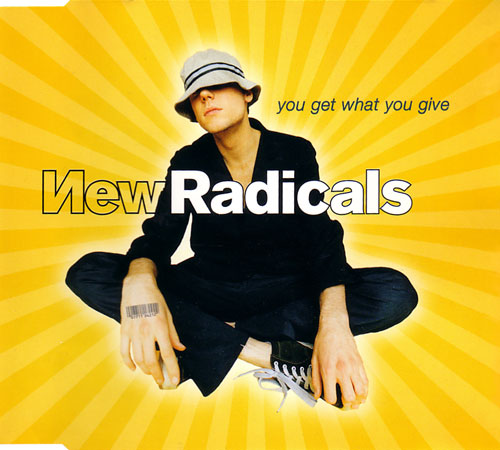
Morning Music Uplift: You Get What You Give

Don’t let go
You’ve got the music in you

It is too easy to begin the day thinking and writing about the latest outrage. Which is why after the first cup of coffee I select some music to move me and the moment elsewise.

This morning the path led to New Radicals’ You Get What You Give. It doesn’t get more uplifting than this! Listen! Dance!

But when the night is falling
You cannot find the light
You feel your dreams are dying
Hold tight
You’ve got the music in you
Don’t let go
You’ve got the music in you
One dance left
This world is gonna pull through
Don’t give up
You’ve got a reason to live
Can’t forget
We only get what we give


China Should Inspire More American Media Eye-Rolling

More media eye-rolling is needed in America. China, another country with cult of personality leadership and canned party-line presentations, shows us the way.

New York Times:

SHANGHAI — It was the eye roll seen across China.

As the annual meeting of the country’s legislature stretched into its second week, the event’s canned political pageantry and obsequious (and often scripted) media questions seemingly proved too much for one journalist on Tuesday.

With a fellow reporter’s fawning question to a Chinese official pushing past the 30-second mark, Liang Xiangyi, of the financial news site Yicai, began scoffing to herself. Then she turned to scrutinize the questioner in disbelief.

Looking her up and down, Ms. Liang rolled her eyes with such concentrated disgust, it seemed only natural that her entire head followed her eyes backward as she looked away in revulsion.

Captured by China’s national news broadcaster, CCTV, the moment spread quickly across Chinese social media….

On Chinese social media, GIFs and other online riffs inspired by Ms. Liang’s epic eye roll quickly proliferated, and by evening they were being deleted by government censors. Ms. Liang’s name became the most-censored term on Weibo, the microblogging platform. On Taobao, the freewheeling online marketplace, vendors began selling T-shirts and cellphone cases bearing her image.

Bros Before: O.J. and Trump

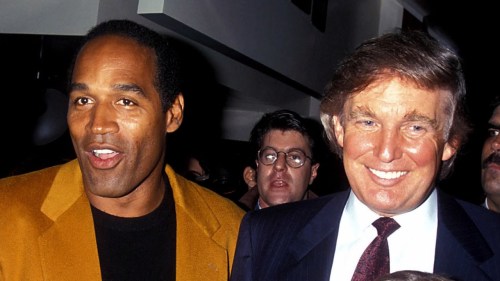
With O.J. Simpson and Donald Trump both in today’s news, a look back at their friendship. The photo above was taken at a club in 1993. Trump was soon to marry his second wife, a wedding O.J. attended; O.J. was soon to murder his first wife. And so it goes.

Bird Talk

Bird Talk

In China
Chinese food is just food
In the yard
Bird song is just
Morning chatter

©