Bob Schwartz

The only wall that matters to Trump is the almost-completed wall around his executive branch

When Trump took office, he assumed that everyone he appointed to an executive branch job was on his team—that they would support whatever he did and said, do whatever he wanted, no questions asked, no backtalk or criticism, public or private. If it ever came to a choice between Trump and “doing the right thing”, the team members would choose him, just as his staff had at the Trump Organization.

He quickly discovered it did not always work that way. And so among his other strategies, he saw that he would have to purge all those whose unconditional loyalty was beyond question, and replace them with those who, for whatever reasons (incompetence, ideology, need for job or job security, etc.), would toe the line.

These replacement players would be a compliant, sycophantic part of the wall—the wall Trump has almost completed around his executive branch. In the Justice Department, for example, Sessions and Comey are gone, as Rosenstein soon will be. The same has happened elsewhere, time and again.

This Trump wall, unlike the one at the southern border, will work, at least for a while. Built with the solid powers of the presidency, the wall won’t be easily gotten around or broken through. With all his glaring deficiencies, Trump knows one thing: how to protect himself. This wall around the executive branch will do just that.

Should you have an opinion?

Opinion: Judgment, view, attitude, appraisal.

The Great Way is not difficult
for those who have no preferences.
When love and hate are both absent
everything becomes clear and undisguised.
Make the smallest distinction, however,
and heaven and earth are set infinitely apart.
Hsin-Hsin Ming/Verses on the Faith Mind by Seng-ts’an, translated by Richard B. Clarke

I am a person of occasional opinion, in a world of opinions. Maybe you are such a person too. Maybe you have media to carry your opinions, circumstances in which you express them or are asked for them or are expected to have them as a part of your work or craft. Maybe you mostly keep your opinions to yourself.

Verses on the Faith Mind, written by Seng-ts’an, Third Ancestor of Zen, is a frequently read Zen text (some say it is the first). Its message is that discriminative thinking tends to lead us astray from the path of self-realization and enlightenment.

Of course, the text itself presents a bit of conundrum, if not contradiction. A recommendation against distinctions is itself a distinction. So we may already be confused.

But there is no conundrum, contradiction or confusion. Having opinions, making judgments and choices, and discriminating are elements of action. A fork in the road demands a choice. (Although, as the wisdom master and baseball great Yogi Berra famously gave driving directions to a visitor, “When you come to a fork in the road, take it.”)

It is the place those opinions hold that is in question, or more precisely, it is the way we hold and use those opinions that matters. Opinions can be a habit or practice. Just the process of generating opinions has the potential to move us away from our selves, even as we are under the impression that we are simply reflecting ourselves. And then when we express those opinions, in whatever form, however loudly and widely, the impact is our responsibility.

Have opinions. I do. But pay attention as those opinions well up in your mind, more attention when you express them and set them loose on the world. You should be aware of them, of the good they might do, of the harm they might do, not only to others, but to yourself. Verses on the Faith Mind suggests that the fewer the better.

Valentine’s Day: Love is Healing

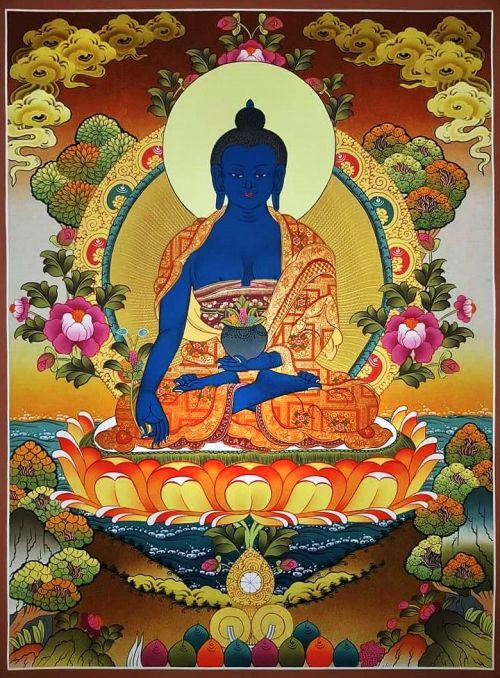
Medicine Buddha of Lapis Lazuli Radiance

Love is Healing

healers are the healed
lovers are the loved
that feeling is not yours
it belongs to them
then returns

Enlightened Insurgency

There are a variety of insurgencies—political, economic, social, cultural, spiritual.

There are also a variety of drivers for these. The same as for the insurgencies themselves, but not necessarily congruent. There are, for example, political insurgencies that are driven by economic forces.

It may be thought that spiritual traditions including practices such as meditation and beliefs in equanimity are quietistic and do not induce or allow insurgency. The same might be thought about other contemplative traditions. This is an incomplete understanding.

In the psychology realm, there are therapies that urge patients to “get in touch with their anger.” The point is not that the patient will never, ever be angry again. That might be as unrealistic and maladaptive as being angry all the time. Instead the thought is that once anger is seen in a different light, it can be experienced in a different way.

Just so, enlightened paths can lead to enlightened insurgencies. This is as tricky as it sounds. In the face of things going in the wrong direction, in the face of injustices, inequities or just plain thoughtless and destructive stupidity, it is easy to forget your principles and, as the cliché goes, become part of the problem and not part of the solution.

We’ve seen it in every movement for change and reform. We’ve seen it in the civil rights movement in America, where there was (and is) continuing disagreement about the vehemence of protest and resistance. Every prophet has faced this—the wrongs may be easy to see, but the rights are harder to formulate, even if God supposedly inspired you to action.

How much harder it is for those of us who are light years from being prophets. All we can do is keep our feet more or less on the path, watch ourselves and our indignation, and figure out, as best we can, how to make things better as quickly as possible without making them worse.

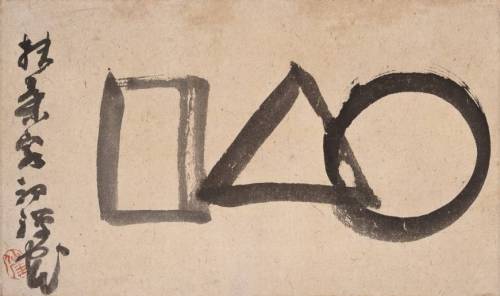
Triangle Square Circle

Sengai Gibon (1750-1837), The Universe

Triangle Square Circle (60-90-0)

Three angles
Four angles
All angles
Here and gone

©

Sarah Sanders Knows God’s Will and Says God Wants Trump

Berry Chapel, Ouachita Baptist University, Arkadelphia, Arkansas, alma mater of Sarah Sanders

“I think God calls all of us to fill different roles at different times and I think that he wanted Donald Trump to become president. And that’s why he’s there.”
Sarah Sanders, White House Press Secretary, interviewed by Christian Broadcasting Network

[long pause]

[another long pause]

Some people believe that that they know the will of God and that God intervenes in worldly affairs according to that will, in any and all matters. In this view, God exercises preference for particular outcomes—from presidential elections to football games to epidemic diseases. God wants Trump to be president. God wants the New England Patriots to win the Super Bowl. God wants to punish homosexuals with AIDS. And so on.

Others believe in a non-interventionist God, who has set the scene, given humans a treasure of tools, and expects those humans to make or break whatever they will. Sometimes those humans use those tools for great good, sometimes they act the fools, and sometimes they are monstrously destructive. It’s up to them. It’s up to us.

If, like Sarah Sanders, you claim to know God’s will and know that he wants Trump, consider this. If you sum up all that Trump has done and said so far, in his life and his presidency, does God by his “choosing” Trump endorse all of that? That is, under the Sanders theology, if we know Trump, we know his benefactor God.

Leaving us with this disturbing question: Just what kind of God does Sanders believe in?

Withholding

Withholding

Of the ten thousand words
I could wield as weapons this moment
to attack an innocent
(all are as innocent as they are guilty)
I withhold:
the greater for all
the lesser for none

©

MLK and AJH: Two Friends, Two Prophets

Abraham Joshua Heschel and Martin Luther King Jr. at Arlington National Cemetery, February 6, 1968.

“Where in America today do we hear a voice like the voice of the prophets of Israel? Martin Luther King is a sign that God has not forsaken the United States of America. God has sent him to us. His presence is the hope of America. His mission is sacred, his leadership of supreme importance to every one of us.”
Abraham Joshua Heschel

From Two Friends, Two Prophets, Plough Quarterly, by Susannah Heschel, Eli Black Professor of Jewish Studies at Dartmouth College and daughter of Abraham Joshua Heschel.


Two Friends, Two Prophets: Abraham Joshua Heschel and Martin Luther King Jr.

It’s easy to forget how unusual the friendship between Heschel and King was in its day. The two came from very different backgrounds – King had grown up in Atlanta, Georgia, while Heschel arrived in the United States as a refugee from Hitler’s Europe in March of 1940 – “a brand plucked from the fire,” as he wrote. Yet the two found an intimacy that transcended the growing public rift between their two communities….

Heschel and King shared a disdain for the popular liberal Protestant theology of the era, and a skepticism for orthodoxies. They mocked Paul Tillich’s definition of God as the “ground of being,” helpless in the face of injustice. Both thought that Karl Barth’s theology left “the average mind lost in the fog of theological abstractions,” as King wrote….

The March on Washington took place in August 1963, with more than two hundred thousand people participating.

“The hour calls for moral grandeur and spiritual audacity.” Abraham Joshua Heschel

Their pleas were met by a disappointing silence. President Kennedy did not declare a state of moral emergency, nor did clergy donate a month of salary to housing and education. If anything, the tensions in the United States grew even more dire. Just weeks later, on September 15, 1963, a church in Birmingham was bombed, killing four young black girls. That same day, James Bevel and Diane Nash launched the Alabama Project that ultimately led to the famous march from Selma to Montgomery in 1965.

The prophets – both Heschel’s book and the biblical figures – drew Heschel and King together. Both men were trained theologians who also knew how to preach. King was the organizer and public figure, while Heschel was the theologian and scholar with the voice of a public intellectual. Prophetic rhetoric has a long public history in the United States, yet it was not only the prophets’ words that stood out. For King and Heschel, the prophets were extraordinary human beings with passionate emotional lives, people who knew how to pray and who created powerful symbolic moments….

The 1965 march from Selma to Montgomery was a major event for both Heschel and King. A few days before the march took place, Heschel led a delegation of eight hundred people to FBI headquarters in New York City in order to protest the brutal treatment of demonstrators in Selma. On Friday, March 19, two days before the Selma march was scheduled to begin, Heschel received a telegram from King, inviting him to join the marchers. Heschel was welcomed as one of the leaders in the front row of marchers, with King, Ralph Bunche, and Ralph Abernathy. Each of them wore flower leis brought by Hawaiian delegates. In an unpublished memoir that he wrote upon returning from Selma, Heschel describes the extreme hostility he encountered from whites in Alabama from the moment he arrived at the airport, in contrast to the kindness he was shown by King’s assistants….

Were Heschel and King the prophets of America? Neither claimed the title, but each spoke of the other as a prophet. In introducing King to the audience, Heschel asked, “Where in America today do we hear a voice like the voice of the prophets of Israel? Martin Luther King is a sign that God has not forsaken the United States of America. God has sent him to us. His presence is the hope of America. His mission is sacred, his leadership of supreme importance to every one of us.”

In response, King stated that Heschel “is indeed a truly great prophet…. Here and there we find those who refuse to remain silent behind the safe security of stained glass windows, and they are forever seeking to make the great ethical insights of our Judeo-Christian heritage relevant in this day and in this age.”

In America It’s Now Every Man, Woman and Child for Themselves

The founders of America had a dream, fueled by the Enlightenment and by what we might call Christian realism about how people really are.

It would be ideal to depend on the kindness of strangers, but experience has shown that strangers cannot always be relied on and are not always kind. Instead, as a national community, we are committed—by the Constitution those founders hammered out—to “promote the general welfare.”

With many ups and downs, and some real gaps, that has generally worked out during the first two centuries of that American dream. Those days may not be over, but the founding principle is under serious, if not existential, threat.

The Shutdown is just one example, but a glaring one. At best, Trump and his cohort believe that forcing federal workers to work without pay will be taken care of by the private sector. At worst and most likely, they just don’t care.

America has tried political philosophies that leaned to individual self-help and more limited government. But never before has the governing philosophy (if you can call it that) literally pushed Americans—Americans working for other Americans—into forced labor and economic hardship.

Welcome to Trump America, where it’s every man, woman and child for themselves.

Humpty Dumpty

Humpty Dumpty sat on a wall,
Humpty Dumpty had a great fall.
All the king’s horses and all the king’s men
Couldn’t put Humpty together again.

“Humpty dumpty” was eighteenth-century slang for a short and clumsy person. (Dictionary of Slang and Unconventional English)


Through the Looking Glass (Alice in Wonderland), Chapter 6

However, the egg only got larger and larger, and more and more human: when she had come within a few yards of it, she saw that it had eyes and a nose and mouth; and when she had come close to it, she saw clearly that it was Humpty Dumpty himself….

‘And how exactly like an egg he is!’ she said aloud, standing with her hands ready to catch him, for she was every moment expecting him to fall.

‘It’s very provoking,’ Humpty Dumpty said after a long silence, looking away from Alice as he spoke, ‘to be called an egg — very!’

‘I said you looked like an egg, Sir,’ Alice gently explained. ‘And some eggs are very pretty, you know’ she added, hoping to turn her remark into a sort of a compliment.

‘Some people,’ said Humpty Dumpty, looking away from her as usual, ‘have no more sense than a baby!’…

‘What a beautiful belt you’ve got on!’ Alice suddenly remarked.

(They had had quite enough of the subject of age, she thought: and if they really were to take turns in choosing subjects, it was her turn now.) ‘At least,’ she corrected herself on second thoughts, ‘a beautiful cravat, I should have said — no, a belt, I mean — I beg your pardon!’ she added in dismay, for Humpty Dumpty looked thoroughly offended, and she began to wish she hadn’t chosen that subject. ‘If I only knew,’ the thought to herself, ‘which was neck and which was waist!’

Evidently Humpty Dumpty was very angry, though he said nothing for a minute or two. When he did speak again, it was in a deep growl.

‘It is a — most — provoking — thing,’ he said at last, ‘when a person doesn’t know a cravat from a belt!’

‘I know it’s very ignorant of me,’ Alice said, in so humble a tone that Humpty Dumpty relented.

‘It’s a cravat, child, and a beautiful one, as you say….

‘When I use a word,’ Humpty Dumpty said in rather a scornful tone, ‘it means just what I choose it to mean — neither more nor less.’

‘The question is,’ said Alice, ‘whether you can make words mean so many different things.’

‘The question is,’ said Humpty Dumpty, ‘which is to be master — that’s all.’