Bob Schwartz

Category: War

The Iraq War and the Ryan Budget: A Modest Proposal
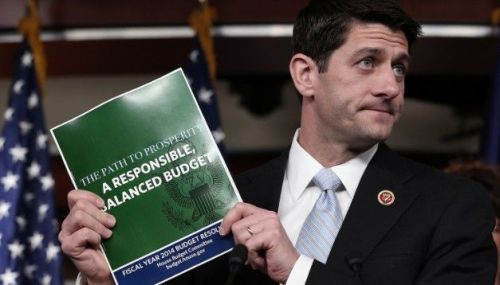
Paul Ryan Budget
We have two budget crises. One is the budget itself, which is clearly in need of work to make concrete our priorities and the willingness of citizens to support those priorities in the form of taxes. The second crisis is political dysfunction, where real and constructive talk about those priorities and that support is transformed and devolved into useless politalk. One way that uselessness is hidden is by obfuscation and throwing around lots of numbers, details, and core American principles.

Simplify, simplify.

We just marked the 10th anniversary of the Iraq War. There is going to be disagreement about many aspects of that war for generations.

But there is consensus on two things.

The war was financially expensive. How expensive is another matter of contention. The Costs of War Project pegs it at a few trillion dollars, give or take. So how expensive? Very expensive.

The war was not paid for. More precisely, the war was paid for by debt, not by taxes. The United States had never done this before. There are two perfectly good reasons to ask Americans to pay for and sacrifice for wars. Wars are expensive. And taxing for war asks all citizens at all economic levels to make real sacrifice, even if they or their loved ones are not in harm’s way. As a political matter, when the sacrifice outweighs support for the war, there may be pressure to question or even end the war.

It is uncontested that George W. Bush and Congress did not ask for that sacrifice. Without arguing about how that happened, it is the fact. There is no argument about the result. In the midst of this massive borrowing to pay for the war, the economy fell down, and is still having trouble getting up.

With a sense of humility, and standing in the shadow of today’s esteemed Congress, here is a simple and modest proposal.

1. Agree on the financial cost of the Iraq War. For purposes of discussion, let’s say $3 trillion, though it is certainly more.

2. Agree to taxes that will generate that amount of revenue, not a cent more or less. That revenue would then be spent on all the important things that would otherwise be underfunded or unfunded, including every possible entitlement for veterans.

3. Once that money is raised and spent, taxes will revert to the earlier levels, and some members of Congress can go back to babbling, bickering and posturing.

Simple, maybe even naïve. Certainly too naive for the sophisticated politicians who are busy building a budgetary hall of mirrors that only they can navigate, where they think they can hide themselves and some simple, inconvenient truths.

The Tin Anniversary of the Iraq War

Tin CupTin is the traditional gift to mark a 10th wedding anniversary, just as it is silver for the 25th and gold for the 50th. There is no tradition about the anniversaries of wars, so tin will have to do.

All wars are controversial, whatever the split in support (80/20, 20/80, 50/50, rarely true 100% support), whatever the rationale, whatever the price. Every American war has had its naysayers, contemporary with combat and in the rear view mirror of history. World War II came close to consensus, although even there questions are still raised about whether we were late getting in and whether the unprecedented brutal way we got out was necessary.

This paragraph was going to include a bunch of numbers about the Iraq War. But you are going to find those numbers everywhere: how many of our personnel served, how many were killed and wounded, how many civilians were killed and wounded, how much it cost in dollars. Those numbers are meant to demonstrate the price paid, in, as they say, blood and treasure. Here it is in brief: the price was staggeringly high.

And next is something surprisingly good to say about the Vietnam War. If we learned nothing else from that nation-dividing conflict, we learned this: whatever we believe about a war, we can never, ever, ever take anything away from the service of those who fight.

Some people miss an important point when they argue that we have to justify a war after the fact so that those who suffered won’t have suffered “in vain”. It is the exact opposite. When a war turns out in hindsight to present real questions about why, those who fought are maybe more our most loyal heroes, especially in a volunteer army. They didn’t answer a call to defeat some cosmic embodiment of evil (e.g., Hitler); they just loyally answered a call to serve. They deserve all we can give them (which, by the way, includes world-class medical care).

In August 2002 I sent an e-mail to some U.S. Senators, including Bob Graham of Florida and Robert Byrd of West Virginia. Both of them were skeptical about the rush to war, and both—particularly Byrd—believed that the role of Congress was being ignored.

This is an excerpt from that e-mail It is not here to reveal some astute analysis or prescience. Lots of people knew or suspected that something was wrong. It is just here as an artifact of a moment that led us to the anniversary today.

Sent August 29, 2002

Congress has the constitutional power to make war, which includes careful deliberation and action if necessary.

In the case of Iraq, you and Congress should assert that power immediately and clearly. Congress has previously allowed that power to erode in the face of political pressure, and now faces an administration that is using an atmosphere of fear (that it has intentionally or inadvertently helped create) to dare Congress to defy its claimed authority.

When you do exercise that power, as I hope you will, it should be more than a rubber stamp. The President seems to have a simplistic and maybe, with all due respect, a simple-minded view of world affairs. The role he is carving out for the U.S. as the world’s sheriff may be right in a moral sense, but is possibly disastrous in the world of the 21st century. Which evildoer is next on the list; which town is he planning to clean up?

This isn’t High Noon or The Magnificent Seven. We have been lucky in Afghanistan, though I expect things will fall apart there within the next year or so. The destabilization of Iraq, especially in the face of global disdain for our actions, could be much more costly.

Finally, I believe that the President’s strange game of hide-the-ball regarding his plans for Iraq (in the guise of not telegraphing our strategy) is wreaking havoc with our economic confidence. Anybody with any economic insight knows that things are much worse than anyone is willing to talk about, restraining such talk in the hope that consumers and businesses will regain lost faith in the future. There is no way that an attack on Iraq can help that situation, and a thousand ways it can and will hurt.

For the record, when the Iraq War Resolution did pass Congress in October 2002, Byrd, Graham and a total of 23 Senators (21 Democrats, 1 Republican, 1 Independent) voted against it. Of those, only a handful are still in the Senate: Barbara Boxer, Dick Durbin, Carl Levin, Barbara Mikulski, Patty Murray, Jack Reed, Debbie Stabenow and Ron Wyden. It has been more than ten years, so choice and death have taken the rest of them. One who did vote for it who is no longer in the Senate is John Kerry, who became Secretary of State after the “official” end of the Iraq War, and who, between the vote for the war and the end of it, ran for President.

It’s a funny old world.

The Rubicon and the Pillar: If We Pass This Little Bridge


The Lives of the Twelve Caesars
By Suetonius

XXXI.

…The lights going out, he [Julius Caesar] lost his way, and wandered about a long time, until at length, by the help of a guide, whom he found towards daybreak, he proceeded on foot through some narrow paths, and again reached the road. Coming up with his troops on the banks of the Rubicon, which was the boundary of his province, he halted for a while, and, revolving in his mind the importance of the step he was on the point of taking, he turned to those about him, and said: “We may still retreat; but if we pass this little bridge, nothing is left for us but to fight it out in arms.”

XXXII.

While he was thus hesitating, the following incident occurred. A person remarkable for his noble mien and graceful aspect, appeared close at hand, sitting and playing upon a pipe. When, not only the shepherds, but a number of soldiers also flocked from their posts to listen to him, and some trumpeters among them, he snatched a trumpet from one of them, ran to the river with it, and sounding the advance with a piercing blast, crossed to the other side. Upon this, Caesar exclaimed, “Let us go whither the omens of the Gods and the iniquity of our enemies call us. The die is now cast.”