Pete Hegseth announced Wednesday that the Department of Defense will offer testosterone deficiency screening for soldiers 30 and older.
The US defense secretary unveiled plans for a new screening program for testosterone deficiency among troops that will work to ensure service members have the “right testosterone levels” to perform at their optimal conditions in a video posted to X.
“I’m authorizing a new screening program for testosterone deficiency for our service members, ensuring you have the right testosterone levels to operate at your absolute best…As we know, the modern battlefield is brutal and unrelenting. It requires and demands maximum psychological and mental readiness, and by addressing these health markers early, we’re keeping you on the leading edge of lethality, and giving you the same level of support that you give this nation – the absolute best.”
I asked my research partner Claude Opus 4.8 to evaluate this proposed policy:
The Endocrine Society and the American Urological Association both explicitly recommend against population screening for testosterone deficiency in asymptomatic men. That’s not a fringe position — it’s the settled guidance, and it exists because of specifics that apply with unusual force to this population.
Testosterone is a noisy measurement. It’s diurnal, pulsatile, and assay-variable. Diagnosis requires two separate early-morning fasting draws, and a meaningful fraction of men with one low value are normal on retest. A “periodic health assessment” is not where careful morning-fasted serial testing happens.
Levels are suppressed by exactly the things military service consists of: sleep restriction, caloric deficit, heavy training load, psychological stress, acute illness. A soldier coming off a field problem with a low reading doesn’t have a disease; he has a normal adaptive response to being a soldier. Screening a population under chronic physiological load will manufacture a large number of “cases” whose correct treatment is sleep and food….
“Leading edge of lethality” is doing work that testosterone can’t do….Nothing in that literature touches marksmanship, judgment under fire, fire discipline, or unit cohesion. And “psychological and mental readiness” is a particularly awkward pitch, since the mood benefits of TRT are small…
TRT [testosterone replacement therapy] suppresses spermatogenesis — often reversibly, sometimes not, and this is a population in its reproductive years. It causes erythrocytosis requiring monitoring. TRAVERSE (2023) established cardiovascular non-inferiority in symptomatic hypogonadal men, which was reassuring, but flagged excess atrial fibrillation, pulmonary embolism, and acute kidney injury. And it’s typically lifelong — you’re enrolling people into permanent therapy and permanent monitoring, often starting from a false-positive lab.
Treatment being voluntary matters and is the right call. But voluntariness under a banner reading “The High-T Department of War,” in an institution built on conformity and hierarchy, is thinner than it looks on paper. If low T is publicly coded as a deficit in warrior-ness, declining treatment carries a cost the consent form doesn’t capture.
The screening design is at odds with the relevant clinical guidelines in ways that are hard to defend on medical grounds; the stated performance rationale isn’t supported by the endocrine literature; and there’s a genuinely good policy — targeted case-finding in TBI and chronic-opioid populations — sitting adjacent to it that this doesn’t do.
It would have been enough if Burt Bacharach and Hal David, writers of dozens of hits for dozens of performers, had just created this simple and powerful message.
It was more that Jackie DeShannon, a gifted songwriter and singer, recorded it as a gift to us.
Songs can be medicine for what ails us. Think about taking this daily.
What the world needs now is love, sweet love It’s the only thing that there’s just too little of What the world needs now is love, sweet love No not just for some but for everyone
Lord, we don’t need another mountain There are mountains and hillsides enough to climb There are oceans and rivers enough to cross Enough to last till the end of time
What the world needs now is love, sweet love It’s the only thing that there’s just too little of What the world needs now is love, sweet love No, not just for some but for everyone
Lord, we don’t need another meadow There are cornfields and wheat fields enough to grow There are sunbeams and moonbeams enough to shine Oh listen, Lord, if you want to know
What the world needs now is love, sweet love It’s the only thing that there’s just too little of What the world needs now is love, sweet love No, not just for some but for everyone No, not just for some, oh, but just for everyone
Like many Americans across the country Monday, August 17, 2017, President Trump gazed at the first solar eclipse in a century to cross the continental United States, coast to coast.
Emerging with first lady Melania and son Barron on the Blue Room Balcony of the White House shortly before the eclipse reached its apex, Trump waved at the crowd and responded to a reporter’s question — “How’s the view?” — with a thumbs up, according to the White House pool.
Then he tilted his head upward and pointed up, prompting a White House aide standing beneath the balcony to shout “don’t look,” according to the White House press pool.
One is to add better thoughts in addition to the ones already in mind.
One is to reduce the thoughts in mind first, then add better ones.
One is to practice no thoughts, first removing all that is already there, then carefully adding some essential ones that ultimately can lead to no thoughts at all.
Imagine the places we live.
Some get a bigger place to fit the things they already have and the things they add.
Some keep the place they have and reduce the number of things in it.
Some remove everything so they can see the place for itself, as it originally was when they first saw it, as it originally was when built, just walls, floors, ceilings, windows, and doors. Then maybe the walls, floors, ceilings, windows, and doors disappear too.
Beyond thinking is ultimately not a thought. It is an experience.
Over the course of decades, Bernie Madoff ran the largest Ponzi scheme in history, defrauding investors of an estimated $65 billion. He was caught in 2008 and died in prison in 2021. A stunningly talented man.
Maybe we are looking for the wrong things in our leaders. We keep a list of virtues that we think a leader should have. Maybe that is old-fashioned thinking. Maybe we are naïve. Maybe there are important qualities beyond those virtues.
We missed our chance to elect Bernie Madoff. But plenty of opportunities to elect other great con men—or women—may present themselves. If we are intent on electing a con man, why not the best?
How beauteous mankind is! O brave new world That has such people in’t! William Shakespeare, The Tempest (Act 5, Scene 1)
Those are famous lines from Shakespeare made more modernly famous by Aldous Huxley in his dystopian novel Brave New World.
In the play, Miranda has been isolated on an island with her father Prospero, and this is her exclamation as she gets her first excited view of beautiful and wondrous men. (Prospero, who is experienced and has seen a thing or two, warns her about the seeming novelty: “Tis new to thee.”)
“Brave new world” has come to mean progress in things and processes, whether for good or ill. But the Shakespeare quote suggests a more essential point. A new world is about new people, not new things.
Our difficulty is that it is easier to make new things than it is to make or be new people.
The supply of new things appears endless. But as for new and better people, at least in some highly visible and powerful segments, we seem to be moving backwards. Some of that regressing comes from people who piously and hypocritically claim that they are all about being new and better people.
If we want to consider new things the markers of a beautiful and wondrous new world—and some of them are— we should at least balance that with aspiring towards beautiful and wondrous and better people. New things make it easy to forget this, and the newer and more plentiful the things, the easier to forget.
A breeze came and lifted Ole and Trufa in the air, and they soared with the bliss known only by those who have freed themselves and have joined with eternity.
Ole & Trufa: A Story of Two Leaves can be read in Stories for Children by Isaac Bashevis Singer. This Nobel Prize winning author is mostly known for stories and novels for adults. All the stories “for children” can be enjoyed by anyone.
Ole & Trufa is particularly a story for anyone since it is a short and simple tale about death. It is the work of a master storyteller to make the life together of two leaves so moving and their deaths so uplifting, “with the bliss known only by those who have freed themselves and have joined with eternity.”
Ole & Trufa: A Story of Two Leaves by Isaac Bashevis Singer
The forest was large and thickly overgrown with all kinds of leaf-bearing trees. It was in the month of November. Usually it’s cold this time of year and it even happens that it snows, but this November was relatively warm. The nights were cool and windy, but as soon as the sun came out in the mornings, it turned warm. You might have thought it was summer except that the whole forest was strewn with fallen leaves—some yellow as saffron, some red as wine, some the color of gold, and some of mixed color. The leaves had been torn down by the rain, by the wind, some by day, some at night, and they now formed a deep carpet over the forest floor. Although their juices had run dry, the leaves still exuded a pleasant aroma. The sun shone down on them through the living branches, and worms and flies which had somehow survived the autumn storms crawled over them. The space beneath the leaves provided hiding places for crickets, field mice, and many other creatures who sought protection in the earth. The birds that don’t migrate to warmer climates in the winter but stay behind perched on the bare tree limbs. Among them were sparrows—tiny birds, but endowed with much courage and the experience accumulated through thousands of generations. They hopped, twittered, and searched for the food the forest offered this time of year. Many, many insects and worms had perished in recent weeks, but no one mourned their loss. God’s creatures know that death is merely a phase of life. With the coming of spring, the forest would again fill with grasses, green leaves, blossoms, and flowers. The migrating birds would return from far-off lands and locate their abandoned nests. Even if the wind or the rain had disturbed a nest, it could be easily repaired.
On the tip of a tree which had lost all its other leaves, two still remained. One leaf was named Ole and the other, Trufa. Ole and Trufa both hung from one twig. Since they were at the very tip of the tree they received lots of sunlight. For some reason unknown to Ole or Trufa, they had survived all the rains, all the cold nights and winds, and still clung to the tip of the twig. Who knows the reason one leaf falls and another remains? But Ole and Trufa believed the answer lay in the great love they bore each other. Ole was slightly bigger than Trufa and a few days older, but Trufa was prettier and more delicate. One leaf can do little for another when the wind blows, the rain pours, or the hail begins to fall. It even happens in summer that a leaf is torn loose—come autumn and winter nothing can be done. Still, Ole encouraged Trufa at every opportunity. During the worst storms, when the thunder clapped, the lightning flashed, and the wind tore off not only leaves but even whole branches, Ole pleaded with Trufa, “Hang on, Trufa! Hang on with all your might!”
At times during cold and stormy nights, Trufa would complain, “My time has come, Ole, but you hang on!”
“What for?” Ole asked. “Without you, my life is senseless. If you fall, I’ll fall with you.”
“No, Ole, don’t do it! So long as a leaf can stay up it mustn’t let go …”
“It all depends if you stay with me,” Ole replied. “By day I look at you and admire your beauty. At night I sense your fragrance. Be the only leaf on a tree? No, never!”
“Ole, your words are so sweet but they’re not true,” Trufa said. “You know very well that I’m no longer pretty. Look how wrinkled I am! All my juices have dried out and I’m ashamed before the birds. They look at me with such pity. At times it seems to me they’re laughing at how shriveled I’ve become. I’ve lost everything, but one thing is still left me—my love for you.”
“Isn’t that enough? Of all our powers love is the highest, the finest,” Ole said. “So long as we love each other we remain here, and no wind, rain, or storm can destroy us. I’ll tell you something, Trufa—I never loved you as much as I love you now.”
“Why, Ole? Why? I’m all yellow.”
“Who says green is pretty and yellow is not? All colors are equally handsome.”
And just as Ole spoke these words, that which Trufa had feared all these months happened—a wind came up and tore Ole loose from the twig. Trufa began to tremble and flutter until it seemed that she, too, would soon be torn away, but she held fast. She saw Ole fall and sway in the air, and she called to him in leafy language, “Ole! Come back! Ole! Ole!”
But before she could even finish Ole vanished from sight. He blended in with the other leaves on the ground and Trufa was left all alone on the tree.
So long as it was still day, Trufa managed somehow to endure her grief. But when it grew dark and cold and a piercing rain began to fall, she sank into despair. Somehow she felt that the blame for all the leafy misfortunes lay with the tree, the trunk with all its mighty limbs. Leaves fell but the trunk stood tall, thick, and firmly rooted in the ground. No wind, rain, or hail could upset it. What did it matter to a tree which probably lived forever what became of a leaf? To Trufa, the trunk was a kind of God. It covered itself with leaves for a few months, then it shook them off. It nourished them with its sap for as long as it pleased, then it let them die of thirst. Trufa pleaded with the tree to give her back her Ole and to make it summer again, but the tree didn’t heed, or refused to heed, her prayers …
Trufa didn’t think a night could be so long as this one—so dark, so frosty. She spoke to Ole and hoped for an answer, but Ole was silent and gave no sign of his presence.
Trufa said to the tree, “Since you’ve taken Ole from me, take me, too.”
But the tree didn’t acknowledge even this prayer.
After a while, Trufa dozed off. This wasn’t sleep but a strange languor. Trufa awoke and to her amazement found that she was no longer hanging on the tree. The wind had blown her down while she was asleep. This was different from the way she used to feel when she awoke on the tree with the sunrise. All her fears and anxieties had now vanished. The awakening also brought with it an awareness she had never felt before. She knew now that she wasn’t just a leaf that depended on every whim of the wind, but that she was a part of the universe. She no longer was small or weak or transient, but a part of eternity. Through some mysterious force, Trufa understood the miracle of her molecules, atoms, protons, and electrons—the enormous energy she represented and the divine plan of which she was a part. Next to her lay Ole and they greeted each other with a love they hadn’t been aware of before. This wasn’t a love that depended on chance or caprice, but a love as mighty and eternal as the universe itself. That which they had feared all the days and nights between April and November turned out to be not death but redemption. A breeze came and lifted Ole and Trufa in the air, and they soared with the bliss known only by those who have freed themselves and have joined with eternity.
It is easy to describe the current American president and his presidency as unprecedented in a number of negative ways. His version of a special 4th of July this weekend can be seen as more glaring evidence of that.
But consider another radical possibility.
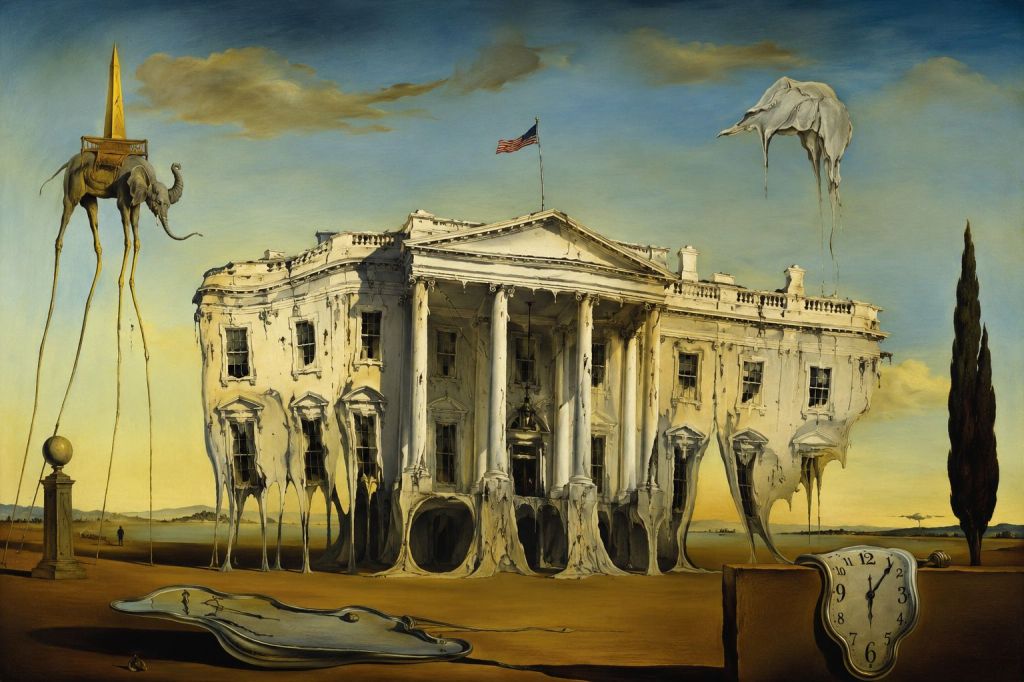
What if this president is actually a supreme political performance artist? What if his presidency is a groundbreaking art project, rather than simply a reflection of his own infirmities for the office?
Proposed here is the possibility that he is just such an artist, a surrealist. In his own terms, the greatest artist ever in history.
This time of year, the male cicadas emerge to call out to potential mates. They are loud. Loud. So loud that the droning outside can be heard inside. The females may find this appealing. Others may not.
Early in the morning I go out to listen to the birds. Lately the birds are singing with the loud cicada drone almost overwhelming the sound. Imagine going to an orchestra concert and having the person in the next seat talking incessantly on the phone through the entire performance.
Yet the birds keep singing. I keep listening. The cicadas will stop at some time. The birds will still be singing and will keep singing. I will keep listening.