Bob Schwartz

Category: Music

Lee and Nancy: Summer Wine and Some Velvet Morning

Phedre - Alexandre Cabanel
When Lee Hazlewood and Nancy Sinatra got together in the 1960s to create pop music (he to write and produce, she to perform and record), who could know that this very day, music fan, you would discover one of those tracks and go “pretty cool”, while the other would elicit “what the heck is that?”

Nancy Sinatra was firstly famous as Frank Sinatra’s daughter, and then as the singer of a string of big hits, most notably These Boots Are Made for Walking. She was never a great singer, but her voice did have an appealing quality (genes count for something), and the material and production were often irresistible.

Lee Hazlewood was the source of many of those hit songs. And then he began performing and recording some of his songs as duets with Nancy Sinatra. If you think that Boots or Sugar Town are all there is to Nancy Sinatra, a couple of these duets just have to be heard.

Summer Wine – Hazlewood’s songs leaned toward country pop, and Summer Wine was a duet in the vein of Jackson from Johnny Cash and June Carter, and scores of other such duets. His pop sensibilities make this work, as does the contrast between his gruff baritone and Sinatra’s sweet not quite innocence. How good is the song? Good enough for it to be well covered even now, including a 2010 collaboration between Andrea Coors and Bono.

Some Velvet Morning – If Summer Wine is cool pop, Some Velvet Morning is something else. Hazlewood is sometimes identified as Cowboy Psychedelic, and the accent here is on psychedelic—in the best possible way. To this day, people argue about whether the song means something or nothing. As usual, reading lyrics don’t do songs justice. But if you want to think about it and listen, consider this:

Lee:
Some velvet morning when I’m straight
I’m gonna open up your gate
And maybe tell you ’bout Phaedra
and how she gave me life
and how she made it in
Some velvet morning when I’m straight

Nancy:
Flowers growing on the hill
Dragonflies and daffodils
Learn from us very much
Look at us but do not touch
Phaedra is my name

Lee:
Some velvet morning when I’m straight
I’m gonna open up your gate
And maybe tell you ’bout Phaedra
and how she gave me life
and how she made it in
Some velvet morning when I’m straight

Nancy:
Flowers are the things we knew
Secrets are the things we grew
Learn from us very much
Look at us but do not touch
Phaedra is my name

Lee:
Some velvet morning when I’m straight
Nancy:
Flowers growing on the hill
Lee:
I’m gonna open up your gate
Nancy:
Dragonflies and daffodils
Lee:
And maybe tell you ’bout Phaedra
Nancy:
Learn from us very much
Lee:
And how she gave me life
Nancy:
Look at us but do not touch
Lee:
and how she made it in

(Phaedra, by the way, is a tragic figure of Greek mythology, in love with her husband’s son—which probably has nothing to do with the song. Or does it? Who can tell with a highly educated psychedelic cowboy?)

In 2003 The Telegraph named this the best pop duet ever:

1. Lee Hazlewood and Nancy Sinatra
Some Velvet Morning, 1968

Most pop music is quickly forgotten. All too rare are the songs that endure, whose sheer otherness takes your breath away, even 30-odd years after they were conceived. Some Velvet Morning belongs in that company. Around the time that Frank Sinatra sang Somethin’ Stupid with his daughter Nancy, she was making other duets which brought a hipper, bolder edge to the format, and which would influence countless subsequent pairings. Nancy conducted these with Lee Hazlewood, a laconic Oklahoman who had masterminded her kitsch anthem of women’s liberation, These Boots Are Made for Walkin’.

In 1967, he recorded songs with her for possible inclusion in her first TV Special, Movin’ With Nancy. One, incredibly, was Some Velvet Morning – one of the strangest, druggiest, most darkly sexual songs ever written. Somehow, perhaps as a sop to the new demographic opening up during the Summer of Love, it made it on to the show. There are “flowers” and “daffodils”, but it’s hardly Sonny and Cher. Hazlewood’s sonorous, old-manly tones tell of “Phaedra, and how she gave me life, and how she made it end”, the reverberating bass sounds surrounding his echoey voice like storm clouds.

The music changes to a skipping, childish rhythm, and Nancy chimes in as Phaedra, innocent but ever more menacing as the verses are intercut more regularly. It’s a song whose mysteries have occasioned numerous covers, most recently by Primal Scream, with Kate Moss “doing” Nancy. None, though, can rival the macabre atmosphere of the original – ambitious, beautiful and unforgettable.

As always, those are just words. The music is in the tracks. Please listen.

Bowie and Gaga: The Shoulders of Giants

Bowie Gaga
If I have seen further, it is by standing on the shoulders of giants.
Isaac Newton

Scroll below today’s news about Egypt or the NSA or dozens of other significant stories and you will come to the contest between the new singles from Katy Perry (Roar) and Lady Gaga (Applause). Which is Number 1? Which is better? Listen if you want, or don’t. Life goes on either way. But music and excellence matter, so a related note.

Depending on whether you want to go back centuries or decades, we are now in the nth generation of popular music. Individual songs or entire genres, music and the styles that go with it are invented, perfected, synthesized, inspired by, borrowed; there is some balance between the entirely new and the entirely old.

The question is whether a listener can take a current artist at face value, without reference to what came before, without knowing (in Newtonian terms) what giant shoulders are stood on, or whether a listener should be aware of the influences, precursors, originators. This becomes particularly important when the earlier or original version was, once it is experienced by comparison, simply better art.

David Bowie’s extraordinary artistry can be summed up in two points.

He has six albums among the Rolling Stone 500 Greatest Albums of All Time. And each of these is created in a different style than the others.

Which brings us to the second point. Aside from creating superb music, Bowie devised the process of total artistic reinvention in pop—not only in musical style, but in performing personality. Up to that time, the assumption was that fans wanted a degree of continuity in their stars. The Beatles had broken through this assumption with a few changes during their short career, but Bowie smashed artistic continuity entirely: Ziggy Stardust, The Thin White Duke, etc. A review of his album covers is a roster of these personas.

Above is an image of Bowie as Ziggy Stardust. Next to it is an image of Lady Gaga from her current ARTPOP album period (all caps from her; it’s that important).

All artistically painted faces are not related, of course. But Gaga acknowledges David Bowie as an artistic influence. This presumably explains the various Gagas during her brief career: the artist dressed in meat, the artist emerging from a plastic womb, etc. Change all the clothes and makeup you want, and say all the right things that make you seem like an artist (Bowie, by the way, let his style do his talking), and it still comes down to music.

So, Gaga fans, if you are reading this, listen up, literally. While she may be copying only his approach to style and not his music, nothing she has done measures up artistically to Bowie. This isn’t a song-by-song, style-by-style comparison. It is a reminder, not just about Gaga but about music new and old, that tastes vary, but excellence doesn’t. With the release of the rest of ARTPOP, maybe there will be some artistic gems. Gaga is actually a talented singer and performer, so it is possible.

But for the moment, and pending further developments: Gaga, we’ve seen David Bowie, we’ve heard David Bowie, and you are no David Bowie. Or Isaac Newton.

(For fans of Isaac Newton, who may be wondering why his picture isn’t included, below is something from his CALCULUS period.)

newton

Bandon by the Sea and Living Forever

Continuum Center
This is about a beach town and the possibility of living forever.

Bandon is a small beach town (about 3,000 people) on the southern coast of Oregon. It is special because of its beauty and spirit, including extraordinary rock outcroppings and stacks of bleached drift logs that hover in the sun and occasional fog. It is also special because few know about it. It is far enough from anywhere—248 miles south of Portland, 465 north of San Francisco—that there are other tourist stops better known and, to some, more exciting.

Bandon 4

The New Age is an ignored topic that deserves more than this brief discussion. In the 1970s, the movement toward a new consciousness coalesced around the concept of a New Age, a new era of human enlightenment and evolution that would move us forward, leaving some of the darkest aspects of our sometimes-sorry history behind. This included not only spirituality and religion, but psychology, art, music, mythology, earth, food, sex—anything that could help transform us and the way we live. By name, “New Age” has fallen into disuse; but as a matter of fact, many of the ideas and expressions are now part of our cultural fabric.

In 1979, philanthropist Hugh Harrison visited the Continuum Exhibit at JFK University in California. The exhibit showcased the Immortality Principle, the possibility of consciousness continuing after death. He was impressed and put the exhibit on tour, and also established a home for it in Bandon, in a building on Main Street called the Continuum Center. It was a splendid multimedia exhibit, state of the art for its time.

Continuum Book
One of faces of the New Age movement that is powerful though sometimes mocked is its music. New Age music was once a common category, though it has fallen into disuse. No good cultural development goes untortured. New Age music at its start and at its best is an attempt to coax, drag, push, pull and otherwise move your consciousness by the ear. In less talented hands it has been oversimplified and underpowered, but no different than with any other musical genre.

When I walked into the Continuum Center in Bandon years ago, I saw the oversized graphics and read about a vision of consciousness. But the very first thing I noticed was the music playing. It was, it turned out, the sublime Angel’s Flight by Shadowfax, and it was the first New Age music I had ever heard. The pictures and text of that visit are a little indistinct in memory, but that song isn’t, maybe because I’ve listened to it a few hundred times since.

A recent visit to Bandon, for the first time in a long time, revealed that not much had changed, a good thing. Maybe it was not a surprise that the Continuum Center as an exhibit is gone. But the building is still there, transformed into a small shopping plaza, but as you’ll see above, the name remains. Spirit abides.

So if any of this is interesting, here’s what to do. Listen to Angel’ Flight and other transportive music by Shadowfax and other worthy New Age artists. Learn a little more about the possibilities of consciousness and change, if you aren’t already doing so. Does consciousness survive death? Who knows, but what a beautiful question.

Last but not least, if your travels take you to the Pacific coast, visit Bandon. Unlike the Continuum Center exhibit, which lasted a few years, the beach and rocks and waves go on and on and on, waiting for you. They will wait forever.

Detroit: Motown and Corvettes and Tigers, Oh My!

Stingray 1963

Sometimes the best way to tell a story is not to tell it. The news about Detroit’s municipal bankruptcy, the biggest ever in America, is like that. Others will tell it at length. Sometimes the best way is to offer a few items that are interesting and related, and let readers and listeners make the connections, draw the lines, complete the picture.

Just in case your dot-connecting doesn’t make it clear, the story of Detroit’s bankruptcy is the biggest American story of the day, and possibly one of the biggest in many years. It is bigger than the story of Trayvon Martin and George Zimmerman, bigger than last fall’s story of the rich son of a former Michigan governor disastrously running for President (and loving those Michigan trees, though not Detroit), bigger than the continuing economic malaise, but related to all of them.

Fifty years ago, in July 1963, Motown Records, Hitsville U.S.A., released the single Heat Wave by Martha and the Vandellas. It reached #4 on the Billboard Top 100, but did top the R&B chart. Like so many Motown records, who cares about the numbers? Motown is some of the best pop music ever produced in America. Want proof? Just play Heat Wave, or other irresistible tracks by the Vandellas, the Temps, the Tops, or put on another Motown single from fifty years ago that did go to #1, the astonishing Fingertips (Part 2) by 11-year-old phenomenon Little Stevie Wonder. Motown founder Berry Gordy was not just a model of black entrepreneurship in a white country, at a time when black voting rights had still not been established, but was the model for some of the hugest entertainment moguls in the world, including Jay-Z. But that was fifty years ago in Detroit.

Fifty years ago, the Corvette Stingray was introduced. Edmunds not only rates it the best Corvette of all time; it says “A full half-century after its debut, the 1963 Corvette coupe remains one of the most alluring automotive designs ever conceived.” The ad above shows an airline pilot in Los Angeles (back when being a pilot was super-special manly, and LA was the city of the future) ogling the new Stingray. He was envying the Motor City vision. But that was fifty years ago.

This very day, as the second half of baseball season begins, the Detroit Tigers are one of the best teams in baseball, with maybe the best pitcher (Max Scherzer) and certainly the best hitter (Miguel Cabrera), who may be on his way to becoming the first player to win consecutive Triple Crowns. Detroit fans appreciate this, and have been showing up for home games at a solid pace, about 37,000 a game—equal to the attendance for the Los Angeles Angels and way more than the 17,000 fans per game that show up in “ultra cool” Miami.

Saying that Detroit will be back from beyond the brink isn’t just wishful thinking. The idea that Detroit can fail but that everybody else in America will be alright is all wrong. The 17th century poet John Donne said it:

No man is an Island, entire of itself; every man is a piece of the Continent, a part of the main; if a clod be washed away by the sea, Europe is the less, as well as if a promontory were, as well as if a manor of thy friends or of thine own were; any man’s death diminishes me, because I am involved in Mankind; And therefore never send to know for whom the bell tolls; It tolls for thee.

And if you don’t go for old poetry that you hated in high school, and would rather forget the troubles of Detroit and the world, Motown has lots to offer, especially on a sweltering July day.

Whenever I’m with him
Something inside starts to burning
And I’m filled with desire
Could it be a devil in me
Or is this the way love’s supposed to be?

It’s like a heat wave, burning in my heart
I can’t keep from crying, it’s tearing me apart

The Voice Has a Big Secret

Danielle Bradbery
The Voice has a big secret, but it has always been hiding in plain sight.

It is no secret that Danielle Bradbery won NBC’s singing competition, or that she should have or would. The overwhelming talent of this 16-year-old phenom—not just compared to her competition, but to professional singers twice her age—left the coaches/judges speechless, literally running out of superlatives. The outspoken Adam Levine on the night of the final performances essentially declared her the winner, before the public votes were cast. (On the results show, he backed off before the announcement, diplomatically offering the opinion that it was close and all the finalists were great.)

Will Danielle become a star or superstar? As with winning The Voice, she should, if there is any justice. But the music business is funny and anything but just. And yet, just like in farm fysics, cream rises, and Danielle is very heavy musical cream.

Now to that secret. The point of The Voice—in its system and even in its name—was to better itself over American Idol, which in the balance between talent and entertainment has weighed heavily towards crowd pleasing and audience building. The Voice was supposed to be, and mostly is, a little more about singing. About “the voice.”

In an instance of cleverness meeting mission, The Voice decided to begin its competition by having the coaches just listen to singers—chairs turned away, not looking. Though performing is about a raft of things, singing is about sound, even at a time when videos sit in parity with audio tracks.

And so, the secret. As much as it seems antithetical to the interests of NBC, its ratings and its sponsors, we are supposed to listen to The Voice, not watch it. We are supposed to be auditors, not viewers, not distracted by the form “the voice” takes, even though that form is obviously critical to live performance and videos. Maybe that works in somebody’s favor (not having the perfect looks or stage presence) or against it (cute does not necessarily sing as cute appears). That is the precise point of the turned around chairs and blind listening.

If you just listen to the live performances and close your eyes, you’ll see. (The studio performances of the same songs, extended, sweetened, smoothed out, are only partly representative).

People have quibbled—been downright defiant—about Danielle for a host of reasons (the internet is where reasons, sound and ridiculous, go to thrive). Maybe the biggest complaint is from those who just don’t like country music, or even claim to “hate” it, which is a legitimate preference. De gustibus non est disputandum—there is no disputing taste.

But for those non-country folk, please be open to the talent, current and historic. Here is Patsy Cline, one of the great pop singers ever, performing Crazy live. or the studio version of Sweet Dreams (more arrangement, a little chorus, but still an unadorned voice in need of no help). There are “the voices” in every genre, and if you would be willing to say “I hate opera, but she sure can sing” then you have to say the say the same about country, blues, R&B, musicals, whatever. In Patsy’s case, she was one of the first to land in the country-pop crossover space, based on the sheer appeal and power of her singing.

This isn’t meant, no way, no how, to compare Danielle to Patsy. Danielle may get close someday; time will tell, but that’s a nearly impossible standard. It’s just meant to remind us that beyond stage performance and videos, beyond human interest back stories, beyond genre fragmentation and hybrids, beyond all the chazerai—a great Yiddish word meaning the insubstantial junk that surrounds important things, there is the singing.

The Voice got that right by showing us how to just listen, chairs turned, eyes closed. The Voice voters got that right by listening to Danielle Bradbery and declaring her “the voice.” It’s no secret that she is.

The Voice: “I Hate This Country”

Adam Levine - The Voice
Adam Levine is a popular musical artist with Maroon 5 and a coach on NBC’s singing competition The Voice.

Last night was an elimination round for two of the remaining eight contestants. Each of the four coaches (including Shakira, Usher and Blake Shelton) has members of their respective teams in the competition.

After the typical tense triage, three contestants remained. Only one would survive. Of those, two were from Team Adam, and one was a talented singer named Judith Hill. She may not have been destined to win, but she was a solid performer who had already had a career as a backup singer for Michael Jackson, and might yet get a chance on her own. The two other singers remaining were not in her league.

The camera was on those three as host Carson Daly pronounced the obligatory nail-biting “America has voted” spiel. In the background, you could hear a simple comment from Coach Adam, as he likely sensed that the most worthy of the three was about to be eliminated:

“I hate this country.”

Meaning, one presumes: I hate these stupid popularity contests, even one that I am a part of, where merit matters less than the judgment of numbers and the crowd. I don’t hate America, but I hate it when America speaks like this.

And then, Judith Hill was gone.

Every one of the artist-coaches has built a successful career, and knows that entertainment, like every other field, is not entirely a meritocracy. Still, even accounting for differences in taste, a few minutes of singing can reveal those with consistent control, those who can find and hit all the notes, those who can put power and style in what they sing—and those who can’t.

So Adam, and everybody else who gets frustrated by singing competitions that don’t always give us the best, or political systems that don’t either, embrace your frustration. At least it means that you haven’t given up, that you still have standards, that you still have hope and expectations that the competitions and elections will give us winners who really can sing—even if we lose some worthy ones along the way.

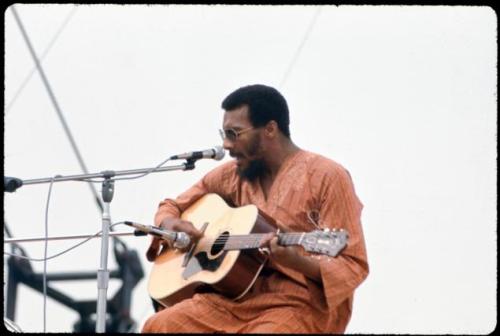
Richie Havens

Richie Havens
Every artist wants their spirit to be a presence, and to stay a presence. Every artist would love to be so recognizable that with just one note sung a listener would be certain—and would instantly want to hear more.

Since Richie Havens released his album Mixed Bag, and since his legendary performance at Woodstock, he grew older but never changed. Decades where peace, love and freedom looked like something radical, then something hip, then something imminent, then something commercial, then something distant and quaint, he did just what artists do. He stayed true to himself, true to his ideals, true to his craft as a unique troubadour. He was irresistible and his music still is.

Richie Havens died yesterday at the age of 72.

And close your eyes, child, and look at what I’ll show you;
Let your mind go reeling out and let the breezes blow you,
And maybe when we meet then suddenly I will know you.
If all the things you see ain’t what they seem,
Then don’t mind me cause I ain’t nothing but a dream,
And you can follow…

Happy Record Store Day: I Like It Like That

I Like It LIke That
To celebrate International Record Store Day on April 20, Ambassador Jack White might have visited I Like It Like That Records & Tapes on Main Street in Newark, Delaware.

The problem is that the second most important record store in my life is no longer around. Hasn’t been for years. And even if it was, I’m not sure Jack White would be there, though he would have been welcome.

(The first most important record store? A hole in the wall in New Jersey, which soaked up every bit of available adolescent cash, like a dealer peddling stuff to an underage junkie. A gateway drug.)

For the record, Newark has a number of musical distinctions.

The Stone Balloon, also on Main Street, was the site of some epic performances by not-quite-yet-superstars like Bruce Springsteen. That The Balloon is now a “Winehouse” says something about civic and commercial evolution, though there’s too much loud laughter to tell that story.

The Deer Park, also on Main Street, is even more important musically than The Balloon. George Thorogood and the Destroyers began as George Thorogood and the Delaware Destroyers, and back then George could be found some Thursday nights at the Park, finishing off the destruction of masses of Newark townies with his guitar.

But this is about I Like It Like That. Main Street had a number of worthwhile places to simultaneously be enlightened and spend/kill lots of time. Two in the pantheon were the world’s greatest and most significant bookstore and I Like It Like That.

Somewhere in space, the sounds of I Like It Like That are still reverbing, though those alien rockers will be missing the feeling of walking through that door into another world (though, technically, they are in another world).

To celebrate, one thing would be a marathon playing of Frampton Comes Alive—the most overbought and traded-in album of all time, at least by ILILT standards. Wah-wah-wah-wah-wah-wah-wah-wah-wah.

Better yet, the name of the store is I Like It Like That. So let’s sing:

They got a little place
Across the track
The name of the place is
I Like It Like That
Now, you take Sally
And I’ll take Sue
And we are gonna rock away
All our blues

Now, the last time I was down there
I lost my shoes
They had some cat
Shoutin’ the blues
The people was yellin’
Out for more
And all they were sayin’
Was, ‘Go man go’

Come on, let me show you where it’s at
The name of the place is
I Like It Like That

Every record store, past, present and future, is where it’s at. BJL, JG and DC—thanks and rock on.

Accidental Racist or Ebony and Ivory

Accidental Racist
You know that the controversy about Accidental Racist, the track and video from Brad Paisley’s new Wheelhouse album, is way out of hand when he is criticized for not being a “real” Southerner anyway because he was born in West Virginia and only now lives in Tennessee.

Seriously.

If you haven’t heard, Accidental Racist is a collaboration between Paisley and LL Cool J. You can find, listen to and purchase the audio. But the official video was pulled almost immediately, in the wake of an unprecedented avalanche of criticism and derision of the song—musically, culturally, politically, sociologically, morally—which adds up to this: It is the worst, most misguided, most laughable, most unlistenable record ever.

What did Brad Paisley, not quite authentic Southerner, and certainly a musical lightweight (20 number one singles, but those were country number ones), do to deserve this?

He wrote and recorded a song that, stripped to its essentials, says that it’s hard to be a Southerner because people come at you with all kinds of presuppositions, not the least of which is that everything you do or say has to be measured against a history which you were not involved in, which doesn’t reflect who you are, and which puts you in the position of not being quite sure of what you can embrace and what you have to reject. LL Cool J comes in to briefly add exactly the same perspective for urban black men.

Simplistic and clumsy, musically and poetically? Maybe. Sincere? Absolutely. Reflects a real problem for Southerners, who just like post-War Germans, have a culture they are proud of, but have to still perform a delicate balancing act to make sure they aren’t the wrong kind of proud so that they can distance themselves from aspects of their own history and from that very culture? If you think that’s easy, try it yourself.

Is Accidental Racist really that bad? Submitted for your consideration, Sir Paul McCartney and Sir Stevie Wonder (he deserves a knighthood too). These two are musical geniuses and real humanitarians. Brad Paisley and LL Cool J would be the first to admit that they are not in their league.

The success of McCartney and Wonder includes their collaboration Ebony and Ivory, which spent seven weeks as a number one single in 1982. The song did not propose anything  challenging or deep about racism, nothing about history, or blame, or stereotypes. Instead, it all comes down to something obvious, something uncontroversial that nobody could complain about. Maybe covering this would have been a better choice in 2013. Or maybe not.

Ebony and Ivory

Ebony and ivory live together in perfect harmony
Side by side on my piano keyboard, oh Lord, why don’t we?

We all know that people are the same where ever we go
There is good and bad in everyone
We learn to live, we learn to give
Each other what we need to survive together alive

Ebony and ivory live together in perfect harmony
Side by side on my piano keyboard, oh Lord, why don’t we?
Ebony, ivory living in perfect harmony
Ebony, ivory, ooh

We all know that people are the same where ever we go
There is good and bad in everyone
We learn to live, we learn to give
Each other what we need to survive together alive

Ebony and ivory live together in perfect harmony
Side by side on my piano keyboard, oh Lord why don’t we?

Close to Her

Karen Carpenter
This past week on American Idol, a show on life support, some finalist named Lazaro—whose back story includes the fact that he apparently doesn’t speak English and he stutters—chose to perform the song Close to You by the Carpenters.

Also, Lazaro apparently can’t sing. The performance was rated by Idol experts as the worst ever in the show’s history. It is available online, but please don’t listen; treatment for it will require years of therapy. Lazaro was summarily eliminated by viewers.

In a 1994 tribute album, If I Were a Carpenter, Karen Carpenter songs are covered by an amazing collection of artists. In the video of their version of Superstar,  Sonic Youth includes a Karen Carpenter montage, with their riding around in a convertible, passing a sign announcing “Now Entering Downey, Home of the Carpenters.” It is a moving tribute, and the vocal couldn’t be any farther from Karen Carpenter’s.

Here’s why: no vocals are close to Karen Carpenter’s, and nobody sane or self aware goes there. Not even her brother Richard’s heavy-handed arrangements and production—responsible for their massive commercial success—could obscure that. Watching her sing is a revelation. The revelation is that while she certainly knew she was good, she probably had no idea just how good (or beautiful) she really was. Knowing she was so much more than good enough might not have saved her, but she was that good.

How good? If she was in a competition like American Idol, they would just stop the season right there, if not cancel the show entirely. Same thing if she was on The Voice, because they would have found The Voice. Search over.

In 1980, she sang a television duet with Ella Fitzgerald.  If there has ever been a queen of American popular song, Ella may have been it. Duets are funny things. They are frequently a bit off or complete misfires, even when the two artists are separately good. Another thing is that each one of the pair has to bring something special, even when they are not artistic equals. Comparing Karen to Ella, or anyone to Ella, is like comparing anyone to Karen: pointless. In the case of this duet, remember that Ella was renowned for her purity of tone, her effortless range, and for that something that was supremely and gorgeously her. All those things can be said about Karen Carpenter. Ella was already having health problems at this point, though you wouldn’t know it from her voice, and she would live for another sixteen years to the age of 79. Karen was visibly suffering from the problem that would end her life, three years later, at the age of 32.

Karen Carpenter singing Superstar.