Bob Schwartz

Tag: Spirituality

How to Prepare Spiritually for the Debate

The Clinton-Trump debate is taking place tonight, if you hadn’t heard. People will watch for a whole lot of different reasons. Some to see the candidate they like succeed, some to see the candidate they don’t like that much succeed, some to see the candidate they really don’t like be destroyed, some because they just like to watch twisted spectacles and disaster movies. Sharknado, maybe?

The term soul-sucking may be colloquial, but there’s real truth in it. Some things just seem to draw the life force right out of you, creating a spiritual vacuum. Depending on your perspective, this debate could be one of those.

Here are three optional steps for dealing with this.

  1. Don’t watch. Estimates are that over 100 million people may watch this. This might include friends and loved ones, and it might include you. Which makes it unlikely that you won’t watch a little of it, or the whole thing. Friends don’t let friends watch alone.
  1. Prior to watching, read something or do something that will settle you firmly on the ground and in reality. This may already be part of your regular practice. If not, this may be a good time to start.
  1. After watching, you will notice seemingly millions of talking heads trying to spin what you’ve already seen and heard, or trying to prove how smart they are by repeating what you’ve already seen and heard, and then telling you about it, attempting to impart meaning to what you may regard as meaningless. At that point, if you insist on listening to them, repeat Step 2.
Music: Calling All Angels

Calling All Angels

The last post discussed asking angels to intercede on behalf our attempts to turn as a new year (Rosh Hashanah) begins. Whether or not you believe in angels, whether or not you believe they have any influence, it never hurts to ask.

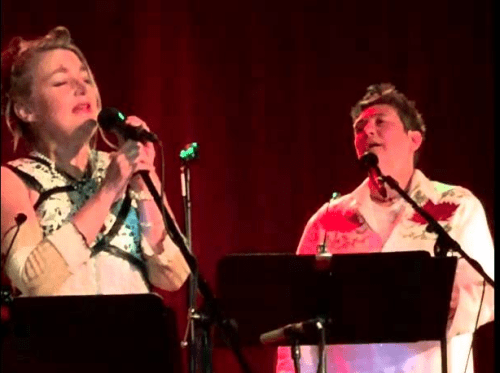
Here is a favorite angels song, Calling All Angels, written by the great Jane Siberry, performed by Siberry and the equally great KD Lang.

Calling All Angels

Santa Maria, Santa Teresa, Santa Anna, Santa Susannah
Santa Cecilia, Santa Copelia, Santa Domenica, Mary Angelica
Frater Achad, Frater Pietro, Julianus, Petronilla
Santa, Santos, Miroslaw, Vladimir and all the rest

A man is placed upon the steps and a baby cries
High above you can hear the church bells start to ring
And as the heaviness, oh, the heaviness, the body settles in
Somewhere you can hear a mother sing

Then it’s one foot, then the other as you step out on the road
Step out on the road, how much weight, how much?
Then it’s how long and how far and how many times
Oh, before it’s too late?

Oh, and every day you gaze upon the sunset with such love and intensity
Why?
It’s ah, it’s almost as if you could only crack the code then you’d finally understand
What this all means

Oh, but if you could, do you think you would trade in all
All the pain and suffering?
Oh, but then you’d miss the beauty of the light upon this earth
And the sweetness of the leaving

Calling all angels, calling all angels
Walk me through this one, don’t leave me alone
Calling all angels, calling all angels
We’re tryin’, we’re hopin’, we’re hurtin’, we’re lovin’
We’re cryin’, we’re callin’ ’cause we’re not sure how this goes

Selichot and Angels


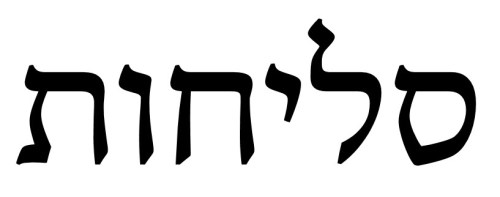
Selichot

Do Jews pray to angels? Do all of us need all the help we can get?

The Jewish Days of Awe begin soon, starting with Rosh Hashanah on the evening of October 2, ending with Yom Kippur on the evening of October 11.

It is a time of teshuvah, often translated as “repentance”, but more precisely “turning”—that is, turning away from ourselves and our ways and to God and godly ways. To start the process of reflection, on a Saturday night before Rosh Hashanah a special set of preparatory prayers begin to be recited, known as Selichot. This year, Selichot begins tonight, on the night of Saturday, September 24.

The conventional cast of characters in the soulful dialogue of teshuvah and the Days of Awe are yourself, the people and world around you, and God. But Rabbi Geoffrey W. Dennis, in the fascinating Encyclopedia of Jewish Myth, Magic and Mysticism, adds an unexpected player:

Machnisei Rachamim (Conveyors of Compassion)

This is a prayer petitioning the angels to intervene with God:

Conveyers of compassions, obtain our mercy before the Master of compassion,
Makers of prayer, make our prayer heard before the Hearer of prayer.
Makers of wailing, make our wail heard, before the Hearer of wailing.
Conveyers of tears, convey our tears before the King who yields to tears.
Strive to raise up supplication, raise up supplication and plea,
Before the King, high and exalted. The King, high and exalted.

This prayer is only recited at Selichot, a penitential service recited prior to the coming of Rosh Hashanah.

This prayer is anomalous in that the rule that Jews should pray only to God, and not to intermediaries, extends back to Talmudic times: “If troubles come upon a person, do not entreat the angel Michael or the angel Gabriel. Rather, entreat Me alone and I will help you immediately” (J. Ber. 9:1). Maimonides makes this normative, “It is only fitting to pray to God and it is not fitting to pray to any other.”

The Maharal of Prague was sufficiently troubled by the appearance of this prayer that he amended the wording (Netivot Olam, Netiv Ha’Avodah no.12), an innovation that did not catch on. In modern times, no less an ultra-Orthodox authority than the Hatam Sofer wrote that at Selichot he personally skips over this prayer (Orach Chaim no. 166), a shocking confession from the leader of a community that insists ALL of the tradition is sanctified and obligatory. The prayer has been entirely edited out of Selichot liturgy in the modernist Reform movement.

And yet at least one Midrash exists that endorses the idea of angels as intermediaries of our prayers (S of S R. 2:7). And many Jews worldwide recite the words barchuni l’shalom … (“bless me with peace”), when they sing the popular Shabbat hymn, Shalom Aleichem. This prayer is found only in the Ashkenazi (northern European) tradition, suggesting it was written when Jews were surrounded by a Christian culture that emphasized the use of divine intermediaries (saints) and even had services in honor of specific angels (Michaelmas).

Music: Calling on John Coltrane

A Love Supreme

The last post was about Gil Scott-Heron’s Lady Day and John Coltrane. Realizing now that some (most?) readers were not familiar with Coltrane, here’s some background and suggestions.

Music fans love to debate “the best”. There is no debate here. Coltrane was the best saxophonist, and some would argue, jazz player. Along with his gifts as an artist, part of that is how spiritual his music is.

He came by that spirituality when, in the midst of his too short career, he kicked a heroin habit by finding a Higher Power. The truth is that he had always been channeling that Higher Power. He just hadn’t been aware of it.

His most overtly spiritual work is A Love Supreme. For those who are not jazz listeners, this may be a bit challenging for a first stop. But at some point, please give this a listen. Bach and centuries of holy music have nothing on Coltrane.

A good place to start gently is the album My Favorite Things, which opens with the title track. All due respect to Julie Andrews (who I do like), this is the famous Sound of Music song in a whole other cosmos. While you’re there, stick around for the next track, a slowly lyrical Every Time You Say Goodbye, a perfect piece of love’s longing, Coltrane style.

Praying for Everybody. Even Trump.

I ran into a neighbor this morning, someone who goes to morning prayers every day.

Me: How was davening (prayer) today?

Him: Good. I prayed for everybody. Even Trump.

Me: Thank you. That’s the Yiddishe (Jewish) way.

And so it is.

Reason and spirit, wisdom and compassion

Reason

Reason
as solid
as a rock.
Clinging to it
in the middle
of the ocean.

When I look to friends, colleagues and mentors who have taught and influenced me, I see in many of them a happy and helpful balance of reason and spirit. I thank them, and recommend having such people in your life.

This may be what I might want others to say of me, that I neither abandoned reason nor clung to it too tightly.

Lao-tzu’s Taoteching

Taoteching

“The world is a spiritual thing.”

Taoteching, Chapter 29

Trying to govern the world with force
I see this not succeeding
the world is a spiritual thing
it can’t be forced
to force it is to harm it
to control it is to lose it
sometimes things lead
sometimes they follow
sometimes they blow hot
sometimes they blow cold
sometimes they expand
sometimes they collapse
sages therefore avoid extremes
avoid extravagance
avoid excess

Reading and studying the little (81 tiny chapters) and infinite pool of Lao-tzu’s Tao Te Ching is as valuable as knowing any text from any tradition. Of the dozens of translations into English, all different and many worthy, the one by Red Pine—the translator and scholar Bill Porter—is the place to visit and rest awake. Along with his translation, he includes excerpts from 2,000 years of commentaries.

Poem: My Night with the Sages

Talmud

My Night with the Sages

I found their numbers
Six, sixty-three.
Dispensing wisdom
Demanding action
Citing authority.
Talking
And talking
And talking.
How could they possibly
Help with the night?
Lost in loud logic
Where is the comfort or distraction?
But I called anyway
And they came.
To uneasy free floating
In the bleak
They added gravity
And light
Not quite
In reach
But there.
To sleep.

The Whole Wheat of Spirit and the Millstone of Reason

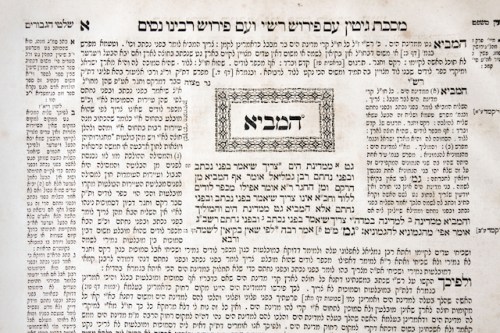
Encyclopedia of Jewish Myth

Going beyond pure reason is a trip too far for many, to a place where the possible and the impossible seem to coexist on equal terms.

But why not go beyond, at least for a visit or vacation? You never know what you will find or learn there.

Mama always told me not to look into the sights of the sun
Oh but mama that’s where the fun is
Bruce Springsteen, Blinded by the Light

To the pious man God is as real as life, and as nobody would be satisfied with mere knowing or reading about life, so he is not content to suppose or to prove logically that there is a God; he wants to feel and to give himself to Him; not only to obey but to approach Him. His desire is to taste the whole wheat of spirit before it is ground by the millstone of reason. He would rather be overwhelmed by the symbols of the inconceivable than wield the definitions of the superficial.
Abraham Joshua Heschel, Man Is Not Alone

Recommended:

The Encyclopedia of Jewish Myth, Magic and Mysticism: Second Edition, Geoffrey W. Dennis

The new edition of a thoroughly readable and accessible compendium of information and insights. Fun for the casually curious, valuable for the interested reader and researcher.

From the Introduction:

Judaism is one of the oldest living esoteric traditions in the world. Virtually every form of Western mysticism and spiritualism known today draws upon Jewish mythic and occult teachings—magic, prayer, angelology, alchemy, numerology, astral projection, dream interpretation, astrology, amulets, divination, altered states of consciousness, alternative, and rituals of power—all have roots in the Jewish occult….

Modern Jews like to imagine that magic has been swept into the dustbin of history by the long, inexorable progress of rationalism. More than that, Jews have been taught from our youth that Judaism has always possessed an essentially naturalistic worldview and that magic, merely a marginal Jewish preoccupation at most, was just an anomaly resulting from our being situated (and corrupted) by the superstitions of our neighbors. But that’s not entirely accurate. It is only in the last two centuries that Jews have fully embraced science, but we have always been looking for ways to change the world for the better, whether it be through science, medicine, or “practical Kabbalah.”

Even today, rationalism has not completely displaced our sense that there is a mystical potential at work in the world; Occam’s razor has never been able to fully overpower the Sixteen-Sided Sword of the Almighty. Millions of people, both Jews and gentiles, continue to believe that the stars influence our lives. Most Americans believe in the reality of angels. Jewish techniques of dream interpretation and for combating the evil eye are still widely practiced today. When you read the entries of this book on topics such as these, you will realize that magical thinking and enchanting deeds have always had a place in Judaism and, however much some might want to dismiss Judaism’s miraculous and wondrous traditions, the presence of Jewish magic in Jewish life has merely been eclipsed, never uprooted; it still has the potential to empower us.

Mystic Maps

Maps

Mystic Maps

Before the journey
The maps were few,
Colorful, promising.
Destination uncertain
Roads to travel
Randomly real.
More maps
Until there was no room
To hold them
No time
To study them.
The map makers,
Had they seen these roads
Visited these towns
Or are these conjectures
Visions, fantasies
Conjured up?
Map makers or magicians
Directions or tricks,
Now I see where they took me
Where I stop and sit.
Time and joy
For the maps
And the trip.