Bob Schwartz

Tag: Bible

Why We Should Teach and Learn Ancient History First

Children in America who attend some sort of religious school, even before going to secular school, may learn some limited sort of ancient history. Ancient in that it concerns purported people and events from millennia ago. Limited in that some number of those people and events, however instructional and enlightening, may be of some historical question.

There is other ancient history worth teaching our kids early, and catching up with ourselves, just in case we missed it in our own education. There are continuous civilizations all around the world that have been ongoing, in the same place, also for millennia.

China, for example. Or India. Or the native populations in the Americas. This is where education should start, before we start talking about admittedly important people arriving on these North American shores and establishing an admittedly important nation just a few centuries ago.

Why? Because it would give us a sense of perspective on what we have, or have not, achieved so far. And because it would give us a missing sense of the scope of history, in that everything comes and goes. Which you could learn from the history of China. Or you could learn from reading the I Ching, the book about things changing, written in China millennia ago. Or if you prefer something more Western and familiar, from reading the Bible itself. A time for every purpose, it says. And so it goes.

Translators May Be Traitors

If you read important books that are written in a language other than your own, you are at a disadvantage. You are depending on the kindness or brilliance of strangers. On translators.

That is doubly complicated if the original text is ancient, and the original language itself is a mystery, even for those who are expert.

The Bible, both First and Second Testaments, not to mention collatral ancient scriptural books and fragments, are a well-known example. The same problem arises with Asian texts such as the Tao Te Ching, the I Ching, or early Buddhist discourses.

So you see the challenge. Jesus or the Buddha said great things in their native language. Nobody transcribed them when spoken. The thoughts and words were remembered and kept accurately alive, as accurately as possible, in oral transmission and storage. Then they were set down in writing, in a language related to the original speech, maybe, but later in entirely different languages. And as the words migrated, the texts were overlaid and transformed, even as there was a sincere attempt to preserve the original.

Finally, they come to you, in the language you speak, read and understand. Which is far removed from the original.

When the French had the audacity to translate Dante into their own language, the Italians came up with a harsh accusation: Traduttore, traditore. Translator, traitor.

Consider that when you read translations, you are someone who cannot read yourself, or even see. You are in the dark. You depend on those who read to you. And hope that they are good and true readers themselves.

Babel On

Babel On

What is the point and price of
The tower of words and thoughts?

High and fine
To reach higher and finer.

Was God protective,
Jealous even,
Of the secret word
That would reveal all
And make him redundant,
Obsolete, inferior?

Or was it a sign
We couldn’t read
That in the clouds,
On the moon,
Mars, the stars
We would find nothing but ourselves
Still babbling
Traveling
Going nowhere?

Donald Trump Wants to Make the Bible Great Again!

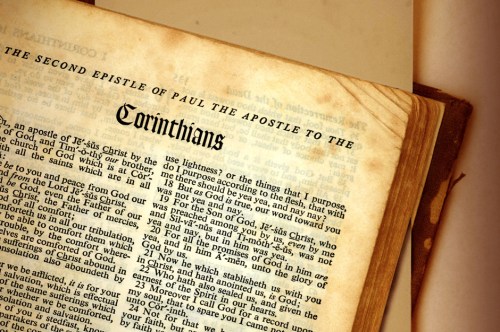
2 Corinthians

Donald Trump spoke to an assembly of students at Liberty University, one of the best-known evangelical colleges in the country. He quoted a Bible passage to show his depth of Christian faith and knowledge.

In doing that, he mispronounced the name of the New Testament book “2 Corinthians” as “Two Corinthians.” It is in fact universally called “Second Corinthians.” Anyone who has glancing familiarity with the Bible knows that, including five-year-olds in Sunday School. Every time there is a numbered series of books (such as 1 Kings and 2 Kings in the Old Testament, etc.), they are called by the ordinal number (First, Second).

Does this prove that Trump has little familiarity with the Bible? Yes. Does this prove that he is willing to cynically use faith as a tool to “close the deal” on the Republican nomination? Yes. Will this affect his support among evangelical Christians, Christians in general, or people of faith? Who knows?

Here’s the thing. It was no mistake.

Trump may not know much about the Bible or about the Presbyterian Church he identifies himself as belonging to. But he knows a “not great” situation when he sees it. Calling these books “First” or “Second” makes no sense. Plus, it’s a waste of time and breath. Everyone knows that Trump is all about making sense and not wasting breath.

And so, this is part of his strategy to make everything terrific. He wants to change the way people have been referring to the Bible for centuries.

He wants to make the Bible great again! Who can blame him? Thank you, Donald.

Chaos and Order in the Bible

The most important section of the Old Testament, even for non-readers and non-believers, is the beginning, the stories of creation up to the appearance of people. (Stories plural, because there are two different versions of creation in Genesis.)

The second thing that happens in the Bible is that God brings order. But the first thing is the chaos from which that order is brought, chaos presumably also created, and created first.

For most of our religions and their histories, this task of putting matters in good order has been a primary mission. Protocols, hierarchies, calendars, rules. In imitation of God. Orderliness is next to godliness. Order, though, in religion and in our lives, can take on the color of compulsion.

Chaos not only preceded order in the Bible, it became a continuing theme. People are constantly getting lost and tossed around, in floods, in deserts. Being found or finding a way is presumed to be the highest value. And yet the very first moment is not just chaos, but created chaos. Not just a necessary predicate, but a necessary ongoing and perpetual element. No lost, no found.

The Eight Ways of Hanukkah

happy-hanukkah

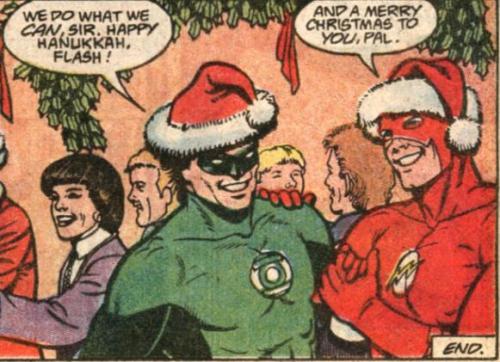
Hanukkah, which begins at sunset with the lighting of the first candle, may be the most interesting, confusing, and confused of Jewish holidays. Let me count the ways.

1. It is the most historic of the traditional Jewish holidays. The historicity of more important holidays is somewhat shrouded in antiquity, bible stories, and faith. We have a pretty good chronicle of the events commemorated by Hanukkah: the Jewish rebellion of around 163 BCE led by the Maccabee family against the Seleucid/Syrian occupiers of Israel.

2. The best chronicle of Hanukkah is found in the Books of Maccabees. Maccabees is found in the bible, but because of textual happenstance, not in the Jewish Bible. Books of Maccabees are part of the Roman Catholic and Eastern Orthodox bibles, and are apocryphal books of the Protestant bible. But the Jewish biblical canon (the books officially included) was closed before these books were available. So if Jews want to read this particular biblical story, they have to turn to Christian bibles. Not that there’s anything wrong with that.

3. Hanukkah is probably not just about the Maccabees. As with other holidays, including Christmas, it is likely a melding of other seasonal celebrations at that time of year.

4. Because Hanukkah is extra-biblical, it did not achieve the stature of other holidays. You will often see it referred to as a “minor” holiday. In baseball terms, though, Hanukkah is at least AAA minor league, that is, completely ready to play in the majors. Which, as it turned out, it kind of does.

5. How Hanukkah became a much more important holiday than ever is covered by the wonderful book Hanukkah in America. For one thing, the original story of the Maccabees is about fighting not just the occupiers but the tendency of Jews in that situation toward assimilation and Hellenization. This obviously resonated in America, where secular culture and particularly Christmas became a juggernaut.

6. The candelabra used on Hanukkah for the eight nights of lights is usually referred to, by Jews and non-Jews alike, as a menorah. This is not exactly right. A menorah is a lamp, more particularly the seven-armed lamp that is an abiding symbol of Judaism and Israel. The lamp lit at Hanukkah is more properly called a hanukkiah. But hardly ever is.

7. The spelling of the word Hanukkah in English remains an unsettled mess. “Hanukkah” is now prevalent, but there is still plenty of the older “Chanukah” or, less likely, “Chanukkah” or other variations. The problem stems from trying to transliterate a Hebrew word into English—especially a word that has the guttural “ch” sound not heard in English (that is, not “ch” as in China). But as the saying goes: You can spell it Hanukkah or Chanukah, just don’t call me late for latkes. (No, that’s not an actual saying.)

8. This is from a little book that is a century old. The Hanukkah Festival: Outline of Lessons for Teachers (1914) was published by The Teachers’ Institute of the Hebrew Union College in Cincinnati and written by Rabbi Louis Grossmann, its principal. One of the benedictions for lighting the candles goes well beyond Judaism, history, or faith. It should work for just about anyone, tonight and every night.

Eight days long the Lights burned in the homes of our Fathers, and eight days long they rejoiced. One little flask of sacred oil was enough to illumine the Temple and to keep it bright. So each one of us may gladden those with whom we are, and the Light within our heart may make bright all who are about us.

Happy Hanukkah.

The Tower of Babel and Technological Humility

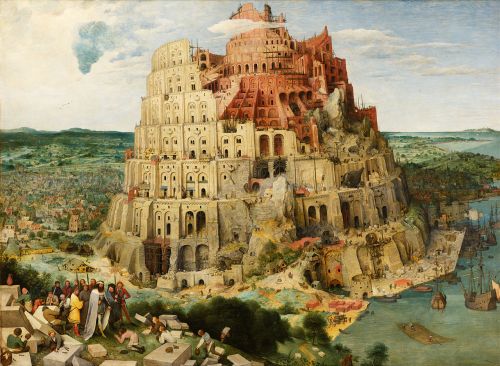
Tower of Babel - Bruegel the Elder

This week’s Torah reading, Genesis 6:9-11:32, includes two very different STEM achievements.

The first is the story of Noah, with a boat big enough to hold representatives of everything that lives (but does not swim). The ark’s purpose is to save all life in the face of an ultimate disaster. It works.

The other story is the Tower of Babel, with an immensely tall structure that has no obvious or express practical purpose. It is an early and elegant literary example of “because we can” philosophy. Think of it as a giant cosmic finger by some very arrogant builders.

Giving the finger is always rude and dangerous. Here, though, there is no violent retribution and no smiting by flood or fire. Instead, the result of that technological arrogance is eternal confusion and failure to communicate.

The Hebrew Bible has lots to say about human behavior, psychology, and spirituality. But no story may have more to tell us about life today than the Tower of Babel, especially when read in conjunction with Noah.

If we think we can build a boat big enough to save us from a particular catastrophe, maybe we can. But even then, as the rest of the post-Noah biblical stories and the rest of world history demonstrate, staying dry in the flood is just the beginning of our problems.

And if we think we can just show how smart we are by concocting a bunch of oversized technological wonders, monuments of pride, we may find ourselves, as the saying goes, too clever by half.

Consequences are inevitable. Purposes are necessary. Really big towers are awesomely cool. Just be sure you know, more or less, what you’re doing and why.


And all the earth was one language, oe set of words. And it happened as they journeyed from the east that they found a valley in the land of Shinar and settled there. And they said to each other, “Come, let us bake bricks and burn them hard.” And the brick served them as stone, and bitumen served them as mortar. And they said, “Come, let us build us a city and a tower with its top in the heavens, that we may make us a name, lest we be scattered over all the earth.” And the LORD came down to see the city and the tower that the human creatures had built. And the LORD said, “As one people with one language for all, if this is what they have begun to do, now nothing they plot to do will elude them. Come, let us go down and baffle their language there so that they will not understand each other’s language.” And the LORD scattered them from there over all the earth and they left off building the city. Therefore it is called Babel, for there the LORD made the language of all the earth babble. And from there the LORD scattered them over all the earth.

Genesis 11:1-9
The Five Books of Moses: A Translation with Commentary
Robert Alter

In the Beginning, Again

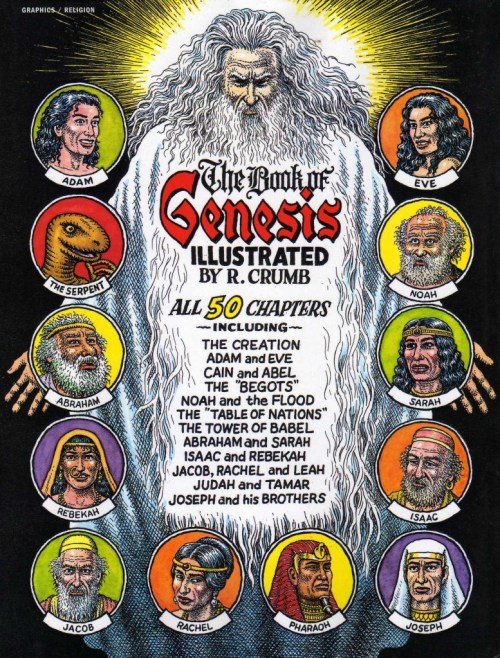
Genesis Illustrated Cover

This Sabbath, the annual cycle of Torah readings starts all over again. Again. Back to the beginning. Genesis (Breisheit), Chapter 1.

In the beginning….Well, you probably know how it goes. But don’t be jaded by familiarity. And don’t avoid it or be put off by belief that this and all the Genesis stories that follow are neither history nor science. So what? These are big stories and we need big stories. Not to be used as clubs to beat us up (though there is that), but as invitations and portals to bigger things. If not, then why are so many watching Hunger Games or Downtown Abbey?

Instead of learned discourse, here is something much more fun. R. Crumb, one of the great comic artists (beginning with his classic underground comics in the 1960s—Mr. Natural, etc.), published his Book of Genesis Illustrated in 2010.

Genesis Illustrated Back Cover

(If you don’t like pictures or Crumb’s illustrations, you might just try the excellent translation of Genesis that Crumb used, by Robert Alter)

Take a moment, whatever your inclinations, and allow yourself to be awed. Whatever you think is awesome, the sudden appearance of everything is more awesome than that, however you explain it. And for those who are waiting to see the Big Guy with the long beard–you know you’ve just gotta have it–here it is.

Genesis Illustrated Page 1

Why I Read the Qur’an This Yom Kippur

Qur'an

There comes a time on Yom Kippur, the holiest day on the Jewish calendar, when the official proceedings pause. In the space between morning and afternoon services, lunch on a fast day not being an option, some people engage in group discussions of matters biblical and theological. A sort of hungry High Holy Days Torah study.

This year, I read the Qur’an.

At Yom Kippur services, the Book of Jonah is read. I made that the topic of my High Holy Days blog post, writing that Jonah is a tale we tell to the youngest children, as if, literally, a five-year-old would get it. In fact, Jonah is unique among all Old Testament prophetic books, and may be one of the most variously interpreted texts in the Hebrew Bible. So if you or that five-year-old think it is the simple story of obedience to God and the power of repentance, you might think twice.

Then a few days later, it was reported that an Iranian psychotherapist had just been hanged for, among other things, misinterpreting the Qur’an and insulting the prophet Jonah. For those unfamiliar with the Qur’an, many of the major figures of the Bible—Abraham, Noah, Moses, Jesus, and others—make appearances there. Sometimes it is a quick mention, but they are important links in the chain leading to Mohammed. Jonah among them.

This then became for me the Yom Kippur of Jonah. The Book of Jonah is so short, four brief chapters, that it can be read in minutes. While I have read many of the suras (chapters) in the Qur’an, I had never focused on the role of Jonah.

My interest in Qur’an began years ago with an extraordinary 3-volume set, Judaism, Christianity, and Islam by Professor F. E. Peters. Peters is one of the leading scholars on the shared foundations of these faiths, and this work offers parallel scriptural excerpts from each on a range of themes. I was well-versed in the Bible, Jewish and Christian, but had never read a single word of Qur’an. This began my still-ongoing attempt to fill that gap.

Literacy and familiarity with Abrahamic scriptures—reading them, being aware of structure and content, knowing some of the theological and interpretive issues—might run from 0 (no knowledge) to 10 (comprehensive knowledge). On that scale, many if not most Jews would probably score a 2 for the Hebrew Bible (maybe higher if limited to Torah and assorted familiar books of the Tanach), 0 for the New Testament, and a negative number for the Qur’an, that is, a studied and sometimes antagonistic ignorance. No blame for any of that, though we hope that those who engage in discussion or offer opinions about them might do it with some measure of knowledge.

The sura Jonah (Yonus) in the Qur’an is not what a non-Muslim might expect. Jonah is mentioned only once in it at verse 98:

If only a single town had believed and benefited from its belief! Only Jonah’s people did so, and when they believed, We relieved them of the punishment of disgrace in the life of this world, and let them enjoy life for a time.

The next verse of the sura encourages the Prophet (Mohammed) to be patient in waiting for unbelievers to come around:

Had your Lord willed, all the people on earth would have believed. So can you [Prophet] compel people to believe?

The more familiar biblical story is found at verse 139 of the sura Al-Saffat (37). As with many of the Qur’an’s recaps of these stories, it is very condensed:

Jonah too was one of the messengers. He fled to the overloaded ship. They cast lots, he suffered defeat, and a great fish swallowed him, for he had committed blameworthy acts. If he had not been one of those who glorified God, he would have stayed in its belly until the Day when all are raised up, but We cast him out, sick, on to a barren shore, and made a gourd tree grow above him. We sent him to a hundred thousand people or more. They believed, so We let them live out their lives.

It isn’t clear from the reports how the psychotherapist, who was leading a Qur’an study, insulted Jonah. It is true that much of official Islam “discourages” unorthodox translation and interpretation (in some cases with fatwas, imprisonment, and death). It is also true that translators, scholars, and teachers have continued to push the boundaries anyway, shaking up the tradition and risking it all.

If you have an interest in seeing what the modern generation of Qur’an translations reads like, see M.A.S. Abdel Haleem’s The Qur’an: A New Translation (2005)
(from which the above excerpts are taken).

Don’t wait until next Yom Kippur. You don’t even need a holiday, Jewish or Christian. If you are of the non-Muslim Abrahamic persuasion, or even if you’re not persuaded at all, have a look at the Qur’an. You may believe in many respects besides religious—historical, social, cultural—that the Bible is one of the most important books in the world. You may also have to admit that in its impact, the Qur’an is its equal.

We hear regularly about how there are people killing for the Qur’an, or at least for their often misguided interpretations of it. Remember that there are also those trying to correct those interpretations, and they are dying for it.

Jonah, Yom Kippur, Iran and Irony

Mohsen Amir-Aslani

Sometimes coincidence is irony to the point of cruelty.

This week, the Book of Jonah is read as a part of the Yom Kippur service.

Last week, Iranian psychotherapist Mohsen Amir-Aslani was hanged for, among other things, insulting the prophet Jonah.

In a post last week, Jonah and the New Year, I gave free rein to biblical possibilities. I pointed out, “It is supposedly so simple a story that we tell it to the youngest children. It isn’t that simple.”

For many reasons, it is a good thing that I am not in Iran. It is also a good thing to be part of a faith and a country that not only tolerate interpretive iconoclasm but (theoretically) encourage and thrive on it. According to the report in The Guardian:

Mohsen Amir-Aslani was arrested nine years ago for his activities which the authorities deemed were heretical. He was engaged in psychotherapy but also led sessions reading and reciting the Qur’an and providing his own interpretations of the Islamic holy book, his family said….

According to the source, Iran’s ministry of intelligence was behind Amir-Aslani’s arrest. “He was initially held for making innovations in Islam and providing his own interpretations of the Qur’an but later he was accused of insulting prophet Jonah and also faced accusations of having sex outside marriage,”

This week, whether you read the Book of Jonah at Yom Kippur services or on your own, consider Amir-Aslani. We can do little directly about this aspect of Iranian life. And if we are not Muslims, there is little that we can do about the evolution of someone else’s religion, other than encouragement and modeling progressive behavior. The best we can do—and it is no small thing—is to honor openness in religion by demonstrating openness in our own religion. By supporting innovation, and making sure it is never tantamount to a capital crime.