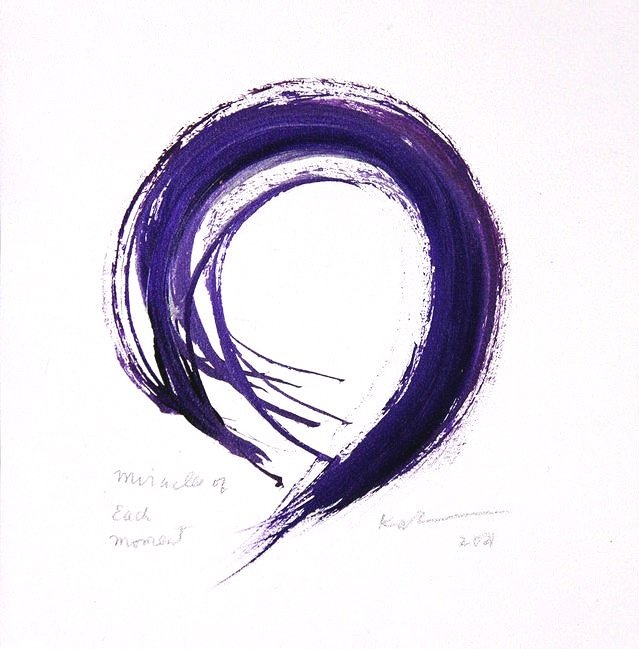
Oceans of valley Seas of mountain Prayers and lessons From birds and insects Voices in the temple: Turn turn turn
Rosh Hashanah 5783, the Jewish New Year, begins the evening of Sunday, September 25, 2022. It is the first day of the Ten Days of Awe, ending with Yom Kippur.
Teshuvah is the spirit of these days. It is variously translated and interpreted as repentance, returning, turning. Repentance for what? Returning to what? Turning toward what? You know.
Simple Gifts A Shaker song
Tis the gift to be simple, ’tis the gift to be free ‘Tis the gift to come down where we ought to be, And when we find ourselves in the place just right, ‘Twill be in the valley of love and delight. When true simplicity is gained, To bow and to bend we shan’t be ashamed, To turn, turn will be our delight, Till by turning, turning we come ’round right.
Wishing you days of turning and transformation. Have a sweet new year. Shana tova.
Students lose access to books amid ‘state-sponsored purging of ideas’ Measures across the country aim to restrict what children can read.
By Hannah Natanson and Lori Rozsa
In one Virginia school district this fall, parents will receive an email notification every time their child checks out a book. In a Florida school system, teachers are purging their classrooms of texts that mention racism, sexism, gender identity or oppression. And a Pennsylvania school district is convening a panel of adults to sign off on every title that school librarians propose buying.
The start of the 2022-2023 school year will usher in a new era of education in some parts of America — one in which school librarians have less freedom to choose books and schoolchildren less ability to read books they find intriguing, experts say.
In the past two years, six states have passed laws that mandate parental involvement in reviewing books, making it easier for parents to remove books or restrict the texts available at school, according to a tally kept by nonprofit EveryLibrary. Five states are considering similar legislation. Typical of these is an Arizona bill, signed by Gov. Doug Ducey (R) in April, that requires districts to send parents who ask lists of the books their children check out, as well as to publish the titles of all library materials bought after Jan. 1. Policies are proliferating at the district level, too: One Nebraska system will require that parents sign permission slips for library books. A Texas system will divide its library into “juvenile,” “young adult” and “adult” sections, with parents choosing the “level” their child can access.
Books being banned and challenged in American schools and libraries is nothing new. But with the unmistakable rise of regressive politics and culture, it has had renewed momentum.
With the availability of other media, books may not seem to have the power they once had to inform and inspire, to entertain and expand consciousness. They still have that power, which is exactly why those who are worried—panicked—about too much information, too much of the wrong kind of inspiration, or too much consciousness expansion, want tighter control of what people read.
If you wonder what sort of books are being banned or challenged, the American Library Association’s Office for Intellectual Freedom (OIF) has compiled a list of the most banned and challenged books from 2010-2019.
Top 100 Most Banned and Challenged Books 2010-2019 American Library Association’s Office for Intellectual Freedom (OIF)
The Absolutely True Diary of a Part-Time Indian by Sherman Alexie Captain Underpants (series) by Dav Pilkey Thirteen Reasons Why by Jay Asher Looking for Alaska by John Green George by Alex Gino And Tango Makes Three by Justin Richardson and Peter Parnell Drama by Raina Telgemeier Fifty Shades of Grey by E. L. James Internet Girls (series) by Lauren Myracle The Bluest Eye by Toni Morrison The Kite Runner by Khaled Hosseini Hunger Games by Suzanne Collins I Am Jazz by Jazz Jennings and Jessica Herthel The Perks of Being a Wallflower by Stephen Chbosky To Kill a Mockingbird by Harper Lee Bone (series) by Jeff Smith The Glass Castle by Jeannette Walls Two Boys Kissing by David Levithan A Day in the Life of Marlon Bundo by Jill Twiss Sex is a Funny Word by Cory Silverberg Alice McKinley (series) by Phyllis Reynolds Naylor It’s Perfectly Normal by Robie H. Harris Nineteen Minutes by Jodi Picoult Scary Stories (series) by Alvin Schwartz Speak by Laurie Halse Anderson A Brave New World by Aldous Huxley Beyond Magenta: Transgender Teens Speak Out by Susan Kuklin Of Mice and Men by John Steinbeck The Handmaid’s Tale by Margaret Atwood The Hate U Give by Angie Thomas Fun Home: A Family Tragicomic by Alison Bechdel It’s a Book by Lane Smith The Adventures of Huckleberry Finn by Mark Twain The Things They Carried by Tim O’Brien What My Mother Doesn’t Know by Sonya Sones A Child Called “It” by Dave Pelzer Bad Kitty (series) by Nick Bruel Crank by Ellen Hopkins Nickel and Dimed by Barbara Ehrenreich Persepolis by Marjane Satrapi The Adventures of Super Diaper Baby by Dav Pilkey This Day in June by Gayle E. Pitman This One Summer by Mariko Tamaki A Bad Boy Can Be Good For A Girl by Tanya Lee Stone Beloved by Toni Morrison Goosebumps (series) by R.L. Stine In Our Mothers’ House by Patricia Polacco Lush by Natasha Friend The Catcher in the Rye by J. D. Salinger The Color Purple by Alice Walker The Curious Incident of the Dog in the Night-Time by Mark Haddon The Holy Bible This Book is Gay by Juno Dawson Eleanor & Park by Rainbow Rowell Extremely Loud & Incredibly Close by Jonathan Safran Foer Gossip Girl (series) by Cecily von Ziegesar House of Night (series) by P.C. Cast My Mom’s Having A Baby by Dori Hillestad Butler Neonomicon by Alan Moore The Dirty Cowboy by Amy Timberlake The Giver by Lois Lowry Anne Frank: Diary of a Young Girl by Anne Frank Bless Me, Ultima by Rudolfo Anaya Draw Me a Star by Eric Carle Dreaming In Cuban by Cristina Garcia Fade by Lisa McMann The Family Book by Todd Parr Feed by M.T. Anderson Go the Fuck to Sleep by Adam Mansbach Habibi by Craig Thompson House of the Spirits by Isabel Allende Jacob’s New Dress by Sarah Hoffman Lolita by Vladimir Nabokov Monster by Walter Dean Myers Nasreen’s Secret School by Jeanette Winter Saga by Brian K. Vaughan Stuck in the Middle by Ariel Schrag The Kingdom of Little Wounds by Susann Cokal 1984 by George Orwell A Clockwork Orange by Anthony Burgess Almost Perfect by Brian Katcher Awakening by Kate Chopin Burned by Ellen Hopkins Ender’s Game by Orson Scott Card Fallen Angels by Walter Dean Myers Glass by Ellen Hopkins Heather Has Two Mommies by Lesle´a Newman I Know Why the Caged Bird Sings by Maya Angelou Madeline and the Gypsies by Ludwig Bemelmans My Princess Boy by Cheryl Kilodavis Prince and Knight by Daniel Haack Revolutionary Voices: A Multicultural Queer Youth Anthology by Amy Sonnie Skippyjon Jones (series) by Judith Schachner So Far from the Bamboo Grove by Yoko Kawashima Watkins The Color of Earth (series) by Tong-hwa Kim The Librarian of Basra by Jeanette Winter The Walking Dead (series) by Robert Kirkman Tricks by Ellen Hopkins Uncle Bobby’s Wedding by Sarah S Brannen Year of Wonders by Geraldine Brooks
Just from some of the titles, you can sense why some of the books would cause concerns for parents who deem them controversial or dangerous. Of course, a book picturing the complicated social life of twenty-first century teenage girls is going to be read by twenty-first century teenage girls, whether it’s in school or library or not.
There are, however, books truly amazing to still be on this list. Some have been demonized and banned for decades, almost as a tradition of cultural opposition. 1984, for example, suggests the possibility of a totalitarian state in a Western democracy. Why would you want to expose young Americans—any Americans—to such a vile fantasy (possibility)?
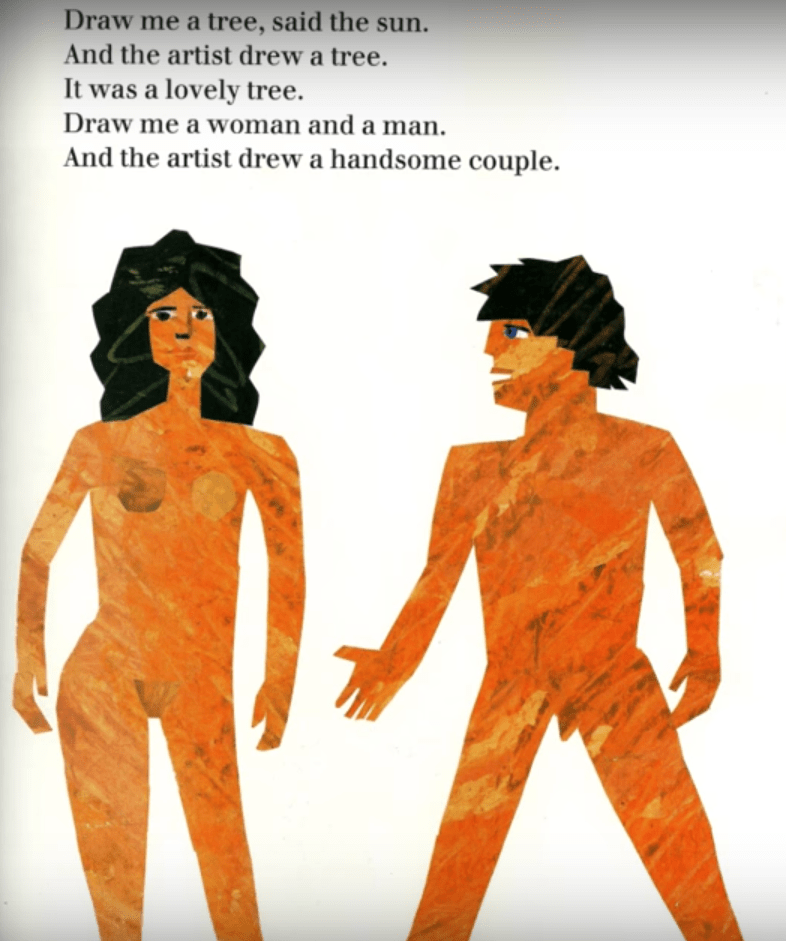
Astonishing is the banning of a book by the iconic and hugely popular children’s author Eric Carle (Brown Bear, Brown Bear, The Very Hungry Caterpillar). Draw Me a Star contains an illustration of a naked man and woman, suggestive of Adam and Eve (pre-apple). Apparently, even the Bible is not endorsement enough to allow children, or even adults, to see genitals.
Speaking of the Bible, you will see that it too is on the list of frequently banned and challenged books. As for the dangers it poses, other than naked people, you can look it up.
There are going to be books that, in the case of children, some legitimately believe feature things that may be inappropriate for the young. But mostly, the banning and challenging involve an attempt to illegitimately control the creative conversation and impose values—illegitimate because, by constitution and in theory, the American experiment involves open conversation about a variety of values.
And now, a personal incident that is roughly related.
It is junior year in high school. It is English class. It is time for an oral book report. the book I chose is J.D.TSalinger’s Catcher in the Rye, which is on the list above, and has been regularly banned for over seventy years since its publication in 1951.
The plan for my report was to read aloud a few quotes from the book. I wasn’t sure about a particular quote, but the girl sitting next to me, very pretty and very voluptuous (by high school or any standards) urged me to do it.
I stood up, and this is the quote from the book that caused the commotion:
“I went down by a different staircase, and I saw another “Fuck you” on the wall. I tried to rub it off with my hand again, but this one was scratched on, with a knife or something. It wouldn’t come off. It’s hopeless, anyway. If you had a million years to do it in, you couldn’t rub out even half the “Fuck you” signs in the world. It’s impossible.”
The reason for the bannings of Catcher, even now, is the plethora of “fuck yous” in this great book. My case was no exception. Word got around the school about my report, and I was called to the office of the Vice Principal. I was told I had to be punished, and I was.
Salinger/Holden Caulfield was right. We know that those words and the hundreds of other instances of transgression can’t possibly be rubbed out, and shouldn’t be, especially among creators and their readers/viewers/listeners. The fact is that in this century “fuck you” is everywhere, in movies, on TV and in songs, not to mention where it has always been—in our real lives.
Director Jean-Luc Godard has died at the age of 91.
You can read millions of words about him, about the influence he and other French, European and American directors of that generation had on the way movies are made and viewed. Godard is neart the top of many lists, because a series of films he made during the 1960s helped change everything. Not to mention that the films, once seen, whatever your response (delight, thoughtfulness, confusion), will not allow you to watch any other movies the same way.
It began in 1960 with Breathless (French: A Bout de Souffle). You can read about it elsewhere and, more, view clips or the full movie online. You should (and follow that by viewing some others by Godard).
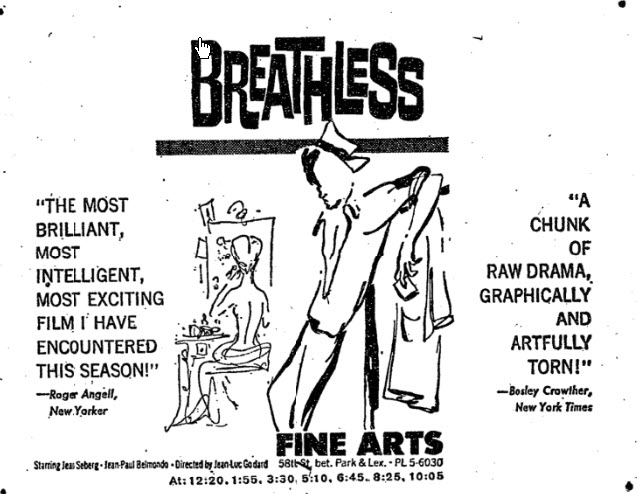
Here I take a different approach. Breathless opened in New York on February 8, 1961. At that point New York had a dozen or more what were called “art houses” where you could see the most recent foreign films. In fact, Breathless opened at a theater called the Fine Arts.
Above is the New York Times ad of that day for Breathless. For context, here is the biggest ad in the New York Times for a very different popular movie, The Wackiest Ship in the Army.
If you watch the two movies together, not just look at the ads, you will conclude that they were made not in different countries but on different planets. Which is the point. It was possible to put together a camera, a story, a scene and some actors to create a record of a visit to another planet which happened to be right here, or in the case of Breathless, Paris. All you needed was a director with the creativity and sense of total freedom.
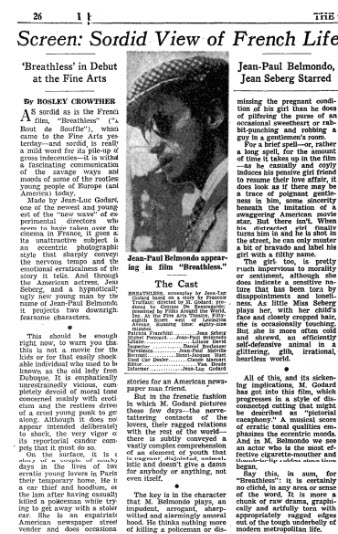
Not everyone agreed this was a good thing. Bosley Crowther was the iconic film critic at the New York Times when Breathless arrived. His review revealed not only his tastes but the general sense of America at that point. John F. Kennedy had been president for about two weeks. Most of America was still culturally conservative, and sensing that something was going on, particularly with some young people on the fringes (or worse, in their own homes). Crowther reflected that in his review, excerpted below:
SORDID VIEW OF FRENCH LIFE
By Bosley Crowther
As sordid as is the French film, “Breathless” (“A Bout de Souffle”), which came to the Fine Arts yesterday—and sordid, is really a mild word for its pile-up of gross indecencies—it is withal a fascinating communication of the savage ways and moods of some of the rootless young people of Europe (and America) today….
But in the frenetic fashion in which M. Godard pictures these few days-the nerve tattering contacts of the lovers, their ragged relations with the rest of the world there is subtly conveyed a vastly complex comprehension of an element of youth that is vagrant, disjointed, animalistic and doesn’t give a damn for anybody or anything, not even itself….
All of this, and its sickening implications, M. Godard has got into this film, which progresses in a style of disconnected cutting that might be described as “pictorial cacophony.” A musical score of erratic tonal qualities emphasizes the eccentric moods. And in M. Belmondo we see an actor who is the most effective cigarette-mouther and thumb-to-lip rubber since time began.
Say this, in sum, for “Breathless”: it is certainly no cliche, in any area or sense of the word. It is more a chunk of raw drama, graphically and artfully torn with appropriately ragged edges out of the tough underbelly of modern metropolitan life.
Sordid, gross indecencies, savage, animalistic, sickening. If you have seen Breathless, or will, you wonder what Crowther was watching. But it tells us about the cultural vision of much of America in February 1961, a vision that is still alive in some of America. Films can entertain us by reinforcing sweet fairy tales we tell ourselves. No blame for such entertainment. But films can also remind us that the literature of fairy tales has dark streams and unhappy endings. Godard, maybe more than any of his cohort of new guard directors, told stories in new ways that shattered the fairy tales. Some movies, thanks to him and others, are shattering them still.
Desert to ocean to hills hills to lake to ocean roads straight gently curving twisted. Sun rises in the west sun sets in the east sun rises moon follows. Love is a lasting legacy we leave.
Peace on the mountain Peace in the valley Peace at the waterfall Cascading notes High and low Smooth and rough In the end Begin again Play
Three or four notes in, you are somewhere else. Not a perfect place, but perfectly there. Holy of holies, commonplace of commonplaces. Which is, when we ask, if we ask, all we ask for.
Pay attention—how could you not?—to the few discordants thrown in setting what came before and comes after. We are always setting what came before and what comes after.
As played by Bill Evans, it is all. A just-discovered new performance by guitarist Sean Shibe is now on the list. Now.
Republicans think they have another rhetorical winner in tagging anyone with any contemporary ideas and policies as “woke”. This appears to have some appeal, demonstrated by presidential wannabe DeSantis delivering an entire “Woke! Woke! Woke!” speech.
The opposite of woke is asleep. The only question then is whether Republicans want an electorate that is asleep. Maybe.
Or is it even more revealing? Maybe Republicans want to govern while they themselves are asleep, dreaming of reconstructing a simpler and more manageable (for them) America that never existed.
If Republicans want to stay asleep and dream, let us help. Why should they have their dreamtime interrupted by the inconvenience of actually governing? Even bad governing takes time. So let us send them back to their comfortable bedrooms, or wherever else they lay their heads, and let them dream their unawake lives away. Far away from the controls of government.
You look around a room In the middle is a door You stand in front of the door Walk through to the other side You look around You are in the same room Only on the other side of the door You turn around to face the door You walk back through to the other side Where were you Where have you been Where are you What is this room What is this door Knock knock
First they came for the socialists, and I did not speak out—because I was not a socialist. Then they came for the trade unionists, and I did not speak out—because I was not a trade unionist. Then they came for the Jews, and I did not speak out—because I was not a Jew. Then they came for me—and there was no one left to speak for me. —Martin Niemöller
The New York Times reports that according to analysis of 10 states with available voter registration data, “On average in the month after Dobbs, 55 percent of newly registered voters in those states were women, according to the analysis, up from just under 50 percent before the decision was leaked in early May.”
Which begs the question: Why didn’t they choose to vote before?
The most likely answer is that they didn’t vote because they weren’t motivated and interested enough, that is, the circumstances did not seem to affect their interests enough. Now they do.
Which is shortsighted because:
IN A DEMOCRACY VOTING IS ALWAYS IN YOUR INTEREST.
The famous quote from Martin Niemöller about living in Nazi Germany is not specifically about voting, just about “speaking out”. So if we substitute “vote” for “speaking out”:
First they came for the socialists, and I did not vote—because I was not a socialist. Then they came for the trade unionists, and I did not vote—because I was not a trade unionist. Then they came for the Jews, and I did not vote—because I was not a Jew. Then they came for me—and there was no one left to vote for me.
In a democracy, voting is the ultimate and most effective means of speaking out. Americans who are newly choosing to register—and hopefully then to vote—are welcome and needed participants in that democracy.
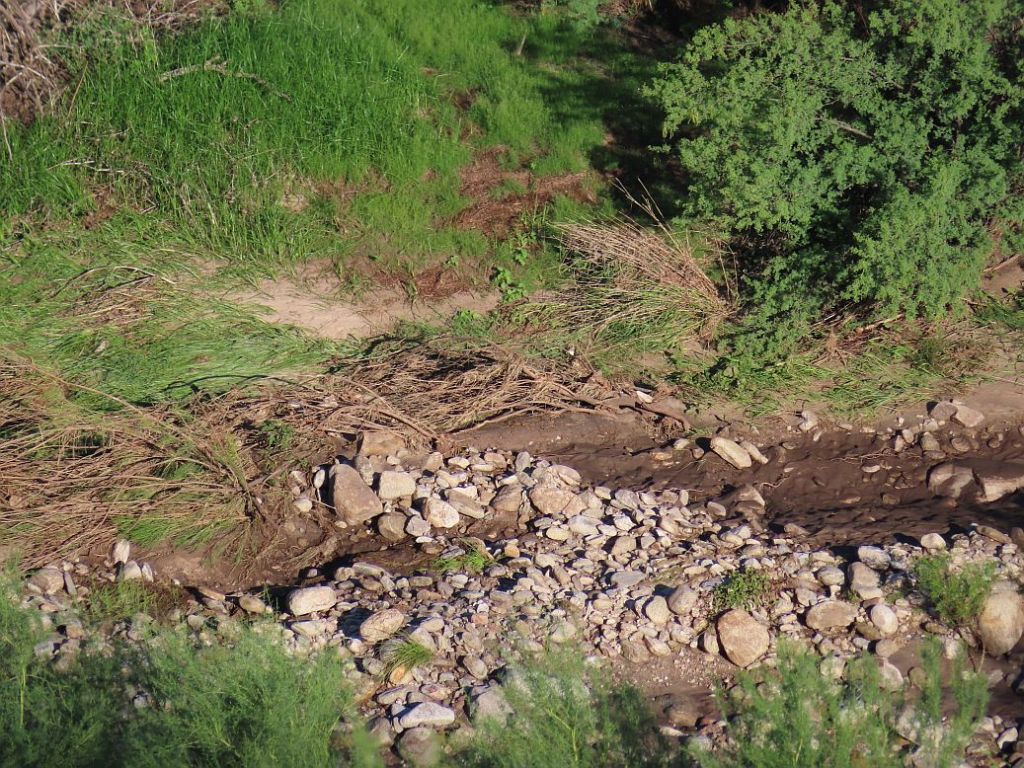
Night monsoon leaves water rushing through the wash. The mountains are silent and invisible. The clouds are silent and invisible. The wash that is usually dry is a noisy stream. The rain washed the mountains, the mountains washed the waters.
“All waters appear at the foot of the eastern mountains. Accordingly, all mountains ride on clouds and walk in the sky. All mountains are the tops of the heads of all waters. Walking beyond and walking within are both done on water. All mountains walk with their toes on waters and make them splash.” Zen Master Dogen, Mountains and Waters Sutra





 Bob Schwartz