Bob Schwartz

Antisemitism in the Oval Office

The encounter in the White House was antisemitic….It was all there, in the Oval Office, in the shouting and in the interruptions, in the noises and in the silences. A courageous man seen as Jewish had to be brought down. When he said things that were simply true he was shouted down and called a propagandist. There was no acknowledgement of Zelens’kyi’s bravery in remaining in Kyiv.
Timothy Snyder, Antisemitism in the Oval Office

https://snyder.substack.com/p/antisemitism-in-the-oval-office

Timothy Snyder is one of the great contemporary historians, especially of the Holocaust. His books include Black Earth: The Holocaust as History and Warning, On Tyranny: Twenty Lessons from the Twentieth Century, The Road to Unfreedom, and more.

His post today, Antisemitism in the Oval Office, is about the inherent antisemitism of the recent confrontation between Zelensky and Trump in the Oval Office. It is Snyder’s view, and the view of other experts, that this was a clear example of public antisemitism. By the President of the United States.

Please read the post in its entirety. A brief excerpt below.


The attempt to humiliate Volodymyr Zelens’kyi in the Oval Office a week ago was an American strategic collapse. It heralded a new constellation of disorderly powers, obsessed with resources, seizing what they can. Inside that new disaster is something old and familiar that we might prefer not to see: antisemitism. The encounter in the White House was antisemitic.

I am historian of the Holocaust. I was trained by a survivor. Jerzy Jedlicki was nine years old when the Germans invaded, and fourteen when he emerged from hiding in Warsaw, and a prominent Polish historian by the time we met. He talked to me about antisemitism for decades, from the time of the breakup of the Soviet Union until his death in 2018. The way that I reacted to the scene in the Oval Office, and how I have pondered and considered it since, have to do with my research, but also with him….

To conclude that the scene in the White House was antisemitic, one does not need to know anything further. It’s all right there: the demand for deference, the obsession with money, the claims of corruption and dishonesty, the encirclement, the loud voices, the bizarre grievances, the underlying sense that a Jewish person does not fit and must be expelled. The context was evocative enough, and nothing more is really needed: those historical markers of antisemitism; Zelens’kyi’s Jewish origins; the particular way he was treated by non-Jews.

Timothy Snyder, Antisemitism in the Oval Office

If Democrats won’t lead us out of this political wilderness, who will?

American political parties have produced some great leaders and leadership. Also some less than great, terrible or even criminal leaders and leadership.

This is the most extreme political moment in American history. It may be an extreme that some Americans support and cheer, but for others of us, it is a lawful, constitutional and democratic disaster.

At the moment, of our two political parties, only the Democratic Party is not enabling that disaster. Yet up to the moment, the party has not stood up and stepped up, and is not offering much more than “help us retake Congress in 2026. Send money.”

Democrats retaking one or both houses of Congress in 2026 would provide some slowing of this downward slide. But it won’t stop it, because even if the Supreme Court reins in some of the executive actions, some of those actions will get through and stay in effect. Besides that, even if in 2026 and 2028 Democrats retake Congress and the White House, the mass of suffering will have happened, the mass of damage will have been done and will require—this may sound hyperbole but isn’t—rebuilding the republic.

All of which says that there must be action now to try to slow the devolution and degeneration. “Try” because even under the best circumstances, with Congress and the Supreme Court mostly on his side, overwhelming power resides in a twisted presidency.

So try we must. But try what? That’s where the Democratic Party has so far fallen short. Yes, electing not-Republicans is a necessary condition. Necessary but not sufficient. Electing Democrats in 2026 is not enough.

Americans need leadership that plans and organizes action that is not about the next election and not rhetorical. We will continue to wait for the Democrats to tell us what we should be doing—now, not next and not two years from now. So far, we haven’t seen or heard that.

If the Democrats won’t take that role, who will?

Losar/Tibetan New Year: Happy New Year 2025

Losar/Tibetan New Year 2025 begins today.

A New Year message from Ringu Tulku Rinpoche:

Ringu Tulku Rinpoche is a Tibetan Buddhist master who belongs to the Kagyu tradition of Tibetan Buddhism. He was born in Eastern Tibet (Kham) and received extensive training in all schools of Tibetan Buddhism. He studied under many great masters including the 16th Karmapa and Dilgo Khyentse Rinpoche. He has a PhD in Buddhist studies and is known for his scholarly work.

He founded Bodhicharya, an international organization that coordinates his educational and humanitarian activities. He travels extensively, teaching meditation and Buddhist philosophy at centers around the world, and is respected for his ability to present traditional Buddhist teachings in a way that’s relevant to contemporary life.

Music: Without Canadian artists where would we be?

Among the treasures recorded by k.d. lang is Hymns of the 49th Parallel, an album of covers of songs by her fellow Canadians—the artistry of Neil Young, Joni Mitchell, Leonard Cohen, and others. And of course k.d. herself.

This should give you a clue to just how important Canadians have been to popular music and other arts. If Canada was represented by just one of these extraordinary artists, it would be enough. Taken together (need I add The Band, The Guess Who, Arcade Fire, Celine Dion, Alanis Morrisette, The Weeknd, Shania Twain, Drake, Rush and more?) it is a banquet of music. (See Rolling Stone’s 50 Greatest Canadian Artists of All Time. No surprise that Joni is #1, Neil #2, Rush #3, Leonard #4. Okay, maybe I’d move Leonard Cohen up a notch, but that’s quibbling.)

Listening to just Canadian artists until this madness is over is asking too much. Listening to lots of Canadian artists, maybe having one Canada-only day each week, is not punishment and would be a joy.

Since I often include one video track in my music posts, I have a quandary. Look at the list above. Just the ones named add up to hundreds of tracks. So if I offer just one or two, that doesn’t take away from the mountain of song. O Canada!

For those who really don’t like Trump but did not vote, a voting booth that is also a time machine

If you didn’t vote in the last presidential election, but are very unhappy with the current administration, good news!

There is now a hybrid voting booth-time machine. You can now go back in time and actually vote in the last election, with a better chance that Trump does not win the presidency.

OF COURSE THERE IS NO HYBRID VOTING BOOTH-TIME MACHINE! THERE IS NO TIME MACHINE AT ALL!

Remember that next time you have the opportunity to vote but don’t.

The King of America

Now I try hard not to become hysterical
But I’m not sure if I am laughing or crying
Brilliant Mistake, Elvis Costello

Brilliant Mistake (1986) by Elvis Costello, on his album King of America, meant something at the time that was not a commentary on this moment almost forty years later. It refers to something else.

And yet…the work of great artists can transcend its origins. That’s what art does.

Brilliant Mistake just seems so now. Plus, like so much Elvis, it is a great track.


He thought he was the King of America
Where they pour Coca Cola just like vintage wine
Now I try hard not to become hysterical
But I’m not sure if I am laughing or crying
I wish that I could push a button
And talk in the past and not the present tense
And watch this hurting feeling disappear
Like it was common sense
It was a fine idea at the time
Now it’s a brilliant mistake
Brilliant Mistake, Elvis Costello


Cactus Flower (springing desert)

Spring is different in the desert. It happens earlier, as does summer, and summer+. Plants that don’t look like they will exhale beauty amaze, like people who don’t look like they will exhale beauty amaze. The shadows of the spikes on the petals tell you something.

© 2025 by Bob Schwartz

Abhaya Mudrā: Gesture of fearlessness, protection and refuge

There are dozens of hand gestures used in the world, some with universal meaning, many with different meanings in different cultures.

Among those well-known in America and elsewhere are the peace gesture, the V of index and middle finger, and the power gesture, the raised fist.

I’ve been thinking that in troubling times, a common gesture might be a way to express shared resistance to that trouble and a positive attitude toward that trouble. In past crisis, that is a role played by the peace gesture.

My suggestion for this moment is the abhaya mudrā. As the descriptions below explain, its meanings include fearlessness, protection, refuge, benevolence, peace and more. All things we need now.


abhayamudrā. (Tibetan mi ’jigs pa’i phyag rgya; Chinese shiwuwei yin; Japanese semuiin; Korean simuoe in). In Sanskrit, “the gesture of fearlessness” or “gesture of protection”; also sometimes called the gesture of granting refuge. This gesture (mudrā) is typically formed with the palm of the right hand facing outward at shoulder height and the fingers pointing up, although both hands may simultaneously be raised in this posture in a double abhayamudrā. This gesture is associated with Śākyamuni Buddha immediately following his enlightenment, and standing buddha images will often be depicted with this mudrā, portraying a sense of the security, serenity, and compassion that derive from enlightenment.
Princeton Dictionary of Buddhism

abhaya-mudrā (Sanskrit, gesture of fearlessness). Iconographic hand gesture (mudrā) whose purpose is to dispel fear and communicate protection, benevolence, and peace. Commonly found in representations of the Buddha and celestial Bodhisattvas, where the figure is usually depicted standing with the right arm bent, the palm raised and facing forwards, and the fingers joined.
A Dictionary of Buddhism (Oxford)

THE PROTECTION GESTURE
(Sanskrit abhaya-mudra; Tibetan mi-’jigs-pa’i phyag-rgya)
The gesture of protection or fearlessness is also identified with the gesture of giving refuge, described below. The right ‘method’ hand usually makes this gesture, with the palm held outwards and the fingers extending upwards.
Handbook of Tibetan Buddhist Symbols


Fearless mudra hand gesture or Abhayaprada Mudra yoga mudra hand gesture isolated on black background.;

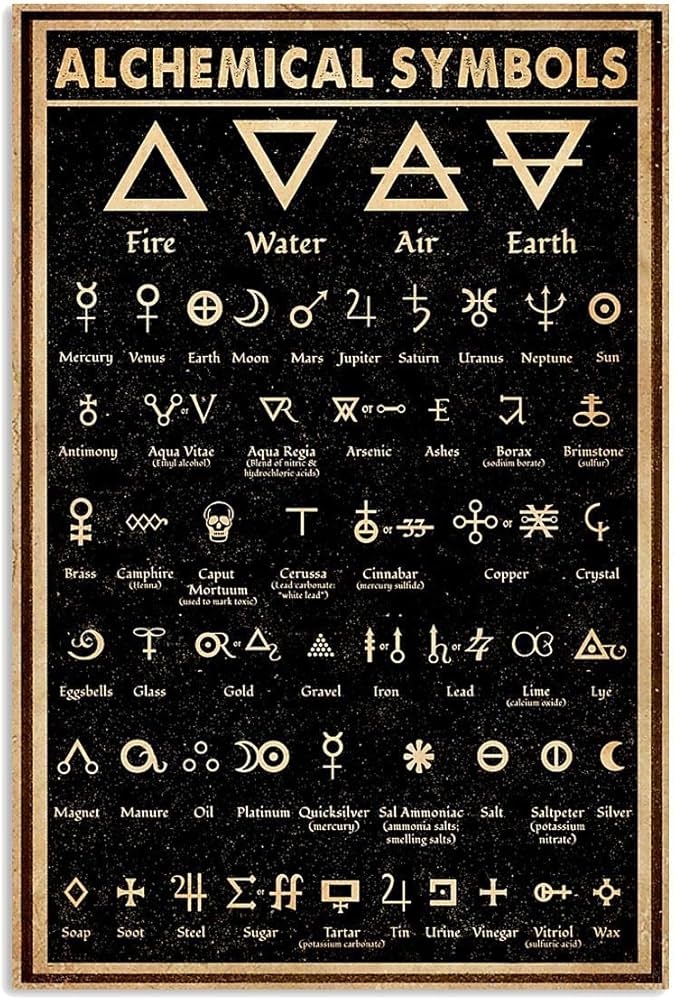
The truth about alchemy

Alchemy is not about turning lead into gold. It is about realizing that lead is already gold.

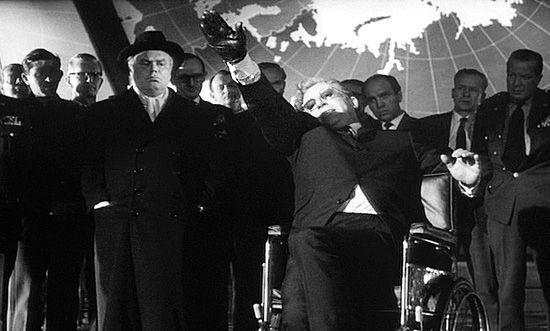
Presidential adviser on breeding America after nuclear war: Ten females to each male!

PRESIDENTIAL ADVISER
Mr. President, I would not rule out the chance to preserve a nucleus of human specimens. It would be quite easy… heh heh…

At the bottom of ah… some of our deeper mineshafts. The radioactivity would never penetrate a mine some thousands of feet deep. And in a matter of weeks, sufficient improvements in dwelling space could easily be provided.

PRESIDENT
How long would you have to stay down there?

PRESIDENTIAL ADVISER
Well let’s see now ah… cobalt thorium G… aa… nn… Radioactive halflife of uh,… hmm. I would think that uh… possibly uh… one hundred years.

PRESIDENT
You mean, people could actually stay down there for a hundred years?

PRESIDENTIAL ADVISER
It would not be difficult mein Fuhrer! Nuclear reactors could, heh… I’m sorry. Mr. President. Nuclear reactors could provide power almost indefinitely. Greenhouses could maintain plantlife. Animals could be bred and slaughtered. A quick survey would have to be made of all the available mine sites in the country. But I would guess… that ah, dwelling space for several hundred thousands of our people could easily be provided.

PRESIDENT
Well I… I would hate to have to decide.. who stays up and.. who goes down.

PRESIDENTIAL ADVISER
Well, that would not be necessary Mr. President. It could easily be accomplished with a computer. And a computer could be set and programmed to accept factors from youth, health, sexual fertility, intelligence, and a cross section of necessary skills. Of course it would be absolutely vital that our top government and military men be included to foster and impart the required principles of leadership and tradition.

(Slams down left fist. Right arm rises in stiff Nazi salute.)

Arrrrr!

(restrains right arm with left)

Naturally, they would breed prodigiously, eh? There would be much time, and little to do. But ah with the proper breeding techniques and a ratio of say, ten females to each male, I would guess that they could then work their way back to the present gross national product within say, twenty years.

PRESIDENT
But look here doctor, wouldn’t this nucleus of survivors be so grief stricken and anguished that they’d, well, envy the dead and not want to go on living?

PRESIDENTIAL ADVISER
No sir… Also when… when they go down into the mine everyone would still be alive. There would be no shocking memories, and the prevailing emotion will be one of nostalgia for those left behind, combined with a spirit of bold curiosity for the adventure ahead! Ahhhh!

(Right arm reflexes into Nazi salute. He pulls it back into his lap and beats it again.)

GENERAL
Doctor, you mentioned the ratio of ten women to each man. Now, wouldn’t that necessitate the abandonment of the so called monogamous sexual relationship, I mean, as far as men were concerned?

PRESIDENTIAL ADVISER
Regrettably, yes. But it is, you know, a sacrifice required for the future of the human race. I hasten to add that since each man will be required to do prodigious… service along these lines, the women will have to be selected for their sexual characteristics which will have to be of a highly stimulating nature.

Adapted from Dr. Strangelove by Stanley Kubrick and Terry Southern