Lincoln and Washington used to have separate national holidays for their birthdays. Then the holidays were combined into Presidents’ Day. It is now a bit of history, a lot of sales and shopping.
Lincoln is highly-regarded by historians. An overview of expert evaluations, across the ideological spectrum, is that the he was the greatest or near-greatest president in America’s long and sometimes rocky history.
Above is an editorial cartoon from 1963 by Bill Mauldin, an earlier time of American upheaval. Looking back now, we realize that we hadn’t seen anything yet.
Lincoln is crying, and the reasons for his tears may have changed over sixty years. Today the greatest President looks on the nation and the party he founded and they are somewhat unrecognizable. Lincoln also knew what Ben Franklin said when asked about what kind of government the new America had: “A republic…if you can keep it.”
Keep the faith in what America can be. Lincoln did—and sacrificed for it. We can too.
If you say “pitchers and catchers” to a baseball fan, they understand. It is the beginning of Major League Baseball Spring Training. Pitchers and catchers arrive first, to get more work in. Then the rest of the roster arrives, along with prospects invited for evaluation. We are a little more than a month until the regular season starts.
Baseball as a distraction is no sin, just as being a fan of other sports, or music, or any cultural phenomenon needs no justification. As regularly pointed out, Bart Giamatti was President of Yale University before he became—a tenure cut very short by his death—Commissioner of MLB. He loved the game, wrote movingly about it. If it was good enough for him, it’s good enough for anybody.
That this spring, this year, some of us might seek distraction is no secret. The thing about distraction is that like everything it should be in balance. There is a life to lead and a nation to tend. As citizens we should pay attention and act appropriately. As fans, though, we know about fresh starts. Every game, every inning, every pitch and at bat is a new possibility. It all starts here and now.
Trump has friends or at least sympathizers on the Supreme Court. He is hoping to appoint more.
Already in the first few weeks, Trump has taken executive actions that are clearly unconstitutional. Then yesterday, Vance said that judges don’t have the right to control presidential power. Vance and other Republican lawyers know better. The Trump Justices of the Supreme Court know better.
Those Justices are scared.
Knowing that Trump will continue to act in unconstitutional ways that threaten the core concept of separation of powers and checks and balances, and knowing history, they are concerned about the trajectory of the republic.
As the constitutional challenges work their way through the judiciary, they know that the challenges—and ultimately interpretation of the Constitution—will end up on their bench. Whether or not they want to take on Trump, his Republican supporters, and tens of millions of Americans who believe that Trump should be able to do whatever he wants, they are going to have to.
Maybe they decide that centuries of precedent in interpreting the Constitution should stand, and these executive actions must stop. Or maybe they decide that these are extraordinary times, and under these circumstances, the constitutional structure must give way to the president.
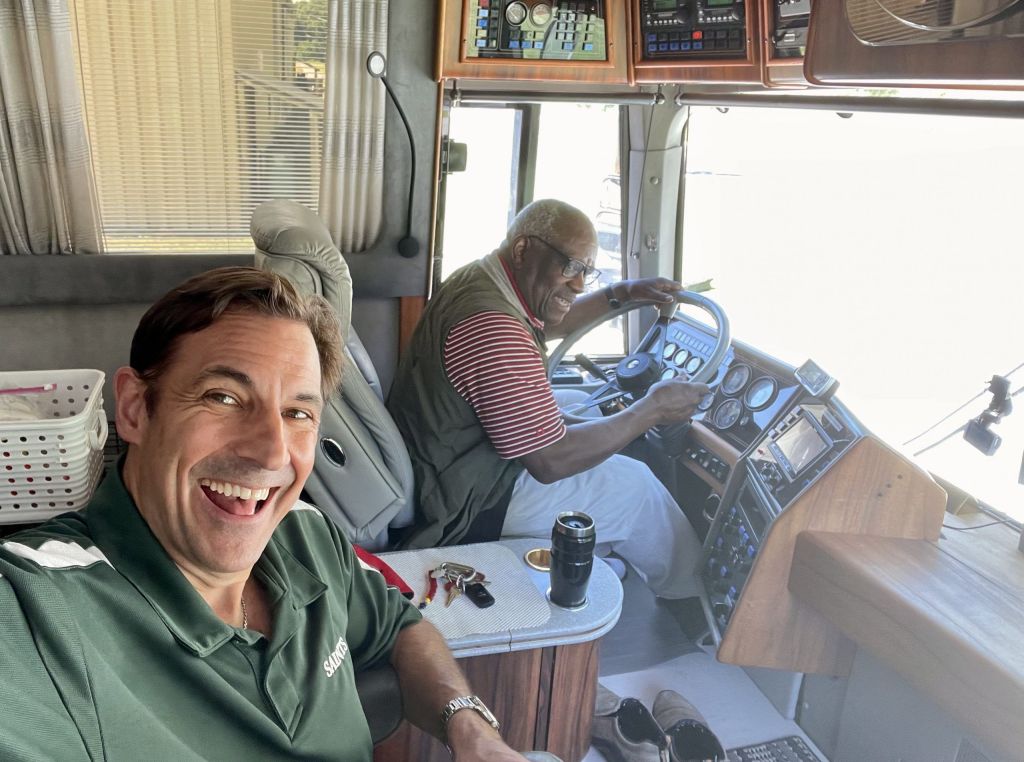
Either way, as students of history, the Justices would rather not have to face that crossroad, since whatever they decide, they know the last time the Constitution itself was so deeply contested, the result was the literal division of America. They—at least one Justice—would rather be touring America in a luxury RV, rather than deciding the fate of the republic.
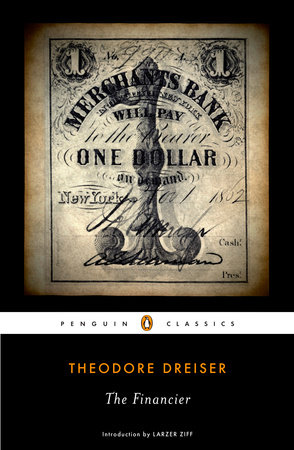
There is a certain fish, the scientific name of which is Mycteroperca bonaci, its common name Black Grouper, which is of considerable value as an afterthought in this connection, and which deserves to be better known. It is a healthy creature, growing quite regularly to a weight of two hundred and fifty pounds, and lives a comfortable, lengthy existence because of its very remarkable ability to adapt itself to conditions. That very subtle thing which we call the creative power, and which we endow with the spirit of the beatitudes, is supposed to build this mortal life in such fashion that only honesty and virtue shall prevail. Witness, then, the significant manner in which it has fashioned the black grouper. One might go far afield and gather less forceful indictments—the horrific spider spinning his trap for the unthinking fly; the lovely Drosera (Sundew) using its crimson calyx for a smothering-pit in which to seal and devour the victim of its beauty; the rainbow-colored jellyfish that spreads its prismed tentacles like streamers of great beauty, only to sting and torture all that falls within their radiant folds. Man himself is busy digging the pit and fashioning the snare, but he will not believe it. His feet are in the trap of circumstance; his eyes are on an illusion.
Mycteroperca moving in its dark world of green waters is as fine an illustration of the constructive genius of nature, which is not beatific, as any which the mind of man may discover. Its great superiority lies in an almost unbelievable power of simulation, which relates solely to the pigmentation of its skin. In electrical mechanics we pride ourselves on our ability to make over one brilliant scene into another in the twinkling of an eye, and flash before the gaze of an onlooker picture after picture, which appear and disappear as we look. The directive control of Mycteroperca over its appearance is much more significant. You cannot look at it long without feeling that you are witnessing something spectral and unnatural, so brilliant is its power to deceive. From being black it can become instantly white; from being an earth-colored brown it can fade into a delightful water-colored green. Its markings change as the clouds of the sky. One marvels at the variety and subtlety of its power.
Lying at the bottom of a bay, it can simulate the mud by which it is surrounded. Hidden in the folds of glorious leaves, it is of the same markings. Lurking in a flaw of light, it is like the light itself shining dimly in water. Its power to elude or strike unseen is of the greatest.
What would you say was the intention of the overruling, intelligent, constructive force which gives to Mycteroperca this ability? To fit it to be truthful? To permit it to present an unvarying appearance which all honest life-seeking fish may know? Or would you say that subtlety, chicanery, trickery, were here at work? An implement of illusion one might readily suspect it to be, a living lie, a creature whose business it is to appear what it is not, to simulate that with which it has nothing in common, to get its living by great subtlety, the power of its enemies to forefend against which is little. The indictment is fair.
Would you say, in the face of this, that a beatific, beneficent creative, overruling power never wills that which is either tricky or deceptive? Or would you say that this material seeming in which we dwell is itself an illusion? If not, whence then the Ten Commandments and the illusion of justice? Why were the Beatitudes dreamed of and how do they avail?
In general, there are many pop music tracks from the 80s that are uplifting.
In particular, this track from Swing Out Sister is one of them.
In addition to the music, the video shows off lead singer Corrine Drewery, who along with singing is also a fashion designer and model, something included in the video.
There are no guarantees in life or music. Beautiful song, beautiful woman. If you have 3 minutes and 48 seconds (you know you do), what have you got to lose?
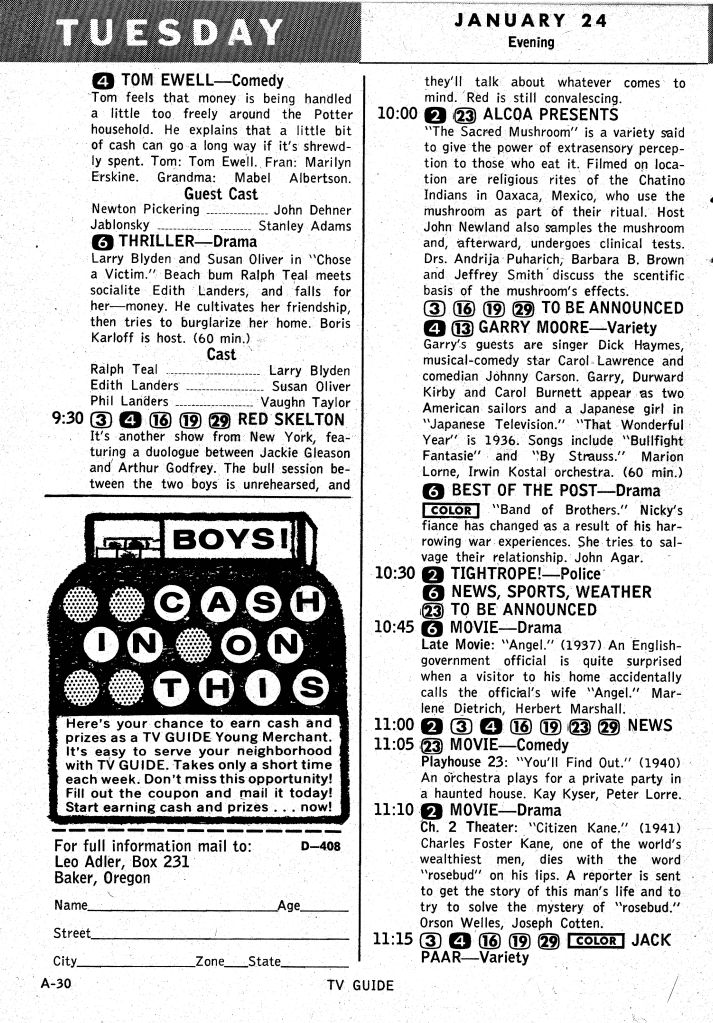
It is January 24, 1961. Just a few days earlier, John F. Kennedy was sworn in as President of the United States, marking a change of era from the days of President Eisenhower.
You look inside your TV Guide to see what’s on that evening.
You might stay up until 11:10 to watch Citizen Kane. But there at 10:00 is an odd-sounding program:
Alcoa Presents
“The Sacred Mushroom” is a variety said to give the power of extrasensory perception to those who eat it. Filmed on location are religious rites of the Chatino Indians in Oaxaca, Mexico, who use the mushroom as part of their ritual. Host John Newland also samples the mushroom and, afterward, undergoes clinical tests.
Sacred Mushroom? Extrasensory perception? Chatino Indians in Oaxaca, Mexico? Okay, let’s have a look:
“We can’t tailor the world to suit ourselves, or force it to fit into our vision of things. This doesn’t mean we shouldn’t aspire to make things better.” Traleg Kyabgon Rinpoche
Point Three: Transforming Adversity into the Path of Awakening
We now come to the instructions on how to train our minds amid the unfavorable and unwanted circumstances of our lives. We have been born into an imperfect world, characterized by unpredictability and adversity, as finite human beings that have foibles, make mistakes, get confused, and think irrationally. There is much to contend with, and our ability to prevent or circumvent difficulty is quite limited. We aren’t omnipotent beings, and while we try to protect ourselves and maintain order in our lives, we simply don’t have the ability to safeguard ourselves from its disasters….
We can’t tailor the world to suit ourselves, or force it to fit into our vision of things. This doesn’t mean we shouldn’t aspire to make things better. The bodhisattva ideal specifically recommends trying to improve our world to the best of our ability, but that ideal is based on a realistic recognition that the world is imperfect and likely to remain that way. Things may sometimes work a little better, sometimes a little worse, but so long as there is ignorance, hatred, jealousy, pride, and selfishness, we will all be living in a world that is socially and politically imperfect….
Sometimes things just happen, and there may be nothing we can do to change that, but we can control our responses to events. We don’t have to despair in the face of disaster. We can either continue to respond in the way we’ve always done and get progressively worse, or we can turn things around and use our misfortune to aid our spiritual growth. For example, if we suffer from illness, we should not allow despondency to get the better of us if our recovery is slow. Despite seeing the best doctors and receiving the best medication, we should accept our situation with courage and fortitude and use it to train our minds to be more accommodating and understanding. No matter what situation we encounter, we can strengthen our minds by incorporating it into our spiritual journey.
When Democrats brought attention to the Heritage Foundation’s Project 2025 (officially Mandate for Leadership: The Conservative Promise) the reaction from many was horror and revulsion. “Not this, NEVER”. Democrats used this call for rejection as a loud talking point in the unsuccessful 2024 presidential election.
One way to look at Project 2025 is to compare it to the Democratic Platform of 2024.
The Democratic Platform is 92 pages long, a comprehensive length, identifying important areas, with praise for what the Biden administration had accomplished in these areas, and a promise that the next Democratic administration would build on that. It represented what establishment Democrats could agree on, but is not particularly inspiring.
Project 2025 is 922 pages long—ten times the Democratic Platform. More than that, it is a detailed plan for an American revolution, step by step. Which is why the reaction from Democrats was so extreme. As unlikely as it seemed that Republicans would have the opportunity to actually execute the plan—Trump would very likely lose the election—just the possibility was frightening.
For those who haven’t seen or read Project 2025, here is the Table of Contents:
It is a little late for Democrats to inspire the hearts and minds of enough Americans to win the 2024 election. However, right now is the time to inspire the hearts and minds of Americans—Democrats and others—to believe in the Democrats, with a detailed plan starting now, that isn’t just “not those bad guys” or “choose more of the same”. A detailed plan that is a step-by-step exciting and even risky path to a new future that doesn’t look like the past—either of the party or of America. A detailed actionable vision that goes beyond “put us back in office in 2026 and 2028 and everything will be fine again”.
Don’t you know that this could start On any street in any town In any state if any clown Decides that now’s the time to fight For some ideal he thinks is right And if a million more agree There ain’t no Great Society As it applies to you and me Trouble Every Day
But I’m telling you It can’t happen here Oh darling, it’s important that you believe me That it can’t happen here It Can’t Happen Here
Frank Zappa was a genius. The Mothers of Invention, the first group he founded and led, was breakthrough significant (still is). Both should be heard.
When I see that the Mothers have only 205,000 monthly listeners and that Zappa has only 962,000 monthly listeners on Spotify, I shouldn’t be surprised, but I am disappointed. Plenty of worthy artists, contemporary and throwback, struggle to get big numbers, compared to the latest fave. But in this case, those missing listeners could really benefit from it, cause they’re missing something.
Freak Out (1966) is the first Mothers album. Artists, musical and otherwise, like to shake things up and break things. Zappa saw things in 1960s culture and society that need shaking and breaking, and being a true artist, he set out to do that. And did that for decades to come.
The two tracks from Freak Out featured here are Trouble Every Day and It Can’t Happen Here, lyrics and videos below. If this is your first taste of the Mothers and Zappa, explore.
Trouble Every Day
Well I’m about to get sick From watchin’ my TV Been checkin’ out the news Until my eyeballs fail to see I mean to say that every day Is just another rotten mess And when it’s gonna change, my friend Is anybody’s guess
Wednesday I watched the riot I seen the cops out on the street Watched ’em throwin’ rocks and stuff And chokin’ in the heat Listened to reports About the whisky passin’ ’round Seen the smoke and fire And the market burnin’ down Watched while everybody On his street would take a turn To stomp and smash and bash and crash And slash and bust and burn
Well, you can cool it, you can heat it ‘Cause, baby, I don’t need it Take your TV tube and eat it ‘N all that phony stuff on sports ‘N all the unconfirmed reports You know I watched that rotten box Until my head begin to hurt From checkin’ out the way The newsman say they get the dirt Before the guys on channel so-and-so And further they assert That any show they’ll interrupt To bring you news if it comes up They say that if the place blows up They will be the first to tell Because the boys they got downtown Are workin’ hard and doin’ swell And if anybody gets the news Before it hits the street They say that no one blabs it faster Their coverage can’t be beat And if another woman driver Gets machine-gunned from her seat They’ll send some joker with a Brownie And you’ll see it all complete
So I’m watchin’ and I’m waitin’ Hopin’ for the best Even think I’ll go to prayin’ Every time I hear ’em sayin’ That there’s no way to delay That trouble comin’ every day No way to delay That trouble comin’ every day
Hey, you know something, people? I’m not black but there’s a whole lots a times I wish I could say I’m not white
Well, I seen the fires burnin’ And the local people turnin’ On the merchants and the shops Who used to sell their brooms and mops And every other household item Watched a mob just turn and bite ’em And they say it served ’em right Because a few of them were white And it’s the same across the nation Black and white discrimination Yellin’ “You can’t understand me!” ‘N all that other jazz they hand me In the papers and TV And all that mass stupidity That seems to grow more every day Each time you hear some nitwit say He wants to go and do you in Because the color of your skin Just don’t appeal to him No matter if it’s black or white Because he’s out for blood tonight
You know we got to sit around at home And watch this thing begin But I bet there won’t be many Live to see it really end ‘Cause the fire in the street Ain’t like the fire in the heart And in the eyes of all these people Don’t you know that this could start On any street in any town In any state if any clown Decides that now’s the time to fight For some ideal he thinks is right And if a million more agree There ain’t no Great Society As it applies to you and me Our country isn’t free And the law refuses to see If all that you can ever be Is just a lousy janitor Unless your uncle owns a store You know that five in every four Just won’t amount to nothin’ more Gonna watch the rats go across the floor And make up songs about being poor
Blow your harmonica, son!
It Can’t Happen Here
It can’t happen here I’m telling you, my dear That it can’t happen here Because I been checkin’ it out, baby I checked it out a couple a times
But I’m telling you It can’t happen here Oh darling, it’s important that you believe me That it can’t happen here
Who could imagine that they would freak out somewhere in Kansas… Who could imagine that they would freak out in Minnesota… Who could imagine…
Who could imagine That they would freak out in Washington, D.C. But it can’t happen here Oh baby, it can’t happen here Everybody’s safe and it can’t happen here No freaks for us Everybody’s clean and it can’t happen here No, no, it won’t happen here Plastic folks, you know It won’t happen here You’re safe, mama You’re safe, baby You just cook a tv dinner And you make it Oh, we’re gonna get a tv dinner and cook it up Oh, and it won’t happen here Who could imagine That they would freak out in the suburbs! Man you guys are really safe Everything’s cool
I remember They had a swimming pool
And they thought it couldn’t happen here They knew it couldn’t happen here They were so sure it couldn’t happen here But…