Bob Schwartz

Mitt Romney, Ted Nugent and Chevy Chase
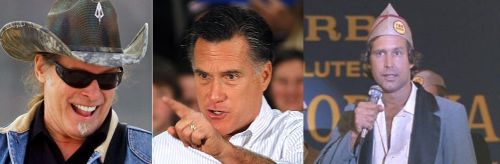
The recent silliness regarding Ted Nugent’s endorsement of Mitt Romney, followed by Nugent’s seeming threats to kill the current President, brought to mind a classic movie moment involving Ted Nugent and another rich guy.

It wasn’t actually Ted Nugent. It was Chevy Chase in Fletch. In the movie, Fletch/Chevy Chase is a smart-mouthed investigative reporter who regularly cracks wise by using ridiculous names. In this scene, Fletch is disguised as a beach bum, and businessman Alan Stanwyk (played by Tim Matheson) offers him a deal:

Stanwyk: Excuse me. I have something I’d like to discuss with you.

Fletch: What’s that?

Stanwyk: We can’t talk about it here.

Fletch: Why not?

Stanwyk: Because we can’t.

Fletch: You on a scavenger hunt, or did I forget to pay my dinner check?

Stanwyk: Come to my house to talk.

Fletch: Wrong gal, fella.

Stanwyk: I’ll give you cash.

Fletch: What?

Stanwyk: Come to my house and listen to the proposition. If you reject the proposition, you keep the thousand…and your mouth shut.

Fletch: Does this entail my dressing up as Little Bo Peep?

Stanwyk: It’s nothing of a sexual nature.

Fletch: Yeah.

Stanwyk: One thousand just to listen? How can you pass that up, Mister…

Nugent. Ted Nugent.

Stanwyk: Alan Stanwyk.

Fletch: Alan, charmed. For an extra grand, I’ll let you take me out to dinner.

There’s no reason to believe that the one conversation between Mitt Romney and Ted Nugent went anything like this. Mitt Romney is much richer than the fictional Alan Stanwyk, and the fictional Fletch/real Chevy Chase is much funnier than Ted Nugent. But it is fascinating to speculate how that endorsement conversation really did go, and if it might have been as surreal as this.

Thinking about Fletch can’t help but bring to mind the scene where Fletch disrupts an American Legion meeting by singing an earnestly terrible version of our national anthem. And thinking about Chevy Chase can’t help but bring to mind National Lampoon’s Vacation and a dog being tied to the bumper of a station wagon. Idle thoughts, none of which have anything to do with Ted Nugent.

But if we were thinking about singing, Mitt Romney, and Ted Nugent, we might idly wonder which song—either Nugent or Amboy Dukes—Romney might choose the next time he sings or recites a song on the campaign trail (though it’s doubtful he ever will again).

Journey to the Center of the Mind (1968) was the biggest Amboy Dukes hit, but maybe the most interesting song on an album that combined blues and psychedelia was Why Is A Carrot More Orange Than An Orange?.  Mitt Romney will not sing or recite it, of course, but it would be a memorable and humanizing moment:

First the world,
Then boy then girl,
Six days it took in all.
In His image he designed us
With no thought of flaw.

Now the question of perfection
Lingers in my mind.
Why is a carrot more orange than an orange?
Why are you greener than green?
Why do we sometimes believe
In things we’ve never seen?
Never doubt what it’s about
And you’ll get along fine.
But thy seeing the true meaning
Proves you’ve got a mind.
My suggestion is inspection of humanity.

I see why the ground is lower than the sky
And why sound can penetrate your mind.
But why is a carrot oranger than an orange?
Oranger than an orange?

Thank you, Ted Nugent.

Jackie Robinson and Sanford, Florida


Last week marked the 65th anniversary of Jackie Robinson’s first major league game with the Brooklyn Dodgers, on April 15, 1947. This event was covered, though far short of the saturation coverage of stories such as the Trayvon Martin/George Zimmerman case. But there is important common ground between the two stories—Sanford, Florida.

What brought this up was watching The Jackie Robinson Story, a biopic released in 1950 and starring Jackie Robinson as himself, while he was still one of baseball’s biggest stars.

It is not much of a film (though it includes a sweet performance by a young Ruby Dee as Robinson’s wife). But as a social document, it is essential, both for its candor about the obstacles he faced and for its occasional softening of history. One of those softened spots is Sanford.

In the spring of 1947, Robinson was playing for the Dodgers’ farm team in Montreal. Spring training was held in Sanford. There were concerns about what the reaction would be, and in fact some people in Sanford who denied Robinson the opportunity to stay there during spring training; he ended up living in Daytona Beach. In the movie, this episode is represented less heatedly, with a black lawyer simply meeting the bus in Daytona and taking Robinson to arranged housing.

Some take current events as proving that things haven’t changed, in Sanford and in general. But the year that Jackie Robinson transformed baseball, he became one of the most popular people in America—people, not just baseball players. It’s still pretty striking to watch the real Jackie Robinson standing one-of-a-kind in a fake clubhouse filled with white actors playing white players. The scene has now been replaced by clubhouses where that is unthinkable, for performance alone, if not for higher reasons of fairness and humanity. There’s little time to be comforted by achievements when faced with evidence of continuing race issues, in Sanford and elsewhere. But it’s okay to take a moment to appreciate progress where you find it, and then move on to the next fight.

Levon Helm

Garth Hudson, Robbie Robertson, Levon Helm, Richard Manuel, and Rick Danko

Levon Helm is dead at the age of 71.

The Band was one of the greatest American musical groups of its era. Great as in musically few better, American as in of and about America, which is strange because all but one of the members was Canadian. That was Levon Helm.

Levon was from Arkansas, son of a cotton farmer. Along with Ronnie Hawkins, he was an original member of The Hawks, which evolved into The Band with the addition of Canadians Robbie Robertson, Rick Danko, Richard Manuel, and Garth Hudson. As much as the influences came from every which where, as much astonishing musicianship and creativity as each member constantly demonstrated, this was an American band, an Arkansas band.

That was the key to The Band’s second album, The Band (1969). If The Band, the group, is unlike any other, The Band, the album, is even more unlike. At a time when synthesizing genres and styles was becoming normal, The Band stood out, and still does. These are songs about some sort of 19th century American South, played as if The Band had brought all their electric instruments and modern sensibilities back and forth in a time machine. Impossible to classify because it was created by Canadian rockers reborn in Arkansas, except for the one member who was actually born there the first time. That was Levon Helm.

No Levon, no Band. It’s that simple.

The night they drove old Dixie down
And the bells were ringing
The night they drove old Dixie down
And all the people were singing
They went na na na…

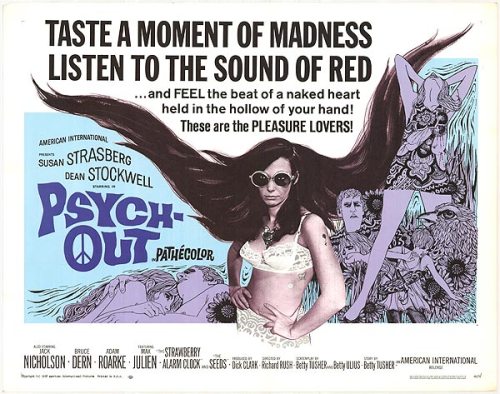
Dick Clark’s Psych-Out

Dick Clark, who died this week, was a pop culture polymath and phenom. He became expert in so many aspects of emerging entertainment forms, inventing some, exploiting others, and almost everything he touched turned to gold.

Among the less celebrated but fascinating parts of his career are his work as an actor and a movie producer.

Acting was not Dick Clark’s strength, though he made more than a dozen appearances in movies and television, starting in 1960. In Because They’re Young (above), he plays a new high school teacher facing his own personal challenges. His struggles help him understand and get close to his troubled students—something the school administrations frowns upon. Clark followed this in 1961 with The Young Doctors, in which he plays one of them.

Movie production in the 1960s is where we see Clark’s instinct for exploiting pop culture. He produced three movies in 1968, and stars in one of them. In Killers Three he plays a North Carolina backwoods criminal who rips off some bootleggers, and ends up as a killer on the lam (most notably, Merle Haggard plays a sheriff, and composed his classic Mama Tried for the film). Savage Seven was a typical biker gang movie. But the crowning achievement of Clark’s career as movie producer is the hippie epic Psych-Out.

Critics and fans argue about whether Roger Corman-produced The Trip (1967) or Dick Clark-produced Psych-Out is the best of the psychedelic period movies. Both films share cast members, including Susan Strasberg and Bruce Dern; The Trip also has Peter Fonda and Dennis Hopper, while Psych-Out has Jack Nicholson.

There is no contest. Dick Clark produced the great dramatized on-location non-documentary about the last days of love in San Francisco. The plot is ridiculous, and ridiculously complex and fevered. It begins with Jenny (Strasberg), a deaf runaway, who comes to Haight Ashbury looking for her brother The Seeker (Dern), falls in love with musician Stoney (Nicholson), and ends up standing in traffic on the Golden Gate Bridge, her hearing miraculously restored.

We have a lot of major achievements to thank Dick Clark for, but just in case it gets missed, note that Psych-Out is surely one of those.

Permissions, Privacy and App Reviews

In the ongoing battle between your privacy and mobile app developers seeking—and getting—your permission to access personal information about you and your life, you are losing.

Millions of people reflexively agree to permissions that go far beyond the functional needs of particular apps. Sometimes it is because users don’t bother looking at permissions lists, or don’t understand all the permissions. Sometimes it is because the permissions requests are strategically placed: while Google Play includes a Permissions tab on its Web site, the mobile site doesn’t include Permissions at first screen, instead revealing it only after the Download button, when the Accept & download button appears. Sometimes, maybe most of the time, it is because users just don’t care, particularly when apps are free, and it seems that permissions, however onerous, are simply the price to pay.

The reasons to care are the subject for another time. But there is a critical way which this may be rebalanced right now, if just a little bit.

Few reviews, from big media reviewers or from user comments, ever mention permissions as a factor in recommending or avoiding particular apps. For example, and by no means singling out any reviewer or app developer, this morning brought a glowing review from Lifehacker about the new version of the  Springpad app:

Use Springpad as Your New Personal Assistant: Get Organized, Save Money, and Have Fun Being Productive

There seems no doubt that Springpad, especially in this latest iteration, is a creative app in a very crowded field. But looking carefully at permissions, you find the list above.

This isn’t to suggest that these permissions are or are not directly related to the functionality of the app or to subsidiary commercial support from advertising and marketing opportunities. And there is no implication that anything malicious is intended.

The point is information. Whether or not it is to a developer’s advantage to have users pay close and continuing attention to app permissions, it is definitely to the users’ advantage to do that.

Which brings us to a modest—and a slightly less modest— proposal.

Responsible reviewers should at least begin including some form of permissions listing in their reviews. This could be as simple as a shorthand list, something like the ratings for movies and television:  PV (Pictures and Video), RC (Read Contacts), RP (Read Phone), and so on.

The next step would be for reviewers to evaluate permissions in two detailed ways. One is to write about how necessary (or unnecessary) the set of requested permissions is to the functionality of or commercial support for the app. The other is to compare similar apps relative to the intensity of permissions. It’s true to that no two apps are exactly alike, but if you try sometime, you just might find that very similar apps request vastly different access rights.

The issues of mobile privacy are not going away. As the user base grows, as the commercial stakes get higher, and as sophisticated data strategies evolve, things are going to get much more complicated. Having reviewers keep permissions front and center is a small but valuable step in keeping users aware and vigilant.

SketchBook MobileX App

Two points.

Of the hundreds of thousands of mobile apps, free and paid, so many fail because of poor usability, lack of sophistication and polish, or because they are asking for permission to take over your phone and life.

The second point is that the idea of being able to sketch on your mobile display seems questionable. On a tablet, fine, but drawing with even the tiniest finger on eight square inches of screen may be like swimming in your bathtub. And yet, when the visual urge strikes, it would be nice to be able to realize it, however small and unoptimally.

This brings us to imaging and design giant Autodesk. From its beginnings with Autocad, the gold standard for computer-aided design, it is now a billion dollar company engaged in all sorts of digital initiatives. While most are commercial, it has been dabbling in consumer software. A few years ago it acquired Pixlr, a photo-manipulation app superior to Instagram, but obviously less well known.

Autodesk has also developed a line of drawing software called SketchBook. They offer a paid mobile version for phones and tablets. But they also offer a very capable free version for both platforms. The phone version is SketchBook MobileX, If you think that the world’s leading computer aided design company would create a mobile app reflecting that expertise, you would be right. While the paid app ($1.99) offers expanded capabilities, the free version should be enough for most people with an artistic finger and an inspiration.

The balance between capability and elegant, intuitive user interface is exemplary. Some users quibble about the learning curve, and there is an included tour and help function (here is the PDF of the user’s guide). But mostly, a little attention and adventure are all you need. The UI itself is a piece of design brilliance, and may be some of the best use of tiny digital real estate ever.

The final commendation for this should-have app is that Autodesk has done what every developer—multi-billion dollar corporation or one-person shop—should do: request only those mobile permissions needed to run the app (in this case, just network communication and storage).

Women Who (Don’t) Develop Apps

Why are there so few women developing mobile apps? The numbers haven’t yet been established, but the guess is that out of the literally million apps already created, and more on the way, few are developed by women.

The app world is one of the most fascinating phenomena in technology. It is in some ways an extension of the old school software development model, and bears some similarity. But a number of things are different. Development is easier, creativity is open, distribution is seamless and global (thanks to the apps markets), and the user base is expanding exponentially. The scale of the resulting tech opportunity is mind-boggling.

One more thing: it is a transparent development world. Many of the most popular apps (popular as in millions of downloads) are the work of one person. It is, even more than in the early days of computers, a place for garage developers, the equivalent of the garage band model of rock. And in many cases, we know exactly who that person is, because the market allows us to communicate directly with him. And, anecdotally, it is almost always a him.

The thought is prompted by the continuing drumbeat that women are severely underrepresented in STEM (science, technology, engineering, math). The focus is properly on the failure to cultivate and use so much needed talent in our always needy enterprises. But app development is also an enterprise, a remarkably democratic and free market that is now an inextricable part of daily life.

Discovering the extent to which women don’t develop apps, and the reasons why, may hold a key to the entire women and STEM debate, as well as to bigger issues of emerging consumer tech. In any case, it is an intriguing and fun question. As to the question of whether women can develop apps, the garage rock analogy is useful, if not entirely encouraging. It turns out that women actually could rock pretty hard, given the opportunity. But in a boy’s club, that continues to be a struggle to this day. Let’s hope it goes better for app development and next gen tech.

Tragedy and Branding

It may seem insensitive to mention this small and bizarre facet of a fresh tragedy. Yet an intensive commercial campaign has run headlong into sad current events in a very peculiar way.

The tragedy is the shooting and killing of multiple students at Oikos University, a small Christian college in Oakland, California. Few have heard of this school, and except for some scholars, Greek-speakers, and religionists, few will have heard the word “oikos” (which means house, home, household, or in the religious context, house of God; it is also the root of the word “ecology”).

Few, that is, except for the millions who have been exposed to this strange-sounding word by the Dannon Company in promoting its Greek-style yogurt. The story behind the brand is a little complicated. Stonyfield introduced it as its brand of organic Greek yogurt first. Then last year, its sister company Dannon adopted the Oikos brand as a new name for its previously unnamed non-organic “Greek yogurt.” Dannon launched the campaign starring John Stamos with its Super Bowl commercial, and it has been pushing ever since, aimed at its  insurgent independent yogurt rival Chobani (“chopani” means shepherd in Greek).

There is no sensitive way to say this: In the days ahead, as the coverage about this school tragedy expands and intensifies, it is likely that some small number of consumers is going to think of this yogurt the first time that they hear about an unknown college named Oikos. It’s not that the name is familiar to them; it’s that the name is peculiar and newly almost-familiar to them. It is also possible that some brand managers are thinking about this too, though their likely response is to do nothing at all in the face of strange happenstance. Strange happenstance, and a tragic event, much more important than any yogurt business.

Mean-ing

For those who wonder whether meanness is a sin or vice, you can start with Summa Theologica by St. Thomas Aquinas, where Question 135 addresses the issue. Or you could ask your parents or your elementary school teachers or your spouse or your children: It’s not nice to be mean.

Which should make us think about why rampant meanness is not only acceptable, but encouraged, entertaining, and profitable. Cheaters may never prosper (though they often do), but meaners are doing very well these days.

Saying that all things virtuous seem to be dying and on life support is an overstatement that doesn’t get us far. Instead, four possible explanations of how what was once a private disturbance has become such a pandemic, a public poison:

Meanness by proxy: All art and performance is based on the ability and willingness of creators to express what we can’t or won’t. It would be nice to think that we only long to be the one who can move people to tears or laughter, inspire people to reach higher, and if we can’t be those creators, at least they are doing that for us. The same thing unfortunately applies to darker messaging, though. We may not be able to attack quite so sharply and eloquently, but we appreciate that someone can. “Yeah, what he said!”

Meanness as superiority: This is a subset of meanness by proxy. There’s perversity in enjoying the meanness of others, but at the same time taking pride in being one who would never say something like that because…we are better than that and would never be so mean. (Whatever the theological status of meanness, by the way, pride is definitely on all the lists of sins.)

Meanness as incompetent and faulty criticism: This is the explanation of meanness as sub-juvenile behavior. When little children aren’t sure why they hate somebody or something, or can’t articulate it, they revert to name-calling and indiscriminate meanness: “You’re a poo-poo head!” It’s a fantastic dream that one day, thanks to some spell, the most gratuitously mean would be magically forced to speak only such childish epithets.

Meanness unconditioned by a thought/speech barrier: The thought/speech barrier, the wall that should keep many thoughts from ever being spoken, is dissolving. Whether phenomena such as Twitter are causal, enabling, or merely symptomatic is beside the point. Thought moves from brain to mouth (or keyboard) at the speed of synapse. Mean heart becomes mean words in a literal instant.

There is a genuine critical function, which can be exercised with thoughtfulness, care, and respect. That simple sentence, a foundation of a free, enlightened society, is looking particularly quaint, and seems for many to have lost its meaning.

“Will No One Rid Us of This Genocidal Leader?”

When Thomas Becket, Archbishop of Canterbury, stood in the way of Henry II of England, reports are that the king uttered these words: “Will no one rid me of this turbulent priest?” Henry’s men took this not as an idle wish but as a command, and killed Becket.

Except in times of war (which has taken on an ever fuzzier meaning), the assassination of world leaders risks crossing all kinds of legal, moral, and political lines, not to mention its assault on national sovereignty and its likelihood to incite new problems and precedents as it resolves old ones.

Nevertheless, even the most humane among us – or especially the most humane – may be heard to paraphrase good King Henry regarding Syria: “Will no one rid us of this of this genocidal leader?”

Sad to say that Syria today may not even be the worst we’ve seen in recent years. But there is some quality about it, perhaps the arrogance and impunity of Assad, perhaps the daily display of malevolent slaughter, which sets this one apart.

It would not be surprising to learn that in the corridors of power, behind closed doors, a “wish” like that is being made. In the front rooms idealistic but unworkable peace plans are being announced, but maybe in some back rooms there is talk about the pragmatics and consequences of “ridding.”

You have to be careful what you wish for, since wish fulfillment can carry high and unexpected prices. But for some, particularly those living in daily fear of annihilation and mayhem, the price may be worth it if certain wishes do come true.