Fanfare for the Common Bird
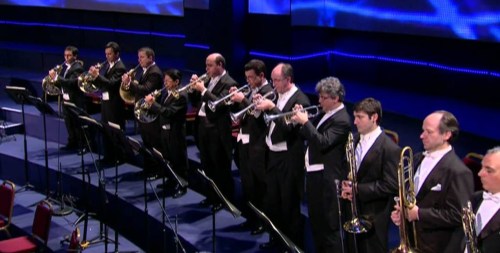
Fanfare for the Common Bird
Inside Copland gathers horns
Lifting common people
To the heights we belong
Outside a bird sits
On an impossibly slender branch
Sings uncommonly good
Flies up and away
©
Fanfare for the Common Bird
Inside Copland gathers horns
Lifting common people
To the heights we belong
Outside a bird sits
On an impossibly slender branch
Sings uncommonly good
Flies up and away
©

“You are Whitman, you are Poe, you are Mark Twain, you are Emily Dickinson and Edna St. Vincent Millay, you are Neruda and Mayakovsky and Pasolini, you are an American or a non-American, you can conquer the conquerors with words.”
Lawrence Ferlinghetti, Poetry as Insurgent Art
“There is a strong underground tradition of the poetry of engagement, which we might also call the poetry of citizenzry.”
Edward Hirsch, A Poet’s Glossary
“Poetry, an act of the imagination, is subject to historical forces, but it also talks back to history. The idea of witnessing should be widened to go beyond the documentary response to events. ‘I am the man . . . I suffered . . . I was there,’ Walt Whitman declared. A broad imaginative sympathy was part of his lived experience.”
Edward Hirsch, A Poet’s Glossary
I’ve written before about poetry as insurgent art, a term used by Lawrence Ferlinghetti. Here I add to the conversation with three entries from A Poet’s Glossary by Edward Hirsch—an essential book for those who read write study or teach poetry.
It is no surprise to regular readers that I think these are extraordinary times. And that I think people in all quarters should consider the ways they can help right the ship and steer it in a different direction. That is, all hands on deck, including poets.
How well that works, or whether it works at all, is to be determined. But as the student Sophie Scholl said of her tiny but morally mighty White Rose resistance movement in Nazi Germany, which boldly distributed simple leaflets, “Somebody, after all, had to make a start.” As well poets as anyone else.
From A Poet’s Glossary by Edward Hirsch:
political poetry
Poetry of social concern and conscience, politically engaged poetry. The feeling often runs high in the social poetry of engagement, especially when it is partisan. Poets write on both sides of any given war, defend the State, attack it. All patriotic and nationalistic poetry is by definition political. Political poetry, ancient and modern, good and bad, frequently responds vehemently to social injustice. Thus the poet is Jeremiah crying out to the assembly to witness the folly, unprecedented in both West (Cyprus) and East (Kedar), of a people who have forsaken the fountain of living waters for the stagnant water at the bottom of a leaky cistern. The Lamentations of Jeremiah, a series of poems mourning the desolation of Jerusalem and the sufferings of her people after the siege and destruction of the city and the burning of theTemple by the Babylonians, is also a political poem.
Strabo came up with the label stasiotika (“stasis-poems”) for Alcaeus’s partisan songs, political poems, which are propagandistic poems of civil war and exile, accounts of his political commitments. The premise of political poetry is that poetry carries “news” or information crucial to the populace. Political poetry is a poetry self-consciously written inside of history, of politics. It responds to external events. “Mad Ireland hurt you into poetry,” W. H. Auden famously decreed in his elegy for W. B. Yeats, and so, too, we might say that the madness of any country’s brutality has often wounded its poets into a political response in poetry. “I stand as a witness to the common lot, / survivor of that time, that place,” Anna Akhmatova wrote in 1961. Behind the poem in quest of justice, these lines from Shakespeare’s Antony and Cleopatra (1623): “our size of sorrow, / Proportion’d to our cause, must be as great / As that which makes it.”
There is an ephemeral quality to a lot of political poetry—most of it dies with the events it responds to—but a political poem need not be a didactic poem. It can be a poem of testimony and memory. For the best political poems of the twentieth century, I think of Vahan Tekeyan’s poems of the Armenian genocide; of the Spanish Civil War poet Miguel Hernandez’s haunting prison poems, especially “Lullaby of the Onion” (1939); and the Turkish poet Nazim Hikmet’s equally poignant prison poems, especially “On Living” (1948) and “Some Advice to Those Who Will Spend Time in Prison” (1949); of Bertolt Brecht’s World War II poems and Nelly Sachs’s Holocaust poems. I think of the Italian poet Cesare Pavese’s testimonies to ordinary people in trouble, Hard Labor (Lavorare stanca, 1936), and Pablo Neruda’s epic testament, Canto General (1950). I think of the many poems of indictment and summons, of land and liberty, collected in the Nigerian writer Wole Soyinka’s breakthrough anthology, Poems of Black Africa (1975).
There is a strong tradition in England of political poems. Edmund Spenser’s Complaints (1591) takes aim at social and political targets. John Milton wrote a series of pro-Cromwellian short poems in the 1640s and ’50s. Some of John Dryden’s greatest poetry was written in response to events, such as his two-part political satire Absalom and Achitophel (1681, 1682). William Wordsworth’s political poems are among his best, such as his sonnet “To Toussaint L’Ouverture” (1803), though a few of his late patriotic poems are also among his worst. Percy Bysshe Shelley’s The Mask of Anarchy (1819), which was “Written on the Occasion of the Massacre at Manchester” (“I met Murder on the way—/ He had a mask like Castlereagh”), is a frankly political poem that always gives me a chill. Elizabeth Barrett Browning published two striking books of political poetry during her Italian sojourn, Casa Guidi Windows (1850) and Poems Before Congress (1860). The most popular Victorian poet, Alfred, Lord Tennsyon, never distinguished between the personal and the political, the private and the public.
Political poetry has always seemed somewhat suspect in American literary history. “Our wise men and wise institutions assure us that national political events are beyond the reach of ordinary, or even extraordinary, literary sensitivity,” Robert Bly writes. Yet there is a strong underground tradition of the poetry of engagement, which we might also call the poetry of citizenzry. This runs from Walt Whitman’s political poems of the 1850s, which prefigure Leaves of Grass, and John Greenleaf Whittier’s Anti-Slavery Poems (1832–1887), to leftist poets of the 1930s (Kenneth Fearing, Edwin Rolfe, Muriel Rukeyser). The civil rights movement and the Vietnam War enraged poets, and, as Bly points out, some of the most inward poets, such as Robert Duncan, Denise Levertov, and Galway Kinnell, wrote some of the best poems against the Vietnam War. Most poetry of the 1940s and ’50s shunned politics, but Thomas McGrath (“Ode for the American Dead in Korea,” retitled in the early 1970s “Ode for the American Dead in Asia”) and Kenneth Rexroth (“A Christmas Note for Geraldine Udell,” 1949) bucked the trend. For forty years, Adrienne Rich was one of the most outspoken political poets in late twentieth-century American poetry, a model for a generation of political and activist poets. She went through several phases in relationship to polemics. She proposed a position that resists didacticism in “Power and Danger: Works of a Common Woman” (1978), her introduction to a collection of poems by Judy Grahn:
No true political poetry can be written with propaganda as an aim, to persuade others “out there” of some atrocity or injustice (hence the failure, as poetry, of so much anti-Vietnam poetry of the sixties). As poetry, it can come only from the poet’s need to identify her relationship to atrocities and injustice, the sources of her pain, fear, and anger, the meaning of her resistance.
protest poetry
Poetry of dissent, of social criticism. It protests the status quo and tries to undermine established values and ideals. The protest poet is a rebellious citizen, speaking out, expressing disapproval of a political policy or social action. Protest poetry, the most earnest of genres, is timely, oppositional, reactive, urgent. It is an activist type of political poetry born from outrage and linked to social action. It turns poetry into a medium for polemics.
The reprehensible policy of apartheid in South Africa, which legislated racism, also stimulated a powerful tradition of protest poetry. The Zulu poet Herbert I. E. Dhlomo’s long poem Valley of a Thousand Hills (1941) is the most extended work of South African protest poetry. One thinks of the contributions of Dennis Brutus (1924–2009), whose work is brought together in Poetry and Protest: A Dennis Brutus Reader (2006); Arthur Nortje (1942–1970), whose work is published posthumously in Dead Roots (1973) and Lonely Against the Light (1973); and Mazisi Kunene (1930–2006), who first sounded his aggressive, telegraphic note in Zulu Poems (1970). The New Black poetry of the 1970s, or Soweto poetry, was a protest poetry of black consciousness. In the United States, there is also a strong tradition of African American poetry that protests racism. It extends from the Harlem renaissance to the Black Arts movement. Most antiwar poetry is protest poetry. The combatant antiwar poetry of Wilfred Owen (1893–1918) and Siegfried Sassoon (1886–1967) protested the technological horrors of modern warfare. The Spanish Civil War generated both local and global protest poetry. The Vietnam War galvanized a tremendous amount of protest poetry by such poets as Robert Lowell, Allen Ginsberg, Adrienne Rich, and Robert Bly. These poets felt a cultural imperative to speak out against the war. The repression and disintegration of the American imagination is one of the persistent themes of Vietnam-era protest poetry. Much of the feminist poetry of the 1960s and ’70s is protest poetry. “A patriot is not a weapon,” Adrienne Rich writes in her long poem An Atlas of the Difficult World (1981). “A patriot is one who wrestles for the soul of her country / as she wrestles for her own being.” Sam Hamill’s anthology Poets Against the War (2003) was a hastily gathered book of protest poems against the war in Iraq. The strength of protest poetry is its sense of immediacy and outrage. However, most of these politically motivated poems, which are often made in outrage against a specific atrocity, don’t outlive their historical moment.
witness of poetry, poetry of witness
Poetry of testimony. In the early 1990s, Carolyn Forché transformed the Polish poet Czeslaw Milosz’s phrase the witness of poetry (taken from the book of the same name, 1983) into “the poetry of witness.” Her anthology Against Forgetting: Twentieth-Century Poetry of Witness (1993) gathers together the work of 145 poets “who endured conditions of historical and social extremity during the twentieth century—through exile, state censorship, political censorship, house arrest, torture, imprisonment, military occupation, warfare, and assignation. Many poets did not survive, but their works remain with us as poetic witness to the dark times in which they lived.” Poetry, an act of the imagination, is subject to historical forces, but it also talks back to history. The idea of witnessing should be widened to go beyond the documentary response to events. “I am the man . . . I suffered . . . I was there,” Walt Whitman declared. A broad imaginative sympathy was part of his lived experience.
In 1944, the Hungarian poet Miklós Radnóti wrote four harrowing “Postcard” poems in the midst of a forced march westward across Hungary. Radnóti was one of twenty-two prisoners murdered and tossed into a collective grave. After the war, his widow had his body exhumed and these poems were found in his field jacket, written in pencil in a small Serbian exercise book. Thus his poems nearly literally rise up from a mass grave. They inscribe a suffering unimaginably intense, a consciousness of death nearly unbearable. They are purposefully entitled “Postcards.” Here the informality of the postcard (dashed off, superficial) is belied by the scrupulousness with which Radnóti describes and re-creates the scene of his impending death. The postcard is a message directed to another person. It has a particular reader in mind, but its openness also suggests that it can be read by anyone. Thus the poem in the guise of a postcard is a testimony back to life, a signal that Radnóti had pushed back the silence long enough to embody a final experience. His poems of witness display the classical brevity and poise of an Orphic art that comes back from the underworld to give testimony.

Today is Shabbat. Today is also International Holocaust Remembrance Day.
The Sabbath is a celebration, compared to a wedding day. The Holocaust is not. A paradox, perhaps.
From The Sabbath by Abraham Joshua Heschel:
The Sabbath is a bride, and its celebration is like a wedding.
“We learn in the Midrash that the Sabbath is like unto a bride. Just as a bride when she comes to her groom is lovely, bedecked and perfumed, so the Sabbath comes to Israel lovely and perfumed, as it is written: And on the Seventh Day He ceased from work and He rested (Exodus 31:17), and immediately afterwards we read: And He gave unto Moses kekalloto [the word kekalloto means when he finished, but it may also mean] as his bride, to teach us that just as a bride is lovely and bedecked, so is the Sabbath lovely and bedecked; just as a groom is dressed in his finest garments, so is a man on the Sabbath day dressed in his finest garments; just as a man rejoices all the days of the wedding feast, so does man rejoice on the Sabbath; just as the groom does no work on his wedding day, so does a man abstain from work on the Sabbath day; and therefore the Sages and ancient Saints called the Sabbath a bride.
International Holocaust Remembrance Day:
The United Nations General Assembly designated January 27—the anniversary of the liberation of Auschwitz-Birkenau—as International Holocaust Remembrance Day. On this annual day of commemoration, the UN urges every member state to honor the six million Jewish victims of the Holocaust and millions of other victims of Nazism and to develop educational programs to help prevent future genocides.
Nowhere in all of our obligations are we asked to make sense of things. Celebrate? Yes. Remember? Yes. Make sense of things? That would be a miracle.
And speaking of miracles, from Hasidic Tales of the Holocaust by Yaffa Eliach:
A Kvitl on the Frankfurter’s Grave
RABBI ISRAEL PERLOW (1869–1922), KNOWN AS THE BABE OF KARLIN-Stolin, was one of the most famous Hasidic rabbis of Lithuanian Hasidism. He became a Hasidic leader at the age of four when his father, Rabbi Ascher of Karlin, passed away. Rabbi Israel was a scholar, a fine composer, and had a commanding knowledge of the sciences. He died in Frankfurt an Main during one of his many travels and was buried there. After his death he was sometimes referred to as the Frankfurter. Despite the desecration of many Jewish cemeteries in Nazi Germany, the rabbi’s grave was never vandalized.
After liberation, Germany became the center for displaced persons. Most of them were people who had been liberated from the concentration camps; the others were those who came to seek possible survivors of their families and ways to emigrate to Palestine and America. Among the many refugees were a handful of Hasidim from Karlin-Stolin. For them, the Frankfurter’s grave was a source of strength and solace.
One day a Hasid of Karlin-Stolin who, along with his son, had been fortunate enough to survive the horrors of the war, came to pray at the rabbi’s grave. He placed a pebble on the gravestone as is customary, and said a few chapters of Psalms. Then he poured out his heart before the holy grave, begging the Frankfurter that his holiness would intercede with the Almighty so that his son would find a proper mate, befitting a pious young man. As is also customary, he wrote his son’s name and his request on a piece of paper, folded the kvitl neatly, and placed it in one of the crevices of the tombstone. The Hasid left the Frankfurter’s grave in high spirits, sure that his prayers and request would be answered.
A few days later another Hasidic Jew, also a Karlin-Stolin Hasid, made his way to Frankfurt to the Babe of Stolin’s grave. Like the thousands before him, he told his bitter tale and asked the rabbi’s blessing. He too was fortunate, more than many others. Though he had lost almost his entire family, one daughter of marriageable age survived. He prayed now on his daughter’s behalf, that she should meet a Jewish boy who would find favor in the eyes of God and men, and if possible, also be a Hasid of Karlin-Stolin. As he was about to write his request, he realized that he did not have anything to write on. Just then a gentle wind blew and a piece of paper fluttered to his feet. He picked up the paper and wrote his request in the customary manner. As he was about to fold the kvitl, he noticed that the other side also had writing on it. It was the kvitl of none other than the first Hasid of Karlin-Stolin who had appeared earlier.
A few days later, a wedding took place in a D.P. camp in Germany. The two young people whose fathers had prayed on the zaddik’s grave were united in matrimony. And so you see that the miracles of the Frankfurter Rebbe do not cease unto this very day.

The emailed response from the Guggenheim’s chief curator to the White House was polite but firm: The museum could not accommodate a request to borrow a painting by Vincent Van Gogh for President and Melania Trump’s private living quarters.
Instead, wrote the curator, Nancy Spector, another piece was available, one that was nothing like “Landscape With Snow,” the 1888 Van Gogh rendering of a man in a black hat walking along a path in Arles, France, with his dog.

The curator’s alternative: an 18-karat, fully functioning, solid gold toilet — an interactive work titled “America” that critics have described as pointed satire aimed at the excess of wealth in this country.
For a year, the Guggenheim had exhibited “America” — the creation of contemporary artist Maurizio Cattelan — in a public restroom on the museum’s fifth floor for visitors to use.
But the exhibit was over and the toilet was available “should the President and First Lady have any interest in installing it in the White House,” Spector wrote in an email obtained by The Washington Post.
The artist “would like to offer it to the White House for a long-term loan,” wrote Spector, who has been critical of Trump. “It is, of course, extremely valuable and somewhat fragile, but we would provide all the instructions for its installation and care.”
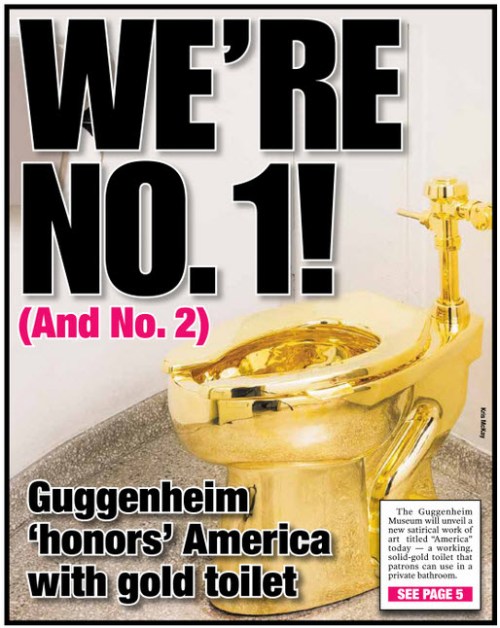
New York Post – September 16, 2016
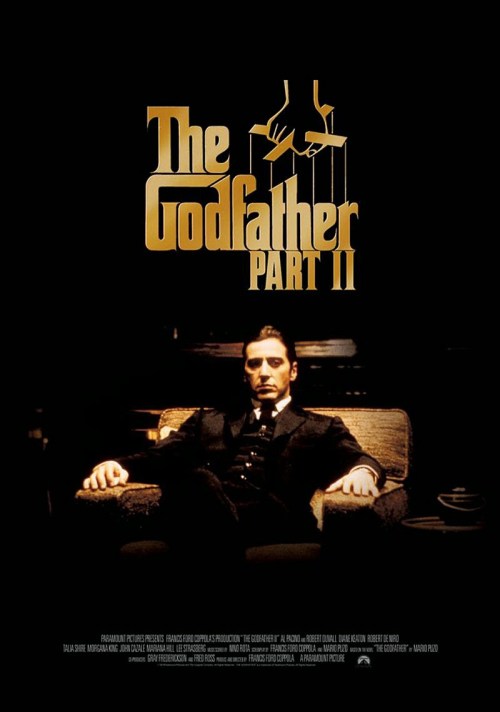
“All my people are businessmen; their loyalty is based on that…and on that basis, anything is possible.”
“Free to make our profits without the Justice Department, the FBI…looking for a man who desperately wants to be President of the United States.”
The Godfather Part II
The Godfather Part I and Part II are more than near-perfect movies, two of the most critically-acclaimed films of all time. They are compelling pictures of the unrestrained grab for power and money, fueled by mutual self-interest and governed by no other values.
These two quotes from The Godfather Part II (1974), more than forty years old, encapsulate where America finds itself today:
MICHAEL CORLEONE
“All my people are businessmen; their loyalty is based on that. One thing I learned from my father is to try to think as the people around you think…and on that basis, anything is possible.”
HYMAN ROTH
“If only I could live to see it, kid; to be there with you. How beautifully we’ve done it, step by step. Here, protected, free to make our profits without the Justice Department, the FBI; ninety miles away in partnership with a friendly government. Ninety miles, just a small step, looking for a man who desperately wants to be President of the United States, and having the cash to make it possible.”

Sid Gillman is a towering figure in National Football League history—in fact, in the history of American football:
He began his coaching career in an era that taught that running the ball was the surest way to victory.
It was a philosophy with which he disagreed. “The big play comes with the pass,” he would tell anyone who would take time to listen. “God bless those runners because they get you the first down, give you ball control and keep your defense off the field. But if you want to ring the cash register, you have to pass.”
Sid went on to become the foremost authority on forward passing offense. He was the first coach to produce divisional champions in both the National and American Football Leagues. Gillman’s first pro coaching job came in 1955 when he became the Los Angeles Rams head coach. In his first year he led the team to a division crown.
The rest is history. Not only did opposing teams have to learn to defend against the big pass play, which opened up the field, but they had to develop new and innovative playbooks of their own.
Like it or not, there is a new playbook in American politics, at least from one of the teams. Maybe—hopefully—it will return to a game that unconditionally rewards excellence, competence, integrity, morality, ethics, reasonableness, responsibility, accountability, civility and honesty. But not at the moment.
This isn’t to suggest that Democrats adopt the Trump playbook. But just as with the football teams that had to play against Gillman, the Democrats have to spend time—much of which they wasted in 2017—doing more than tweaking the plays or even finding better players. The old playbook is not going to work in 2018, and for all we know, in the foreseeable future.
Whatever you hear the Democrats propose, whoever you see the Democrats running, ask yourself whether it is part of a brand new playbook, or just updated versions of the same old one. Because without that new playbook, winning will remain often out of reach.

First Thing
Whatever I read or hear
First thing
Thousand year old dead man
Or new born bird
Whatever I drink
Cool clear water
Or hot brown coffee
There is the floor and a cushion
And if gone
The ground and a rock
The incense stick is lit
Fragrance up
Burning down
©

Whatever the disparate historical origins of the two [creation] accounts, the redaction gives us first a harmonious cosmic overview of creation and then a plunge into the technological nitty-gritty and moral ambiguities of human origins.
Robert Alter, The Five Books of Moses
Much of the federal government has shut down today—it has ceased from its work. And it is Shabbat when, based on the story of creation in the Torah, people are asked to cease from their everyday work because this day is different and set apart.
It is an opportunity to see if that story of creation offers any insights into the government situation. (It is tempting but ungracious to suggest that one particular person who could use those insights—any insights—turn to the Bible for wisdom—any wisdom. But that’s not happening, even on Shutdown Shabbat.)
The creation story in Genesis 2 radically switches focus. When the six days of cosmic creation are over, there is the familiar seventh day break:
And God completed on the seventh day the task He had done, and 3 He ceased on the seventh day from all the task He had done. And God blessed the seventh day and hallowed it, for on it He had ceased from all His task that He had created to do. (Genesis 2:3-4)
But with the big picture, high-concept work done, the detailed tasks begin. God, as they say, is in the details:
On the day the LORD God made earth and heavens, no shrub of the field being yet on the earth and no plant of to cease from their everyday the field yet sprouted, for the LORD God had not caused rain to fall on the earth and there was no human to till the soil, and wetness would well from the earth to water all the surface of the soil, then the The LORD God fashioned the human, humus from the soil, and blew into his nostrils the breath of life, and the human became a living creature. And the LORD God planted a garden in Eden, to the east, and He placed there the human He had fashioned. And the LORD God caused to sprout from the soil every tree lovely to look at and good for food, and the tree of life was in the midst of the garden, and the tree of knowledge, good and evil. Now a river runs out of Eden to water the garden and from there splits off into four streams. The name of the first is Pishon, the one that winds through the whole land of Havilah, where there is gold. And the gold of that land is goodly, bdellium is there, and lapis lazuli. And the name of the second river is Gihon, the one that winds through all the land of Cush. And the name of the third river is Tigris, the one that goes to the east of Ashur. And the fourth river is Euphrates. And the LORD God took the human and set him down in the garden of Eden to till it and watch it. (Genesis 2:5-15)
Robert Alter notes:
As many modern commentators have noted, the first Creation account concludes with the summarizing phrase in the first half of this verse: “This is the tale [literally, these are the begettings] of the heavens and the earth when they were created,” these two paired terms, “heavens” and “earth,” taking us back in an envelope structure to the paired terms of the very first verse of the Creation story. Now, after the grand choreography of resonant parallel utterances of the cosmogony, the style changes sharply….In this more vividly anthropomorphic account, God, now called YHWH ’Elohim instead of ’Elohim as in the first version, does not summon things into being from a lofty distance through the mere agency of divine speech, but works as a craftsman, fashioning (yatsar instead of bara’, “create”), blowing life-breath into nostrils, building a woman from a rib. Whatever the disparate historical origins of the two accounts, the redaction gives us first a harmonious cosmic overview of creation and then a plunge into the technological nitty-gritty and moral ambiguities of human origin. (emphasis added)
This, on Shutdown Shabbat, is a root of the problem. The story suggests that even God, who could reportedly talk his way into any grand scheme, had to stop talking, roll up his sleeves, and do the difficult work, “plunge into the technological nitty-gritty and moral ambiguities.”
Those who have somehow ended up in exalted positions of power are urged to use Shabbat, especially this one, to contemplate morality, their actions, and the effect those actions have on human beings. The powerful might rather be golfing, but there’s plenty of other time to do that. This is Shutdown Shabbat.

Updated to include the Discovery Channel response to Trump’s views on sharks.
In Touch Weekly has published an interview with Stormy Daniels about her affair with Trump—while he was married to Melania, starting just after the birth of their son Barron.

It is profoundly sad, dispiriting, and disturbing. But not surprising. Not surprising either is the silence of his Republican henchmen and supporters, who seem to put up with anything, provided they can make more money or keep their jobs and power.
Among the non-sexual tidbits that have caught everyone’s attention is her relating Trump’s obsessive fear and hatred of sharks:
The strangest thing about that night — this was the best thing ever. You could see the television from the little dining room table and he was watching Shark Week and he was watching a special about the U.S.S. something and it sank and it was like the worst shark attack in history. He is obsessed with sharks. Terrified of sharks. He was like, “I donate to all these charities and I would never donate to any charity that helps sharks. I hope all the sharks die.” He was like riveted. He was like obsessed. It’s so strange, I know.
Just as vampires are put off by crosses, it is possible, just possible, that shark jewelry can protect us from Trump. Either figurative sharks or shark’s teeth might work. No guarantees, but it’s worth a try.
Update
From Mashable:
/https%3A%2F%2Fblueprint-api-production.s3.amazonaws.com%2Fuploads%2Fcard%2Fimage%2F696766%2Ff5c48e69-6c57-459d-8097-e1407149c282.png)
Mashable reached out to the Shark Week network after reading a report alleging that Trump once said, “I hope all sharks die.” Its response was measured.
“Shark Week celebrates the wonder of these majestic creatures and their critical importance to the ecosystem,” a Discovery Channel representative told Mashable when asked for comment about the president’s Shark Week viewing habits and fears. “Their safety and conservation is the most important message conveyed throughout the week.”

Mister Mxyzptlk was an imp from the fifth dimension who was a constant nemesis of Superman in the comics. The only way this villain could be made to disappear was to trick him into saying his own name backwards.
And so, while we wait for something to rid us of our meddlesome president, one suggestion is to trick him into saying (or tweeting) his name backwards: Pmurt (pronounced puhmurt?)
How? Well, if someone were to tweet something critical, including a claim that Trump was a “pmurt”, the president could not resist answering the charge, including in his replies a flat out denial of the fake news that he is a pmurt.
Yup, that should do it.

