Do you want a government that gives you what you want most of the time? Or do you want a government that because of democratic principles sometimes—maybe often—goes against your wishes?
Lawful democracy doesn’t always go your way. But if you find an authoritarian who almost always agrees with your position, would that really be so bad?
Apparently in America right now, a substantial number want to get their way, and are willing to lean authoritarian, even if the democratic rule of law suffers. Americans have virtually no experience with this, and certainly not at the highest federal level. The worst case scenarios that seemed to some mere paranoid concerns are becoming even worse realities. There are supposed to be correcting mechanism available, but we suddenly see that those mechanisms take time, and more importantly, depend on the good will of those working the machines. Good will, prudence and integrity that we are discovering may be missing.
To those who love history, the saving grace is that you are getting to live through singularly historic times. To those who are young enough to see another generation or two, you will be able to tell your children and grandchildren that you were around when an all-time constitutional clash—the battle for American democracy—took place. Let’s hope you will be allowed to tell the whole story, and that you will be believed and not dismissed as the purveyor of fake history.
you have to say something
even if and though nothing
you have to do something
even if and though nothing
you have to think something
even if and though nothing
the moment demands that
the smart and swift
the stupid and still
pick up and lay down
their thoughts words and deeds
to pick them up and lay them down
endlessly again
Yesterday I reported about an open letter signed by hundreds of former federal prosecutors, a letter saying that given the substantial evidence in the Mueller report, each of them would have indicted Trump for obstruction of justice–except for the Department of Justice guidance that a sitting president not be indicted. Those lawyers who elaborated said it wasn’t even close–that Trump could have been indicted and convicted for multiple crimes.
At the time it was first released, 300 or so former Department of Justice lawyers, some with as much as 41 years of service, including many former U.S Attorneys, working in Republican and Democratic administrations from Nixon through Trump, had signed. As of this morning, that number of signers had grown to 680 and is still growing. These lawyers represent over 8,500 years of nonpartisan service in the cause of American justice. In the cause of the rule of law.
The story got some attention for a few hours yesterday, and then sank, as critical stories have a tendency to do in these critical days. Maybe the news media don’t think Americans are interested in this sort of “inside baseball” technical legal issue or that Americans are tired of the whole Mueller thing. Maybe many Americans aren’t interested in this. Maybe Americans think that lawyers are liars who will say anything, including lawyers who work for the previously most respected legal organization in America–the Department of Justice.
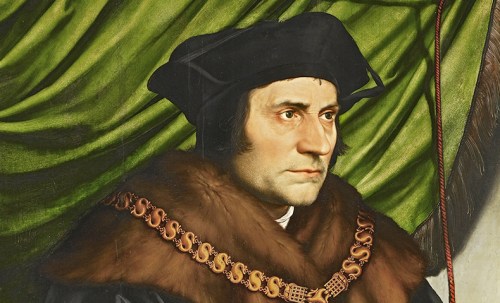
A brief note about Sir Thomas More, the Chancellor for Henry VIII. More is celebrated in multiple realms, both religious and legal. He was named by lawyers as the lawyer of the last millennium for his unwavering stand for the rule of law and conscience over selfish motives, convenience or the wishes of a king. He was famously executed for his conscientious resistance.
In Robert Bolt’s play A Man for All Seasons, More explains his steadfast allegiance to the rule of law. When the laws are cut down or ignored one by one, what will be left for us?:
ROPER: So now you’d give the Devil the benefit of law!
THOMAS MORE: Yes. What would you do? Cut a great road through the law to get after the Devil?
ROPER: I’d cut down every law in England to do that!
THOMAS MORE: Oh? And when the last law was down, and the Devil himself turned round on you—where would you hide, Roper, the laws all being flat? This country’s planted thick with laws from coast to coast—man’s laws, not God’s—and if you cut them down—and you’re just the man to do it—d’you really think you could stand upright in the winds that would blow then? Yes, I’d give the Devil himself the benefit of law, for my own safety’s sake.
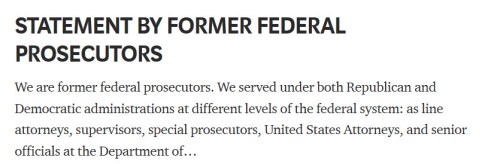
More than 400 540 former federal prosecutors from Republican and Democratic administrations have signed a letter contending that President Donald Trump would have been charged with obstruction of justice based on the findings of the Mueller report if he weren’t president. And the list of signers is growing.
We are former federal prosecutors. We served under both Republican and Democratic administrations at different levels of the federal system: as line attorneys, supervisors, special prosecutors, United States Attorneys, and senior officials at the Department of Justice. The offices in which we served were small, medium, and large; urban, suburban, and rural; and located in all parts of our country.
Each of us believes that the conduct of President Trump described in Special Counsel Robert Mueller’s report would, in the case of any other person not covered by the Office of Legal Counsel policy against indicting a sitting President, result in multiple felony charges for obstruction of justice.
The Mueller report describes several acts that satisfy all of the elements for an obstruction charge: conduct that obstructed or attempted to obstruct the truth-finding process, as to which the evidence of corrupt intent and connection to pending proceedings is overwhelming. These include:
The President’s efforts to fire Mueller and to falsify evidence about that effort;
The President’s efforts to limit the scope of Mueller’s investigation to exclude his conduct; and
The President’s efforts to prevent witnesses from cooperating with investigators probing him and his campaign.
Attempts to fire Mueller and then create false evidence
Despite being advised by then-White House Counsel Don McGahn that he could face legal jeopardy for doing so, Trump directed McGahn on multiple occasions to fire Mueller or to gin up false conflicts of interest as a pretext for getting rid of the Special Counsel. When these acts began to come into public view, Trump made “repeated efforts to have McGahn deny the story” — going so far as to tell McGahn to write a letter “for our files” falsely denying that Trump had directed Mueller’s termination.
Firing Mueller would have seriously impeded the investigation of the President and his associates — obstruction in its most literal sense. Directing the creation of false government records in order to prevent or discredit truthful testimony is similarly unlawful. The Special Counsel’s report states: “Substantial evidence indicates that in repeatedly urging McGahn to dispute that he was ordered to have the Special Counsel terminated, the President acted for the purpose of influencing McGahn’s account in order to deflect or prevent scrutiny of the President’s conduct toward the investigation.”
Attempts to limit the Mueller investigation
The report describes multiple efforts by the president to curtail the scope of the Special Counsel’s investigation.
First, the President repeatedly pressured then-Attorney General Jeff Sessions to reverse his legally-mandated decision to recuse himself from the investigation. The President’s stated reason was that he wanted an attorney general who would “protect” him, including from the Special Counsel investigation. He also directed then-White House Chief of Staff Reince Priebus to fire Sessions and Priebus refused.
Second, after McGahn told the President that he could not contact Sessions himself to discuss the investigation, Trump went outside the White House, instructing his former campaign manager, Corey Lewandowski, to carry a demand to Sessions to direct Mueller to confine his investigation to future elections. Lewandowski tried and failed to contact Sessions in private. After a second meeting with Trump, Lewandowski passed Trump’s message to senior White House official Rick Dearborn, who Lewandowski thought would be a better messenger because of his prior relationship with Sessions. Dearborn did not pass along Trump’s message.
As the report explains, “[s]ubstantial evidence indicates that the President’s effort to have Sessions limit the scope of the Special Counsel’s investigation to future election interference was intended to prevent further investigative scrutiny of the President’s and his campaign’s conduct” — in other words, the President employed a private citizen to try to get the Attorney General to limit the scope of an ongoing investigation into the President and his associates.
All of this conduct — trying to control and impede the investigation against the President by leveraging his authority over others — is similar to conduct we have seen charged against other public officials and people in powerful positions.
Witness tampering and intimidation
The Special Counsel’s report establishes that the President tried to influence the decisions of both Michael Cohen and Paul Manafort with regard to cooperating with investigators. Some of this tampering and intimidation, including the dangling of pardons, was done in plain sight via tweets and public statements; other such behavior was done via private messages through private attorneys, such as Trump counsel Rudy Giuliani’s message to Cohen’s lawyer that Cohen should “[s]leep well tonight[], you have friends in high places.”
Of course, these aren’t the only acts of potential obstruction detailed by the Special Counsel. It would be well within the purview of normal prosecutorial judgment also to charge other acts detailed in the report.
We emphasize that these are not matters of close professional judgment. Of course, there are potential defenses or arguments that could be raised in response to an indictment of the nature we describe here. In our system, every accused person is presumed innocent and it is always the government’s burden to prove its case beyond a reasonable doubt. But, to look at these facts and say that a prosecutor could not probably sustain a conviction for obstruction of justice — the standard set out in Principles of Federal Prosecution — runs counter to logic and our experience.
As former federal prosecutors, we recognize that prosecuting obstruction of justice cases is critical because unchecked obstruction — which allows intentional interference with criminal investigations to go unpunished — puts our whole system of justice at risk. We believe strongly that, but for the OLC memo, the overwhelming weight of professional judgment would come down in favor of prosecution for the conduct outlined in the Mueller Report.
I stood at the front of the room. I shouldn’t be standing there, I realized, as if I was the teacher, and they my students. It was upside down.
I had called them together, the wisdom teachers I had followed over the years. They had no choice but to come and sit in their chairs. This was my assembly.
Some had identifiable names and lives, most historical and actual, but a few apocryphal. Others were general, not a particular person, but a tradition or text.
Many traditions and sub-traditions were represented: Buddhism, Taoism, Judaism, Christianity, Islam and others. Within each tradition, no teacher could claim primacy, no superstars versus stars. There was Abraham Joshua Heschel and Rabbi Nachman of Bratslav. There was Jesus and Thomas Merton. There was Dogen and Shunryu Suzuki Roshi. Among themselves they might make distinctions. But as teachers who had all given me something significant, they were all at parity.
Were they talking with each other or to me? No. They sat silently, looking at me with calm intensity, waiting for me to answer the unasked question: why had I called them all together?
I did have a reason. But now I wondered if I should ask. The question was whether it was time to give up my practice of drawing wisdom from any and all of them, like a hummingbird feeding from an array of beautiful flowers. Instead, I wanted to know, should I focus on one to the exclusion of the others.
I couldn’t bring myself to ask, because I knew, or thought I knew, what they might say. What a stupid question. Or: You already know the answer. Or: There is no answer. Or: What a stupid question. Or, in the case of a Zen teacher who clung to the old ways, I might be beaten with a stick. And deserve it.
This week’s Torah portion is Acharei Mot, the second part of which is Leviticus 18. It contains very specific laws for sexual conduct, prohibiting practices that Jews must avoid on penalty of death.
Some of the prohibitions are still commonly accepted by most (though not all) in modern times and societies, including bans on incest within extended families and on bestiality. But among them is one that increasingly requires explanation in the face of changing norms–a ban on male homosexual relations. (Lesbian relations are not covered, as Robert Alter notes: “Lesbianism, which surely must have been known in the ancient Near East, is nowhere mentioned, perhaps because no wasting of seed is involved, although the reason for the omission remains unclear.”)
This demands some attention from people of faith who nevertheless believe that homosexual relations are as godly and natural as relations between men and women. The squaring of this circle is actually not that complex, though for some it remains difficult.
It is entirely possible to regard scripture as special, elevated and inspired without treating it as immutable and eternal law. That of course creates its own set of challenges, that is, which of the laws are we to embrace and which do we set aside? The ten commandments contain some valuable guidance we would like generally followed. Not lying, for example, comes immediately to mind.
Here’s the good news. We can do this, we can study and discern what is good and healthy for us individually and as communities. Here’s the inconvenient news. Study and discernment are hard, though rewarding. In my experience, discarding the Bible, or religion for that matter, because of its most pernicious elements and outcomes, is self-defeating and self-denying.
There are people who don’t eat vegetables because, to be honest, some vegetables are pretty terrible or are abysmally prepared. But vegetables are truly wondrous, as taste treats and as part of a healthful diet. You just have to be open to it and work at it a little. And not be put off by the stuff you don’t like and can’t accept.
A good economy, at least for the moment. Entertainment and digital diversions to infinity and beyond. If there is also a diminishing—a devolution—of democracy, will Americans care?
Over the last year, as the presidential campaign grew increasingly bizarre and Donald Trump took us places we had never been before, I saw a spike in media references to Amusing Ourselves to Death, a book written by my late father, Neil Postman, which anticipated back in 1985 so much about what has become of our current public discourse….
The central argument of Amusing Ourselves is simple: there were two landmark dystopian novels written by brilliant British cultural critics – Brave New World by Aldous Huxley and Nineteen Eighty-Four by George Orwell – and we Americans had mistakenly feared and obsessed over the vision portrayed in the latter book (an information-censoring, movement-restricting, individuality-emaciating state) rather than the former (a technology-sedating, consumption-engorging, instant-gratifying bubble)….
Unfortunately, there remained a vision we Americans did need to guard against, one that was percolating right then, in the 1980s. The president was a former actor and polished communicator. Our political discourse (if you could call it that) was day by day diminished to soundbites (“Where’s the beef?” and “I’m paying for this microphone” became two “gotcha” moments, apparently testifying to the speaker’s political formidableness).
The nation increasingly got its “serious” information not from newspapers, which demand a level of deliberation and active engagement, but from television: Americans watched an average of 20 hours of TV a week. (My father noted that USA Today, which launched in 1982 and featured colorized images, quick-glance lists and charts, and much shorter stories, was really a newspaper mimicking the look and feel of TV news.)
But it wasn’t simply the magnitude of TV exposure that was troubling. It was that the audience was being conditioned to get its information faster, in a way that was less nuanced and, of course, image-based. As my father pointed out, a written sentence has a level of verifiability to it: it is true or not true – or, at the very least, we can have a meaningful discussion over its truth. (This was pre-truthiness, pre-“alternative facts”.)
But an image? One never says a picture is true or false. It either captures your attention or it doesn’t. The more TV we watched, the more we expected – and with our finger on the remote, the more we demanded – that not just our sitcoms and cop procedurals and other “junk TV” be entertaining but also our news and other issues of import. Digestible. Visually engaging. Provocative. In short, amusing. All the time. Sorry, C-Span.
This was, in spirit, the vision that Huxley predicted way back in 1931, the dystopia my father believed we should have been watching out for. He wrote:
What Orwell feared were those who would ban books. What Huxley feared was that there would be no reason to ban a book, for there would be no one who wanted to read one. Orwell feared those who would deprive us of information. Huxley feared those who would give us so much that we would be reduced to passivity and egoism. Orwell feared that the truth would be concealed from us. Huxley feared the truth would be drowned in a sea of irrelevance. Orwell feared we would become a captive culture. Huxley feared we would become a trivial culture.
1984 – the year, not the novel – looks positively quaint now. One-third of a century later, we all carry our own personalized screens on us, at all times, and rather than seven broadcast channels plus a smattering of cable, we have a virtual infinity of options….
Our public discourse has become so trivialized, it’s astounding that we still cling to the word “debates” for what our presidential candidates do onstage when facing each other. Really? Who can be shocked by the rise of a reality TV star, a man given to loud, inflammatory statements, many of which are spectacularly untrue but virtually all of which make for what used to be called “good television”?
Who can be appalled when the coin of the realm in public discourse is not experience, thoughtfulness or diplomacy but the ability to amuse – no matter how maddening or revolting the amusement?
So, yes, my dad nailed it. Did he also predict that the leader we would pick for such an age, when we had become perhaps terminally enamored of our technologies and amusements, would almost certainly possess fascistic tendencies? I believe he called this, too.
For all the ways one can define fascism (and there are many), one essential trait is its allegiance to no idea of right but its own: it is, in short, ideological narcissism. It creates a myth that is irrefutable (much in the way that an image’s “truth” cannot be disproved), in perpetuity, because of its authoritarian, unrestrained nature….
I wish I could tell you that, for all his prescience, my father also supplied a solution. He did not. He saw his job as identifying a serious, under-addressed problem, then asking a set of important questions about the problem. He knew it would be hard to find an easy answer to the damages wrought by “technopoly”. It was a systemic problem, one baked as much into our individual psyches as into our culture.
The founders of America were not fools. They knew history. They knew politics. They knew law. They knew people, good men and scoundrels.
They did their best to craft an elegant and sustainable system. They did as much as they could, and they did it well. But they knew, as we all know, that the best systems cannot build in total safeguards for their benign operation and maintenance. For that, every system depends on a sufficient number of people in control who place the best interests of the system first—before their own interests.
In the case of American democracy, that means sufficient people in positions of power who are patriots. How many patriots in power are sufficient? We can’t be sure, because in all of American history, we have never had to ask the question. We’ve assumed there would always be enough patriots in positions of power to correct our course. How many patriots in power are sufficient? We may be about to find out by falling short.
The percentage of people living in extreme poverty globally fell to a new low of 10 percent in 2015 — the latest number available — down from 11 percent in 2013, reflecting steady but slowing progress, World Bank data show. The number of people living on less than $1.90 a day fell during this period by 68 million to 736 million.
Buzz Aldrin, one of the first astronauts on the moon, says that both the US and the wider international community
“Should focus on opening the door, in our time, to the great migration of humankind to Mars.”
It’s true that humankind has been able to walk and chew gum at the same time, that is, pursue various initiatives in very different spheres. You can definitely see migration to Mars as simply the next frontier for our pioneering instincts (and our power/mercenary instincts too).
But it is also possible to see this as responsible parties turning their backs on important but seemingly intractable situations. Poverty, as just one example of the areas to address, looks a little brighter, given a one-percent reduction over five years. On the other hand, 736 million people living on $1.90 a day doesn’t sound all that great.
Human beings, as individuals and communities, want to do all kinds of exciting and forward-looking things. We shouldn’t throw gratuitous shade on those initiatives. But whatever the vision of heaven on earth, we shouldn’t pretend that we are anywhere near that.