Everybody tells the occasional fib. But whereas liars consciously conceal the truth, reckons Harry Frankfurt, a philosopher, bullshitters are shameless: they say what they want to, without even considering the truth. Bluffers seem to be everywhere: the share of Americans who believe that most people can be trusted has fallen from 48% in 1984 to just 31% today.
A new study of the phenomenon has found that North America is especially prone to speaking bull. John Jerrim, Phil Parker and Nikki Shure, three academics, have used an educational survey of 40,000 teenage students in nine English-speaking countries to find out who is most likely to spout nonsense. They inserted a section into the questionnaire which asked students how well they understood a collection of 16 mathematical concepts. Some were familiar, such as “polygon” and “probability”, but three were fake: “proper number”, “subjunctive scaling” and “declarative fraction”.
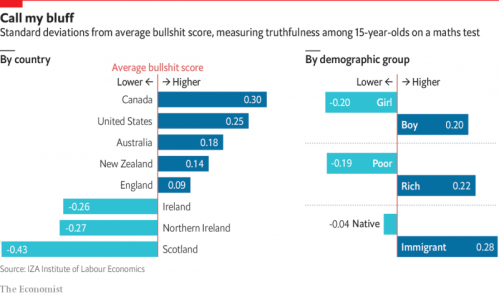
The results show substantial differences between countries. Canadian and American teenagers were especially likely to profess knowledge of these bogus topics, whereas the Scots and Irish were perfectly happy to admit their ignorance. In news that will shock nobody, in every country men claimed to be experts more often than women. The rich were more boastful than the poor. More surprising was the finding that immigrants were generally more likely to bluff about maths than native students were.
What explains these differences? The academics doubt that the bullshitters were simply trying to impress the questionnaire’s markers. The students who bluffed about maths were just as likely as the non-bluffers to admit that they had skipped school recently, for example. A more likely answer is that the blaggers over-estimated their own knowledge. They also tended to rate themselves highly when it came to gauging their own popularity, perseverance on academic tasks and problem-solving ability. The data suggest that they might not be consciously lying, but instead be weaving their own fantasies.
On January 1, 1975, former U.S. Attorney General John Mitchell was convicted of conspiracy, obstruction of justice, and three counts of perjury for his part in the Watergate cover-up.
You may have seen or heard about Samantha Bee’s Not the White House Correspondents’ Dinner on TBS. The first one of these two years ago was meant to point to Trump’s attempt to diminish journalism by not attending, as president’s have for decades. In years past, the WHCA Dinner became known as the Nerd Prom, combining a celebration of a free press, journalists, celebrities and sharp roasting—including roasting the president.
This year, thin-skinned Trump not only held his usual alternative rally at the exact same time, but somehow cowed the White House Correspondents’ Association into abandoning roasting, humor and celebrities entirely, in favor of earnest attention to journalism. Samantha Bee would have none of it, instead offering her own combination of humor, entertaining discussion, and celebrities.
The segment getting the most attention is probably her closing roast of Trump, which was no holds barred. But in the analysis category, no segment was better than the one on how media attempts to offer “balanced” coverage is useless when the matter covered doesn’t really have two civilized and defensible sides. The segment was grounded in this from an op-ed piece by Norm Ornstein and Thomas Mann:
We understand the values of mainstream journalists, including the effort to report both sides of a story. But a balanced treatment of an unbalanced phenomenon distorts reality. If the political dynamics of Washington are unlikely to change anytime soon, at least we should change the way that reality is portrayed to the public.
Our advice to the press: Don’t seek professional safety through the even-handed, unfiltered presentation of opposing views.
“Balanced” media coverage, not calling out demagoguery, venality and incompetence at an early stage, is part of how Trump managed to get elected, and how the current devolution of American democracy continues. For more than two centuries, a mostly two-party America could say that there were very fine people on both sides. But it is not only possible that that is not eternally true; we are living through the proof.
It is wrong, I suggest, it is a misreading of the Constitution for any member here to assert that for a member to vote for an article of impeachment means that that member must be convinced that the President should be removed from office. The Constitution doesn’t say that. The powers relating to impeachment are an essential check in the hands of the body of the Legislature against and upon the encroachments of the Executive….
James Madison again at the Constitutional Convention: “A President is impeachable if he attempts to subvert the Constitution.” The Constitution charges the President with the task of taking care that the laws be faithfully executed, and yet the President has counseled his aides to commit perjury, willfully disregard the secrecy of grand jury proceedings, conceal surreptitious entry, attempt to compromise a federal judge, while publicly displaying his cooperation with the processes of criminal justice. “A President is impeachable if he attempts to subvert the Constitution.”…
If the impeachment provision in the Constitution of the United States will not reach the offenses charged here, then perhaps that 18th-century Constitution should be abandoned to a 20th-century paper shredder!
Barbara Jordan, Statement on the Articles of Impeachment, 25 July 1974, House Judiciary Committee
Politician, legislator, educator, groundbreaker. Most especially orator. Former Congressman Barbara Jordan (1936-1996) was an American hero. And objectively one of the greatest American public figures of all time.
Objectively? How do we know this?
When you review American Rhetoric’s list of Top 100 Speeches you find Barbara Jordan at Number 5 (1976 Democratic National Convention Keynote Address) and Number 13 (Statement on the Articles of Impeachment, 25 July 1974, House Judiciary Committee). Her 1976 DNC speech is ranked below only MLK’s I Have A Dream, JFK’s Inaugural Address, and two speeches by FDR (First Inaugural Address and Pearl Habor Address to the Nation).
The reason her impeachment speech achieved its status is not only because of her unmatched talents as wordsmith and orator. It is because, as she often did, she went to the heart of the matter, which in the case of impeachment is not removal from office, but subverting the Constitution.
Mr. Chairman, I join my colleague Mr. Rangel in thanking you for giving the junior members of this committee the glorious opportunity of sharing the pain of this inquiry. Mr. Chairman, you are a strong man, and it has not been easy but we have tried as best we can to give you as much assistance as possible.
Earlier today, we heard the beginning of the Preamble to the Constitution of the United States: “We, the people.” It’s a very eloquent beginning. But when that document was completed on the seventeenth of September in 1787, I was not included in that “We, the people.” I felt somehow for many years that George Washington and Alexander Hamilton just left me out by mistake. But through the process of amendment, interpretation, and court decision, I have finally been included in “We, the people.”
Today I am an inquisitor. An hyperbole would not be fictional and would not overstate the solemnness that I feel right now. My faith in the Constitution is whole; it is complete; it is total. And I am not going to sit here and be an idle spectator to the diminution, the subversion, the destruction, of the Constitution.
“Who can so properly be the inquisitors for the nation as the representatives of the nation themselves?” “The subjects of its jurisdiction are those offenses which proceed from the misconduct of public men.”1 And that’s what we’re talking about. In other words, [the jurisdiction comes] from the abuse or violation of some public trust.
It is wrong, I suggest, it is a misreading of the Constitution for any member here to assert that for a member to vote for an article of impeachment means that that member must be convinced that the President should be removed from office. The Constitution doesn’t say that. The powers relating to impeachment are an essential check in the hands of the body of the Legislature against and upon the encroachments of the Executive. The division between the two branches of the Legislature, the House and the Senate, assigning to the one the right to accuse and to the other the right to judge, the Framers of this Constitution were very astute. They did not make the accusers and the judgers — and the judges the same person.
We know the nature of impeachment. We’ve been talking about it awhile now. It is chiefly designed for the President and his high ministers to somehow be called into account. It is designed to “bridle” the Executive if he engages in excesses. “It is designed as a method of national inquest into the conduct of public men.”² The Framers confided in the Congress the power if need be, to remove the President in order to strike a delicate balance between a President swollen with power and grown tyrannical, and preservation of the independence of the Executive.
The nature of impeachment: a narrowly channeled exception to the separation-of-powers maxim. The Federal Convention of 1787 said that. It limited impeachment to high crimes and misdemeanors and discounted and opposed the term “maladministration.” “It is to be used only for great misdemeanors,” so it was said in the North Carolina ratification convention. And in the Virginia ratification convention: “We do not trust our liberty to a particular branch. We need one branch to check the other.”
“No one need be afraid” — the North Carolina ratification convention — “No one need be afraid that officers who commit oppression will pass with immunity.” “Prosecutions of impeachments will seldom fail to agitate the passions of the whole community,” said Hamilton in the Federalist Papers, number 65. “We divide into parties more or less friendly or inimical to the accused.”³ I do not mean political parties in that sense.
The drawing of political lines goes to the motivation behind impeachment; but impeachment must proceed within the confines of the constitutional term “high crime[s] and misdemeanors.” Of the impeachment process, it was Woodrow Wilson who said that “Nothing short of the grossest offenses against the plain law of the land will suffice to give them speed and effectiveness. Indignation so great as to overgrow party interest may secure a conviction; but nothing else can.”
Common sense would be revolted if we engaged upon this process for petty reasons. Congress has a lot to do: Appropriations, Tax Reform, Health Insurance, Campaign Finance Reform, Housing, Environmental Protection, Energy Sufficiency, Mass Transportation. Pettiness cannot be allowed to stand in the face of such overwhelming problems. So today we are not being petty. We are trying to be big, because the task we have before us is a big one.
This morning, in a discussion of the evidence, we were told that the evidence which purports to support the allegations of misuse of the CIA by the President is thin. We’re told that that evidence is insufficient. What that recital of the evidence this morning did not include is what the President did know on June the 23rd, 1972.
The President did know that it was Republican money, that it was money from the Committee for the Re-Election of the President, which was found in the possession of one of the burglars arrested on June the 17th. What the President did know on the 23rd of June was the prior activities of E. Howard Hunt, which included his participation in the break-in of Daniel Ellsberg’s psychiatrist, which included Howard Hunt’s participation in the Dita Beard ITT affair, which included Howard Hunt’s fabrication of cables designed to discredit the Kennedy Administration.
We were further cautioned today that perhaps these proceedings ought to be delayed because certainly there would be new evidence forthcoming from the President of the United States. There has not even been an obfuscated indication that this committee would receive any additional materials from the President. The committee subpoena is outstanding, and if the President wants to supply that material, the committee sits here. The fact is that on yesterday, the American people waited with great anxiety for eight hours, not knowing whether their President would obey an order of the Supreme Court of the United States.
At this point, I would like to juxtapose a few of the impeachment criteria with some of the actions the President has engaged in. Impeachment criteria: James Madison, from the Virginia ratification convention. “If the President be connected in any suspicious manner with any person and there be grounds to believe that he will shelter him, he may be impeached.”
We have heard time and time again that the evidence reflects the payment to defendants money. The President had knowledge that these funds were being paid and these were funds collected for the 1972 presidential campaign. We know that the President met with Mr. Henry Petersen 27 times to discuss matters related to Watergate, and immediately thereafter met with the very persons who were implicated in the information Mr. Petersen was receiving. The words are: “If the President is connected in any suspicious manner with any person and there be grounds to believe that he will shelter that person, he may be impeached.”
Justice Story: “Impeachment” is attended — “is intended for occasional and extraordinary cases where a superior power acting for the whole people is put into operation to protect their rights and rescue their liberties from violations.” We know about the Huston plan. We know about the break-in of the psychiatrist’s office. We know that there was absolute complete direction on September 3rd when the President indicated that a surreptitious entry had been made in Dr. Fielding’s office, after having met with Mr. Ehrlichman and Mr. Young. “Protect their rights.” “Rescue their liberties from violation.”
The Carolina ratification convention impeachment criteria: those are impeachable “who behave amiss or betray their public trust.”4 Beginning shortly after the Watergate break-in and continuing to the present time, the President has engaged in a series of public statements and actions designed to thwart the lawful investigation by government prosecutors. Moreover, the President has made public announcements and assertions bearing on the Watergate case, which the evidence will show he knew to be false. These assertions, false assertions, impeachable, those who misbehave. Those who “behave amiss or betray the public trust.”
James Madison again at the Constitutional Convention: “A President is impeachable if he attempts to subvert the Constitution.” The Constitution charges the President with the task of taking care that the laws be faithfully executed, and yet the President has counseled his aides to commit perjury, willfully disregard the secrecy of grand jury proceedings, conceal surreptitious entry, attempt to compromise a federal judge, while publicly displaying his cooperation with the processes of criminal justice. “A President is impeachable if he attempts to subvert the Constitution.”
If the impeachment provision in the Constitution of the United States will not reach the offenses charged here, then perhaps that 18th-century Constitution should be abandoned to a 20th-century paper shredder!
Has the President committed offenses, and planned, and directed, and acquiesced in a course of conduct which the Constitution will not tolerate? That’s the question. We know that. We know the question. We should now forthwith proceed to answer the question. It is reason, and not passion, which must guide our deliberations, guide our debate, and guide our decision.
I have recommended 198 Methods of Nonviolent Action by the late Gene Sharp (1928-2018) of the Albert Einstein Institution three times before. I am starting to feel it should be recommended once a month, once a week, or every day. The list is from one of Gene Sharp’s many books that have been used to help bring democracy to nations around the world.
When you read this fascinating and creative list, you may be surprised at how few of the tactics have been considered, let alone tried, as open and just democracy seems to be slipping away–or racing away–from America. Maybe we have so many outlets for self-expression and outrage that that we think our social media protests are enough. They are not.
198 Methods of Nonviolent Action
Formal Statements
1. Public Speeches
2. Letters of opposition or support
3. Declarations by organizations and institutions
4. Signed public statements
5. Declarations of indictment and intention
6. Group or mass petitions
Communications with a Wider Audience
7. Slogans, caricatures, and symbols
8. Banners, posters, displayed communications
9. Leaflets, pamphlets, and books
10. Newspapers and journals
11. Records, radio, and television
12. Skywriting and earthwriting
Group Representations
13. Deputations
14. Mock awards
15. Group lobbying
16. Picketing
17. Mock elections
Symbolic Public Acts
18. Displays of flags and symbolic colors
19. Wearing of symbols
20. Prayer and worship
21. Delivering symbolic objects
22. Protest disrobings
23. Destruction of own property
24. Symbolic lights
25. Displays of portraits
26. Paint as protest
27. New signs and names
28. Symbolic sounds
29. Symbolic reclamations
30. Rude gestures
Honoring the Dead
43. Political mourning
44. Mock funerals
45. Demonstrative funerals
46. Homage at burial places
Public Assemblies
47. Assemblies of protest or support
48. Protest meetings
49. Camouflaged meetings of protest
50. Teach-ins
Withdrawal and Renunciation
51. Walk-outs
52. Silence
53. Renouncing honors
54. Turning one’s back
The Methods Of Social Noncooperation
Ostracism of Persons
55. Social boycott
56. Selective social boycott
57. Lysistratic nonaction
58. Excommunication
59. Interdict
Noncooperation with Social Events, Customs, and Institutions
60. Suspension of social and sports activities
61. Boycott of social affairs
62. Student strike
63. Social disobedience
64. Withdrawal from social institutions
Withdrawal from the Social System
65. Stay-at-home
66. Total personal noncooperation
67. “Flight” of workers
68. Sanctuary
69. Collective disappearance
70. Protest emigration (hijrat)
The Methods of Economic Noncooperation: Economic Boycotts
Actions by Consumers
71. Consumers’ boycott
72. Nonconsumption of boycotted goods
73. Policy of austerity
74. Rent withholding
75. Refusal to rent
76. National consumers’ boycott
77. International consumers’ boycott
Action by Workers and Producers
78. Workmen’s boycott
79. Producers’ boycott
Action by Middlemen
80. Suppliers’ and handlers’ boycott
Action by Owners and Management
81. Traders’ boycott
82. Refusal to let or sell property
83. Lockout
84. Refusal of industrial assistance
85. Merchants’ “general strike”
Action by Holders of Financial Resources
86. Withdrawal of bank deposits
87. Refusal to pay fees, dues, and assessments
88. Refusal to pay debts or interest
89. Severance of funds and credit
90. Revenue refusal
91. Refusal of a government’s money
Action by Governments
92. Domestic embargo
93. Blacklisting of traders
94. International sellers’ embargo
95. International buyers’ embargo
96. International trade embargo
The Methods Of Economic Noncooperation: The Strike
Multi-Industry Strikes
116. Generalized strike
117. General strike
Combination of Strikes and Economic Closures
118. Hartal
119. Economic shutdown
The Methods Of Political Noncooperation
Rejection of Authority
120. Withholding or withdrawal of allegiance
121. Refusal of public support
122. Literature and speeches advocating resistance
Citizens’ Noncooperation with Government
123. Boycott of legislative bodies
124. Boycott of elections
125. Boycott of government employment and positions
126. Boycott of government depts., agencies, and other bodies
127. Withdrawal from government educational institutions
128. Boycott of government-supported organizations
129. Refusal of assistance to enforcement agents
130. Removal of own signs and placemarks
131. Refusal to accept appointed officials
132. Refusal to dissolve existing institutions
Citizens’ Alternatives to Obedience
133. Reluctant and slow compliance
134. Nonobedience in absence of direct supervision
135. Popular nonobedience
136. Disguised disobedience
137. Refusal of an assemblage or meeting to disperse
138. Sitdown
139. Noncooperation with conscription and deportation
140. Hiding, escape, and false identities
141. Civil disobedience of “illegitimate” laws
Action by Government Personnel
142. Selective refusal of assistance by government aides
143. Blocking of lines of command and information
144. Stalling and obstruction
145. General administrative noncooperation
146. Judicial noncooperation
147. Deliberate inefficiency and selective noncooperation by enforcement agents
148. Mutiny
Domestic Governmental Action
149. Quasi-legal evasions and delays
150. Noncooperation by constituent governmental units
International Governmental Action
151. Changes in diplomatic and other representations
152. Delay and cancellation of diplomatic events
153. Withholding of diplomatic recognition
154. Severance of diplomatic relations
155. Withdrawal from international organizations
156. Refusal of membership in international bodies
157. Expulsion from international organizations
The Methods Of Nonviolent Intervention
Psychological Intervention
158. Self-exposure to the elements
159. The fast
a) Fast of moral pressure
b) Hunger strike
c) Satyagrahic fast
160. Reverse trial
161. Nonviolent harassment
Social Intervention
174. Establishing new social patterns
175. Overloading of facilities
176. Stall-in
177. Speak-in
178. Guerrilla theater
179. Alternative social institutions
180. Alternative communication system
Economic Intervention
181. Reverse strike
182. Stay-in strike
183. Nonviolent land seizure
184. Defiance of blockades
185. Politically motivated counterfeiting
186. Preclusive purchasing
187. Seizure of assets
188. Dumping
189. Selective patronage
190. Alternative markets
191. Alternative transportation systems
192. Alternative economic institutions
Political Intervention
193. Overloading of administrative systems
194. Disclosing identities of secret agents
195. Seeking imprisonment
196. Civil disobedience of “neutral” laws
197. Work-on without collaboration
198. Dual sovereignty and parallel government
President Trump said on Friday that he was open to releasing migrants detained at the border into mostly Democratic “sanctuary cities,” suggesting that the idea should make liberals “very happy” because of their immigration policies.
Due to the fact that Democrats are unwilling to change our very dangerous immigration laws, we are indeed, as reported, giving strong considerations to placing Illegal Immigrants in Sanctuary Cities only….
— Donald J. Trump (@realDonaldTrump) April 12, 2019
….The Radical Left always seems to have an Open Borders, Open Arms policy – so this should make them very happy!
— Donald J. Trump (@realDonaldTrump) April 12, 2019
Mr. Trump’s comments came a day after his administration said the policy proposal was never seriously considered. But after the president’s Twitter posts on Friday, a White House spokesman said Democrats should work with the administration to welcome migrants into their districts….
Last year, Trump administration officials had floated the idea of transporting migrants to sanctuary cities, which do not strictly adhere to federal immigration laws, as a way to address the influx of migrants crossing the border with Mexico. One of the highest-profile sanctuary cities is San Francisco, home to Speaker Nancy Pelosi, who is one of the president’s top political rivals and a thorn in his efforts to change American immigration laws. The White House raised the proposal again in February, suggesting it could punish Democrats for rejecting budget requests for border security.
Using captive human beings as political weapons—literally thrown at your “enemies” like some kind of virus—is cruel, heinous and monstrous. I’ve combed the Gospels for approval of this as a tactic, and I’ve come up empty. On the contrary, if you asked for a technique that is un-Christian, inhumane and immoral, the list could begin there.
Yet millions of Christians, including some at the highest rank of the Trump administration and the Senate, either enable, make excuses or stay silent. How they manage that, and how their pastors don’t speak up, is baffling and heart-rending.
Americans love to watch monsters for entertainment. It’s different when they arrive at the White House and make themselves at home.
“I’ve seen the devil of violence, and the devil of greed, and the devil of hot desire; but, by all the stars! these were strong, lusty, red-eyed devils, that swayed and drove men—men, I tell you. But as I stood on this hillside, I foresaw that in the blinding sunshine of that land I would become acquainted with a flabby, pretending, weak-eyed devil of a rapacious and pitiless folly.” Joseph Conrad, Heart of Darkness
Well we know where we’re going
But we don’t know where we’ve been
And we know what we’re knowing
But we can’t say what we’ve seen
And we’re not little children
And we know what we want
And the future is certain
Give us time to work it out
We’re on a road to nowhere
Come on inside
Taking that ride to nowhere
We’ll take that ride Talking Heads, Road to Nowhere
Let’s Get Lost
Passover
Americans are lost
Jews are lost
Jews are used to being lost
Wake up wandering in the wilderness
Wanting guidance assurances
That it will be all right
Promises will be kept
A land will be found
No assurances
No promises
No land
No turning back
Tell the story
Then like the afikomen
Broken and lost
Let’s get lost
Stephen Miller is the driving force behind current American immigration policy—policy that seems to get darker and crueler by the day.
Instead, there is a lady who should be the guiding light for that policy. As usual, better women are pushed aside to make room for lesser men. Anyway, here she is:
It’s almost Passover, so Pharaoh is our minds. Also on our minds because we are living under an American Pharaoh—or at least a wannabe Pharaoh.
Don’t let him fool you. Just because his chief henchman is Jewish, or his son-in-law is Jewish, or some of his rich donors are Jewish, or because he says and does things that make it seem that he understands and cares about Jews and Israel (he doesn’t), he is nothing less than a Pharaoh.
So where does that leave American Jews, particularly at Passover?
It is actually not that surprising that some Jews have joined the Pharaoh’s cause. There are dramatic moments in the exodus story where Jews are willing to throw away freedom and principle for a golden calf and the comfort of the Pharaoh’s harsh protection.
And Aaron said to them, “Take off the golden rings that are on the ears of your wives, your sons, and your daughters, and bring them to me.” And all the people took off the golden rings that were on their ears and brought them to Aaron. And he took them from their hand and he fashioned it in a mold and made it into a molten calf. And they said, “These are your gods, O Israel, who brought you up from the land of Egypt.” And Aaron saw, and he built an altar before it, and Aaron called out and said, “Tomorrow is a festival to the LORD.” And they rose early on the next day, and they offered up burnt offerings and brought forward communion sacrifices, and the people came back from eating and drinking and they rose up to play.
Exodus 32:2-6
So where does that leave the Jews who do not believe in Pharaoh? We can stay and argue with those who support Pharaoh, though that has so far proven pointless. We can escape to the wilderness in search of a Promised Land of freedom and light, although by many conventions America is already the Promised Land of freedom and light.
Or we can all be tiny Moses, telling fellow Jews at Passover that worshiping Pharaoh and a golden calf and unprincipled conduct is ungodly and unholy. We cannot wait for God to intervene because God leaves it up to us. Let us not disappoint.