Bob Schwartz

If You Pray, Pray for Dr. Fauci
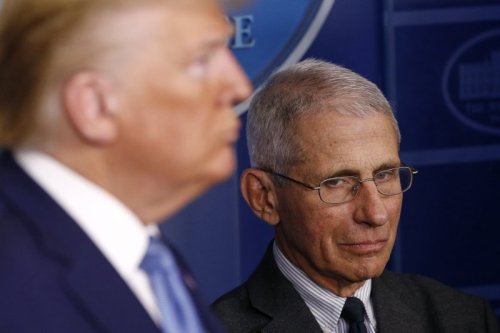
In her New York Times column today, Maureen Dowd interviews Dr. Anthony Fauci.

If you have been paying attention, you know that 79-year-old Dr. Fauci has been the trusted national voice of fact and reason in response to the pandemic. He is currently director of the National Institute of Allergy and Infectious Diseases, and has served six presidents.

In the interview, we learn that Dr. Fauci has been working 18-hour days, and at one point worked four or five days on three hours sleep each day. Because as a doctor, scientist and public servant he wants us to understand, wants us to behave appropriately, and wants as few Americans as possible to suffer and maybe die.

Part of that interview:


Thank God the Doctor Is In

By Maureen Dowd

March 21, 2020

WASHINGTON — It’s not easy being a national treasure.

“I’m exhausted,” confessed Tony Fauci when I reached him Thursday evening in the middle of another 18-hour workday.

“I have changed my tune a bit, probably thanks to my wife,” said the 79-year-old director of the National Institute of Allergy and Infectious Diseases. “About a week ago, I was going about four or five days in a row on about three hours of sleep, which is completely crazy, ’cause then I’ll be going on fumes. The last couple of nights, I’ve gotten five hours’ sleep, so I feel much better.”

He said he misses the endorphins of power walking, and he is wracked when he gets home at midnight and it’s too late to answer calls and emails.

“I gotta get rid of this guilt feeling,” he murmured about that moment’s 727 emails.

He said he has not been tested for the coronavirus but takes his temperature every day and usually has it taken another couple times before White House press conferences and meetings in the Oval.

When I spoke with him, he had been missing from the White House briefing for two days and Twitter blew a gasket, with everyone from Susan Rice to Laurence Tribe seeking an answer to the urgent query, “Where is Dr. Fauci?”

Donald Trump, the ultimate “me” guy, is in a “we” crisis and it isn’t pretty. The president is so consumed by his desire to get back his binky, a soaring stock market, that he continues to taffy-twist the facts, leaving us to look elsewhere — to Dr. Fauci and governors like Andrew Cuomo and Gavin Newsom — for leadership during this grim odyssey.

Dr. Fauci chuckled at speculation that he was banished due to his habit of pushing back on Trump’s hyperbolic and self-serving ad-libbing.

“That’s kind of funny but understandable that people said, ‘What the hell’s the matter with Fauci?’ because I had been walking a fine line; I’ve been telling the president things he doesn’t want to hear,” he said. “I have publicly had to say something different with what he states.

“It’s a risky business. But that’s my style, Maureen. You know me for many years. I say it the way it is, and if he’s gonna get pissed off, he’s gonna get pissed off. Thankfully, he is not. Interestingly.”

The first time I talked to Dr. Fauci was during a panic in the mid-80s about stopping another virus, the cause of the heartbreaking AIDs crisis. Then, as now, he was honest, brave and innovative. He told me that he tries to be diplomatic when he has to contradict the president about what “game-changer” cures might be on the horizon and whether everyone who wants to be tested can get tested.

“I don’t want to embarrass him,” the immunologist says, in his gravelly Brooklyn accent. “I don’t want to act like a tough guy, like I stood up to the president. I just want to get the facts out. And instead of saying, ‘You’re wrong,’ all you need to do is continually talk about what the data are and what the evidence is.

“And he gets that. He’s a smart guy. He’s not a dummy. So he doesn’t take it — certainly up to now — he doesn’t take it in a way that I’m confronting him in any way. He takes it in a good way.”

On Friday, a trigger-happy Trump was so quick to talk up the fabulous possibilities of an antimalarial drug in combating the virus that Dr. Fauci had to pump the brakes, taking the microphone to explain that we do not know yet because controlled testing is needed.

The president returned to the lectern to press his unscientific case and compliment himself: “I’m a smart guy,” he said. “I feel good about it. And we’re going to see. You’re going to see soon enough.”

Probably thinking about all his government staffers working round-the-clock, Dr. Fauci could not help rubbing his forehead and cheek — going against his own advice to the public — when Trump cracked a joke about the “Deep State Department.”

Though the scientist listens respectfully when the president and the vice president are talking, he somehow manages to emit an “Oh my God, please don’t say that” vibe when the two men scamper over the line. When Mike Pence went into false-hope overdrive, saying, “I just can’t emphasize enough about the incredible progress that we have made on testing,” Dr. Fauci and Dr. Deborah Birx, the administration’s virus response coordinator, exchanged a whispered aside that sent the internet into a frenzy.

Dr. Fauci assured me that, despite their crosscurrents and an early overconfidence about how easy it would be to control the path of the virus, the president “absolutely” now gets the threat of “the invisible enemy,” as Trump calls the virus.

I Ching Pandemic Edition: Hexagram 13 – Seeking Harmony

An ancient Chinese maxim says, “People in the same boat help each other, sharing weal and woe.”

I have been regularly consulting the I Ching during these strange days. The I Ching embodies the wisdom of thousands of years, from a civilization that has seen it all. Bright days and dark, order and chaos, wise men and fools, humility and arrogance, life and death. They have learned that we do not escape the truth of everything changes.

This is what the I Ching says today.


The Complete I Ching: The Definitive Translation by Taoist Master Alfred Huang

HEXAGRAM 13

TONG REN • SEEKING HARMONY

NAME AND STRUCTURE

Wilhelm translates Tong Ren as Fellowship with Men, and Blofeld translates it as Lovers, Beloved, Friends, Like-Minded Persons, Universal Brotherhood. In Chinese, tong means similar, alike, the same. Ren means person or people. When the two characters are put together as a unit, it means to treat people alike. In ancient China, tong ren also meant people with the same interests. Herein, Tong Ren is translated as Seeking Harmony. It has the connotation of forming alliances. To break through a tough situation, people need to work together in harmony, as in an alliance.

The ideograph of the first character, tong, consists of three parts. The first part looks like an upright rectangle without the bottom line, symbolizing a door frame or a house. Within the house, there is a single horizontal stroke representing the number one. Underneath this is a little square symbolizing a mouth. In ancient China, people were counted by mouths. For instance, if someone wanted to know how many people there were in your family, they would ask “How many mouths are there in your family?” The three parts of the ideograph come together to depict a group of people gathered together as a single unit. Here, the mouth indicates that they are thinking or speaking as one. The Chinese can feel the harmony in the group. The ideograph of the second character, ren, suggests a person standing.

SEQUENCE OF THE GUA: Events cannot remain hindered; thus, after Hindrance, Seeking Harmony follows.

The image of this gua is Heaven above, Fire below. Heaven suggests ascension. The flame of fire moves upward. Fire approaching Heaven gives an image of people with the same interests working together in harmony. There is only one yielding line, at the second place. The ancient sage saw this as a picture of harmony; the one at the second place treated the other five elements at different places equally, with the same attitude. An ancient Chinese maxim says, “People in the same boat help each other, sharing weal and woe.”

According to the I Ching, however, there is no absolute sameness. The ancient sages passed on the secret of obtaining harmony, that is, seeking common ground on major issues while reserving differences on minor ones. Tong Ren teaches that the wise classify people according to their natures, not for the purpose of treating them differently, but to seek common ground. If there is common ground, each one is able to act in harmony with the others. The ancient Chinese dreamed day and night that the world would belong to the majority and the government would serve the common interest of its countrymen. This is Seeking Harmony.

DECISION

Seeking harmony among people,
Prosperous and smooth.
Favorable to cross great rivers.
Favorable for the superior person
To be steadfast and upright.

COMMENTARY ON THE DECISON

Seeking Harmony.
The yielding obtains the proper place.
It is central
And corresponds with Qian, the Initiating.
This is Seeking Harmony.

Seeking Harmony says:
Seeking harmony among people.
Prosperous and smooth.
Favorable to cross great rivers.
It is because Qian, the Initiating,
Is progressing and advancing.

Brilliance with strength,
Central and corresponding.
This is the correct way for the superior person.
Only the superior person is able
To convey the wills of all under Heaven.

COMMENTARY ON THE SYMBOL

Heaven with Fire.
An image of Seeking Harmony.
In correspondence with this,
The superior person makes classifications of people
According to their natures
And makes distinctions of things
In terms of their categories.

SIGNIFICANCE

The Decision says, “Seeking harmony among people.” This is the main theme of the gua. Seeking harmony should be done with absolute unselfishness and among the majority. This was the ancient lofty ideal of a world of harmony. Seeking harmony among people, in Chinese, is tong ren yü ye. Tong ren means seeking harmony. Yü means at, in, or among. And ye is the place beyond the suburbs. Thus, most English translations give ye as “the open.” However, ye also means the folk or the people, as contrasted with the government. Considering the theme of this gua, it is more suitable to employ people for ye. In this way, it brings more sense to the Decision: “Seeking harmony among people. Prosperous and smooth.”

The outer gua is Qian (Heaven), symbolizing firmness and strength. With this quality, it is favorable for a person to cross great rivers, to overcome difficulties. The inner gua is Li (Fire), symbolizing a quality of inner brightness. In this situation, the host is the yielding line at the second place. It plays a leading role. It is a yin element at a yin place, central and correct. Thus, Confucius’s Commentary on the Decision explains that the yielding obtains the proper place and corresponds with Qian. This yin line in the center of the lower gua indicates that one at this place possesses a high morality and is gentle and sincere, humble and modest, and willing to seek harmony with other people. It corresponds to the solid line at the fifth place, which is also central and correct. These two lines symbolize an ideal condition where the time is auspicious, the situation is favorable, and the people are in harmony. This ideal situation results from the circumstance of overcoming hindrance.

Tong Ren reveals the truth that if people deal with each other in a spirit of equality, then peace and advancement are possible. Otherwise, there will be conflict and obstruction. The first three lines of this gua represent the fact that from sameness differences originate. The next three lines tell us that sameness derives from differences. Thus, at the fifth line, people are at first weeping and full of regret and then laughing to celebrate the victory. In ancient times, people called the piping time of peace the Great Harmony.

This gua symbolizes the historical incident in which King Wen formed alliances with neighboring clans to battle the rebellious Rong clan. King Wen proclaimed that seeking harmony with people of other clans would be prosperous and smooth. The Duke of Zhou recounts how there was no hindrance in seeking alliances with different clans, yet seeking alliances exclusively within his own clan caused isolation and brought about unfavorable results. At the very beginning, the alliance took defensive action by placing troops on a high hill and hiding fighters in the bushes. For three years there was no trouble. Later, the alliance besieged Rong’s city walls. After great struggles it was victorious. What began with weeping ended with laughing. At last, the alliance gathered in Zhou’s countryside. There was no regret about the struggles that resulted in success.

Music: O-o-h Child (things are gonna get easier), The Five Stairsteps

O-o-h Child

Ooh child
Things are gonna get easier
Ooh child
Things’ll get brighter
Ooh child
Things are gonna get easier
Ooh child
Things’ll get brighter

Some day
We’ll put it together and we’ll get it undone
Some day
When your head is much lighter
Some day
We’ll walk in the rays of a beautiful sun
Some day
When the world is much brighter

Best Breakfast in America: Pete and Jimmy

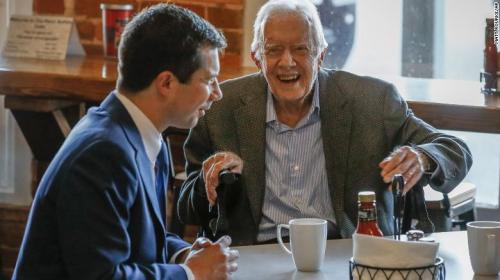
The morning of the day that Pete Buttigieg suspended his campaign for president, he and his husband Chasten stopped in Plains, Georgia to have breakfast with Jimmy Carter and his wife Rosalynn.

Maybe no event could be a more fitting coda.

Among all the presidents of the late 20th and early 21st centuries, Jimmy Carter holds a special place. The political qualities of his presidency are still being debated. The quality of his humanity, evidenced by decades of enlightened, faithful and humble service, are towering. His life and longevity are a gift and a model to us all.

Pete and Jimmy are separated in age by almost sixty years. In terms of spirit and love for people and country, they might as well be brothers. Just as we needed Jimmy Carter to help wash away the Nixon years, we need Pete Buttigieg, or someone like him, to help wash away the Trump years. All of us who support him know that there is no one on the scene right now quite like Pete.

Jimmy and Rosalynn Carter have been married for 73 years. To hear Pete talk about his marriage to Chasten in the speech announcing the suspension of his campaign, he has every intention of being married to Chasten for the rest of their lives. Having seen them together, and knowing Pete’s honesty and thoughtful earnestness, there is every reason to believe that. And to believe in the real possibility that we will thankfully have Pete in our national future for a long time to come.

In the 1930s many Americans thought the destruction of democracy was none of their business. It had nothing to do with America, where democracy would live forever. They woke up almost too late.

UPDATE: Following publication of this post, it was discovered that HBO is about to present a limited series based on the novel. It premieres on March 16th. See trailer below.


In the 1930s it was hard to convince Americans that democracy was in the first stages of dying in Europe and the world or that it was something that America should be involved in anyway. Some of the biggest American companies were doing business with what they considered a benign and profitable dictatorship. The media didn’t know quite what to make of this unusual Hitler guy, but he seemed to be a fascinating new face on the scene, and always good copy. Some Americans even thought they heard something from Hitler that sounded like cultural music to their ears. Above all, this had nothing to do with democracy in America, which no matter what, was never in danger.

Three years ago, I wrote about Philip Roth’s novel The Plot Against America (2004). It is an alternative history in which Charles Lindbergh—Nazi sympathizer and supporter of Hitler—defeats FDR in 1940 to become President of the United States.

America woke? Not even close.

It is not about what is happening in these times. It is about who we are and can be.

Dresden 1945

“Listen. Billy Pilgrim has come unstuck in time.”
Kurt Vonnegut Jr., Slaughterhouse-Five

Last week was the 75th anniversary of the Dresden firebombings in World War II. If you didn’t know that, chalk it up to a gap in learning and the media being preoccupied. On February 13 and 15, 1945, with Germany on its way to inevitable defeat, the Allies rained fire on the beautiful and culturally significant German city of Dresden, destroying much of it and killing no less than 25,000 people. To this day, the moral questions surrounding that attack are still debated.

When the author Kurt Vonnegut Jr. died in 2007, here is what a writer in The Economist wrote:

Kurt Vonnegut Jr died yesterday at the age of 84. So it goes. The New York Times offers up a halfway decent obituary, but it is hard to capture the impact of such a man in a few thousand words, let alone a blog post. His best novels—”Cat’s Cradle”, “God Bless You, Mr Rosewater” and the epic, heartbreaking “Slaughterhouse-Five”—spoke to the deepest doubts and fears of a generation. But his books weren’t just beautifully written. They were hilarious, too.

A generation did embrace Kurt Vonnegut. Slaughterhouse-Five (1969) is listed as one of the 100 best novels of all time. The plot, as with most Vonnegut novels, is impossible to condense in short form. Significant is that Vonnegut himself witnessed Dresden as a prisoner of war, as does the main character Billy Pilgrim. In the novel, this has a profound effect on an already fragile Billy Pilgrim, who “comes unstuck in time” and is visited by aliens, learning new and different ways of viewing life and history.

Slaughterhouse-Five had obvious appeal as an anti-war novel, with young readers opposing a pointless and, in 1969, seemingly endless war. More than that, it offered those just starting out in life and history the possibility that there were other ways of being and doing. It turned out that other ways of being and doing are not so easy, but just like reading Kurt Vonnegut, it can be lots of fun. And occasionally helpful.

In America, and globally, what we are witnessing may have us feeling that we are coming unstuck in time. There are plenty of places and distractions to retreat into, which given the currents and demands of our lives, is perfectly understandable. But there remain opportunities for other ways of knowing and being, even if you don’t learn it from aliens. Young or old, be adventurous and bold.

Making breakfast for one: one’s not half two

It is one of those days unusually when I am making breakfast just for myself. e.e. cummings came to mind.

one’s not half two. It’s two are halves of one:

by e.e. cummings

one’s not half two. It’s two are halves of one:
which halves reintegrating,shall occur
no death and any quantity;but than
all numerable mosts the actual more

minds ignorant of stern miraculous
this every truth-beware of heartless them
(given the scalpel,they dissect a kiss;
or,sold the reason,they undream a dream)

one is the song which fiends and angels sing:
all murdering lies by mortals told make two.
Let liars wilt,repaying life they’re loaned;
we(by a gift called dying born)must grow

deep in dark least ourselves remembering
love only rides his year.
All lose,whole find

Mistake After Mistake (File a File)

Mistake after mistake: 將錯就錯 [shōshaku jushaku], literally, take a file (rasp) and work on the file. File a file about something. Take up a mistake and settle in with the mistake. Mistakes surpass mistakes.

“When we reflect on what we are doing in our everyday life, we are always ashamed of ourselves. One of my students wrote to me saying, “You sent me a calendar, and I am trying to follow the good mottoes which appear on each page. But the year has hardly begun, and already I have failed!” Dogen-zenji said, “Shoshaku jushaku.” Shaku generally means “mistake” or “wrong.” Shoshaku jushaku means “to succeed wrong with wrong,” or one continuous mistake. According to Dogen, one continuous mistake can also be Zen. A Zen master’s life could be said to be so many years of shoshaku jushaku. This means so many years of one single-minded effort.”
–Shunryu Suzuki, Zen Mind Beginner’s Mind

“We should understand that, in reality, mistakes are called learning, and the state of no mistake is called nowness. In nowness there is no before or after, no goals, agendas, or fixed direction. Like the meandering river, it twists and turns in accord with circumstances but always knows how to find its way to the great ocean. If you wish to travel like this, you must go alone, not carry any baggage, and trust yourself implicitly.”
–Dogen, The True Dharma Eye

Dark Night of the Republican Soul

Don’t be fooled. Don’t let them fool you. Don’t think they are fooling themselves. Many Republicans, especially Senators, sleep badly and fitfully in a dark night.

The restless nights began for some when they saw Trump likely to win the nomination, as he ultimately did. They were comforted by the uneasy thought that, rooting against their own candidate, he had slim chance of being elected.

By the time of the inauguration, the difficult nights set in. At first, and for years to come, rationalizations, some very practical, such as holding on to their seats, helped. Delusions, drink and drugs might provide a little rest and respite.

But at some quiet moments, awake and alone in the dark with their thoughts, reality grips them. For the more religious, they realize that they can relentlessly lie to America, lie to themselves, but God is too smart for that. Others who have some sense of history imagine the history books they will spend the rest of their lives trying, against the current, to criticize and correct. History books that will paint them at best as selfish dupes, at worst as enablers and accomplices.

Many people have dark nights, brought on by the unavoidable tragedies of capricious life. Those nights are not wished on anyone. Sometimes it is the anguish of bad choices made. Sometimes the sleepless nights never ever end.

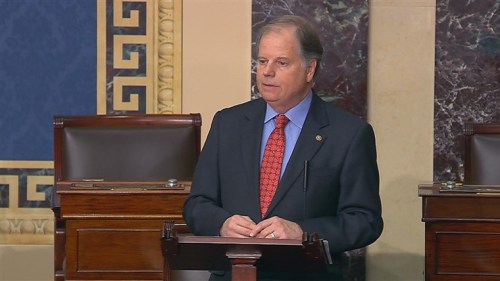
Sen. Doug Jones says he is not a profile in courage for voting to convict the president. He is.

“After many sleepless nights, I have reluctantly concluded that the evidence is sufficient to convict the President for both abuse of power and obstruction of Congress….Very early on I implored my colleagues in both houses of Congress to stay out of their partisan corners. Many did, but so many did not. The country deserves better.”

Statement to the Senate by Sen. Doug Jones, an Alabama Democrat who may pay a political price in his 2020 reelection bid, about why his voting to convict Trump today is simply doing the right thing:

“On the day I was sworn in as a United States Senator, I took an oath to protect and defend the Constitution. At the beginning of the impeachment trial, I took a second oath to do ‘impartial justice’ according to the same Constitution I swore to protect.

“These solemn oaths have been my guides during what has been a difficult time for our country, for my state, and for me personally. I did not run for Senate hoping to participate in the impeachment trial of a duly-elected President, but I cannot and will not shrink from my duty to defend the Constitution and to do impartial justice.

“In keeping with my oaths, I resolved that throughout this process I would keep an open mind and hear all of the evidence before making a final decision on the charges against the President. For months, I have been studying the facts of this case exhaustively. I have read thousands of pages of transcripts, watched videos of testimony, taken copious notes, reviewed history and precedents and discussed this case with colleagues, staff, and constituents, in addition to having participated in the Senate trial over the past two weeks. After many sleepless nights, I have reluctantly concluded that the evidence is sufficient to convict the President for both abuse of power and obstruction of Congress.

“With the eyes of history upon us, I am acutely aware of the precedents this impeachment trial will set for future presidencies and Congresses. Unfortunately, I do not believe those precedents are good ones. I am particularly concerned that we have now set a precedent that a fair trial in the Senate does not include witnesses and documentary evidence, even when those witnesses have first-hand information and the evidence would provide the Senate and the American people with a more complete picture of the truth.

“I am also deeply troubled by the partisan nature of these proceedings from start to finish. Very early on I implored my colleagues in both houses of Congress to stay out of their partisan corners. Many did, but so many did not. The country deserves better. We must find a way to rise above the things that divide us and find the common good.

“Having done my best to see through the fog of partisanship, I am deeply troubled by the arguments put forth by the President’s lawyers in favor of virtually unchecked presidential power. In this case, the evidence clearly proves the President used the weight of his office and that of the United States government to seek to coerce a foreign government to interfere in our election for his personal political benefit. The President’s actions placed his personal interests well above the national interests and threatened the security of the United States, our allies in Europe, and our ally Ukraine. His actions were more than simply inappropriate. They were an abuse of power. With impeachment as the only check on such presidential wrongdoing, I felt I must vote to convict on the first charge of abuse of power.

“The second article of impeachment, obstruction of Congress, gave me even more pause. I have struggled to understand the House’s strategy in their pursuit of documents and witnesses and wished they had done more. However, after careful consideration of the evidence developed in the hearings, the public disclosures, the legal precedents, and the trial, I believe the President deliberately and unconstitutionally obstructed Congress by refusing to cooperate with the investigation in any way. While I am sensitive to protecting the privileges and immunities afforded to the President and his advisors, I believe it is critical to our constitutional structure that we protect Congress’ authorities also. In this matter it was clear from the outset that the President had no intention whatsoever of any accommodation with Congress when he blocked both witnesses and documents from being produced. In addition, he engaged in a course of conduct to threaten potential witnesses and smear the reputations of the civil servants who did come forward and provide testimony. The President’s actions demonstrate a belief that he is above the law, that Congress has no power whatsoever in questioning or examining his actions, and that all who do so, do so at their peril. That belief, unprecedented in the history of this country, simply must not be permitted to stand. To do otherwise risks guaranteeing that no future whistleblower or witness will ever come forward and no future President — Democrat or Republican — will be subject to Congressional oversight as mandated by the Constitution.

“Senators are elected to make tough choices. We are required to study the facts of each issue before us and exercise our independent judgment in keeping with the oaths we take. The gravity of this moment, the seriousness of the charges, and the implications for future presidencies and Congresses all contributed to the difficulty with which I have arrived at my decision.

“This has been a divisive time for our country, but I think it has nonetheless been an important constitutional process for us to follow. As this chapter of history draws to a close, one thing is clear: our country deserves better than this. We must find a way to come together, to set aside partisan differences, and to focus on what we have in common as Americans. We are facing great challenges both domestically and internationally, but it remains my firm belief that united, we can conquer them and remain the greatest hope for people around the world.”