Bob Schwartz

Category: Television

The Comcast-Time Warner Cable Merger

Comcast TWC
Meet the new boss
Same as the old boss
The Who, Won’t Get Fooled Again

Comcast and Time Warner Cable are not bad companies, but their proposed merger is a bad idea, for consumers and for the country. For one thing, it would put cable Internet service for the majority of the country—including 19 of 20 metros—in the hands of a single enterprise. Consumers Union among others has come out against the merger. For an excellent overview, see Free Press, which has been articulate and vocal in its opposition.

Even in these first weeks after the proposal, this should have caused more public concern than it has. Some of that diffidence may be understandable. Without impugning motives, in this 2014 election cycle, federal candidates have received $1,184,535 in contributions related to Comcast ($3,188,117 for 2012) and $351,649 related to TWC ($845,616 for 2012)—split almost evenly across party lines.

MSNBC, the chatty and progressive cable outlet, has been relatively quiet. You can determine this by searching for “merger” on the MSNBC.com site over the last month. Of the 54 hits, it looks like all but one reflect a February 14 Morning Joe joint appearance by Comcast CEO Brian Roberts and TWC CEO Robert Marcus. Their positive talk was expected. But the lack of sharp questioning is a different matter. In fact, at one point Joe Scarborough strangely prefaced his praise for Comcast this way: “It’ll sound like a softball question, but I’m genuinely intrigued: what is Comcast doing right over the past several years?” Why is that so strange? Because Joe and Mika and everyone else on Morning Joe and the network work for Brian Roberts, since Comcast owns NBCUniversal. None of that was discussed or disclosed.

But even that isn’t the solution to the puzzle of why this issue hasn’t and may never reach the level of concern it deserves. It’s this: consumers aren’t worried about living with cable monopoly because they already do, and have for a long time.

To understand that, we have to go back to the start of broadcast regulation. Radio was the beginning of over-the-air broadcasting. Just because the radio pipeline was invisible didn’t mean it couldn’t be filled to overcapacity; the radio spectrum was finite. People could build bigger and more powerful transmitters, using brute force to fight over frequencies, leaving the radio listener lost in chaos. Order had to be imposed so that some body—now the FCC—could control who was on the air, how they maintained their presence on the air, and, most controversially, what they said on the air.

Cable turned that (and cutting-edge modernity) on its head. Instead of just building bigger and more powerful transmitters to reach farther and more people invisibly, old-fashioned physical wires would be strung and laid to connect consumers to a network. Theoretically, there was no limit to how many cables you could build over mountains and across valleys, on poles and underground, all to bring broadcasts, and eventually Internet, from a source to your home. But practically, building out that infrastructure was expensive and inconvenient. To maintain, expand and improve service, cable companies wanted assurance that it would be worth it. And so local cable monopoly was born. For decades, and to this day, municipalities across the country enter into agreements with cable providers to be the sole source for particular areas, with loose oversight of rates and service. In general the place you live will be served by one particular provider.

This squeeze was a little relieved by certain technological advances. Satellite service could provide both television and Internet, though the physical requirement of line-of-sight to the sky made it sometimes impractical. DSL Internet over phone lines also offers an alternative, though as Internet needs have grown, cable has proven a much “fatter” pipeline for data. In the end, as a practical matter, the local cable provider is for many consumers the best choice.

If you can call it a choice. Those consumers may not be as concerned about whether Comcast/TWC acquires some sort of monopoly because for years those consumers have been living with a local cable monopoly. This is another of the strange moments from the Morning Joe interview with Comcast’s Brian Roberts. One of the arguments used to defend the merger is that there is practically no overlap between the Comcast and TWC markets. Of course, that is precisely the point. Roberts’s argument, though it isn’t what he meant to say, is that since consumers never had a choice in the first place, they won’t notice the difference.

And maybe, just maybe, he’s right.

An Askew Take on the Grammy Awards

Lorde - Grammy 2014
There are a few kinds of award shows. One is the kind that you’re glad you watched live, even if you can always see it in a recorded version later on, skipping the ads and the bad or worst parts, focusing only on the good or (if any) great parts. The other is the kind that, assuming you didn’t escape early, leaves you wondering whether or how you can get the two or three hours of your life back.

So which kind was Grammy 2014? Far from a CWOT (complete waste of time), with moments of validation, pathos, and brilliance. But with all the coverage and videos you can find, you don’t need one more. If you haven’t heard about Pharrell William’s hat or about Taylor Swift’s seizure-style hair whipping and mistaken belief that she won album of the year, check it out. Or not.

Here instead are a few askew points.

Lorde – Okay, this is close to mainstream coverage, but having written so much about Lorde before, I can’t skip it. She won Best Pop Solo Performance and Best Song for Royals. That’s best songwriting won by a seventeen-year-old. She also performed Royals, with a really haunting arrangement of an already haunting, what’s-that-sound track. She also has a softly herky-jerky stage presence, not quite Joe Cocker, but very cool and punk (unlike Taylor Swift’s hair whipping). Accepting an award she said, “Thank you everyone who has let this song explode. Because it’s been mental.” That’s her performing above.

Paul Williams – When Daft Punk won Album of the Year, one of their many awards, and couldn’t speak for themselves (because they are robots), a somewhat short older guy came to the mic, as one of the songwriters. That guy is Paul Williams, 72, who has been around the business so long that a recent documentary about him is called Paul Williams Still Alive. Many if not most viewers had no idea who this guy is, but he gave the final speech of the night, a funny, wonderful, inspirational few moments that put the whole Ryan Lewis and Macklemore/Same Love/mass gay marriage event in brightly positive context. For those who don’t know, Williams is a songwriter, singer, actor and, currently, president of ASCAP. His compositions include Top Ten hits for Barbara Streisand (Evergreen), Three Dog Night (Just an Old Fashioned Love), the Carpenters (We’ve Only Just Begun, Rainy Days and Mondays), and many more. Now he’s part of the Album of the Year in 2014. How f***g cool is that.

CBS and Language – And speaking about language, CBS or any broadcast network that wants to feature music awards, or for that matter movie or television awards, is going to have to figure out how to deal with language in 2014. Questions about the evolution/devolution of language norms and niceties are huge right now, but outside the scope of these notes. Kendrick Lamar’s electrifying performance with Imagine Dragons wasn’t spoiled by the bleeps (the button guy missed one, by the way), but it goes beyond silly to artistically hurtful. If you’re going to feature and exploit current art, take it and present it for what it is, or don’t. But if you want to feature universally praised nude paintings as cultural highlights, neither CBS nor the FCC should be putting black bars across the nice but naughty bits.

The Finale – And speaking about artistically hurtful, the show ran late, as awards shows will. The Grammys and CBS make a big promotional deal about all-star finales, in this case an interesting combination of Dave Grohl, Lindsey Buckingham, Nine Inch Nails and Queens of the Stone Age. For those who don’t follow music, three of these people are in the pantheon: Grohl (Nirvana), Buckingham (Fleetwood Mac) and Trent Reznor (Nine Inch Nails). Most of these big-name combinations don’t work, but this was really captivating, in a kind of dark, progressive, alt rock way. It seemed a little unusual as an ending, but artistic, edgy and vital. Before it was done, though, the cameras pulled back, and the sponsorship promos began, followed by the credits—all while the artists were still performing.

Reznor tweeted: “Music’s biggest night…to be disrespected. FUCK YOU guys.”

Led Zeppelin – In covering the nominations, I wrote about the absurdity of Led Zeppelin being nominated for Best Rock Album. In 2014. For a performance in 2007. Of songs released in 1975. They won.

TV: Love Note to Tessanne Chin

Tessanne Chin
Last night were the semifinal performances on The Voice. There are three worthy contenders left, including Cole Vosbury and James Wolpert. Then there is Tessanne Chin from Jamaica.

Tessanne sang Bridge Over Troubled Water and owned the night. Talent competitions are not meritocracies, so she may not win, and it won’t matter.

1. She is beautiful, inside and out, delightfully open-hearted, loving and modest. You can tell this by watching and listening to her and by the testimony of her coach, Adam Levine. Adam obviously has a crush on her and he isn’t alone.

2. Even with the normal lyricism of a Jamaican accent, hers is especially enrapturing. Randy Jackson, former judge on the soon-to-be-former American Idol, constantly complimented contestants by saying they could sing the phone book. Tessanne could read the phone book and people would pay for it.

3. Her performance last night was one of the great performances on a singing competition ever. There are dozens of recorded covers of the original, most famously by Aretha Franklin. Listening to some of them, there may be a few that are technically more pristine, but not a one that seems to have skipped the singer’s vocal cords and lungs and sprung directly from a beating heart. This may explain in part why her coach was tearing up, as were undoubtedly many others.

All that is why it doesn’t matter whether Tessanne wins or not. If you don’t watch The Voice, see her first performance of Pink’s Try. And consider that performances are gifts, no matter what the circumstances, and Tessanne is a very talented and generous giver.

Lesson from The Voice: Caveat Inspector

The Voice
The Voice is now the dominant singing competition on television, having surpassed, probably permanently, American Idol. There is a lesson from The Voice that goes beyond just music, a lesson that goes to the heart of what has become a more media centric/entertainment centric society.

The reasons for the success of The Voice are pretty simple:

A substantial number of solidly talented and interesting contestants.

Panels of likeable and helpful celebrity coaches, with real musical expertise and real chemistry between them: Adam Levine, Cee-Lo Green, Christina Aguilera and Blake Shelton in the fall; Shakira, Usher with Levine and Shelton in the spring.

The show process begins with the uber-concept in the show’s name. The first round is a blind competition, where the panelists can hear but not see the contestants sing. It is, at least in part, all about “the voice.”

This week began the Knockout Rounds, where votes from the TV audience determine who will stay and who will be eliminated. The first of two nights on Monday was peculiar, anomalous for any singing competition. Of the ten singers who performed, not a single one was criticized, even for a tiny misstep—even though a few performances were very good, some were okay, and some were just not quality singing.

American Idol never quite figured out how to deal with judges’ criticism of contestants. Starting with the original panel, and continuing through the revolving door of judges who failed, there were more or less roles for the judges: the more brutal but somewhat constructive one (Simon Cowell), the kind, encouraging and heart-on-the-sleeve, maybe a little ditzy one (Paul Abdul) and whatever one (Randy Jackson).

There was an underlying issue in all that. There is little doubt that the producers of Idol shaded and spun the show so that certain contestants might rise a little higher than others. Whether this amounted to rigging results is unsubstantiated overstatement. But clearly, with all the elements at their command, producers could shine a different light on different singers, light that might affect voting. A judge’s praise or criticism could certainly be one of those elements.

In so many ways, for the better, The Voice is not American Idol. But the toolbox has some of the same tools: heartwarming or heartrending back stories, strategic song choices, etc. If the panelists/coaches criticism could affect the outcome, on Monday the decision seemed to be to have none at all.

And it was weird. At some point, even as the least trained audience ears could sense a musical problem, you could see coaches forcing smiles and faint praise. One big tell is when a panelist begins by telling a singer how good they look or how wonderful a person they are. Which is utterly ironic, since the show is based on the premise that voice matters above all.

If Monday’s absence of criticism was notable, it was even more apparent as soon as the Tuesday Knockout Round began. From the first singer on, many of the performances received what was in all cases deserved small critiques—never devastating, sometimes not as big as it could have been, but critique nonetheless. It was as if someone behind the scenes had noticed and said: our audience may like certain singers for their look, their attitude, their personality, but the audience isn’t deaf or stupid. We have a panel with four eminently talented musicians, and while we don’t want brutality, their credibility as judges of performances—their honesty—is on the line.

Which brings us to the greater lesson that should never be forgotten. From the beginning of advertiser-paid media, newspapers to now, all of those media have dual roles to play. They are whatever they essentially do—report news, entertain us, stage competitions, offer ways to publish short messages to the world, etc. But they are all also ways of delivering eyes, ears, hearts and minds to advertisers. There is nothing wrong with this. Nor is there anything wrong with media not being transparent about this obvious dual role and announcing all the things they do to increase the audience.

So enjoy. Get invested in your favorites (this season: Caroline Pennell, Tessanne Chin and Cole Vosberry, all of whom could be The Voice, all of whom deserve success). But remember that in commercial media, along with caveat emptor (buyer beware), it is caveat lector (reader beware), caveat inspector (viewer beware), and on this day of the Twitter IPO, caveat tweeter.
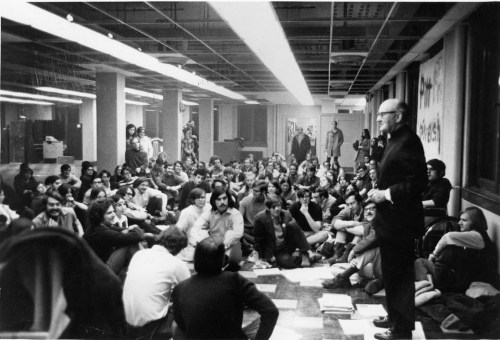

League of Denial: The NFL’s Concussion Crisis

league-of-denial-raster-br10-8
You may not think that you want to watch the new PBS Frontline documentary League of Denial: The NFL’s Concussion Crisis.

You may not want to spend almost two hours on a documentary, even a superb one. You may not like football, may not know anybody who plays football at any level, may not care about the business of sports. Then again, some or all of those may apply to you.

It doesn’t matter. You can watch League of Denial online. Please watch it.

One of the many lessons you will learn, if you didn’t already know, is that we pay a price for everything. Or at least somebody does. The price is sometimes advertised and obvious, but sometimes hard to find or even hidden. The point is not that something is good or bad, right or wrong, but that we can only make informed and enlightened decisions when everything is known. No more or less.

Jane Austen To Be American Idol Judge

Jane Austen

Jane Austen is actually dead; has been for almost two centuries. Whether or not that would stop American Idol from circulating rumors about her possible addition to the ever-changing panel of judges is unknown.

There is a new Idol connection to one of the most popular of British authors. The headline from the Daily Mail:

Anonymous donor gives $150,000 to stop U.S. singer Kelly Clarkson buying Jane Austen ring and keep in the UK

An anonymous donor has handed a Jane Austen museum £100,000 so that it may try and buy one of the author’s rings back from U.S. singer Kelly Clarkson who wants to take it out of Britain.

Earlier this month, the British government placed a temporary export ban on the gold-and-turquoise ring in the hope that money could be found to keep it in Britain.

The Jane Austen’s House museum said it had raised £103,200 of the £152,450 asking price since launching a fundraising campaign on Friday, most of it from a single anonymous donation.

Clarkson, a big Austen fan who reportedly owns a first edition of Persuasion, was top bidder for the ring in a Sotheby’s auction. The museum appreciates that the attention of an adoring pop star will help further raise awareness of the already-trendy author (see the newly-released indie film Austenland). But it also bemoans how much of Austen’s legacy has already left Britain, and how little remains there.

Two of the many thoughts this sparks:

Is there an Austen-inspired Kelly Clarkson single or album in the offing? One can imagine tracks inspired by each of the novels.

Should American Idol give up on judges with musical backgrounds (or in at least one case, a comedy/talk show one), and go instead with literary types? It could be current authors (J.K. Rowling, for example). Deceased authors may be out of bounds, although technically they could go with holograms or “tribute” judges pretending, i.e., if Kelly Clarkson won’t be a judge as herself, she could appear as Jane Austen. Given some of the judging antics past, this sort of thing might not be a reach too far.

Preston Sturges on TCM Today

Preston Sturges

If you are quick, and have never seen any of the irreplaceable movies written and directed by Preston Sturges, Turner Classic Movies is devoting part of today to him. If you don’t manage to catch them there, and love movies, and can find the best of these elsewhere, find them and watch them.

As TCM describes his work

Featuring razor-sharp wit and astringent dialogue, writer-director Preston Sturges ranked as one of American cinema’s most gifted creative talents.

We take for granted the unified title of film writer-director, but seventy years ago, Sturges invented and perfected that role. He was Woody Allen before Woody Allen, and with all respect for what Allen has managed to do, none of his work is funnier or more biting than the best of Sturges. There were misses, but the best of Sturges includes three movies released in just two years, between 1941 and 1942. Here’s a summary from TCM:

Sturges went on to direct “The Lady Eve” (1941), a complex romantic comedy about a bumbling snake hunter (Henry Fonda) who becomes the prey of a cool, sexy con artist (Barbara Stanwyck). Fonda and Stanwyck enjoy a shipboard romance but he rejects her when he learns of her unsavory past, and in order to win her man, Stanwyck reinvents herself as a British noblewoman. In one of the most memorable set pieces in film, Stanwyck takes a moment on their honeymoon to regale her new husband with a list of every love affair she has ever had. As the scene progresses and Fonda’s jealousy increases, Sturges skillfully employs the soundtrack as a counterpoint; the train enters tunnels with its wheels clacking and whistles blowing, a storm develops and the score swells. Marvelously acted, “The Lady Eve” was a hit for Paramount and boosted the stock of all involved.


Paramount gave Sturges free rein with his next films, starting with perhaps his most personal, “Sullivan’s Travels” (1941), a satire that focused on a comedy film director (Joel McCrea) who wants to make more meaningful motion pictures. Determined to experience poverty firsthand, he sets off as a hobo with an aspiring actress (Veronica Lake) in tow. For a comic piece, “Sullivan’s Travels” had a dark undertone with the ultimate moral being that people don’t want to be reminded of their situations, they want escapism. As Sullivan says near the end of the picture, “There’s a lot to be said for making people laugh.” The following year, Sturges wrote and directed “The Palm Beach Story” (1942), a satire on business and greed about a woman (Claudette Colbert) who leaves her inventor husband (McCrea) for a millionaire (Rudy Vallee). When the husband arrives in Florida, he is pursued by Vallee’s sister (Mary Astor) with unpredictable results. The film owed much to the French farces that once captivated a youthful Sturges.

If you see these movies, today or some other time, you won’t forget them, you will want to see them again, and you will wonder how you ever missed them. If you love comedy, and especially if you love comedy with witty language at its heart, and have been disappointed by those who say you “must” see this classic comic genius or other but come away thinking “boring”, “horribly dated” or “stupid”, these are for you. Brilliant, timeless, unforgettable. There was only one Preston Sturges.

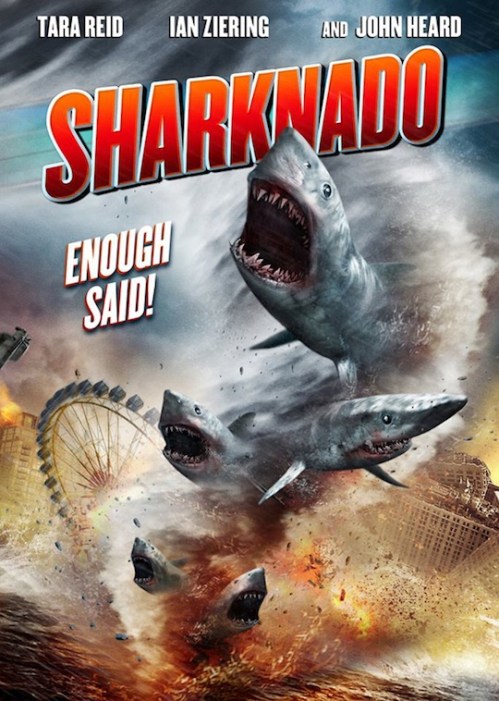
Sharknado

Sharknado
Some of us have been watching and loving the Syfy channel’s ludicrous scary animal disaster movies for years, such as

Dinocroc
Dinocroc vs. Supergator
Dinoshark
Frankenfish
Mega Piranha
Mega Python vs. Gatoroid
Mega Snake
Piranhaconda
Supergator

Then there are the newcomers who just this week discovered the film art of Syfy with the premiere of Sharknado  and have made it an entertainment sensation. If you haven’t yet heard about it, Sharknado, like many of these Syfy movies, pretty much gives away the basic concept in the title. Sharknado combines sharks and tornadoes: “When a freak hurricane swamps Los Angeles, thousands of sharks terrorize the waterlogged populace. And when the high-speed winds form tornadoes in the desert, nature’s deadliest killer rules water, land, and air.”

Soon, millions will be “experts”, comparing the performances of Debbie Gibson (as Dr. Nikki Riley) and Tiffany (as Park Ranger Terry O’Hara) in Mega Python vs. Gatoroid (2011), as well as trying to understand the symbolism of Monkee Mickey Dolenz appearing as himself in the movie.

Debbie Gibson and Tiffany

Being an early adopter of cutting edge art means learning to share with latecomers. So if you are a newbie and want to go back to the classics, be assured that any of the above are worth your attention and time.

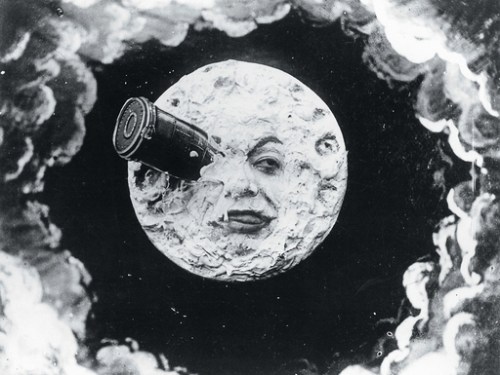
Celebrity Colony on the Moon

Melies - A Trip to the Moon
The success of Celebrity Colony on the Moon, a follow-up to NBC’s Celebrity Apprentice, is guaranteed, based on a few premises:

Celebrities are the only people able to take advantage of private space travel.
Celebrities like to increase their celebrity and to do things other people can’t.
People want to see some celebrities sent far away—even to the moon.

In Celebrity Colony on the Moon, celebrities will demonstrate their knowledge of space and science, and their ability to settle a frontier colony. People will vote based on these and other factors—including the desire to see particular celebrities housed in a lunar outpost.

Donald Trump will of course host the show. While he will not be official commander of the mission, he will travel along with the colonists. The demand to see him 238,900 miles away will be overwhelming.

It is expected that NBC will soon begin considering which celebrities might be sent to the moon, in the name of exploration and ratings. Nominations are now open.

The STR-AV1010 Is Dead, Part 2

STR-AV1010 Connections
Why does the demise of an audio component deserve even one blog post, let alone two?

Because I came across the manual for the Sony STR-AV1010 receiver (circa 1989), which manual demonstrates that tech archaeology and history is as important as any other kind, maybe more. If you don’t believe that, just look at one of my favorite tech photos of all time.
Motorola Brick
Here is a man who is implicitly the most successful, stylish and cool guy holding up the most ridiculous object to his ear, as we pretend (then) it is not. And it sort of isn’t, because he was able to do something that was until then the stuff of sci-fi. And yet it sort of is ridiculous, because, well, look at the photo.

The soon to be buried receiver (actually, it won’t be buried, instead being put in a storage closet until future science can figure out how to cure it) was, as noted in the earlier post, a wonder more than twenty years ago. Look at some of the possible connections in the above chart:

Turntable
Tape deck
VCR
DAT (Digital Audio Tape, a Sony format officially terminated in 1995)

The point? Not one really. Maybe just that we are in the river, it flows, and we swim with it, against it, and sometimes just stand in it, if we can touch bottom and it doesn’t knock us over and we drown.