Bob Schwartz

Category: Television

Ghosts of Mad Men

In the words of Kurt Vonnegut, Don Draper has come unstuck in time. Again.

In the first episode of the last half season of Mad Men, Don as always walks among ghosts. Because, of course, he is a ghost himself, literally the embodiment of a dead man.

He may sense that he will be happiest when he is whole and most present, but that difficult state is looking ever less possible. His most complete moments were with Anna Draper, the widow of the dead man whose identity he stole. As she was dying, he painted her house, stripped down to t-shirt and work pants, no costume, no pretense. Just love for and from one of the few people who knew him fully and unconditionally.

Don Draper, the real one, is dead. Dick Whitman, the real one, is dead. Anna Draper is dead. Lane Pryce is dead. Rachel Menken is dead. Others are alive but dead to Don.

The ghosts are coming, as they will for those who unwittingly seek and invite them.

Discovering Rachel’s death, Don visits the apartment where her family is sitting shiva, the Jewish mourning tradition. He brings cake, an appropriate gesture of respect and regard. But he admits that he doesn’t know exactly why he came, especially because Rachel’s sister begrudges him his relationship with Rachel when Don was still married. Don weakly explains that he is no longer married to that wife, and almost unmarried to his second wife. He looks over to Rachel’s husband and children, as the minyan recites Kaddish, the prayer for the dead.

Don is beyond wanting a do-over or indulging in what ifs. He wants the ghosts to help him make sense of the years and of the present, which they can’t or won’t do.

Coming Out: How Cosmetic Surgery Is Like Being Gay

South Park - Tom Cruise

In case you haven’t noticed, the noise surrounding Renee Zellweger’s about face sounds just like the conversations we have about celebrities being gay: did she or didn’t she, is he or isn’t he?

There are three kinds of cosmetic surgery: the public kind that can be explained as the result of exercise and nutrition (body shaping and toning), the public kind that is hard to explain that way (obviously enhanced breasts), and the private kind that is (sort of) meant to be private (vagina rejuvenation, penis enhancement).

Questions about the public kinds can be met with a variety of replies, all of them valid:

Yes.
No.
No comment.
It’s none of your business.

This remarkably parallels the situation of those who are “suspected” of being gay. Sometimes it is made public, sometimes it is kept private, sometimes it is treated matter-of-factly: it is what it is, it’s my life, take it or leave it, so what?

Admitting to plastic surgery is in many contexts (including and especially entertainment) as delicate as admitting to being gay—even if the fact is relatively obvious. One of the many reasons the late Joan Rivers was so beloved, why what was obnoxious in others was endearing in her, is that the fact of her many plastic surgeries was a prime subject of her own bits. As with other topics, she just gave you the finger, laughed, and had you laughing too.

In the scheme of all but the tiniest matters, Renee Zellweger’s face is inconsequential. But as with all the tongue wagging about the sexual preferences of some celebrity, it exposes unanswered and mostly unspoken questions about how people feel about certain things. Many people still don’t know exactly what they think about major or minor voluntary body mod, any more than they may have totally resolved their deepest puzzlement about homosexuality, no matter how genuinely progressive and tolerant they are.

For better or worse, we are actually seeing a bit of that in the Renee Zellweger situation: along with an avalanche of typically mindless chatter, there has been some useful discussion about the nature of celebrity, privacy, aging, feminism, and health. It is unfortunate that this has to fall on a single individual’s shoulders, with so much collateral and gratuitous hurt. But if we are careful, we might just learn something, mostly about ourselves. How rare and valuable an opportunity is that?

Illustration: The obvious illustration for this post would be yet another photo of Renee Zellweger, which neither the world nor she need. Instead, above is a frame from South Park, the 2005 episode called Trapped in the Closet. It is widely considered the show’s most controversial episode, which is saying something. In it, the fearless and brilliant and culturally incorrect Parker and Stone managed to skewer (eviscerate?) both Scientology and the rumored homosexuality of Hollywood stars. In this scene, Tom Cruise won’t come out of the closet (where he will ultimately be joined by John Travolta). Nicole Kidman, his then-wife, is trying to talk him out. As I said, culturally incorrect, and probably intolerant and spiteful in light of all that’s written above. But it is funny, and not surprisingly, it is the equally fearless and funny Joan Rivers who also took on the very same subject. Laughing and thinking. What a combo.

The iBrain and gBrain Devices

My Favorite Martian

With the release of the iWatch, both Apple and Google realize a challenge they face. There has been a bit of pushback to Google Glass, and there will no doubt be a similar issue for the iWatch. Even the most avant garde people may have second thoughts about just how cool they don’t look wearing and using those devices.

Which is why Apple and Google are working on devices that are innovatively powerful but completely inconspicuous. These are brain implants that will function as smartphones—and more. Working names for these devices might be iBrain and gBrain. No one will know you are wearing them. No more pulling your smartphone out of your pocket, or putting on a pair of glasses, or bringing your wrist up to your face.

Ironically, the problem that Apple and Google have is precisely that: nobody will know you are using it. That is, there is no badge. Which is why, on a parallel track, marketers are working on an actual badge that tells the world that you are wearing an iBrain or gBrain. Another thought that marketers have is to encourage jewelry or tattoos that bring attention to the implant site. One product manager has even suggested a non-working antenna that could attach to the implant, giving the user the look of an old-fashioned Martian. Futuristic glasses and watches might not be cool, but that sure would be.

We Need a Doctor: Who Hasn’t Seen Jennifer Lawrence’s Breasts or Why We Need Social Therapy

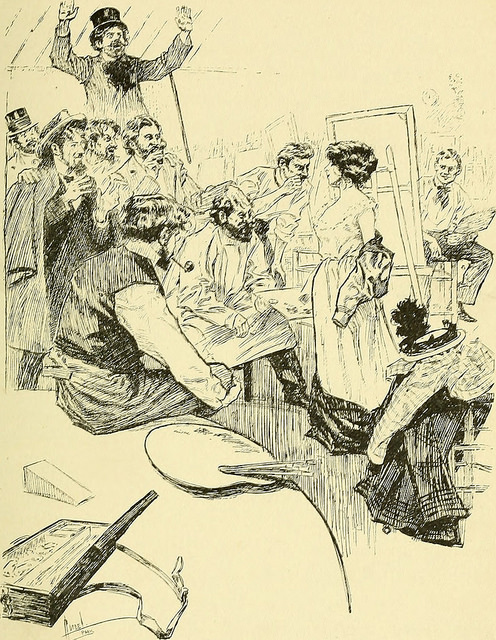
Bohemian Paris of Today

One of the biggest stories of the weekend was the posting of nude photos of Jennifer Lawrence and other female celebs, apparently stolen from their cloud storage accounts. The search activity for these photos almost brought the Internet down.

So in the immediate aftermath, with more to be revealed, what might we learn, besides how these beautiful strangers look without their clothes?

We are no closer than ever to figuring out what we think about privacy, or even what privacy means, especially now.

Digital didn’t create the issue, just heightened it exponentially. Inquiring minds have always wanted to know, and see. Celebrities, some though not all, have used degrees of exposure for publicity—or in some cases to put curious fans off the trail of the truth. Now we have an entire industry of programs about the “real” lives of unknowns, used-to-be-knowns, just-a-little-knowns, and soon-to-be-knowns because they are on a reality show.

Then there is the willingness of many people to chronicle everything. Twitter long ago dropped its signature question, but the most important phrase of the century so far may be “What are you doing?”, which was supposed to be answered in 100 characters or less. It turns out that people are more than willing to talk about what they are doing, what they are thinking, how they are looking, and anything else.

This doesn’t mean people don’t deserve privacy, morally and legally. It’s that line-drawing is now so hard for so many, and that goes along with a certain amount of confusion or even hypocrisy. The same people who searched for these photos or others like it in the past would be fuming if anyone stole their private shots and published them. They might try to rationalize the distinction, but it would be pretty feeble. Yet, not to forgive their double-standard, it is not surprising under the circumstances.

When we are confused about anything, and have difficulty drawing a line, sex makes it worse, clouding our judgment and our actions. Private parts are signifiers of sex, and if the private parts of loved ones or of strangers are arousing, the private parts of the quasi-strangers who are celebrities are positively crazy-making. So it is understandable, if not acceptable. People are only human, or so we say. But that doesn’t mean a little help and discussion—about privacy, about the cloud, about celebrity—might not be valuable. Maybe a little social therapy is in order.

We need a doctor, call us a doctor
We need a doctor, doctor to bring us back to life

(apologies to Dr. Dre, Eminem, and Skylar Gray)

Aereo: Agreeing with Justice Scalia

Aereo

It doesn’t happen often that I agree with Justice Antonin Scalia. On the law or much else.

But his dissent in today’s Supreme Court decision in ABC v. Aereo is pretty good and pretty right. By 6-3, the Court decided to allow Aereo to be subject to violation of copyright law.

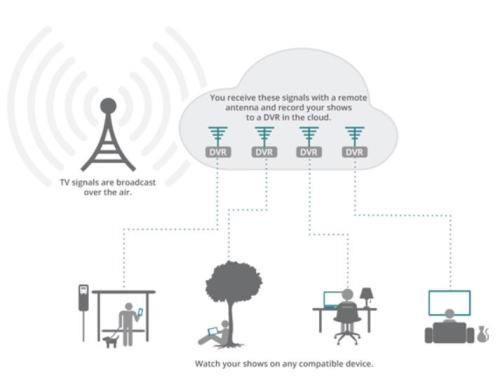
As explained in an earlier post at the time of oral arguments, Aereo has devised a complex tech scheme by which it captures over-the-air-broadcasts at the request of subscribers, using tiny antennas that subscribers essentially time-share, and then allows subscribers to watch those broadcasts online.

In the opinion, the majority agreed with the networks, finding that this is just a too-clever-by-half way of getting around copyright law and avoiding paying retransmission fees, as cable companies are required to do. Justice Scalia found the reasoning and judgment of the majority deficient in many ways, and his dissent is well worth reading.

Among the points, he notes that exploiting loopholes is not illegitimate, and is in fact one of the things that lawyers are good at and are supposed to do. Justice Scalia does not necessarily think that Aereo should go without liability or responsibility, but that trying to make the law fit to reach a desirable result is not the way to get there. If the law doesn’t fit the technology, Congress is charged with and capable of fixing it. (Note that this is the connection between his strict constructionism and his very progressive position in this particular case.)

There was a lot of apocalyptic talk at oral arguments (Aereo would destroy broadcasting as we know it), and there is apocalyptic talk today (the somewhat fuzzy majority opinion leaves all sorts of cloud-based services under legal suspicion). The earlier post repeated the maxim: hard cases make bad law. This is a hard case, and whether the law is bad or not, it sure is an irresolute path to the future. About that, Justice Scalia is right.

Honeywell Kitchen Computer and the Delights of Old Tech

Kitchen Computer - Menu Selection

Some people love old cars. Others of us delight in old digital tech.

We are not alone. The latest episode of Mad Men on AMC includes the installation of a computer at the agency. And the new AMC series Halt and Catch Fire is (coincidentally?) about the early days of personal computing. (Halt and Catch Fire is a real/apocryphal/funny code instruction that might send a computer into an endless loop, resulting in its ultimately stopping or bursting into flames.)

This is a page from the Neiman-Marcus Christmas 1969 catalog. The impeccably dressed N-M housewife is standing next to what appears to be an unusual table, but is actually the Honeywell Kitchen computer, which can be purchased for $10,000. (The apron will cost you another $28.) “If she can only cook as well as Honeywell can compute.” Indeed.

Kitchen Computer

Here is something completely different from the era, prophetic rather than silly. It is Isaac Asimov, a science fiction great, advertising Radio Shack’s TRS-80.

Asimov - TRS-80

Note that in the spirit of what goes around comes around, this is a pocket computer almost exactly the size of a smartphone—or is a smartphone a pocket computer exactly the size of a TRS-80? Either way, Neiman-Marcus and Honeywell were clueless, but Asimov and Radio Shack were not.

That would be a pretty good close for this post. Except that the following ad is irresistible, telling us something else about the early days of computing.

TSP Plotter

Just as cars were, and to some extent still are, sold by using sex, sometimes so were computers. This is an ad for a plotter, possibly the least sexy of all peripherals. The copy is mostly bone-dry and technical. But then there’s the trio of the model with her dress open to her navel, the headline “New, Fast, and Efficient!”, and the lead “The TSP-212 Plotting System is a real swinger.” $3,300 COMPLETE. Well, almost complete, as the model is presumably not included. But you know, that cool plotter just might attract one.

The Aereo Case and Media Reality

Aereo

Today the Supreme Court hears arguments in the case of ABC, et al. v. Aereo. Some characterize it as the most important media case in decades, one which could destroy broadcasting as we know it.

That is both overstated and understated. The big broadcasters who claim this is the apocalypse won’t go out of business; they will continue, though they might make a little less money or have to work a little harder for it. On the other hand, nothing less than the nature of modern reality is being considered, which is what makes the case so interesting and ultimately so hard to decide.

In a nutshell, this is what Aereo does:

Aereo sets up lots of tiny (thumbnail) antennas in your locality.

The antennas pick up the same over-the-air (OTR) TV signals you would if you had an antenna at your home (but you probably don’t).

You subscribe to Aereo for as little as $8 a month.

When you want to watch something from the stations that are on the air in your locality, Aereo assigns you an antenna, collects and records the signal from that antenna in its cloud, and streams that signal the way you want to the device you want, now or later.

The question is whether Aereo is retransmitting copyrighted content to subscribers, cleverly skirting retransmission fees that cable systems and others must pay, which would be stealing. Or whether Aereo is simply enabling you to do something you are legally entitled to do: receive OTR TV and then watch it, record it, or redistribute it to your own devices for your own personal use.

The Second Circuit Court of Appeal decided in favor of Aereo, with a vigorous dissent and with other Circuit Courts disagreeing, and now the Supreme Court will decide. If you read the briefs you can get an idea of the difficulty and the possible impacts.

One can say, as the big broadcasters do, that Aereo may be trying to fit through a loophole in the law, but that isn’t quite right. Aereo is taking advantage of a reality so profoundly new and so newly understood that every medium and every media business is just barely beginning to come to grips.

When you reduce things to information and can move that information around infinitely and frictionlessly and at relatively low cost, the processes and regulations meant to handle grosser things are of limited value.

First a book was a thing made of paper, then there was a copier which could copy pages on paper, then there was a scanner that could turn paper pages into digital images and, with OCR, characters, then there were entire books that never had anything to do with paper, ever, just pure arranged information. The same goes, with slightly different details, for every medium. The solution for the producers who wanted to control things (often with legitimate interests, such as creators being compensated), was to put the information in some kind of box, which to some looked like an information jail. It was and is this simple: once it gets out of the box, catching it and catching up with it is quite a chore. Because, as Stewart Brand famously said, information wants to be free.

If you had to characterize the actors in this case as good guys or bad guys, it does look like ossified old school versus new school, mega-corporations versus insurgents, or as one of the briefs says, David versus Goliath. Any way you put it though, and wherever your opinion lies, this is a hard case, and the maxim is that hard cases make bad law. In this case, bad law would mean that even if progressive principles are maintained, more looking forward than back, we are still in an astonishing mess when it comes to dealing with all this. One case at a time won’t do, and the expectation that Congress will seize the reins and lead us boldly into an enlightened future on digital intellectual property is, at least for the moment, not in the cards or the cloud.

Mad Men and Kabbalah

Don Draper - Broken Vessel

“I keep wondering, have I broken the vessel?”
Don Draper, Mad Men, Season 7, Episode 1, Time Zones

Matthew Weiner’s Mad Men show is not about Kabbalah, or so it would seem. It has, though, frequently touched on religious and spiritual matters. In the first episode of the new Season 7, for example, Roger Sterling’s daughter appears to have had some sort of enlightenment experience that allows her to accept her father as he is and to forgive him unconditionally. And at the end of last season, Don Draper’s hitting bottom included his punching out a Christian preacher in a bar. There have been Catholics, Jews, Hindus, and all manner of beliefs in the mix.

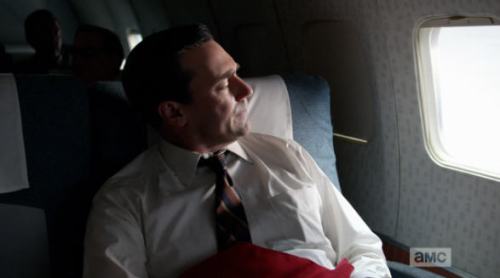
And then, in the latest episode, Don grows introspective and candid with a beautiful stranger on a plane. He admits to being a terrible husband, and then assesses his own responsibility: “I keep wondering, have I broken the vessel?”

For some, the image of the broken vessel instantly brings Kabbalah to mind. According to some traditions, God created the world by sending emanations—holy sparks—encased in ten vessels. Had all the vessels arrived intact, this would be a perfect world. But the force was so powerful and the vessels so delicate that a number of them shattered. In an imperfect world, it is our mission to gather up the holy sparks that have scattered, and thus to make the world better.

One of the first people to make Kabbalah popular and accessible in recent times was Rabbi Herbert Weiner. His book 9-1/2 Mystics: The Kabbala Today (1969)  was the introduction for many to the subject. By coincidence, Rabbi Weiner died almost exactly a year ago at the age of 93.

None of that is much to go on. There is no known connection between Matthew Weiner and Herbert Weiner. And as strange as Don’s dialogue sounds, he has said plenty of strange things before, he is an unlikely Kabbalist, and sometimes a broken vessel is just a broken vessel. Still, Mad Men has taken us places we never thought we’d go, so why not? After musing about the broken vessel, and after refusing the advances of his new friend, Don turns to the plane window and opens the shade. Bright morning sunshine washes his face. Not much to go on. But if there is some message there about Don’s awareness of a duty to gather the broken bits of light and heal his world, Kabbalah or not, that would certainly make Mad Men fans happy.

Putin’s Moldovan Invasion v. Dynasty’s Moldavian Massacre

Dynasty Royal Wedding
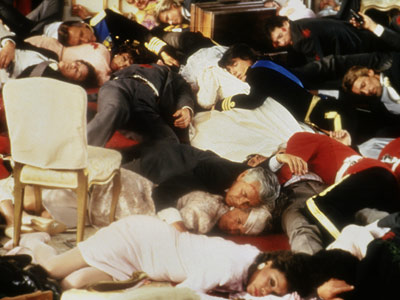
A cliffhanger is a cliffhanger. Russia may be about to invade its neighbor Moldova, based on troop buildup along the border. Almost thirty years ago, on May 15, 1985, the ABC series Dynasty ended Season 5 by leaving the world hanging, as terrorists invaded and shot up the royal wedding of Prince Michael of Moldavia and Amanda Carrington.

(Note: To clarify the Moldavia/Moldova confusion. Moldavia is a traditional region that now straddles the nations of Romania and Moldova. The language of Moldova is Romanian, and the Romanian name for Moldavia is Moldova. The producers of Dynasty may or may not have been aware of this, or that Moldova was at the time a part of the Soviet empire, or much else geographic. Dynasty was not a documentary or reality series. “Prince Michael of Moldavia” just sounded so cool and romantic, as was the fake country.)

Who would survive this now infamous Moldavian Massacre (you can watch it here)? Viewers of Dynasty, then #1 in the ratings, would have to wait all summer to find out. Meanwhile, that season-ending episode reportedly attracted 60 million viewers.

Will Putin invade Moldova, claiming that just as with Crimea, Moldovans are pleading to join up with their Russian friend and neighbor (and former ruler)? How will the world respond? How will Putin respond to that? That’s a real cliffhanger. And even though Putin seems to be playing a part in a costume epic, in which he is the royal hero, a sort of Putin’s Dynasty, this is no television series. Perhaps Czar Vladimir of Russia will wake up and see that.

Teach-in and Dope in the Senate

Teach-in
Yesterday some Senators, mostly Democrats, held an all-night “talkathon” on the Senate floor about climate change. It wasn’t any kind of filibuster, because there wasn’t any particular piece of legislation involved.

Back in the 1960s, this might have been called a teach-in, which was just this sort of session during which change-minded people would learn about the radical issues of the day. Except those people were more likely to be professors and students (or “outside agitators”), and it was more likely to take place in a college administration building than the U.S. Senate.

Two occasional hallmarks of extended teach-ins were sex and drugs. We don’t dare speculate whether any U.S. Senators were having sex during this “talkathon,” but we might just wonder if anybody snuck out to the cloakroom for a quick hit.

In the delightful and trenchant Amazon political comedy Alpha House, one of the four Republican U.S. Senators living in the eponymous D.C. house is seen relieving the tension of running for reelection by bonging it in the bathroom. (The much more serious and dangerous Netflix political series House of Cards also shows the ambitious Frank Underwood, played by Kevin Spacey, sharing joints with his Lady Macbeth of a wife. Sex of all varieties too.)

Back to the climate change teach-in. Even if no substances were involved in the event, what are the odds that any of those participants occasionally indulge, or that any of the rest of the Senate does? As a variant on the old speaker’s trick of imagining your audience without clothes, maybe it would be easier to watch the U.S. Senate if we as citizens just imagined our favorite or least favorite Senators sitting in those iconic smoke-filled rooms passing the pipe. Dope in the Senate. That would explain so much.