Bob Schwartz

Category: Television

The Voice Has a Big Secret

Danielle Bradbery
The Voice has a big secret, but it has always been hiding in plain sight.

It is no secret that Danielle Bradbery won NBC’s singing competition, or that she should have or would. The overwhelming talent of this 16-year-old phenom—not just compared to her competition, but to professional singers twice her age—left the coaches/judges speechless, literally running out of superlatives. The outspoken Adam Levine on the night of the final performances essentially declared her the winner, before the public votes were cast. (On the results show, he backed off before the announcement, diplomatically offering the opinion that it was close and all the finalists were great.)

Will Danielle become a star or superstar? As with winning The Voice, she should, if there is any justice. But the music business is funny and anything but just. And yet, just like in farm fysics, cream rises, and Danielle is very heavy musical cream.

Now to that secret. The point of The Voice—in its system and even in its name—was to better itself over American Idol, which in the balance between talent and entertainment has weighed heavily towards crowd pleasing and audience building. The Voice was supposed to be, and mostly is, a little more about singing. About “the voice.”

In an instance of cleverness meeting mission, The Voice decided to begin its competition by having the coaches just listen to singers—chairs turned away, not looking. Though performing is about a raft of things, singing is about sound, even at a time when videos sit in parity with audio tracks.

And so, the secret. As much as it seems antithetical to the interests of NBC, its ratings and its sponsors, we are supposed to listen to The Voice, not watch it. We are supposed to be auditors, not viewers, not distracted by the form “the voice” takes, even though that form is obviously critical to live performance and videos. Maybe that works in somebody’s favor (not having the perfect looks or stage presence) or against it (cute does not necessarily sing as cute appears). That is the precise point of the turned around chairs and blind listening.

If you just listen to the live performances and close your eyes, you’ll see. (The studio performances of the same songs, extended, sweetened, smoothed out, are only partly representative).

People have quibbled—been downright defiant—about Danielle for a host of reasons (the internet is where reasons, sound and ridiculous, go to thrive). Maybe the biggest complaint is from those who just don’t like country music, or even claim to “hate” it, which is a legitimate preference. De gustibus non est disputandum—there is no disputing taste.

But for those non-country folk, please be open to the talent, current and historic. Here is Patsy Cline, one of the great pop singers ever, performing Crazy live. or the studio version of Sweet Dreams (more arrangement, a little chorus, but still an unadorned voice in need of no help). There are “the voices” in every genre, and if you would be willing to say “I hate opera, but she sure can sing” then you have to say the say the same about country, blues, R&B, musicals, whatever. In Patsy’s case, she was one of the first to land in the country-pop crossover space, based on the sheer appeal and power of her singing.

This isn’t meant, no way, no how, to compare Danielle to Patsy. Danielle may get close someday; time will tell, but that’s a nearly impossible standard. It’s just meant to remind us that beyond stage performance and videos, beyond human interest back stories, beyond genre fragmentation and hybrids, beyond all the chazerai—a great Yiddish word meaning the insubstantial junk that surrounds important things, there is the singing.

The Voice got that right by showing us how to just listen, chairs turned, eyes closed. The Voice voters got that right by listening to Danielle Bradbery and declaring her “the voice.” It’s no secret that she is.

The Voice: “I Hate This Country”

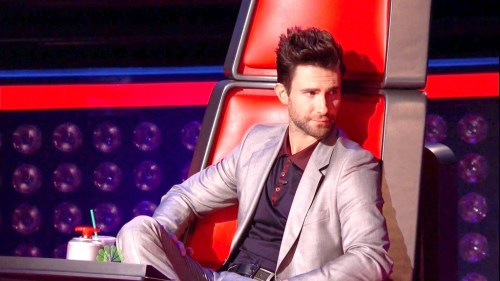
Adam Levine - The Voice
Adam Levine is a popular musical artist with Maroon 5 and a coach on NBC’s singing competition The Voice.

Last night was an elimination round for two of the remaining eight contestants. Each of the four coaches (including Shakira, Usher and Blake Shelton) has members of their respective teams in the competition.

After the typical tense triage, three contestants remained. Only one would survive. Of those, two were from Team Adam, and one was a talented singer named Judith Hill. She may not have been destined to win, but she was a solid performer who had already had a career as a backup singer for Michael Jackson, and might yet get a chance on her own. The two other singers remaining were not in her league.

The camera was on those three as host Carson Daly pronounced the obligatory nail-biting “America has voted” spiel. In the background, you could hear a simple comment from Coach Adam, as he likely sensed that the most worthy of the three was about to be eliminated:

“I hate this country.”

Meaning, one presumes: I hate these stupid popularity contests, even one that I am a part of, where merit matters less than the judgment of numbers and the crowd. I don’t hate America, but I hate it when America speaks like this.

And then, Judith Hill was gone.

Every one of the artist-coaches has built a successful career, and knows that entertainment, like every other field, is not entirely a meritocracy. Still, even accounting for differences in taste, a few minutes of singing can reveal those with consistent control, those who can find and hit all the notes, those who can put power and style in what they sing—and those who can’t.

So Adam, and everybody else who gets frustrated by singing competitions that don’t always give us the best, or political systems that don’t either, embrace your frustration. At least it means that you haven’t given up, that you still have standards, that you still have hope and expectations that the competitions and elections will give us winners who really can sing—even if we lose some worthy ones along the way.

Speed Men

Don Draper on Speed
Definition of Phantasmagoria
1. An exhibition of optical effects and illusions
2. A constantly shifting complex succession of things seen or imagined
3. A bizarre or fantastic combination, collection, or assemblage

The latest episode of Mad Men, Crash, is not the first to involve a car crash or the use of drugs. But it does use both as a device and as prefiguring of what is down the road for Don Draper and company.

Previously on Mad Men, besides the limitless consumption of alcohol and tobacco, in this late 1960s era there has been the increasing use of marijuana, and a few LSD experiments. This time, though, the drug of choice is speed.

Chevy is the agency’s new and prized client. Ken takes the Chevy guys out for a booze-fueled night, and drunken speeding results in a crash that leave’s Ken’s leg injured. Chevy is placing impossible demands on the agency, and so a weekend of work is ahead for the creatives and the account people. A sort-of doctor is brought in to inject the senior staff with a sort-of “stimulant”—a combination of vitamins and speed.

Speed heaven and speed hell break out. People are racing each other down office aisles and over desks, playing William Tell by throwing sharpened pencils at each other, wanting sex, talking nonstop. Don has two distinctive reactions. On the mental side, he seems  on the brink of a breakdown. His mind flows back to his growing up in a whorehouse, where we learn the possible origins of his sex addiction and other problems. He loses track of time, something that has happened before.

On the creative side, he has a breakthrough, the kind that speed can convince you (often falsely) that you are having. Don is obsessed by an old agency campaign for soup that he is sure holds the key to Chevy. He ultimately finds the ad, though it is for oatmeal; the soup is from his memory of a prostitute who nursed him back to health and was his first sexual experience. The headline says, “She Knows What You Want”.

But when Don calls everybody in to announce his creative triumph, the speed speaks, pontificating that, no, he hasn’t solved the Chevy puzzle—he has solved the big puzzle of life itself.

Events in and out of the office keep spinning. The speed has apparently “cured” Ken’s injury, as he throws away his cane and starts tap dancing. Don has left his children alone in the apparent, and an older black lady who calls herself Don’s Grandma Ida breaks in, confronts Don’s daughter Sally, and steals some of Don’s watches. Sally doesn’t believe Ida is Don’s grandmother, but since Sally doesn’t really know anything about Don’s real background, anything is possible.

The speed crash comes on Monday, and it is different than any other of the post-drinking hangovers that Don has ever suffered through. We can’t tell exactly what has gone on in his head, or what combination of murky and clear is operating, or whether he has really figured anything out. But he does something he has never done before, because being creative—making things up—is what his adult life has been about. He relinquishes creating for the Chevy account, and says he will only serve as creative director, managing what others come up with.

At this point, as he has a few times before, Don is seeing that if he keeps moving the way he has, he will crash. But he thinks that if he stops moving, he is dead. Of course, Don Draper is dead, killed accidentally and indirectly in Korea by the young Dick Whitman. Just as Draper’s suicidal younger stepbrother Adam Whitman was killed indirectly by Don, as was Draper’s suicidal partner Lane Pryce.

If it doesn’t stop on its own, maybe the uncaring laws of life and physics will take over. Maybe there will be a much more serious crash.

The Great Gatsby and the Great Draper

Gatsby and Draper
At this point, the reviews of Baz Luhrmann’s The Great Gatsby are mixed, which isn’t surprising. His love of over-the-top spectacle is not to all tastes, and has a tendency to obscure story for fireworks. (His best movie may be his first, most personal and sweetest, the little and lovely 1992 romantic comedy Strictly Ballroom).

Literature to film goes in all directions. Small gets bigger as even the shortest stories are adapted. Big gets smaller, given the need to cut out sometimes huge chunks of narrative. Big gets bigger, as in Gone with the Wind. Big stays big, trying to preserve and show everything, as in Peter Jackson’s still-not-completed Tolkien opus.

The Great Gatsby is a little book. You can read it, even out loud, in a few hours. What has made it endure as one of the great novels is how much Fitzgerald packed into it. Word for word, it is one of the best fictional descriptions of a moment in history; not just that critical moment of the early 1920s either, but maybe every time the country is changing radically, as fortune swings in a blink between good fortune and bad.

Gatsby is not about the parties or the mansions. You can argue that the colorful wildness and glamour and licentiousness make the tragic end starker, so that when narrator Nick Carraway announces that the party is over, we get it. But we can miss the point.

Gatsby is a touching little story about a lost soul in a lost time. The only two ways to tell this story on film are to keep it small, or to actually rewrite and expand the story beyond its outline, to hours and hours of film.

The expanded story is already being made, by Matthew Weiner. Mad Men is the extended, history-spanning story of a fatally charismatic and ambitious man, so ambitious that in keeping with the dynamic times he lives in, he sheds his entire early life and identity to become a successful man of mystery. But he never stops trying to fill the holes that he knows are still there.

Every man wants to be him, every woman wants to have him, nobody knows him. The only difference between James Gatz/Jay Gatsby and Dick Whitman/Don Draper is that so far Draper has managed, somehow, to outlive his younger manhood to reach his middle years without crashing—but coming close almost daily. So just in case the Baz Luhrmann Gatsby doesn’t prove satisfying, don’t worry. The murky madness and capriciousness of Gatsby’s go-and-stop American dream is on view in the epic of Mad Men.

Close to Her

Karen Carpenter
This past week on American Idol, a show on life support, some finalist named Lazaro—whose back story includes the fact that he apparently doesn’t speak English and he stutters—chose to perform the song Close to You by the Carpenters.

Also, Lazaro apparently can’t sing. The performance was rated by Idol experts as the worst ever in the show’s history. It is available online, but please don’t listen; treatment for it will require years of therapy. Lazaro was summarily eliminated by viewers.

In a 1994 tribute album, If I Were a Carpenter, Karen Carpenter songs are covered by an amazing collection of artists. In the video of their version of Superstar,  Sonic Youth includes a Karen Carpenter montage, with their riding around in a convertible, passing a sign announcing “Now Entering Downey, Home of the Carpenters.” It is a moving tribute, and the vocal couldn’t be any farther from Karen Carpenter’s.

Here’s why: no vocals are close to Karen Carpenter’s, and nobody sane or self aware goes there. Not even her brother Richard’s heavy-handed arrangements and production—responsible for their massive commercial success—could obscure that. Watching her sing is a revelation. The revelation is that while she certainly knew she was good, she probably had no idea just how good (or beautiful) she really was. Knowing she was so much more than good enough might not have saved her, but she was that good.

How good? If she was in a competition like American Idol, they would just stop the season right there, if not cancel the show entirely. Same thing if she was on The Voice, because they would have found The Voice. Search over.

In 1980, she sang a television duet with Ella Fitzgerald.  If there has ever been a queen of American popular song, Ella may have been it. Duets are funny things. They are frequently a bit off or complete misfires, even when the two artists are separately good. Another thing is that each one of the pair has to bring something special, even when they are not artistic equals. Comparing Karen to Ella, or anyone to Ella, is like comparing anyone to Karen: pointless. In the case of this duet, remember that Ella was renowned for her purity of tone, her effortless range, and for that something that was supremely and gorgeously her. All those things can be said about Karen Carpenter. Ella was already having health problems at this point, though you wouldn’t know it from her voice, and she would live for another sixteen years to the age of 79. Karen was visibly suffering from the problem that would end her life, three years later, at the age of 32.

Karen Carpenter singing Superstar.

Actor Is Typecast As Satan

Satan
The media is all atwitter over the observation that the actor who plays Satan in a new Bible series looks a lot or something like President Obama.

The Associated Press got a response from the producers:

Mark Burnett and Roma Burnett said Monday the Moroccan actor who played Satan in the History channel series has played Satanic characters in other Biblical programs long before Obama was elected president.

First, separate from any questions about motives or about whether Mohamen Mehdi Ouazanni does look like Obama, let’s quickly get past a gap in this reply. If an actor looks like the President, and you have some creative notion that this helps make it a good casting choice (for artistic, political or publicity reasons), his having played Satan before just might be a bonus. Or if his experience as Satan is the driving reason, then the look-alike feature might be a bonus. The earlier Satan experience doesn’t fully dismiss any possibilities.

Beneath all this is a commentary on the craft and business of acting. From the producers’ comments, it appears that Mohamen Mehdi Ouazanni is, or is on his way to, being typecast as Satan. He played the part before, he is playing it now (and getting lots of attention for it), and may then be asked to play it again. If Charlton Heston had done a few more Moses movies after The Ten Commandments, what would his later career have looked like? Would he have been waiting around for the next Moses movie, instead of giving us Ben Hur, Planet of the Apes, Soylent Green, etc.? No major actor has ever reprised the role of Jesus, either, because besides the fact that there is no sequel to the story, it is the kind of part that is hard to shake.

There is a silver lining, though. Whether or not there are other Satan parts in this actor’s future, there is no doubt that in years to come, we will be seeing all kinds of films about Barack Obama. Some will even cast Obama as a metaphorical devil—a part he already plays in lots of political punditry. When those films are finally made, there will be a call for actors, and maybe having played Satan will be a real qualification.

American Experience: Silicon Valley

Silicon Valley
Tech history is our history. As enlightening and fun as it is, it is also more complex than learning about cars and trains and planes, all of which we understand, or can learn to. But transistors, integrated circuits and, ultimately, microprocessors are harder to grasp.

But this is also human history, the intertia of brilliant people at rest and in motion. That’s why the background of these digital days is fascinating, and why the new PBS American Experience documentary Silicon Valley is so enthralling.

You know where Silicon Valley is, what it is, and may have been there. How that agricultural Santa Clara Valley became the center of the world is a story. But the real story is how Robert Noyce, Gordon Moore and Andrew Grove—the godfathers of Intel—and their colleagues, predecessors and competitors changed the way the world worked technically, commercially and socially.

Silicon Valley is that story. It is inspiring, in the way that all risky ventures into the unknown are inspiring. It is also one of the rare worthy arguments for some sort of true American exceptionalism, since there is an inherent sense watching this—as politically incorrect as some may find it—that this is a quintessentially American story. This is what we did, this is what we do.

Silicon Valley is not to be missed.

The Untouchables: No Justice On Wall Street

The Untouchables
This week, PBS Frontline aired a follow-up to its powerful documentary Money, Power & Wall Street, which covered the origins and aftermath of the 2008 financial meltdown. The Untouchables is an equally scathing and disturbing story about the failure of the Justice Department to prosecute any Wall Street executives for fraud, in the wake of their apparently knowing securitization and sale of worthless mortgages.

For those who wonder whether investigative journalism still matters, this happened yesterday:

Lanny Breuer, the head of the DOJ Criminal Division featured in the documentary, resigned. Questions about why criminal prosecutions have taken so long—and whether there will ever be any—linger like a bad odor.

Mary Jo White, a former federal prosecutor, was nominated to be the next chairwoman of the Securities and Exchange Commission. Richard Cordray, another former prosecutor, was renominated to be director of the Consumer Financial Protection Bureau. The president said these nominations would help prevent a financial crash like the one he inherited four years ago.

People say that the new movie Zero Dark Thirty serves as a thought-provoking wake-up call about the role of torture and, ultimately, the effectiveness and judgment of President Obama. It has been said that those who support the president might find the film unnerving.

The Untouchables is much more unnerving, not just in looking at the president, but in looking at Attorney General Holder, at overseers,  and at all the others who seem to be strangely—or not so strangely—beholden to Wall Street.

Watch The Untouchables, then go back and watch Money, Power & Wall Street. Like all great investigative journalism, it is darkly entertaining, and like all unvarnished views of how government works, it is profoundly discouraging. But necessary.

Walt Whitman Helps Launch Consumer Electronics Show in Las Vegas

Walt Whitman
First it was Abraham Lincoln in the new television campaign for the Lincoln Motor Company (the founder of that firm was a fan of the president, back when the company was started in 1917).

Lincoln Motor Company

Now Walt Whitman, the father of modern American poetry and, coincidentally, a big fan of Lincoln himself, is helping to launch this year’s Consumer Electronics Show in Las Vegas (January 8-11).

Whitman will probably not be seen emerging from a mysterious fog as Lincoln does in the commercial, although that would be unspeakably cool.

Instead, Whitman’s most famous line of poetry is quoted (without attribution) in the official description of the very first CES SuperSession

The Digital Health Revolution: Body, Mind and Soul
January 8, 2013, 9:30-10:30 a.m.

“I sing the body electric” takes on new meaning in our brave new digital world, where devices let us monitor everything from our stress levels to our genetic sequences, and devices with 100 real-time biosensors loom on the horizon. Join moderator Arianna Huffington as she leads four digital health leaders in conversation — on the latest innovations in the field, how those innovations have the potential to change lives, and what the digital revolution means for the body, mind, and soul.

The literarily perspicacious will notice that the first line of copy includes allusions to two groundbreaking writers—not just Whitman, but also Aldous Huxley. Huxley’s Brave New World vision is actually much closer to what is going on at CES than Whitman’s. Unfortunately, Huxley will not be coming out of the mist either, though the thought of his joining up with Whitman in Las Vegas to look at the latest gadgets is mind-blowing—even without Huxley’s Soma or LSD. Add Lincoln, and it is the stuff that dream movies are made of (Steven Spielberg, are you listening?).

Back to Whitman, I Sing The Body Electric is included in his Leaves of Grass (1855). Whitman’s work was a sensation, in part because of his unabashed celebration of the splendor and wonder of the human body and sexuality. The poem is just such a celebration, a spiritual anatomy lesson that is like a painting, whose message is: be not ashamed.

It isn’t clear that is what the CES copywriter had in mind, though writers generally deserve much more credit than they get. If the point is that digital pioneers plan to touch every part of our bodies, that works too.

Meanwhile, Whitman—whose use of the term “electric” was itself quite pioneering—would probably be happy to see his poem alive and well in the context of keeping and making people healthy, head to toe, organ to organ. See you in Vegas, Walt.

For the digiterati and literati, here is the closing section of the poem:

O my body! I dare not desert the likes of you in other men and women, nor the likes of the parts of you,
I believe the likes of you are to stand or fall with the likes of the soul, (and that they are the soul,)
I believe the likes of you shall stand or fall with my poems, and that they are my poems,
Man’s, woman’s, child’s, youth’s, wife’s, husband’s, mother’s, father’s, young man’s, young woman’s poems,
Head, neck, hair, ears, drop and tympan of the ears,
Eyes, eye-fringes, iris of the eye, eyebrows, and the waking or sleeping of the lids,
Mouth, tongue, lips, teeth, roof of the mouth, jaws, and the jaw-hinges,
Nose, nostrils of the nose, and the partition,
Cheeks, temples, forehead, chin, throat, back of the neck, neck-slue,
Strong shoulders, manly beard, scapula, hind-shoulders, and the ample side-round of the chest,
Upper-arm, armpit, elbow-socket, lower-arm, arm-sinews, arm-bones,
Wrist and wrist-joints, hand, palm, knuckles, thumb, forefinger, finger-joints, finger-nails,
Broad breast-front, curling hair of the breast, breast-bone, breast-side,
Ribs, belly, backbone, joints of the backbone,
Hips, hip-sockets, hip-strength, inward and outward round, man-balls, man-root,
Strong set of thighs, well carrying the trunk above,
Leg fibres, knee, knee-pan, upper-leg, under-leg,
Ankles, instep, foot-ball, toes, toe-joints, the heel;
All attitudes, all the shapeliness, all the belongings of my or your body or of any one’s body, male or female,
The lung-sponges, the stomach-sac, the bowels sweet and clean,
The brain in its folds inside the skull-frame,
Sympathies, heart-valves, palate-valves, sexuality, maternity,
Womanhood, and all that is a woman, and the man that comes from woman,
The womb, the teats, nipples, breast-milk, tears, laughter, weeping, love-looks, love-perturbations and risings,
The voice, articulation, language, whispering, shouting aloud,
Food, drink, pulse, digestion, sweat, sleep, walking, swimming,
Poise on the hips, leaping, reclining, embracing, arm-curving and tightening,
The continual changes of the flex of the mouth, and around the eyes,
The skin, the sunburnt shade, freckles, hair,
The curious sympathy one feels when feeling with the hand the naked meat of the body,
The circling rivers the breath, and breathing it in and out,
The beauty of the waist, and thence of the hips, and thence downward toward the knees,
The thin red jellies within you or within me, the bones and the marrow in the bones,
The exquisite realization of health;
O I say these are not the parts and poems of the body only, but of the soul,
O I say now these are the soul!

Holiday from Politics or Holiday with Politics?

Harry Reid Kathy Griffin
Just when you thought you were out, they pull you back in.

New Year’s Eve is supposed to be a politics-free zone. Actually, we assume that, but can’t be entirely sure, because it honestly never came up before.

We needed the break. So what was Congress doing on our New Year’s Eve broadcasts?

Was it maddening to have Sen. Harry Reid et al competing with Ryan Seacrest, Carson Daly, and a bunch of pop stars lip-syncing their hits to preposterously overexcited audiences? Not really. Watching Anderson Cooper and Kathy Griffin on CNN was a complete antidote.  After six years of their improbable New Year’s Eve partnership, they are one of the great unscripted couples in television history.

Theirs is an unforced chemistry, an obviously loving friendship that viewers get to watch. Kathy is professionally outrageous, determined to say and do anything, the more embarrassing the better. Anderson is famously private, so Kathy aggressively pokes around his peccadilloes, making him demur, squirm, giggle and half-heartedly try to uphold CNN network standards.

Among this year’s highlights was a surprise visit by Psy, who understood little English, so that when Kathy congratulated his success by saying he had “money coming out of his butt,” he graciously replied, “That means so much coming from you.” But nothing beat Kathy’s relentless attempts to go down on Anderson, a sequence prompted by CNN’s report about the custom in Eastport, Maine of “kissing the big sardine” on New Year’s Eve.

Comments indicate that some found this, and much of what Kathy does to/with Anderson, to be crude, vulgar, distasteful, pointless, etc. It is edgy, but also good-natured and even sweet. Watching Anderson, one of the most respected journalists in America, protecting his private parts from her advances is just funny—especially when he made it clear that it was not something he was interested in.

Apparently those objecting to distasteful and pointless on New Year’s Eve were not aware of what was going on in Washington that night. Thank God for Anderson and Kathy. They were way more fun.