Bob Schwartz

Category: Television

Lesson from The Voice: Caveat Inspector

The Voice
The Voice is now the dominant singing competition on television, having surpassed, probably permanently, American Idol. There is a lesson from The Voice that goes beyond just music, a lesson that goes to the heart of what has become a more media centric/entertainment centric society.

The reasons for the success of The Voice are pretty simple:

A substantial number of solidly talented and interesting contestants.

Panels of likeable and helpful celebrity coaches, with real musical expertise and real chemistry between them: Adam Levine, Cee-Lo Green, Christina Aguilera and Blake Shelton in the fall; Shakira, Usher with Levine and Shelton in the spring.

The show process begins with the uber-concept in the show’s name. The first round is a blind competition, where the panelists can hear but not see the contestants sing. It is, at least in part, all about “the voice.”

This week began the Knockout Rounds, where votes from the TV audience determine who will stay and who will be eliminated. The first of two nights on Monday was peculiar, anomalous for any singing competition. Of the ten singers who performed, not a single one was criticized, even for a tiny misstep—even though a few performances were very good, some were okay, and some were just not quality singing.

American Idol never quite figured out how to deal with judges’ criticism of contestants. Starting with the original panel, and continuing through the revolving door of judges who failed, there were more or less roles for the judges: the more brutal but somewhat constructive one (Simon Cowell), the kind, encouraging and heart-on-the-sleeve, maybe a little ditzy one (Paul Abdul) and whatever one (Randy Jackson).

There was an underlying issue in all that. There is little doubt that the producers of Idol shaded and spun the show so that certain contestants might rise a little higher than others. Whether this amounted to rigging results is unsubstantiated overstatement. But clearly, with all the elements at their command, producers could shine a different light on different singers, light that might affect voting. A judge’s praise or criticism could certainly be one of those elements.

In so many ways, for the better, The Voice is not American Idol. But the toolbox has some of the same tools: heartwarming or heartrending back stories, strategic song choices, etc. If the panelists/coaches criticism could affect the outcome, on Monday the decision seemed to be to have none at all.

And it was weird. At some point, even as the least trained audience ears could sense a musical problem, you could see coaches forcing smiles and faint praise. One big tell is when a panelist begins by telling a singer how good they look or how wonderful a person they are. Which is utterly ironic, since the show is based on the premise that voice matters above all.

If Monday’s absence of criticism was notable, it was even more apparent as soon as the Tuesday Knockout Round began. From the first singer on, many of the performances received what was in all cases deserved small critiques—never devastating, sometimes not as big as it could have been, but critique nonetheless. It was as if someone behind the scenes had noticed and said: our audience may like certain singers for their look, their attitude, their personality, but the audience isn’t deaf or stupid. We have a panel with four eminently talented musicians, and while we don’t want brutality, their credibility as judges of performances—their honesty—is on the line.

Which brings us to the greater lesson that should never be forgotten. From the beginning of advertiser-paid media, newspapers to now, all of those media have dual roles to play. They are whatever they essentially do—report news, entertain us, stage competitions, offer ways to publish short messages to the world, etc. But they are all also ways of delivering eyes, ears, hearts and minds to advertisers. There is nothing wrong with this. Nor is there anything wrong with media not being transparent about this obvious dual role and announcing all the things they do to increase the audience.

So enjoy. Get invested in your favorites (this season: Caroline Pennell, Tessanne Chin and Cole Vosberry, all of whom could be The Voice, all of whom deserve success). But remember that in commercial media, along with caveat emptor (buyer beware), it is caveat lector (reader beware), caveat inspector (viewer beware), and on this day of the Twitter IPO, caveat tweeter.

League of Denial: The NFL’s Concussion Crisis

league-of-denial-raster-br10-8
You may not think that you want to watch the new PBS Frontline documentary League of Denial: The NFL’s Concussion Crisis.

You may not want to spend almost two hours on a documentary, even a superb one. You may not like football, may not know anybody who plays football at any level, may not care about the business of sports. Then again, some or all of those may apply to you.

It doesn’t matter. You can watch League of Denial online. Please watch it.

One of the many lessons you will learn, if you didn’t already know, is that we pay a price for everything. Or at least somebody does. The price is sometimes advertised and obvious, but sometimes hard to find or even hidden. The point is not that something is good or bad, right or wrong, but that we can only make informed and enlightened decisions when everything is known. No more or less.

Jane Austen To Be American Idol Judge

Jane Austen

Jane Austen is actually dead; has been for almost two centuries. Whether or not that would stop American Idol from circulating rumors about her possible addition to the ever-changing panel of judges is unknown.

There is a new Idol connection to one of the most popular of British authors. The headline from the Daily Mail:

Anonymous donor gives $150,000 to stop U.S. singer Kelly Clarkson buying Jane Austen ring and keep in the UK

An anonymous donor has handed a Jane Austen museum £100,000 so that it may try and buy one of the author’s rings back from U.S. singer Kelly Clarkson who wants to take it out of Britain.

Earlier this month, the British government placed a temporary export ban on the gold-and-turquoise ring in the hope that money could be found to keep it in Britain.

The Jane Austen’s House museum said it had raised £103,200 of the £152,450 asking price since launching a fundraising campaign on Friday, most of it from a single anonymous donation.

Clarkson, a big Austen fan who reportedly owns a first edition of Persuasion, was top bidder for the ring in a Sotheby’s auction. The museum appreciates that the attention of an adoring pop star will help further raise awareness of the already-trendy author (see the newly-released indie film Austenland). But it also bemoans how much of Austen’s legacy has already left Britain, and how little remains there.

Two of the many thoughts this sparks:

Is there an Austen-inspired Kelly Clarkson single or album in the offing? One can imagine tracks inspired by each of the novels.

Should American Idol give up on judges with musical backgrounds (or in at least one case, a comedy/talk show one), and go instead with literary types? It could be current authors (J.K. Rowling, for example). Deceased authors may be out of bounds, although technically they could go with holograms or “tribute” judges pretending, i.e., if Kelly Clarkson won’t be a judge as herself, she could appear as Jane Austen. Given some of the judging antics past, this sort of thing might not be a reach too far.

Preston Sturges on TCM Today

Preston Sturges

If you are quick, and have never seen any of the irreplaceable movies written and directed by Preston Sturges, Turner Classic Movies is devoting part of today to him. If you don’t manage to catch them there, and love movies, and can find the best of these elsewhere, find them and watch them.

As TCM describes his work

Featuring razor-sharp wit and astringent dialogue, writer-director Preston Sturges ranked as one of American cinema’s most gifted creative talents.

We take for granted the unified title of film writer-director, but seventy years ago, Sturges invented and perfected that role. He was Woody Allen before Woody Allen, and with all respect for what Allen has managed to do, none of his work is funnier or more biting than the best of Sturges. There were misses, but the best of Sturges includes three movies released in just two years, between 1941 and 1942. Here’s a summary from TCM:

Sturges went on to direct “The Lady Eve” (1941), a complex romantic comedy about a bumbling snake hunter (Henry Fonda) who becomes the prey of a cool, sexy con artist (Barbara Stanwyck). Fonda and Stanwyck enjoy a shipboard romance but he rejects her when he learns of her unsavory past, and in order to win her man, Stanwyck reinvents herself as a British noblewoman. In one of the most memorable set pieces in film, Stanwyck takes a moment on their honeymoon to regale her new husband with a list of every love affair she has ever had. As the scene progresses and Fonda’s jealousy increases, Sturges skillfully employs the soundtrack as a counterpoint; the train enters tunnels with its wheels clacking and whistles blowing, a storm develops and the score swells. Marvelously acted, “The Lady Eve” was a hit for Paramount and boosted the stock of all involved.


Paramount gave Sturges free rein with his next films, starting with perhaps his most personal, “Sullivan’s Travels” (1941), a satire that focused on a comedy film director (Joel McCrea) who wants to make more meaningful motion pictures. Determined to experience poverty firsthand, he sets off as a hobo with an aspiring actress (Veronica Lake) in tow. For a comic piece, “Sullivan’s Travels” had a dark undertone with the ultimate moral being that people don’t want to be reminded of their situations, they want escapism. As Sullivan says near the end of the picture, “There’s a lot to be said for making people laugh.” The following year, Sturges wrote and directed “The Palm Beach Story” (1942), a satire on business and greed about a woman (Claudette Colbert) who leaves her inventor husband (McCrea) for a millionaire (Rudy Vallee). When the husband arrives in Florida, he is pursued by Vallee’s sister (Mary Astor) with unpredictable results. The film owed much to the French farces that once captivated a youthful Sturges.

If you see these movies, today or some other time, you won’t forget them, you will want to see them again, and you will wonder how you ever missed them. If you love comedy, and especially if you love comedy with witty language at its heart, and have been disappointed by those who say you “must” see this classic comic genius or other but come away thinking “boring”, “horribly dated” or “stupid”, these are for you. Brilliant, timeless, unforgettable. There was only one Preston Sturges.

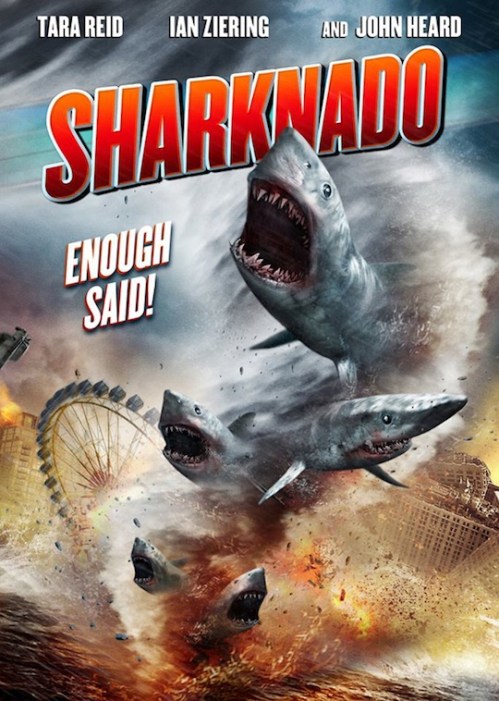
Sharknado

Sharknado
Some of us have been watching and loving the Syfy channel’s ludicrous scary animal disaster movies for years, such as

Dinocroc
Dinocroc vs. Supergator
Dinoshark
Frankenfish
Mega Piranha
Mega Python vs. Gatoroid
Mega Snake
Piranhaconda
Supergator

Then there are the newcomers who just this week discovered the film art of Syfy with the premiere of Sharknado  and have made it an entertainment sensation. If you haven’t yet heard about it, Sharknado, like many of these Syfy movies, pretty much gives away the basic concept in the title. Sharknado combines sharks and tornadoes: “When a freak hurricane swamps Los Angeles, thousands of sharks terrorize the waterlogged populace. And when the high-speed winds form tornadoes in the desert, nature’s deadliest killer rules water, land, and air.”

Soon, millions will be “experts”, comparing the performances of Debbie Gibson (as Dr. Nikki Riley) and Tiffany (as Park Ranger Terry O’Hara) in Mega Python vs. Gatoroid (2011), as well as trying to understand the symbolism of Monkee Mickey Dolenz appearing as himself in the movie.

Debbie Gibson and Tiffany

Being an early adopter of cutting edge art means learning to share with latecomers. So if you are a newbie and want to go back to the classics, be assured that any of the above are worth your attention and time.

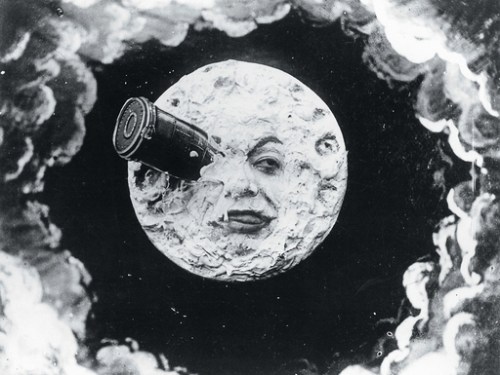
Celebrity Colony on the Moon

Melies - A Trip to the Moon
The success of Celebrity Colony on the Moon, a follow-up to NBC’s Celebrity Apprentice, is guaranteed, based on a few premises:

Celebrities are the only people able to take advantage of private space travel.
Celebrities like to increase their celebrity and to do things other people can’t.
People want to see some celebrities sent far away—even to the moon.

In Celebrity Colony on the Moon, celebrities will demonstrate their knowledge of space and science, and their ability to settle a frontier colony. People will vote based on these and other factors—including the desire to see particular celebrities housed in a lunar outpost.

Donald Trump will of course host the show. While he will not be official commander of the mission, he will travel along with the colonists. The demand to see him 238,900 miles away will be overwhelming.

It is expected that NBC will soon begin considering which celebrities might be sent to the moon, in the name of exploration and ratings. Nominations are now open.

The STR-AV1010 Is Dead, Part 2

STR-AV1010 Connections
Why does the demise of an audio component deserve even one blog post, let alone two?

Because I came across the manual for the Sony STR-AV1010 receiver (circa 1989), which manual demonstrates that tech archaeology and history is as important as any other kind, maybe more. If you don’t believe that, just look at one of my favorite tech photos of all time.
Motorola Brick
Here is a man who is implicitly the most successful, stylish and cool guy holding up the most ridiculous object to his ear, as we pretend (then) it is not. And it sort of isn’t, because he was able to do something that was until then the stuff of sci-fi. And yet it sort of is ridiculous, because, well, look at the photo.

The soon to be buried receiver (actually, it won’t be buried, instead being put in a storage closet until future science can figure out how to cure it) was, as noted in the earlier post, a wonder more than twenty years ago. Look at some of the possible connections in the above chart:

Turntable
Tape deck
VCR
DAT (Digital Audio Tape, a Sony format officially terminated in 1995)

The point? Not one really. Maybe just that we are in the river, it flows, and we swim with it, against it, and sometimes just stand in it, if we can touch bottom and it doesn’t knock us over and we drown.

The Voice Has a Big Secret

Danielle Bradbery
The Voice has a big secret, but it has always been hiding in plain sight.

It is no secret that Danielle Bradbery won NBC’s singing competition, or that she should have or would. The overwhelming talent of this 16-year-old phenom—not just compared to her competition, but to professional singers twice her age—left the coaches/judges speechless, literally running out of superlatives. The outspoken Adam Levine on the night of the final performances essentially declared her the winner, before the public votes were cast. (On the results show, he backed off before the announcement, diplomatically offering the opinion that it was close and all the finalists were great.)

Will Danielle become a star or superstar? As with winning The Voice, she should, if there is any justice. But the music business is funny and anything but just. And yet, just like in farm fysics, cream rises, and Danielle is very heavy musical cream.

Now to that secret. The point of The Voice—in its system and even in its name—was to better itself over American Idol, which in the balance between talent and entertainment has weighed heavily towards crowd pleasing and audience building. The Voice was supposed to be, and mostly is, a little more about singing. About “the voice.”

In an instance of cleverness meeting mission, The Voice decided to begin its competition by having the coaches just listen to singers—chairs turned away, not looking. Though performing is about a raft of things, singing is about sound, even at a time when videos sit in parity with audio tracks.

And so, the secret. As much as it seems antithetical to the interests of NBC, its ratings and its sponsors, we are supposed to listen to The Voice, not watch it. We are supposed to be auditors, not viewers, not distracted by the form “the voice” takes, even though that form is obviously critical to live performance and videos. Maybe that works in somebody’s favor (not having the perfect looks or stage presence) or against it (cute does not necessarily sing as cute appears). That is the precise point of the turned around chairs and blind listening.

If you just listen to the live performances and close your eyes, you’ll see. (The studio performances of the same songs, extended, sweetened, smoothed out, are only partly representative).

People have quibbled—been downright defiant—about Danielle for a host of reasons (the internet is where reasons, sound and ridiculous, go to thrive). Maybe the biggest complaint is from those who just don’t like country music, or even claim to “hate” it, which is a legitimate preference. De gustibus non est disputandum—there is no disputing taste.

But for those non-country folk, please be open to the talent, current and historic. Here is Patsy Cline, one of the great pop singers ever, performing Crazy live. or the studio version of Sweet Dreams (more arrangement, a little chorus, but still an unadorned voice in need of no help). There are “the voices” in every genre, and if you would be willing to say “I hate opera, but she sure can sing” then you have to say the say the same about country, blues, R&B, musicals, whatever. In Patsy’s case, she was one of the first to land in the country-pop crossover space, based on the sheer appeal and power of her singing.

This isn’t meant, no way, no how, to compare Danielle to Patsy. Danielle may get close someday; time will tell, but that’s a nearly impossible standard. It’s just meant to remind us that beyond stage performance and videos, beyond human interest back stories, beyond genre fragmentation and hybrids, beyond all the chazerai—a great Yiddish word meaning the insubstantial junk that surrounds important things, there is the singing.

The Voice got that right by showing us how to just listen, chairs turned, eyes closed. The Voice voters got that right by listening to Danielle Bradbery and declaring her “the voice.” It’s no secret that she is.

The Voice: “I Hate This Country”

Adam Levine - The Voice
Adam Levine is a popular musical artist with Maroon 5 and a coach on NBC’s singing competition The Voice.

Last night was an elimination round for two of the remaining eight contestants. Each of the four coaches (including Shakira, Usher and Blake Shelton) has members of their respective teams in the competition.

After the typical tense triage, three contestants remained. Only one would survive. Of those, two were from Team Adam, and one was a talented singer named Judith Hill. She may not have been destined to win, but she was a solid performer who had already had a career as a backup singer for Michael Jackson, and might yet get a chance on her own. The two other singers remaining were not in her league.

The camera was on those three as host Carson Daly pronounced the obligatory nail-biting “America has voted” spiel. In the background, you could hear a simple comment from Coach Adam, as he likely sensed that the most worthy of the three was about to be eliminated:

“I hate this country.”

Meaning, one presumes: I hate these stupid popularity contests, even one that I am a part of, where merit matters less than the judgment of numbers and the crowd. I don’t hate America, but I hate it when America speaks like this.

And then, Judith Hill was gone.

Every one of the artist-coaches has built a successful career, and knows that entertainment, like every other field, is not entirely a meritocracy. Still, even accounting for differences in taste, a few minutes of singing can reveal those with consistent control, those who can find and hit all the notes, those who can put power and style in what they sing—and those who can’t.

So Adam, and everybody else who gets frustrated by singing competitions that don’t always give us the best, or political systems that don’t either, embrace your frustration. At least it means that you haven’t given up, that you still have standards, that you still have hope and expectations that the competitions and elections will give us winners who really can sing—even if we lose some worthy ones along the way.

Speed Men

Don Draper on Speed
Definition of Phantasmagoria
1. An exhibition of optical effects and illusions
2. A constantly shifting complex succession of things seen or imagined
3. A bizarre or fantastic combination, collection, or assemblage

The latest episode of Mad Men, Crash, is not the first to involve a car crash or the use of drugs. But it does use both as a device and as prefiguring of what is down the road for Don Draper and company.

Previously on Mad Men, besides the limitless consumption of alcohol and tobacco, in this late 1960s era there has been the increasing use of marijuana, and a few LSD experiments. This time, though, the drug of choice is speed.

Chevy is the agency’s new and prized client. Ken takes the Chevy guys out for a booze-fueled night, and drunken speeding results in a crash that leave’s Ken’s leg injured. Chevy is placing impossible demands on the agency, and so a weekend of work is ahead for the creatives and the account people. A sort-of doctor is brought in to inject the senior staff with a sort-of “stimulant”—a combination of vitamins and speed.

Speed heaven and speed hell break out. People are racing each other down office aisles and over desks, playing William Tell by throwing sharpened pencils at each other, wanting sex, talking nonstop. Don has two distinctive reactions. On the mental side, he seems  on the brink of a breakdown. His mind flows back to his growing up in a whorehouse, where we learn the possible origins of his sex addiction and other problems. He loses track of time, something that has happened before.

On the creative side, he has a breakthrough, the kind that speed can convince you (often falsely) that you are having. Don is obsessed by an old agency campaign for soup that he is sure holds the key to Chevy. He ultimately finds the ad, though it is for oatmeal; the soup is from his memory of a prostitute who nursed him back to health and was his first sexual experience. The headline says, “She Knows What You Want”.

But when Don calls everybody in to announce his creative triumph, the speed speaks, pontificating that, no, he hasn’t solved the Chevy puzzle—he has solved the big puzzle of life itself.

Events in and out of the office keep spinning. The speed has apparently “cured” Ken’s injury, as he throws away his cane and starts tap dancing. Don has left his children alone in the apparent, and an older black lady who calls herself Don’s Grandma Ida breaks in, confronts Don’s daughter Sally, and steals some of Don’s watches. Sally doesn’t believe Ida is Don’s grandmother, but since Sally doesn’t really know anything about Don’s real background, anything is possible.

The speed crash comes on Monday, and it is different than any other of the post-drinking hangovers that Don has ever suffered through. We can’t tell exactly what has gone on in his head, or what combination of murky and clear is operating, or whether he has really figured anything out. But he does something he has never done before, because being creative—making things up—is what his adult life has been about. He relinquishes creating for the Chevy account, and says he will only serve as creative director, managing what others come up with.

At this point, as he has a few times before, Don is seeing that if he keeps moving the way he has, he will crash. But he thinks that if he stops moving, he is dead. Of course, Don Draper is dead, killed accidentally and indirectly in Korea by the young Dick Whitman. Just as Draper’s suicidal younger stepbrother Adam Whitman was killed indirectly by Don, as was Draper’s suicidal partner Lane Pryce.

If it doesn’t stop on its own, maybe the uncaring laws of life and physics will take over. Maybe there will be a much more serious crash.