Bob Schwartz

Category: Peace

The Day the Buddha Woke Up

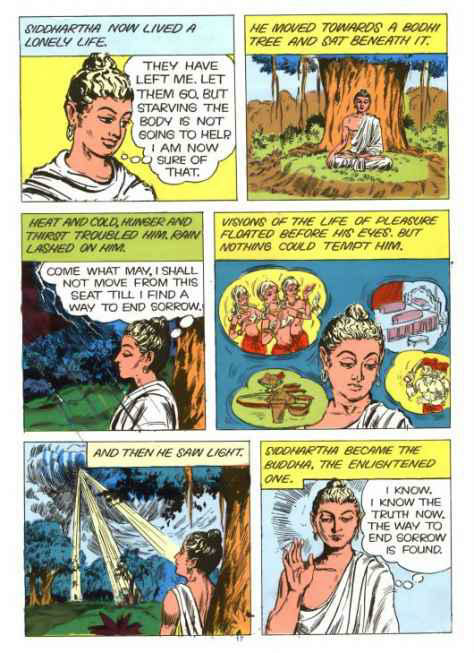
Buddha Comic Bodhi

December 8 is Bodhi Day, the day on which the Buddha’s enlightenment is traditionally celebrated.

The English word “enlightenment” is so packed with meaning that it might be better to just go back to what the Buddha is reported to have said: I am awake.

This is useful because it leads to the two questions: woke up from what and woke up to what?

The Buddha, sitting there under the Bodhi tree, woke up from a journey. Born a royal son, he had fled a life of accidental privilege to answer ultimate questions about suffering and death—the very same questions that consume religious lives of all kinds. He believed that if he tried a, b, and c (such as extreme asceticism), he would discover some secret x, y, and z. There was some kind of magic formula, and all he had to do was learn it. That sort of magic is still at the heart of much of our religion.

He woke up to discover that there was no magic, not in such an instrumental sense. Nothing was different. Suffering and death would not go away, no matter what efforts we make. The best and worst aspects of life would go on, with and without us. Great fortunes would be made and lost. Great structures would be built and then destroyed, by cataclysms natural and human. Love would be here and gone.

But this: He could see something in all of that that made sense of all of that. There is no big plan in which we are players, active or passive, though we could and do make and execute our own little plans. There are just things, relationships between those things, and change, and of all those of a singular piece. We can and do overlay that with all of our very complicated details and distinctions, which is after all a definition of the life we live. But if we discover that underlying existence, we just might choose to live differently. And in that living differently, make change and wake others up. And on and on.

None of that eliminated suffering and death for the Buddha, as it won’t for anyone. He grew old and tired and, legend has it, died from being given spoiled food. He had told his followers what he had discovered, none of which involved magic. It was all about the infinite depth of the ordinary. For him, there was no more a kingdom in the clouds than the kingdom he had left behind when he started his journey. There was just what is. Strive on with diligence, he told those followers at the last.

The Promise of and Lessons from the Hong Kong Protests

Albert Einstein Institute

The Hong Kong pro-democracy protests appear to be over—for now. The protest leaders have surrendered, and the official plan to have Beijing approve candidates for Hong Kong’s highest office remains in place. The result is disappointing but not surprising. Facing off against the world’s biggest and most powerful non-democracy is by definition quixotic.

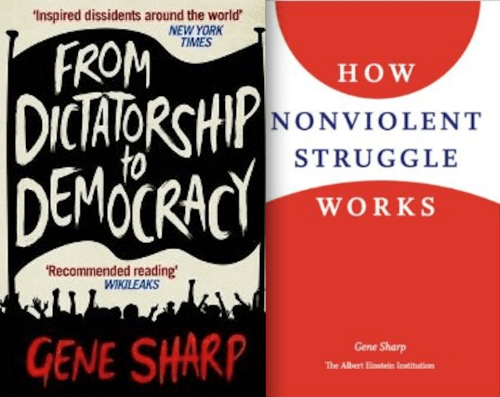
Yet for those of us in the U.S. and elsewhere who admire the thousands who engaged in this nonviolent movement, there are lessons to be learned and practiced. As pointed out here before, thinkers such as Gene Sharp at the Albert Einstein Institution have spent lifetimes mapping the path to nonviolent change. Here are a few of the lessons:

Be organized and disciplined. If you watched the news coverage of the Hong Kong events, you got to see an orderly and colorful tent city that served as a base, along with protestors carrying the symbolic (and also colorful) umbrellas, which served double-duty as a shield against police force.

Be specific. Movement goals can range in size and scope, from the ouster of a president to, as in Hong Kong, the right to select candidates for an election, as promised in an agreement. In the U.S., both the civil rights movement and the Vietnam War movement had such specific goals. In civil rights, it was piece by piece in a bigger picture: desegregation of public transport, desegregation of restaurants, voting rights, etc. Vietnam was specific and absolute: get out. The recent Occupy movements in the U.S., on the other hand, seemed to be all over the map, even when their complaints were justified. We are now seeing a bit of that in the Ferguson movement. The general discontent over the treatment of black citizens by police and justice is justified, but the power of the protests is diluted by uncertainty about what is being requested. (Possible answer: The St. Louis county prosecutor, having made an unprecedented mess of the criminal charging and grand jury process, can convene another grand jury and do it properly the next time. That’s probably as unlikely as Beijing giving in, but it would be something specific to ask for.)

Be informed. One of the other things you might notice about the Hong Kong protest is that protestors could speak knowledgeably about why they were protesting and what they wanted. Not to keep picking on our Occupy movement, but if you asked a hundred protestors about what it is they wanted, you might well have gotten a hundred different answers.

Be patient. Perseverance furthers. The U.S. civil rights movement took decades to achieve its goals, though some would argue that in fact the spirit of those goals is still far from being reached. Globally, movements for change are like the tides, in and out, high and low. Just this week, former Egyptian President Hosni Mubarek was cleared of criminal charges in the deaths of protestors at Tahrir Square four years ago. Today, in terms of democracy, Egypt looks different than but the same as it did then. Perseverance can further, but it is no guarantee. Even without certainty, though, organized, disciplined, specific, informed, patient nonviolence remains the best that can be done.

Return to the Four Freedoms

Four Freedoms

As we approach the holiday season, we might think about the big metaphorical American family gathering around the big metaphorical American table. One thing you notice, as with a lot of families and tables, is that there’s going to be a few disagreements, some pretty heated.

But at some point, in keeping with the spirit of the season, the family will be looking for common ground, those shared ideals that unite us. Unfortunately, we seem to be losing sight of those ideals because, to be honest, it isn’t always clear what they are.

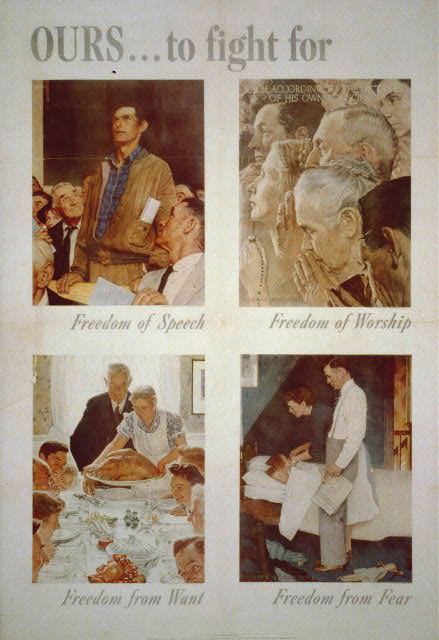
In early 1941, while war was already raging in Europe, but almost a year before Pearl Harbor, FDR gave one of the most famous speeches of the era and of American history. It was the 1941 State of the Union address, but it will always be known as the Four Freedoms speech. To bolster American support for our almost inevitable involvement in the war, he enunciated the Four Freedoms we would be fighting for: Freedom of Speech, Freedom of Worship, Freedom from Want, Freedom from Fear:

In the future days, which we seek to make secure, we look forward to a world founded upon four essential human freedoms.

The first is freedom of speech and expression — everywhere in the world.

The second is freedom of every person to worship God in his own way — everywhere in the world.

The third is freedom from want, which, translated into world terms, means economic understandings which will secure to every nation a healthy peacetime life for its inhabitants — everywhere in the world.

The fourth is freedom from fear, which, translated into world terms, means a world-wide reduction of armaments to such a point and in such a thorough fashion that no nation will be in a position to commit an act of physical aggression against any neighbor — anywhere in the world.

Art turned out to play an important role in keeping these ideals front and center, especially as the prospect of American sacrifice became a reality. The most famous example may be a series of paintings by Norman Rockwell (above), who was then and maybe still the greatest American illustrator. The Library of Congress explains:

Taken from Franklin Roosevelt’s 1941 speech to Congress, the “Four Freedoms” –Freedom of Speech, Freedom of Worship, Freedom from Want, and Freedom from Fear–became a rallying point for the United States during WWII. Artist Norman Rockwell created four vignettes to illustrate the concepts. Rockwell intended to donate the paintings to the War Department, but after receiving no response, the painter offered them to the Saturday Evening Post, where they were first published on February 20, 1943. Popular reaction was overwhelming, and more than 25,000 readers requested full-color reproductions suitable for framing.

Some will say that these Four Freedoms are today “controversial” because we don’t seem to be able as a nation—as an American family—to agree on the strategies to maintain and attain those ideals. Those disagreements are undeniable, as are the related invective, disparagement, and even hatefulness that goes with them. But those disagreements can’t make us give up. On the contrary, they should send us back to the words of FDR, getting past the ideologies and labels, and really look within and at the family of Americans.

Do you really believe that these ideals are exclusive to you, and not shared by others of good will? Are your principles and affiliations so very important that you would sacrifice those ideals to be “right?” Or can we come to the table, dig deeper, and not leave until we have given up a little of our own self-importance and focused instead on getting a little closer to the country and world envisioned in the shared Four Freedoms? And maybe just a little closer to each other?

Warriors Day

Battle of the Somme - 1916

Today is Warriors Day. We call it Veterans Day, which intentionally or inadvertently distances it from a harsher reality. It began in 1919 to commemorate the Armistice that ended World War I, the War to End All Wars.

Who is a warrior?

In broad terms, all of us are warriors of some sort, battling for causes and ideals ranging from the personal to the cosmic, and everything in between. We fight for ourselves, our families, our nation, our ideologies, our traditions.

But the warriors of Warriors Day are something very specific. These are the people we delegate to fight for us, for causes that we deem significant enough to sacrifice their safety, their bodies, their lives. Under threat, current or prospective, real or perceived, we sacrifice them and peace so that we might ultimately have peace.

What should we do?

After the fact of war, we should keep whatever promises we make to warriors—without adjustment, equivocation, or renegotiation. World War I provided one of the most egregious instances of this. World War I veterans were not to receive full payment of their service bonus until 1945. But the Depression left many of them destitute. Thousands of them marched on Washington in 1932, seeking an advance of this payment. The letter of the law dictated waiting; the spirit of their sacrifice and hardship demanded payment. The Bonus Marchers were violently dispersed, though in 1936 Congress met the demands—over FDR’s veto.

Before the fact of war, we should consider everything involved. Really consider, not just blow hard self-righteously and politically. This is easier for those who have actually been warriors, though that number is decreasing as a proportion of our population, especially among our politicians and policy makers. Those veterans may or may not be able to sort through and articulate all the issues of our most complex geopolitics ever, but they can do something home front folks can’t—relive the experience of being a warrior.

Demand truth. Truth is said to be the first casualty of war, including pre-war and post-war. Right now, for example, Obama’s talk about “advisers only” in Iraq is making some veterans, particularly those of Vietnam, shake their heads. Col. Jack Jacobs, an NBC commentator, observed this morning that his experience as an “adviser” in Vietnam inevitably involved combat.

What about peace?

Peace, the absence of conflict at all levels, may not be a possibility. But that doesn’t mean it shouldn’t be our default position, the one from which all other circumstances are an aberration. For whatever reasons, conflict seems to be the default position for some, including those in positions of power and influence. There are things worth fighting for, but before moving forward, we need to be much surer of what those things are, how we are going about the fight, and how honest we can be. Most of all, if it is someone else doing the fighting at our command, we must realize that we are totally answerable for the consequences, as uncomfortable and costly as that might turn out to be.

The News and the Wheel

The Wheel - Jerry Garcia

The wheel is turning
and you can’t slow down
You can’t let go
and you can’t hold on
You can’t go back
and you can’t stand still
If the thunder don’t get you
then the lightning will

The Wheel
Jerry Garcia

If you are still listening to, watching, or reading the news, oh boy. If the world seems out of balance, that’s not just the news talking. That’s the way it is.

Thousands of U.S. troops sent to fight Ebola. No troops but planes and bombs to fight thuggish madmen disguised as religious fanatics whose organizational name we can’t keep straight. Honored gladiators beating their wives and children. Police shooting the people they are sworn to protect. The most powerful legislature in the world doing nothing when something is called for, something when nothing is called for, and blabbering on when silence is golden. Rampant use of destructive drugs, demonizing of less destructive drugs. Speaking of drugs, powerful pharmaceuticals interrupting your entertainment with the news that they can cure you, but may also kill you, harshly and slowly. And that’s just for starters.

Every time that wheel turn round
bound to cover just a little more ground

Won’t you try just a little bit harder
Couldn’t you try just a little bit more?
Won’t you try just a little bit harder?
Couldn’t you try just a little bit more?

Breathe. If it seems like madness, that’s because it is. But it’s our madness and we just have to live with it. Being strong and smart will move us forward, but it’s never enough. Being strong and smart will not, for example, cure our madness, and like those very high-tech pharmaceutical drugs, can do more harm than good. Misplaced confidence in our strength and our brains is like putting a thumb on the scale. Which is no way to get in balance.

Ferguson and The Fire Next Time

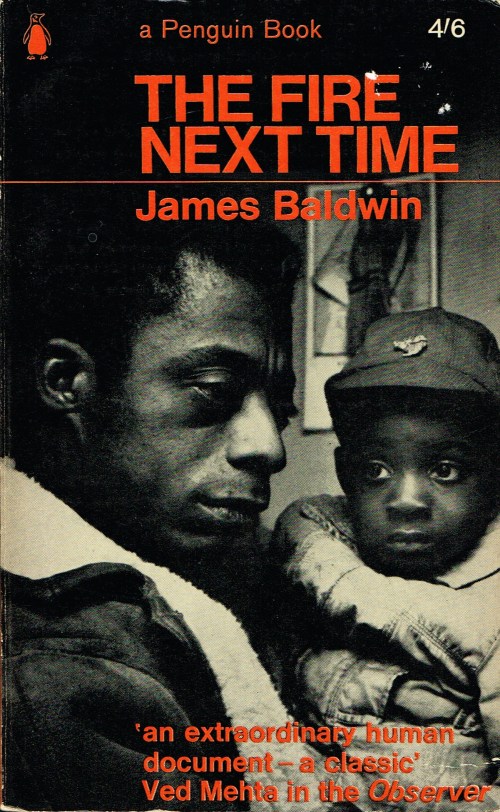
James Baldwin - The Fire Next Time

James Baldwin’s The Fire Next Time may be the best and most eloquent statement of relations between whites and blacks in America ever written. From the publisher:

The appearance of The Fire Next Time in 1963, just as the civil rights movement was exploding across the American South, galvanized the nation and continues to reverberate as perhaps the most prophetic and defining statement ever written of the continuing costs of Americans’ refusal to face their own history. It became a national bestseller, and Baldwin was featured on the cover of Time magazine. Critic Irving Howe said that The Fire Next Time achieved “heights of passionate exhortation unmatched in modern American writing.”

Baldwin was one of the great writers of his or any other American generation. He shouldered the burden of being a triple threat to America of the 1960s—a black man, a brilliant and outspoken intellectual, and gay. This he did with unequaled prose grace, and this work and others are required reading for anyone who wants or claims to be a writer.

The first of the two essays is My Dungeon Shook: Letter to My Nephew on the One Hundredth Anniversary of the Emancipation. Brief and unforgettable, it is a summary of how things are and why his teenage namesake cannot give up and in. It does no justice to this book to excerpt it; it stands as a whole that must be read—not the least of all because with the real progress we have made, we are foolish and destructive to over-measure how far we have come. But here is how the essay closes:

And if the word integration means anything, this is what it means: that we, with love, shall force our brothers to see themselves as they are, to cease fleeing from reality and begin to change it. For this is your home, my friend, do not be driven from it; great men have done great things here, and will again, and we can make America what America must become. It will be hard, James, but you come from sturdy, peasant stock, men who picked cotton and dammed rivers and built railroads, and, in the teeth of the most terrifying odds, achieved an unassailable and monumental dignity. You come from a long line of great poets, some of the greatest poets since Homer. One of them said, “The very time I thought I was lost, My dungeon shook and my chains fell off.”

You know, and I know, that the country is celebrating one hundred years of freedom one hundred years too soon. We cannot be free until they are free. God bless you, James, and Godspeed.

Your uncle,
James

The Economist on Israel: Winning the Battle, Losing the War

Economist - Israel and Gaza

If you read the biblical chronicles instead of the newspapers, you know that the Jewish homelands have lived forever from crisis to crisis. In the history of modern Israel, none of that has changed.

When you live in constant crisis, the historical topography can be indistinct—it can be hard to tell which one is bigger than another. But in Israel’s history, Independence in 1948 and the Six Day War in 1967 are epochal. The current Israel-Gaza conflict is still ongoing, but the current crisis of 2014 may join that cohort.

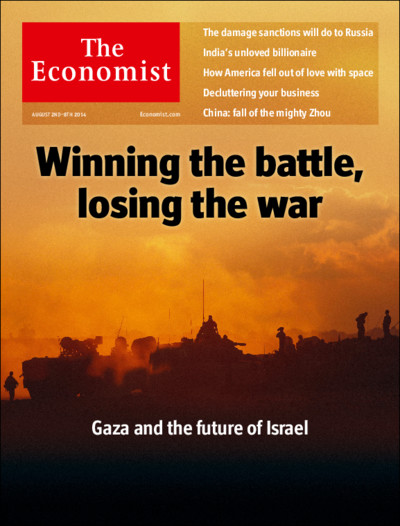
Among the thousands of pieces and millions of words generated over the past few weeks, the new cover story from The Economist, Winning the battle, losing the war is one of best and most even-handed evaluations published about the aftermath of all this.

“Even-handed” and “fair-minded” are hard to find in such a brutal and polarized controversy, and some would say they don’t exist at all. The Economist, for those who don’t know, is one of the most astute and level-headed journals of public affairs in the world. This piece, like others about contested matters, is not without embedded value judgments or opinions. It is just a sharp, worthwhile, and informed point of view that should be heard—even if it is shouted down as somehow biased and mistaken:

For all the blood and misery in Gaza, Mr Netanyahu will soon have a chance to show he has heard the critics. Having won his battle, he could return to the negotiating table, this time with a genuine offer of peace. Every true friend of Israel should press him to do so.

Haftarah for War and Peace: Isaiah

Isaiah

The Jewish scriptural calendar has two parts: a weekly reading from the Torah (the Five Books of Moses) and a weekly reading from the prophets, known as a haftarah.

Today’s reading—Isaiah 1:1-27—is possibly the most special of these haftarot. Isaiah is the most famous and read of all biblical prophets, among Jews and Christians. And today’s reading is the very first chapter of Isaiah. It was written in, about, and for the Jewish kingdoms of the 8th century BCE, which were under threat from without and within.

Whole libraries have been written explaining and interpreting Isaiah. (For those who want a very brief, very readable introduction to these readings, there is no better start than W. Gunther Plaut’s The Haftarah Commentary.) One message is that the form of faith, no matter how punctilious and properly executed, is not enough, never enough. God says:

Trample my courts no more; bringing offerings is futile; incense is an abomination to me. New moon and sabbath and calling of convocation— I cannot endure solemn assemblies with iniquity. Your new moons and your appointed festivals my soul hates; they have become a burden to me, I am weary of bearing them. When you stretch out your hands, I will hide my eyes from you; even though you make many prayers, I will not listen; your hands are full of blood. (Isaiah 1:13-16)

The passage that follows this is one of the best known in the Bible:

Wash yourselves; make yourselves clean; remove the evil of your doings from before my eyes; cease to do evil, learn to do good; seek justice, rescue the oppressed, defend the orphan, plead for the widow. (Isaiah 1:16-17)


Isaiah 1:1-27

1The vision of Isaiah son of Amoz, which he saw concerning Judah and Jerusalem in the days of Uzziah, Jotham, Ahaz, and Hezekiah, kings of Judah.

2Hear, O heavens, and listen, O earth; for the Lord has spoken: I reared children and brought them up, but they have rebelled against me. 3The ox knows its owner, and the donkey its master’s crib; but Israel does not know, my people do not understand. 4Ah, sinful nation, people laden with iniquity, offspring who do evil, children who deal corruptly, who have forsaken the Lord, who have despised the Holy One of Israel, who are utterly estranged! 5Why do you seek further beatings? Why do you continue to rebel? The whole head is sick, and the whole heart faint. 6From the sole of the foot even to the head, there is no soundness in it, but bruises and sores and bleeding wounds; they have not been drained, or bound up, or softened with oil. 7Your country lies desolate, your cities are burned with fire; in your very presence aliens devour your land; it is desolate, as overthrown by foreigners. 8And daughter Zion is left like a booth in a vineyard, like a shelter in a cucumber field, like a besieged city. 9If the Lord of hosts had not left us a few survivors, we would have been like Sodom, and become like Gomorrah.

10Hear the word of the Lord, you rulers of Sodom! Listen to the teaching of our God, you people of Gomorrah! 11What to me is the multitude of your sacrifices? says the Lord; I have had enough of burnt offerings of rams and the fat of fed beasts; I do not delight in the blood of bulls, or of lambs, or of goats. 12When you come to appear before me, who asked this from your hand? Trample my courts no more; 13bringing offerings is futile; incense is an abomination to me. New moon and sabbath and calling of convocation— I cannot endure solemn assemblies with iniquity. 14Your new moons and your appointed festivals my soul hates; they have become a burden to me, I am weary of bearing them. 15When you stretch out your hands, I will hide my eyes from you; even though you make many prayers, I will not listen; your hands are full of blood.

16Wash yourselves; make yourselves clean; remove the evil of your doings from before my eyes; cease to do evil, 17learn to do good; seek justice, rescue the oppressed, defend the orphan, plead for the widow. 18Come now, let us argue it out, says the Lord: though your sins are like scarlet, they shall be like snow; though they are red like crimson, they shall become like wool. 19If you are willing and obedient, you shall eat the good of the land; 20but if you refuse and rebel, you shall be devoured by the sword; for the mouth of the Lord has spoken.

21How the faithful city has become a whore! She that was full of justice, righteousness lodged in her— but now murderers! 22Your silver has become dross, your wine is mixed with water. 23Your princes are rebels and companions of thieves. Everyone loves a bribe and runs after gifts. They do not defend the orphan, and the widow’s cause does not come before them. 24Therefore says the Sovereign, the Lord of hosts, the Mighty One of Israel: Ah, I will pour out my wrath on my enemies, and avenge myself on my foes! 25I will turn my hand against you; I will smelt away your dross as with lye and remove all your alloy. 26And I will restore your judges as at the first, and your counselors as at the beginning. Afterward you shall be called the city of righteousness, the faithful city. 27Zion shall be redeemed by justice, and those in her who repent, by righteousness.
Slaughterhouse-Five


Kurt Vonnegut

A friend in Israel has been corresponding with me about the current mess there. He is a proud and passionate American-Israeli. In the course of the conversation, he mentioned Dresden.

I, along with millions of others, can’t think of Dresden without thinking of Kurt Vonnegut. There is some chance, if you are of a certain age, that you don’t know Dresden or Vonnegut, so here is a summary.

In February 1945, just a few months before World War II ended, the Allies firebombed the city of Dresden, Germany. Much of the city was destroyed and tens of thousands lost their lives. At the same time, Allied prisoners of war were being held by Germany in Dresden.

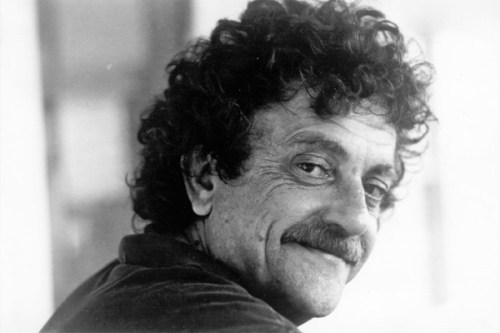
Kurt Vonnegut was one of the most interesting and original writers of the 20th century, and he influenced the cultural lives of readers throughout the 1960s and beyond. He was also one of those prisoners of war who was an eyewitness to the destruction in Dresden. He tried for more than twenty years to write about it, and finally in 1969 published his novel Slaughterhouse-Five, a title reference to the Dresden slaughterhouse in which he was held. It is a masterpiece, but not what anyone would expect a novel about the horrors of war to be like. It is, though, precisely what you might expect from Vonnegut.

The first chapter is his factual history of how he came to write this book. That chapter alone is worth reading, even if you think you don’t want or wouldn’t like the rest. In it, he recounts this conversation with a friend:

Over the years, people I’ve met have often asked me what I’m working on, and I’ve usually replied that the main thing was a book about Dresden.

I said that to Harrison Starr, the movie-maker, one time, and he raised his eyebrows and inquired, “Is it an anti-war book?”

“Yes,” I said. “I guess.”

“You know what I say to people when I hear they’re writing anti-war books?”

“No. What do you say, Harrison Starr?”

“I say, ‘Why don’t you write an anti-glacier book instead?’”

What he meant, of course, was that there would always be wars, that they were as easy to stop as glaciers. I believe that, too.

And even if wars didn’t keep coming like glaciers, there would still be plain old death.

Please read Slaughterhouse-Five (and more Vonnegut if you are so moved). You will be glad you did.

Suit and Tie: The Sad and Silly Syrian Election

Syrian President Assad Votes

It is reported that President Bashar al-Assad wore a dark suit and light blue tie for voting in today’s Syrian election. Good reporting. He looked good. So did his wife Asma.

Assad actually had opponents, the first time Syria has had a contested presidential election in fifty years. No one could think that this opposition meant anything. The other candidates could not think so. And yet there were supporters and voters at the polls, maybe out of fear, maybe out of hope, maybe just wanting to pretend things are normal. Some new normal, so that with one more term, a few more years added to his enlightened regime, there would be no more deaths after the 160,000, no more displaced and refugees after the millions.

Journalists and other nations are sworn by a sense of fairness and professionalism and diplomacy and sovereignty to pretend that this is an election, even if they have some quibbles. They might, if they had a better sense of irony or humor, treat it like Halloween or Mardi Gras. An occasion on which one dresses up to play the part of something you are not, say, a democratically elected leader in dark suit and light blue tie.

The U.S. also had an election during a civil war. Lincoln did have opposition and he did win. Whatever he wore when he voted, he certainly didn’t look as slick as Assad, nor was Mary Todd as socialite beautiful as Asma. By that point Lincoln was deeply tired and sick of the horrible conflict and would do anything he could to finally end it. The good news is that there would be only a few more months of war. The not so good news is that even with the good that came, it would take decades for the wounds to begin healing. The worst news, for Lincoln and the country, is that he would soon be assassinated.

Lincoln and the civil war were sad but never silly. Assad, in his dark suit and light blue tie, within this hollow semblance of an election, is sad and morbidly silly. Unlike Lincoln, he may be around for years, continuing to rack up votes and deaths. But looking real good.