Bob Schwartz

Category: Peace

Defeating ISIS: Lessons from the American and Israeli Wars of Independence

We can’t “defeat” ISIS. Not if that means declaring “victory” over Middle East-based Muslim radicalism and terror.

There are lessons from the American and Israeli Wars of Independence. This isn’t to suggest any moral equivalence comparing those world-changing events to the monstrosity of ISIS. But there are things to learn.

Both Wars of Independence were attempts to upend empire and established order and create a new model (both uprisings, not coincidentally, involving the British). Both were insurgencies by True Believers, one political and economic, one religious. Both are examples of the power of the heart, because the heart not only wants what the heart wants, it will do anything to get what the heart wants. True belief will find a way.

The British thought that their massive and formal force would roll right over the Americans. They did not count on all sorts of stealthy and tricky techniques, on secret communications, on a guerilla war. Mostly, the British didn’t account for the depth of American commitment: hearts and minds and souls. It may not always work that way, but competitions often go, simply, to the side that just wants it more. And that would be the Americans.

The British were never quite sure what they were doing in Palestine. But they did know something about world order and keeping order. Besides, some Brits didn’t much like the Jews anyway. The Zionists believed, literally, that they had God on their side. As far as hearts and minds and souls getting what they want, doing anything to win did mean the occasional act of terror (for example, the 1946 bombing of the King David Hotel in Jerusalem, leaving 96 dead). As far as who wanted it more, the founders of the modern Jewish state not only defeated the British, but turned back all attempts by hate-fueled neighbors to root them out.

In the aftermath of Paris, just as with 9/11 and other recent terrible events, if we keep talking simplistically about “defeating”, “eliminating” or “building American-style democracy”, we are—there’s no other way to say this—fools. We should eliminate and prevent horror, terror and monstrosity wherever and whenever we can. But if we think that the toxic mixture of true belief, grievance and pathology is just going to vanish because we are purer and more powerful, that would be funny if it weren’t so sad and dangerous.

If you don’t think that hearts, minds and souls matter when it comes to extremism, just look at the sorry record of irresolute and wasteful wars when we ignore that. We may feel righteous and superior, and want to vindicate civilization. But that doesn’t relieve us of the responsibility to be smart. Smart about what we face, what we can accomplish and how to accomplish it. So we can do some good, and do less harm.

The I Ching of Paris

Hexagrams 44 and 29

Question for the I Ching (using the coin method of consultation): How do we deal with the events in Paris?

The I Ching replies:

Hexagram 44 – Gou (Encountering, Coming to Meet)
Heaven above, Wind below.
Changing lines in the third, fourth and top place.

Changes to:

Hexagram 29 – Kan (Water, Darkness, The Abysmal)
Water above, Water below.

Excerpts from two leading translations:

The Complete I Ching
Alfred Huang

Hexagram 44 – Gou

The structure of the gua [hexagram] is Heaven above, Wind below. The wind blows everywhere under Heaven, encountering every being. It should be an auspicious gua. However, there is only one yielding line beneath five solid lines, symbolizing that the yin element is advancing and approaching the yang elements. When King Wen saw this happening, he heightened his vigilance. He realized that an unworthy person was worming his way into favor at the court. The growing negative influences would displace good people one after another. Darkness and difficulties had been eliminated, but their negative influences had not totally faded. These influences were permeating different areas. One must beware of this tendency and take prompt precautions against possible misfortune. Thus King Wen’s Decision and the Duke of Zhou’s Yao Text are full of warnings. But Confucius’s commentaries still shed light on the positive side.

This gua discusses the principle of encountering. In Chinese, meeting a person (or anything) unexpectedly is defined as encountering. When people encounter each other, either they are attracted, making adjustment for a harmonious relationship, or they reject each other, creating conflict between them. In human life sometimes one cannot refrain from misunderstanding and conflict. But one should not indulge in it and think that conflict is unavoidable and cannot be resolved. The ancient sages advocated adopting a conciliatory attitude. Here one yin element approaches five yang elements. She dares to come forward because her strength grows stronger. In this situation, one should not overlook taking preventive measures.

King Wen’s strategy of eliminating evil forces was to show no animosity but to act without tolerance. His administration constrained evil elements like tying up rams. But evil elements still wormed themselves into the favor of the court. King Wen realized that the evil forces had been eliminated, yet their influence had not totally faded. His analogy was that the maiden was too strong; it was not good to marry such a woman. The Duke of Zhou describes the evil forces as waiting to move forward like a lean pig. They should be stopped as if fastened with a metal brake. It is wise to restrain their influence by not letting them influence other people, but it was wiser to influence people with positive virtue.

[Changes to:]

Hexagram 29 – Kan

The central theme of this gua is: falling but not drowned; in danger but not lost. Maintain your confidence: soothe your mind. With assurance and faith, caution and trust, you can pass through any difficult situation. Both Abysmal and Abyss carry the sense of being bottomless. Kan is a pit, but it is not bottomless. There is hope.

Darkness represents not only a pit but also a situation of difficulty or danger. The structure of this gua is a doubling of the primary gua, Water. The image of Water is a yang line plunging between two yin lines, like running water flowing along and between the banks of a river. In ancient times, crossing a river represented a great danger. Thus, the attribute of Water was designated a situation of difficulty or danger. Here, Water is doubled, suggesting that one is plunging into a situation fraught with difficulties or danger. However, the ancient Chinese believed that no matter how dangerous or dark a situation was, if one was able to follow the way of Heaven, one could pass through it as safely as water passes through a ravine.

Water flows on twice over,
Darkness is doubled.
In correspondence with this,
The superior person cultivates and practices virtue constantly
And responds through teaching.


The I Ching
Wilhelm/Baynes

Hexagram 44 – Kou

This hexagram indicates a situation in which the principle of darkness, after having been eliminated, furtively and unexpectedly obtrudes again from within and below. Of its own accord the female principle comes to meet the male. It is an unfavorable and dangerous situation, and we must understand and promptly prevent the possible consequences.

The inferior man rises only because the superior man does not regard him as dangerous and so lends him power. If he were resisted from the first, he could never gain influence.
The time of COMING TO MEET is important in still another way. Although as a general rule the weak should not come to meet the strong, there are times when this has great significance. When heaven and earth come to meet each other, all creatures prosper; when a prince and his official come to meet each other, the world is put in order. It is necessary for elements predestined to be joined and mutually dependent to come to meet one another halfway. But the coming together must be free of dishonest ulterior motives, otherwise harm will result.

[Changes to:]

Hexagram 29 – K’an

In man’s world K’an represents the heart, the soul locked up within the body, the principle of light inclosed in the dark—that is, reason. The name of the hexagram, because the trigram is doubled, has the additional meaning, “repetition of danger.” Thus the hexagram is intended to designate an objective situation to which one must become accustomed, not a subjective attitude. For danger due to a subjective attitude means either foolhardiness or guile. Hence too a ravine is used to symbolize danger; it is a situation in which a man is in the same pass as the water in a ravine, and, like the water, he can escape if he behaves correctly.

Through repetition of danger we grow accustomed to it. Water sets the example for the right conduct under such circumstances. It flows on and on, and merely fills up all the places through which it flows; it does not shrink from any dangerous spot nor from any plunge, and nothing can make it lose its own essential nature. It remains true to itself under all conditions. Thus likewise, if one is sincere when confronted with difficulties, the heart can penetrate the meaning of the situation. And once we have gained inner mastery of a problem, it will come about naturally that the action we take will succeed. In danger all that counts is really carrying out all that has to be done—thoroughness—and going forward, in order not to perish through tarrying in the danger.

Properly used, danger can have an important meaning as a protective measure. Thus heaven has its perilous height protecting it against every attempt at invasion, and earth has its mountains and bodies of water, separating countries by their dangers. Thus also rulers make use of danger to protect themselves against attacks from without and against turmoil within.

If You’re Tired of Hearing About the Vietnam War, Tell Our Leaders to Stop Reenacting It

This weekend, an administration official tried to explain in an interview what exactly we are now doing in Iraq and Syria. It was like a ghost or the walking dead, sounding eerily and unhappily exactly like the rhetoric that was rolled out in the middle days of the Vietnam War.

There are roughly three groups about Vietnam: those who lived through it on the home front, those who lived through it (or not) in battle, and a generation or more that is so tired of hearing about a war that ended forty years ago. So tired of it. Can’t you all ever get over it?

Too bad. No, we should never “get over” Vietnam, no matter how many generations pass, and no matter how tired those generations are about the lessons we might learn. Vietnam was the first truly modern war of the media age and of the post-national era.

In media terms, it offered the best possibility up to that time to say positive stuff about a complex war policy, have it widely broadcast (though not as widely as digital today), and have the media endorse it and people believe it. Okay, that does sound like a description of what happened in Iraq, but that just proves the point.

As far as post-national warfare, Vietnam was technically a civil war, but it was obviously something else too. There was an army of North Vietnam, but there were also indigenous forces and a people’s movement trying to upset an unacceptable status quo, which we supported and ultimately defended. For a while. Until there was no more government of South Vietnam. And then it became a matter of just not losing. Which we did.

Another parallel is not paying attention to history, our own and that of others. The French abandoned Indochina, but that was supposedly just because they were, well, French. Americans know and are better than that. Just as in Afghanistan, where the Soviets abandoned their war, but that was supposedly because, well, they were Commies. Freedom loving Americans know and are better.

Which brings us back round to Iraq and Syria today. If you make the effort, you could go back to the LBJ days of Vietnam and hear exactly the same words that were spoken this weekend. Not just something like it, but exactly. Such as: it’s their fight, not ours.

There are things worth fighting for on the world stage, even when it is not on our homeland. But it is hard enough to figure out what those things are, and even harder to commit ourselves and our loved ones to the fight, when we are swimming in a sea of official stuff and nonsense. We want the brutal truth, if our leaders can tell it, especially when it is bound to be a brutal and long fight.

No Refugees in the Democratic Debate

Adding insult to their injury, Syrian refugees were missing from last week’s Democratic debate.

There were some other important issues mentioned, often presented in sound bites, but many more conspicuous by their absence. But you would think the party that considers itself the more progressive, caring, humane and globally sensitive would take the opportunity to at least mention to the 15 million viewers that we are experiencing one of the biggest humanitarian crises since the end of World War II. The same goes, maybe goes double, for the individual candidates who had the floor and could have just once brought it up.

(Note: Jim Webb did raise refugees while talking about his wife, who is a refugee from Vietnam. But that was not in the context of the current crisis.)

The explanation of this is simple and typical, though not particularly happy. Raising questions you can’t answer, or can’t answer with some vague, equivocal, pointless comment is to be avoided. Either voters will realize that you have no answer, or if you do answer from your conscience and heart, you just might lose votes. Either way, as a candidate, you’re screwed.

This isn’t a Democratic purview. When Republicans get together in their overstuffed debate scrum, there isn’t much to be said about the refugee crisis, except that it is an obvious ruse to allow Islamic terrorists to enter our country. It does seem like an elaborate scheme—displacing millions of men, women, and children just to get a chance to disrupt American stability—but you know how tricky those people can be.

And so, the next time a Democratic candidate wants to tell one of those rise from adversity stories that is a sure fire way to seem human and humane, maybe he or she can mention the shared and horrific adversity that won’t just go away—even if he or she has some magic plan to “fix” Syria (which he or she doesn’t). Maybe the next time, at the podium or on a debate stage. Those refugees will certainly still be there, in an increasing hell on earth.

Afghanistan Without End. Amen.

It is time to stop expecting American leadership in either party, at any level, to reasonably articulate an achievable goal in Afghanistan. Either the conclusion they’ve reached is that there is none or it is too hard to tell us the inconvenient truth they have concluded.

So we are just going to have to take on the role of citizen policy analysts and do it ourselves.

We are unlikely to ever help establish an Afghan military capable or willing to hold back whatever insurgent force mortally threatens stability and national integrity.

We are unlikely to see the establishment of a stable semi-permanent semi-democracy in Afghanistan.

We are never going to “defeat” the Taliban or other similar threats in Afghanistan, in the sense of forever eliminating and precluding such evil developments.

That leaves one possibility. We are keeping troops in Afghanistan to help keep things from getting worse.

It’s a problem to admit that. First, because a military mission of stopping things from getting worse seems unending, which it well might be. Entropy tells us that things fall apart naturally unless acted upon otherwise. In Afghanistan that otherwise is us. It’s also hard to tell those who serve that the point of their sacrifice is to keep things from getting worse, rather than seeing a genuinely better future and having a defined endpoint.

But at least it would be honest. And on top of the war without end, that is an equally big problem. From the Vietnam War to today, there has been a lot of official and political obfuscation. Well, let’s call it lying. It isn’t that the policy makers don’t have noble principles in mind, such as freedom, self-determination, and the like. It’s just that the plans they put in place—very expensive plans—have practically no chance of fulfilling any of those principles.

Collateral Damage in Afghanistan

In the vocabulary of war, no term is darker or more chilling than “collateral damage.”

There was last week collateral damage in our war in Afghanistan, where a Doctors Without Borders hospital was the target of aggressive American airstrikes. A number were killed and injured, including children, and the hospital was destroyed.

The few facts, besides the destruction, are these.

Collateral damage is unavoidable, though it can and should be minimized.

The Taliban has overtaken the area, though not the hospital.

We are engaged in supporting the Afghan fight against the Taliban, by, for example, air strikes.

Hospital personnel contacted the U.S. military after the barrage began, but it continued anyway.

Now for the rest of the story, which the Pentagon tried to correct this morning.

Early reports were that the U.S. itself called for the air strikes.

Not so, says the Pentagon. It was the Afghans who identified the target as a Taliban position, and then we conducted the airstrikes.

Don’t you see the difference? The difference, of course, being some sort of operational and moral distinction, being entirely responsible for a tragic and avoidable error versus being only mostly responsible for a tragic and avoidable error. Now we see.

It isn’t really about the particulars anyway. It’s about the need for unceasing realization that if you choose war, you choose its worst impacts. The calculus can’t just include the big win and big benefits—assuming there are any—so that those cancel out the ill you do. It doesn’t work that way. So when and if we choose war, it is never illegitimate to keep the costs constantly in mind. In fact, it is always immoral and ill-advised not to.

Otherwise, you might end up with millions of underserved and nearly abandoned veterans. Or a badly damaged economy. Or a dispirited and skeptical nation. Or some of the world’s most selfless health workers in one of the world’s most needy countries watching as their patients and their hospital die and burn.

For Me To Be A Saint Means To Be Myself: Thomas Merton and Pope Francis

Thomas Merton

In his speech to Congress, Pope Francis put Thomas Merton back in the public light, where he has long belonged as an American spiritual master:

A century ago, at the beginning of the Great War, which Pope Benedict XV termed a “pointless slaughter”, another notable American was born: the Cistercian monk Thomas Merton. He remains a source of spiritual inspiration and a guide for many people. In his autobiography he wrote: “I came into the world. Free by nature, in the image of God, I was nevertheless the prisoner of my own violence and my own selfishness, in the image of the world into which I was born. That world was the picture of Hell, full of men like myself, loving God, and yet hating him; born to love him, living instead in fear of hopeless self-contradictory hungers”. Merton was above all a man of prayer, a thinker who challenged the certitudes of his time and opened new horizons for souls and for the Church. He was also a man of dialogue, a promoter of peace between peoples and religions.

Pope Francis, like Merton, is a natural. One of those players who finds their game and becomes a star because their nature brought them to it. This doesn’t mean there aren’t struggles on the way to greatness. On the contrary, the unceasing struggles are an essential part of their nature. At first we may be inspired by the worthy message and outward model. But ultimately, when we explore them, it is the dimensions and shading we come to admire. A child’s drawing is all black and white, a simple sketch. A master drafts with subtle and powerful lines and shadows, in which we see so much depth.

The Pope’s regard and mention of Merton in his speech to Congress is also natural. Merton chose to be a cloistered monk, then rebelled against his voluntary and self-imposed discipline. The demands of quiet and obedience to authority clashed with the imperative of a great writer freely writing and a great thinker freely thinking. Not gratuitous and loose writing and thought. Always guided by a compass that pointed both higher and back to an inescapable benevolent source, always grounded in the reality of daily life, strong and weak. That sort of creative independence in calling seems to mark Pope Francis too.

Merton died in 1968, almost exactly a year before Pope Francis was ordained. To say they would have loved to have met is understatement. Like many of us, Pope Francis met Merton in countless books, by and about him. In those writings, we learn that Merton was a mystic and a man. What else are saints anyway? “For me to be a saint is to be myself,” Merton said. We can’t be our better self without being our truer self, our littler self and our bigger self. No divine without human, the most and best human possible. It’s all about love and awareness. So Merton lived and wrote. So Pope Francis echoes in his life and his messages.

If you want to learn more about Merton, see The Thomas Merton Center. Among the overwhelming list of books, consider starting small with these:

Thomas Merton: Essential Writings

Love and Living, a collection of essays from the later days of his life.

An excerpt from Learning to Live, the first essay in Love and Living:

What I am saying is this: the score is not what matters. Life does not have to be regarded as a game in which scores are kept and somebody wins. If you are too intent on winning, you will never enjoy playing. If you are too obsessed with success, you will forget to live. If you have learned only how to be a success, your life has probably been wasted. If a university concentrates on producing successful people, it is lamentably failing in its obligation to society and to the students themselves…

The least of the work of learning is done in classrooms. I can remember scores of incidents, remarks, happenings, encounters that took place all over the campus and sometimes far from the campus: small bursts of light that pointed out my way in the dark of my own identity. For instance, Mark Van Doren saying to me as we crossed Amsterdam Avenue: “Well, if you have a vocation to the monastic life, it will not be possible for you to decide not to enter” (or words to that effect). I grasped at once the existential truth of this statement.

One other scene, much later on. A room in Butler Hall, overlooking some campus buildings. Daisetz Suzuki, with his great bushy eyebrows and the hearing aid that aids nothing. Mihoko, his beautiful secretary, has to repeat everything. She is making tea. Tea ceremony, but a most unconventional one, for there are no rites and no rules. I drink my tea as reverently and attentively as I can. She goes into the other room. Suzuki, as if waiting for her to go, hastily picks up his cup and drains it.

It was at once as if nothing at all had happened and as if the roof had flown off the building. But in reality nothing had happened. A very very old deaf Zen man with bushy eyebrows had drunk a cup of tea, as though with the complete wakefulness of a child and as though at the same time declaring with utter finality: “This is not important!”

The function of a university is to teach a man how to drink tea, not because anything is important, but because it is usual to drink tea, or, for that matter, anything else under the sun. And whatever you do, every act, however small, can teach you everything—provided you see who it is that is acting.

Hiroshima: The Year 70 AH and I Ching Heaven

Flag of Hiroshima City

How special is the atomic bomb? So special that many nations want one, many nations have more than one, and yet despite how crazy and desperate some nations have been in the past decades, only one nation has ever used one. A hoarded treasure so dark that it is displayed and demonstrated but not deployed.

So special that it should be the zero of a standard human calendar. Just as Jews measure time from the creation of the world, Christians from the birth of Jesus, Muslims from the hijra from Mecca to Medina, we might all measure time from August 6, 1945.

The U.S. did drop atomic bombs. Twice in three days (August 6 on Hiroshima, August 9 on Nagasaki). And divided history in half, before and after. Before, things might be brutal, tens of millions might be slaughtered, but it would take superhuman effort, and would be followed by an opportunity, however arduous, to rebuild and repopulate. After, in these times, our times, there is a theoretical prospect of erasing some, most, or all of the world and its people. Not easily, but not that hard either, leaving behind a wasteland the size of a city or country or continent.

Above is a picture of the Hiroshima municipal flag, adopted by the city in 1896, almost fifty years before the weapon that destroyed and damaged so many lives. Historians still debate the effect and necessity of the Bomb in hastening the end of the war with Japan, an argument heightened when talking about the second bomb.

On this 70th anniversary, 70 After Hiroshima, let us focus on the flag.

Brief research doesn’t reveal much about the flag’s design. But students of Asian culture might see in it one of the eight I Ching trigrams, since the Chinese oracle has been widely used across Asian nations for thousands of years.

This particular trigram, composed of three unbroken lines, is Qian. When doubled it forms Hexagram 1 of the I Ching, also known as Qian. Heaven. The Creative. Sublime success.

I Ching Hexagram 1

 
John Minford explains in his recent translation:

Heaven above Heaven. Pure Yang. This is the first of eight Hexagrams formed by doubling a Trigram of the same Name. The word chosen for the Trigram/Hexagram Name, Qian, whatever its original meaning may have been (and there are many understandings of this), came in later times to be used more and more as a shorthand for Heaven, emblem of Yang Energy and Creativity.

The classic Wilhelm/Baynes translation notes:

The first hexagram is made up of six unbroken lines. These unbroken lines stand for the primal power, which is lightgiving, active, strong, and of the spirit. The hexagram is consistently strong in character, and since it is without weakness, its essence is power or energy. Its image is heaven. Its energy is represented as unrestricted by any fixed conditions in space and is therefore conceived of as motion. Time is regarded as the basis of this motion. Thus the hexagram includes also the power of time and the power of persisting in time, that is, duration.

The power represented by the hexagram is to be interpreted in a dual sense—in terms of its action on the universe and of its action on the world of men. In relation to the universe, the hexagram expresses the strong, creative action of the Deity. In relation to the human world, it denotes the creative action of the holy man or sage, of the ruler or leader of men, who through his power awakens and develops their higher nature.

THE JUDGMENT

THE CREATIVE works sublime success,
Furthering through perseverance.

We have come a long way in 70 years, and whether or not that trajectory is to everyone’s liking, here we are. That we have managed not to drop any more nuclear bombs or fire any nuclear missiles might be a miracle, or might just be a sign of self-interest in survival coming before everything else.

That we did drop those bombs was a high price to pay for learning just how much damage the “good guys” were capable of and might feel compelled to perpetrate when dire circumstances seemed to call for it. It’s a lesson in self-awareness that we are still learning, more or less studiously. It’s a lesson that the traditions try to help us with. The devil, for example, is not an arm’s length third party who bargains and cajoles. The devil is in us, and handling it is one of our missions. The I Ching is clear on the fluid dynamics of our lives and the world, knowing that we and it flow this way and that, and heaven can be hell for a while, maybe deep and for a long while, but not forever.

Independence Day and STEM Democracy

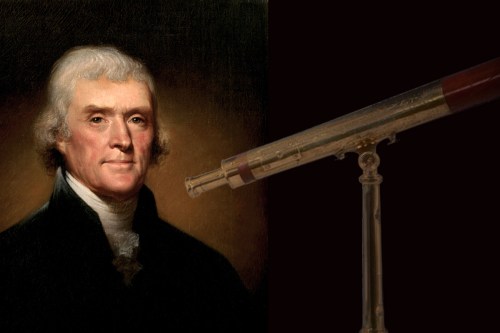
Thomas Jefferson with Telescope

Is the increasing hegemony of STEM education dangerous to the future of American democracy?

In Science and the Founding Fathers: Science in the Political Thought of Thomas Jefferson, Benjamin Franklin, John Adams, and James Madison, Professor I. Bernard Cohen might see it otherwise. As one of the most eminent historians of science, he makes the case that the familiarity of some Founding Fathers with science inspired the new nation, and that the shape of the new democracy was directly based on scientific principles.

One review notes about Professor Cohen’s theory:

The Declaration of Independence, which he [Jefferson] wrote, reverberates with echoes of Newtonian science, as when he invokes “self-evident” truths or “laws of nature.” Benjamin Franklin, far from being a mere tinkerer or inventor, pioneered the science of electricity. Franklin also developed a demographic theory that North America would become a population center of the British world; this led to the policy according to which the British annexed Canada rather than Guadeloupe as the spoils in the war against the French (1754-63). John Adams, who studied astronomy and physics at Harvard, was a founder of the American Academy of Arts and Sciences in Boston. And James Madison, a devoted amateur scientist, drew on scientific metaphors and analogies in his Federalist articles.

Maybe. But in fact, most of those in Philadelphia for the Continental Congress from which the Declaration of Independence emerged were not scientists or even science fans. And even those whose philosophy was shaped in part by science enjoyed a much broader education, one that gave complete dimension to their thinking, what we now call liberal arts. So that while the intriguing questions that Professor Cohen raises are significant, so is the parallel question: If the Continental Congress had been mostly or entirely filled with 18th century scientists, just what kind of Declaration would have been produced, and more broadly, what kind of nation would we be?

Nowhere can the nexus of Big Science and Big Political Philosophy be better seen than in Richard Rhodes’ magnificent book The Making of the Atomic Bomb. It is sort of a fun house mirror of what Cohen claims for the American founding. Rather than world-changing political thinkers with a scientific bent, we have equally historic scientists with a worldly and philosophical bent. They had been educated in the early 20th century, many in Europe, and the standard for education then and there was broad learning beyond the laboratory. In the end, their science was driven by the realities of World War II and Hitler, but that did not stop them from philosophical ponderings and quandaries about the work they were doing and its ultimate impact.

So, yes, it may be that science did help give us what by all measures is a remarkably robust and resilient democracy, starting with the rousing rhetoric of the Declaration of Independence. And we should educate scientists, to make progress and to advance the liberty, peace, and security we want. But we should also have many other thinkers, scientists or otherwise, who are capable of leading and having enlightening debates about exactly what we do need and want, and about the means we choose to get there, and about where it might lead. We do need scientists, technologists, engineers, and mathematicians. But it is never enough, not nearly enough, at least not in this democracy.

Admonishing Others

Teachings of the Buddha

I found this tiny advice in the small and excellent collection Teachings of the Buddha from Shambhala Publications. These words are now required reading for me every day:

ONE who is about to admonish another must realize within herself or himself five qualities before doing so. [He or she must intend] thus:

“In due season will I speak, not out of season. In truth will I speak, not in falsehood. Gently will I speak, not harshly. To one’s profit will I speak, not to one’s loss. With kindly intent will I speak, not in anger.”

Adapted from the VINAYA PITAKA,
Translated by F. L. Woodward