Bob Schwartz

Category: Holidays

The Hanukkah Guest: A Story from Rabbi Nachman of Bratslav

“Now, when you bring your thoughts to Paradise, you are there, on that holy mountain. But when your thoughts return to this world, you will find yourself here once again.”

The Hanukkah Guest, a story from Reb Nachman of Bratslav, retold by Howard Schwartz in A Palace of Pearls:

On the first night of Hanukkah, a poor man, who lived alone, chanted the Hanukkah blessings and lit the Hanukkah candle. He gazed at the candle for a long moment, and then there was a knock at the door. When he opened it, he saw a stranger standing there, and he invited him in. They began to discuss things, as people do, and the guest asked the man how he supported himself. The man explained that he spent his days studying Torah, and that he was supported by others, and didn’t have an income of his own. After a while, their talk became more intimate, and the man told the guest that he was striving to reach a higher level of holiness. The guest suggested that they study Torah together. And when the man discovered how profound were the guest’s insights, he started to wonder if he were a human being or an angel. He began to address the guest as Rabbi.

Time flew by, and the man felt as if he had learned more in that one night than in all the other years he had studied. All at once the guest said that he had to leave, and the man asked him how far he should accompany him. The guest replied, “Past the door.” So the man followed the guest out the door, and the guest embraced him, as if to say goodbye, but then he began to fly, with the man clinging to him. The man was shivering, and when the guest saw this, he gave him a garment that not only warmed him, but, as soon as he put it on, he found himself back in his house, seated at the table, enjoying a fine meal. At the same time, he saw that he was flying.

The guest brought him to a valley between two mountains. There he found a book with illustrations of vessels, and inside the vessels there were letters. And the man understood that with those letters it was possible to create new vessels. The man was taken with a powerful desire to study that book. But when he looked up for an instant, he found himself back in his house. Then, when he turned back to the book, he found himself in the valley once more. The guest, whoever he was, was gone. The man, feeling confident, decided to climb up the mountain. When he reached the summit, he saw a golden tree with golden branches. From the branches hung vessels like those illustrated in the book. The man wanted to pick one of those vessels, as one picks fruit from a tree, but as soon as he reached for one, he found himself back in his house, and there was a knock at the door. He opened the door and saw it was the mysterious guest, and he pleaded with him to come in. The guest replied, “I don’t have time, for I am on my way to you.” The man was perplexed, and asked the guest to explain what he meant. The guest said, “When you agreed to accompany me beyond the door, I gave your neshamah, your highest earthly soul, a garment from Paradise. Now, when you bring your thoughts to Paradise, you are there, on that holy mountain. But when your thoughts return to this world, you will find yourself here once again.” And that is how it remained for the rest of that man’s life, and the story has still not come to an end.

Hanukkah: Joy Comes with the Morning

Reading Psalm 30 is a Hanukkah tradition. Not nearly as well-known or widely practiced as lighting the Hanukkah candles, eating fried foods (latkes and donuts) and playing dreidel, but just as essential.

Psalm 30 contains one of the most uplifting of all biblical verses. The sometimes perplexing Hebrew leads to a variety of English translations, but it is best known this way:

Weeping may linger for the night,
but joy comes with the morning.
Psalm 30:5

Prof. Marc Zvi Brettler explains the connection between Psalm 30 and Hanukkah:

Jewish custom mandates that a psalm be recited for each weekday, and a special psalm for each festival. This custom goes back at least to late rabbinic times, as recorded in the post-Talmudic Tractate Soferim (ch. 18), where Psalm 30 is associated with Chanukah. Ostensibly, the psalm was chosen because the superscription, מזמור שיר חנכת הבית לדוד, refers to the dedication (chanukah) of the temple.

Traditionally, the superscription refers to the dedication of the First Temple, Solomon’s Temple, though some scholars connect it to the dedication of the Second Temple (some psalms are clearly Second Temple in origin). Thus, the connection between Psalm 30 and Chanukah would be a loose one, but the best the rabbis could find—after all, Chanukah occurred in 164 B.C.E., hundreds of years after the dedication of the Second Temple in 515 BCE. Thus, the psalm cannot be referring to Chanukah … or can it?

In fact, I, along with many other biblical scholars, believe that the superscription to Psalm 30 does not refer to the dedication of the Temple (first or second) but literally refers to Chanukah….

A number of points connect this psalm and the Maccabean uprising. First, the psalm describes overcoming, at great odds, enemies—an apt description of the Maccabean experience and the exact situation that led up to Chanukah. In addition, the psalm mentions chasidim (v. 5). The NJPS translates this phrase properly as the “faithful,” the typical meaning of this term in early psalms. Yet we know from both 1 and 2 Maccabees that in the second century B.C.E. a group or party developed, associated with the Maccabees, who called themselves Chasidim, as reflected in the Greek term asidaioi.

In other words, it is possible that someone (on the winning side) after the Hasmonean victory in 164 BCE could have read Psalm 30 and imagined: “David prophesized this about us!” The psalm, for that very reason, may even have been recited as part of the dedication ceremony on Chanukah in 164 BCE since it was seen as broadly appropriate—or even prophetic—to what had happened.

What does Psalm 30 say? In The Jewish Study Bible translation:

Psalm 30

1 A psalm of David. A song for the dedication of the House.
2 I extol You, O Lord,
for You have lifted me up,
and not let my enemies rejoice over me.
3 O Lord, my God,
I cried out to You,
and You healed me.
4 O Lord, You brought me up from Sheol,
preserved me from going down into the Pit.

5 O you faithful of the Lord, sing to Him,
and praise His holy name.
6 For He is angry but a moment,
and when He is pleased there is life.
One may lie down weeping at nightfall;
but at dawn there are shouts of joy.

7 When I was untroubled,
I thought, “I shall never be shaken,”
8 for You, O Lord, when You were pleased,
made [me] firm as a mighty mountain.
When You hid Your face,
I was terrified.
9 I called to You, O Lord;
to my Lord I made appeal,
10 “What is to be gained from my death,
from my descent into the Pit?
Can dust praise You?
Can it declare Your faithfulness?
11 Hear, O Lord, and have mercy on me;
O Lord, be my help!”
12 You turned my lament into dancing,
you undid my sackcloth and girded me with joy,
13 that [my] whole being might sing hymns to You endlessly;
O Lord my God, I will praise You forever.

Whether you celebrate Hanukkah or Christmas or nothing, light candles or tree lights, believe in God or gods or none, this is a message for all seasons and all time. Especially this season and these times.

When we are troubled, with a desecrated temple, death or illness, heartbreak, we can find a path to turn our lament and mourning into dancing. Weeping may linger for the night (many nights), but joy and light come with the morning.

Hanukkah begins on the evening of December 22. Chag urim sameach (Happy Festival of Lights).

Yom Kippur: Martin Luther King, Jr. on Repentance

Yom Kippur (Day of Atonement) begins this evening. It is the final day of the Jewish Days of Awe.

“Such an attitude stems from a tragic misconception of time, from the strangely irrational notion that there is something in the very flow of time that will inevitably cure all ills. Actually, time itself is neutral; it can be used either destructively or constructively. More and more I feel that the people of ill will have used time much more effectively than have the people of good will. We will have to repent in this generation not merely for the hateful words and actions of the bad people but for the appalling silence of the good people.”
Martin Luther King, Jr.
Letter from Birmingham Jail (1963)

Rosh Hashanah 5780: Re-Creating the World

Solomon ben Joel Dubno (1738–1813)

Every year, on Rosh ha-Shanah, everything returns to its very beginning. Creation is renewed. All that was created in the beginning comes into being again. Thus each Rosh ha-Shanah the world is re-created.
—Sefer Netivot ha-Shalom, commentary by Solomon ben Joel Dubno (1793)

Happy Buddhaday to

The celebration of Vesak, also called Buddha Day, varies in detail from place to place around the world, from Buddhism to Buddhism, from Buddhist to Buddhist. This year it is May 18 or May 19 or another date. It is the Buddha’s birthday or the date of his enlightenment or the date of his death or all of them.

As a birthday, this is a Buddhaday poem. Sing the song and eat some cake.


Happy Buddhaday to

how many candles
on the Buddhaday cake
not one
not two

©

Passover: Let’s Get Lost

Well we know where we’re going
But we don’t know where we’ve been
And we know what we’re knowing
But we can’t say what we’ve seen
And we’re not little children
And we know what we want
And the future is certain
Give us time to work it out
We’re on a road to nowhere
Come on inside
Taking that ride to nowhere
We’ll take that ride
Talking Heads, Road to Nowhere


Let’s Get Lost

Passover
Americans are lost
Jews are lost
Jews are used to being lost

Wake up wandering in the wilderness
Wanting guidance assurances
That it will be all right
Promises will be kept
A land will be found

No assurances
No promises
No land
No turning back

Tell the story
Then like the afikomen
Broken and lost
Let’s get lost

©


Living under an American Pharaoh: What’s a Jew to do?

It’s almost Passover, so Pharaoh is our minds. Also on our minds because we are living under an American Pharaoh—or at least a wannabe Pharaoh.

Don’t let him fool you. Just because his chief henchman is Jewish, or his son-in-law is Jewish, or some of his rich donors are Jewish, or because he says and does things that make it seem that he understands and cares about Jews and Israel (he doesn’t), he is nothing less than a Pharaoh.

So where does that leave American Jews, particularly at Passover?

It is actually not that surprising that some Jews have joined the Pharaoh’s cause. There are dramatic moments in the exodus story where Jews are willing to throw away freedom and principle for a golden calf and the comfort of the Pharaoh’s harsh protection.

And Aaron said to them, “Take off the golden rings that are on the ears of your wives, your sons, and your daughters, and bring them to me.” And all the people took off the golden rings that were on their ears and brought them to Aaron. And he took them from their hand and he fashioned it in a mold and made it into a molten calf. And they said, “These are your gods, O Israel, who brought you up from the land of Egypt.” And Aaron saw, and he built an altar before it, and Aaron called out and said, “Tomorrow is a festival to the LORD.” And they rose early on the next day, and they offered up burnt offerings and brought forward communion sacrifices, and the people came back from eating and drinking and they rose up to play.
Exodus 32:2-6

So where does that leave the Jews who do not believe in Pharaoh? We can stay and argue with those who support Pharaoh, though that has so far proven pointless. We can escape to the wilderness in search of a Promised Land of freedom and light, although by many conventions America is already the Promised Land of freedom and light.

Or we can all be tiny Moses, telling fellow Jews at Passover that worshiping Pharaoh and a golden calf and unprincipled conduct is ungodly and unholy. We cannot wait for God to intervene because God leaves it up to us. Let us not disappoint.

A 7-year-old girl dies in U.S. custody. The White House disclaims responsibility. The White House needs lessons in logic. And compassion.

When I was hungry you gave me to eat
When I was thirsty you gave me to drink
Whatever you do to the least, you do it to Me

Washington Post:

Trump administration not to blame for ‘tragic’ death of 7-year-old girl in Border Patrol custody, White House says

A White House spokesman on Friday called the death of a 7-year-old girl in Border Patrol custody a “tragic situation” but said the Trump administration is not to blame and called on Congress to “disincentivize” migrants from making long treks to the southern U.S. border.

U.S. Customs and Border Protection said Thursday that the girl from Guatemala died of dehydration and shock after she was taken into custody last week for crossing from Mexico into the United States illegally with her father and a large group of migrants along a remote span of New Mexico desert.

Asked by a reporter if the administration is “taking any responsibility for the girl’s death,” White House spokesman Hogan Gidley said: “Does the administration take responsibility for a parent taking a child on a trek through Mexico to get to this country? No.”

According to CBP records, the girl and her father were detained about 10 p.m. Dec. 6 south of Lordsburg, N.M., as part of a group of 163 people who approached U.S. agents to turn themselves in.

More than eight hours later, the child began having seizures, CBP records show. Emergency responders, who arrived soon after, measured her body temperature at 105.7 degrees. According to a statement from CBP, she “reportedly had not eaten or consumed water for several days.”

She died less than 24 hours after being transported by helicopter to a hospital in El Paso.

Here is the missing logic:

It is stipulated that the girl died in part from dehydration, also possibly from malnutrition.
It is stipulated by the U.S. CBP that she had not eaten or consumed water for several days.
The CPB had her in custody for eight hours before she showed symptoms.
During the eight hours she was in custody, she could have been given water and food, but apparently wasn’t.
Therefore, CPB could have done something to help prevent the death but didn’t, which indicates some responsibility.

As for the missing compassion, last night the White House held its grand Christmas Party. Maybe somehow, sometime, during the season, they will learn something. Miracles do happen.

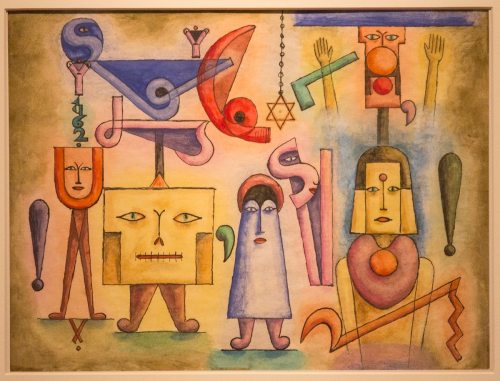
The Hanukkah Guest, Told by Rabbi Nachman of Bratslav

Artist: Xul Solar (1887-1963)

Hanukkah begins on the evening of Sunday, December 2, and continues for eight nights and days. One candle is lit on the first night, with a candle added each night. Light increases.

Every story has something hidden. What is concealed is the hidden light.
Reb Nachman of Bratslav (1772-1810)

The Hanukkah Guest

On the first night of Hanukkah, a poor man, who lived alone, chanted the Hanukkah blessings and lit the Hanukkah candle. He gazed at the candle for a long moment, and then there was a knock at the door. When he opened it, he saw a stranger standing there, and he invited him in. They began to discuss things, as people do, and the guest asked the man how he supported himself. The man explained that he spent his days studying Torah, and that he was supported by others, and didn’t have an income of his own. After a while, their talk became more intimate, and the man told the guest that he was striving to reach a higher level of holiness. The guest suggested that they study Torah together. And when the man discovered how profound were the guest’s insights, he started to wonder if he were a human being or an angel. He began to address the guest as Rabbi.

Time flew by, and the man felt as if he had learned more in that one night than in all the other years he had studied. All at once the guest said that he had to leave, and the man asked him how far he should accompany him. The guest replied, “Past the door.” So the man followed the guest out the door, and the guest embraced him, as if to say goodbye, but then he began to fly, with the man clinging to him. The man was shivering, and when the guest saw this, he gave him a garment that not only warmed him, but, as soon as he put it on, he found himself back in his house, seated at the table, enjoying a fine meal. At the same time, he saw that he was flying.

The guest brought him to a valley between two mountains. There he found a book with illustrations of vessels, and inside the vessels there were letters. And the man understood that with those letters it was possible to create new vessels. The man was taken with a powerful desire to study that book. But when he looked up for an instant, he found himself back in his house. Then, when he turned back to the book, he found himself in the valley once more. The guest, whoever he was, was gone. The man, feeling confident, decided to climb up the mountain. When he reached the summit, he saw a golden tree with golden branches. From the branches hung vessels like those illustrated in the book. The man wanted to pick one of those vessels, as one picks fruit from a tree, but as soon as he reached for one, he found himself back in his house, and there was a knock at the door. He opened the door and saw it was the mysterious guest, and he pleaded with him to come in. The guest replied, “I don’t have time, for I am on my way to you.” The man was perplexed, and asked the guest to explain what he meant. The guest said, “When you agreed to accompany me beyond the door, I gave your neshamah, your highest earthly soul, a garment from Paradise. Now, when you bring your thoughts to Paradise, you are there, on that holy mountain. But when your thoughts return to this world, you will find yourself here once again.” And that is how it remained for the rest of that man’s life, and the story has still not come to an end.

A Palace of Pearls: The Stories of Rabbi Nachman of Bratslav by Howard Schwartz

Black Friday: The American Holiday Exclusively Devoted to Buying Things

Note: #GivingTuesday is next week.

Many holidays have been commercialized. But almost all of them struggle to maintain some semblance of their higher purpose and original meaning. Thanksgiving is still about diverse and somewhat antagonistic neighbors and strangers peacefully getting together for a big meal. Christmas is still about the arrival of someone who brings goodness and light to the world. The same abiding of meaning goes for Founding Fathers (July 4th) and mothers (Mother’s Day)

Black Friday is different. It is exclusively about commerce. The dark name signifies the start of the shopping season that determines whether retailers have a profitable year (be “in the black”). You can look behind the commercial for the true meaning of other holidays. The only thing behind Black Friday is buying. The only way to celebrate Black Friday is to buy things—hopefully at deep discounts.

Some will say this misses the point. Buying on Black Friday is only the preliminary step to gifting on Christmas. Buying cheaper means being able to buy more gifts for more people. That’s what the spirit of Christmas is really about.

Here is a thought for those who participated in Black Friday, in stores or, as is now common, online. Add up all the money you saved by getting Black Firday deals. Donate that amount to the charity of your choice. (Given that Black Friday is the day after Thanksgiving, food banks are one suggestion).

Next Tuesday is #GivingTuesday, a holiday more attuned to the spirit of the season. Americans are expected to spend $90 billion shopping on Black Friday and on the newer holiday of Cyber Monday. If you conservatively guess that shoppers saved just 10% on their purchases, that adds up to savings of $10 billion for those shoppers. So if Black Friday shoppers donated their $10 billion in savings on #GivingTuesday, the meaning of Black Friday would be radically transformed