Bob Schwartz

Tag: Yom Kippur

Jonah and the New Year
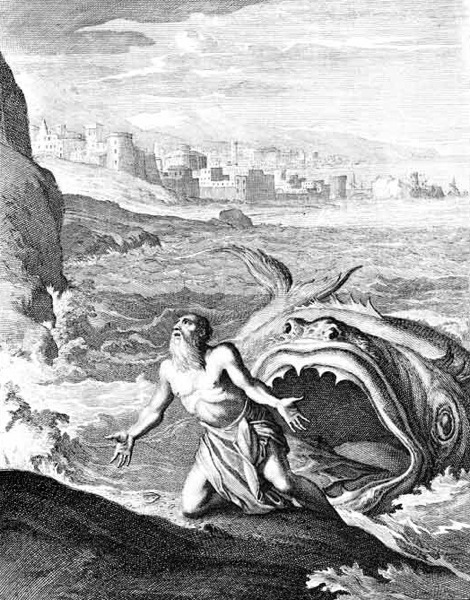
Jonah

“Like Jonas himself I find myself traveling toward my destiny in the belly of a paradox.”
Thomas Merton
The Sign of Jonas

The Jewish High Holy Days begins this evening, starting with Rosh Hashanah (New Year 5775) and ending on the tenth day with Yom Kippur (Day of Atonement). So it is a good time to talk about Jonah.

On Yom Kippur, the Book of Jonah is read at services. It is supposedly so simple a story that we tell it to the youngest children. It isn’t that simple.

Prof. Barry Bandstra writes:

The book of Jonah has been interpreted in many different ways: as a satire on prophetic calling and the refusal of prophets to follow God’s call; as a criticism of Israelite prophets who were insincere in preaching repentance (because they really wanted to see destruction); as a criticism of the Jewish community’s unwillingness to respond to prophetic calls to repentance (in contrast with Nineveh); as a criticism of an exclusive view of divine election (God only cares about “chosen people”); as an assertion of God’s freedom to change God’s mind over and against prophets who would limit that freedom; as emphasizing the problem with true and false prophecy (even true prophets have words that do not come true); or as an allegory of Israel in exile (both Jonah and Judah look to God for destruction of an evil empire). De La Torre argues for an interpretation of the book that views Jonah as a marginalized person frustrated with God for not punishing those who have brutally oppressed people. Person reads the book of Jonah as a conversation between author and reader, focusing on the implied verbal rejection of God’s command by Jonah in 1:3.

The entire very brief Book of Jonah is at the end of this post. It goes something like this:

God tells Jonah to preach to the wicked city of Nineveh.
Jonah runs away from this assignment and gets on a ship.
A storm batters the ship and the sailors figure out Jonah is the cause.
The sailors say they don’t want to throw him overboard to appease God, but then they do anyway.
Jonah is swallowed by a big fish.
After three days, the fish disgorges Jonah on land.
Jonah finally preaches repentance to Nineveh.
Nineveh does repent.
God has mercy and doesn’t destroy Nineveh.
Jonah complains that he went through a lot of trouble, so God should have destroyed Nineveh.
God gives Jonah a special plant and then destroys it, as an example of how a prophet has nothing to do with what happens and shouldn’t care how God ultimately deals with things. God explains:

“You are concerned for the castor-oil plant which has not cost you any effort and which you did not grow, which came up in a night and has perished in a night. So why should I not be concerned for Nineveh, the great city, in which there are more than a hundred and twenty thousand people who cannot tell their right hand from their left, to say nothing of all the animals?”

So for the New Year, among the many things you may ask yourself:

Was God too lenient? Was Jonah not compassionate enough, taking joy in the misfortune of others? Am I or should I be more like God? Like Jonah? Like the sailors on the ship? Like the people of Nineveh? Like the fish? Can I tell my right hand from my left?

Whatever your faith or no-faith, you can never have enough New Years and new starts. Please have a happy one.


Book of Jonah from the Jerusalem Bible (J.R.R. Tolkien)

Selecting a Catholic translation of the Book of Jonah on Rosh Hashanah may seem odd. There are two reasons. The Jerusalem Bible is the best English-language combination of literary style and scholarship. And this particular book has a very special translator/editor: J.R.R. Tolkien.

The original Jerusalem Bible, published in English in 1966, was conceived as a very modern Catholic Bible—modern in terms of both language and scholarship. A French edition had already been published, and for the English version, a number of English-language scholars and writers were enlisted. Some texts were translated from original languages (Hebrew, Greek) while other texts were re-translations of the French. Tolkien was brought on as an editor, but he did create one book in English, taken from the French: The Book of Jonah.

Jonah 1

1. The word of Yahweh was addressed to Jonah son of Amittai:
2. ‘Up!’ he said, ‘Go to Nineveh, the great city, and proclaim to them that their wickedness has forced itself upon me.’
3. Jonah set about running away from Yahweh, and going to Tarshish. He went down to Jaffa and found a ship bound for Tarshish; he paid his fare and boarded it, to go with them to Tarshish, to get away from Yahweh.
4. But Yahweh threw a hurricane at the sea, and there was such a great storm at sea that the ship threatened to break up.
5. The sailors took fright, and each of them called on his own god, and to lighten the ship they threw the cargo overboard. Jonah, however, had gone below, had lain down in the hold and was fast asleep,
6. when the boatswain went up to him and said, ‘What do you mean by sleeping? Get up! Call on your god! Perhaps he will spare us a thought and not leave us to die.’
7. Then they said to each other, ‘Come on, let us draw lots to find out who is to blame for bringing us this bad luck.’ So they cast lots, and the lot pointed to Jonah.
8. Then they said to him, ‘Tell us, what is your business? Where do you come from? What is your country? What is your nationality?’
9. He replied, ‘I am a Hebrew, and I worship Yahweh, God of Heaven, who made both sea and dry land.’
10. The sailors were seized with terror at this and said, ‘Why ever did you do this?’ since they knew that he was trying to escape from Yahweh, because he had told them so.
11. They then said, ‘What are we to do with you, to make the sea calm down for us?’ For the sea was growing rougher and rougher.
12. He replied, ‘Take me and throw me into the sea, and then it will calm down for you. I know it is my fault that this great storm has struck you.’
13. The sailors rowed hard in an effort to reach the shore, but in vain, since the sea was growing rougher and rougher.
14. So at last they called on Yahweh and said, ‘O, Yahweh, do not let us perish for the sake of this man’s life, and do not hold us responsible for causing an innocent man’s death; for you, Yahweh, have acted as you saw fit.’
15. And taking hold of Jonah they threw him into the sea; and the sea stopped raging.
16. At this, the men were seized with dread of Yahweh; they offered a sacrifice to Yahweh and made vows to him.

Jonah 2

1. Now Yahweh ordained that a great fish should swallow Jonah; and Jonah remained in the belly of the fish for three days and three nights.
2. From the belly of the fish, Jonah prayed to Yahweh, his God; he said:
3. Out of my distress I cried to Yahweh and he answered me, from the belly of Sheol I cried out; you heard my voice!
4. For you threw me into the deep, into the heart of the seas, and the floods closed round me. All your waves and billows passed over me;
5. then I thought, ‘I am banished from your sight; how shall I ever see your holy Temple again?’
6. The waters round me rose to my neck, the deep was closing round me, seaweed twining round my head.
7. To the roots of the mountains, I sank into the underworld, and its bars closed round me for ever. But you raised my life from the Pit, Yahweh my God!
8. When my soul was growing ever weaker, Yahweh, I remembered you, and my prayer reached you in your holy Temple.
9. Some abandon their faithful love by worshipping false gods,
10. but I shall sacrifice to you with songs of praise. The vow I have made I shall fulfil! Salvation comes from Yahweh!
11. Yahweh spoke to the fish, which then vomited Jonah onto the dry land.

Jonah 3

1. The word of Yahweh was addressed to Jonah a second time.
2. ‘Up!’ he said, ‘Go to Nineveh, the great city, and preach to it as I shall tell you.’
3. Jonah set out and went to Nineveh in obedience to the word of Yahweh. Now Nineveh was a city great beyond compare; to cross it took three days.
4. Jonah began by going a day’s journey into the city and then proclaimed, ‘Only forty days more and Nineveh will be overthrown.’
5. And the people of Nineveh believed in God; they proclaimed a fast and put on sackcloth, from the greatest to the least.
6. When the news reached the king of Nineveh, he rose from his throne, took off his robe, put on sackcloth and sat down in ashes.
7. He then had it proclaimed throughout Nineveh, by decree of the king and his nobles, as follows: ‘No person or animal, herd or flock, may eat anything; they may not graze, they may not drink any water.
8. All must put on sackcloth and call on God with all their might; and let everyone renounce his evil ways and violent behaviour.
9. Who knows? Perhaps God will change his mind and relent and renounce his burning wrath, so that we shall not perish.’
10. God saw their efforts to renounce their evil ways. And God relented about the disaster which he had threatened to bring on them, and did not bring it.

Jonah 4

1. This made Jonah very indignant; he fell into a rage.
2. He prayed to Yahweh and said, ‘Please, Yahweh, isn’t this what I said would happen when I was still in my own country? That was why I first tried to flee to Tarshish, since I knew you were a tender, compassionate God, slow to anger, rich in faithful love, who relents about inflicting disaster.
3. So now, Yahweh, please take my life, for I might as well be dead as go on living.’
4. Yahweh replied, ‘Are you right to be angry?’
5. Jonah then left the city and sat down to the east of the city. There he made himself a shelter and sat under it in the shade, to see what would happen to the city.
6. Yahweh God then ordained that a castor-oil plant should grow up over Jonah to give shade for his head and soothe his ill-humour; Jonah was delighted with the castor-oil plant.
7. But at dawn the next day, God ordained that a worm should attack the castor-oil plant — and it withered.
8. Next, when the sun rose, God ordained that there should be a scorching east wind; the sun beat down so hard on Jonah’s head that he was overcome and begged for death, saying, ‘I might as well be dead as go on living.’
9. God said to Jonah, ‘Are you right to be angry about the castor-oil plant?’ He replied, ‘I have every right to be angry, mortally angry!’
10. Yahweh replied, ‘You are concerned for the castor-oil plant which has not cost you any effort and which you did not grow, which came up in a night and has perished in a night.
11. So why should I not be concerned for Nineveh, the great city, in which there are more than a hundred and twenty thousand people who cannot tell their right hand from their left, to say nothing of all the animals?’

Yom Kippur: Beyond the Self

Shofar - Chagall
No sin is so light that it may be overlooked; no sin is so heavy that it may not be repented.
Moses ibn Ezra

A person cannot find redemption until he sees the flaws in his soul, and tries to efface them. Nor can a people be redeemed until it sees the flaws in its soul and tries to efface them. But whether it be a person or a people, whoever shuts out the realization of his flaws is shutting out redemption. We can be redeemed only to the extent which we see ourselves.
Martin Buber

Should we despair of our being unable to retain perfect purity? We should, if perfection were our goal. However, we are not obliged to be perfect once and for all, but only to rise again and again beyond the level of the self.
Abraham Joshua Heschel

Bear in mind that life is short, and that with every passing day you are nearer to the end of your life. Therefore, how can you waste your time on petty quarrels and discords? Restrain your anger, hold your temper in check, and enjoy peace with everyone.
Rabbi Nachman of Breslov

Al Cheit (For Our Sins) is a central prayer of Yom Kippur. It is traditionally recited while beating our hearts for each item on the list.

It is a long list. Few will have committed all of them. Few have escaped committing any. It is just a list of examples. Your experience may vary, and there may be others you might add.

The tradition says that the Book of Life is open during the Ten Days of Awe. When the holy days end with Yom Kippur, the Day of Atonement, when the shofar sounds, the book closes and our lives will have been written for the next year. But the book is always open. This isn’t an inventory of recriminations. It is an opportunity to reflect and, if needed, to make amends. That is how, as Heschel says, “to rise again and again beyond the level of the self.” That is how we write the book.

Al Cheit
For Our Sins

For the sins we have committed through arrogance and selfishness:
For being obsessed with our own concerns,
For choosing rudeness over common courtesy,
For loving our egos.

For the sins we have committed by defrauding others:
For using people in pursuit of our ambitions,
For manipulating the love of others,
For gossiping.

For the sins we have committed through denial and deceit:
For creating theories to rationalize our behavior,
For faking emotions for our own benefit,
For using the sins of others to excuse our own,
For claiming that ends justify the means.

For the sins we have committed through greed and overindulgence:
For using force to maintain our power,
For poisoning our planet,
For remembering the price of things but forgetting their value.

For the sins we have committed through hardening our hearts:
For accepting poverty as inevitable,
For staying silent when we should speak out,
For resenting the young and ignoring the elderly,
For abandoning proper outrage.

For the sins we have committed through hypocrisy:
For condemning in our children the faults we tolerate in ourselves,
For condemning in our parents the faults we tolerate in ourselves,
For neglecting our promises.

For the sins we have committed by narrow-mindedness:
For passing judgment without knowledge,
For denying our baseless hatreds.

For the sins we have committed against You through sex and love:
For confusing love with lust,
For pursuing fleeting pleasure while disregarding lasting hurt,
For withholding affection to control the ones we love.

For all these sins, forgive us, pardon us, grant us atonement.

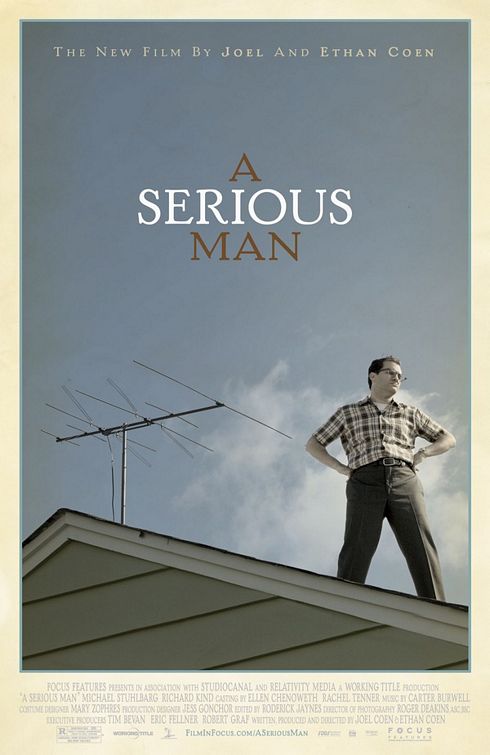
Yom Kippur: A Serious Day for a Serious Man

A Serious Man
This evening begins Yom Kippur, the Jewish Day of Atonement, the last of the ten Days of Awe that starts a new year. The mood is somber. It is the most serious day on the calendar, a day of fasting and reflection, a day to contemplate the actions and inactions of the year past, and to commit to a better year ahead.

Which is why it is a day to recommend a darkly comic movie.

A Serious Man (2009) from Joel and Ethan Coen has never been taken seriously enough (playlist of clips). It was nominated for two major Academy Awards, Best Picture and Best Original Screenplay, but none of the cast members were invited to the festivities until the last week before the event. That is an ironic nod to the movie itself.

Scholars have spent papers—entire careers—explaining why Jews try to be funny and why so many succeed. One of the stock rationales is that Jews are an historically beleaguered people, and the humor is a natural response. Another related thought is that Jewish attempts to make sense of it all have come to nothing, and so absurdity is the only possible answer.

A Serious Man is grounded in those ideas and more. Larry Gopnick is a physics professor in the 1960s. In his academic life, he is up for tenure, a student is trying to bribe him, and even as he lectures on Heisenberg’s Uncertainty Principle, there is a sense that he really doesn’t understand uncertainty at all. Things are worse in his personal life, much worse. As his son prepares for bar mitzvah, Larry discovers that his wife is having an affair with his friend, his brother is caught in a gay bar, his dentist espouses weird mystical tooth theories, and there is a question whether Larry may have a serious health problem.

Larry looks for answers in faith, but the mysterious Rabbi Marshak, the older spiritual head of the congregation, is impossible to see. At the bar mitzvah. Larry’s son Danny, who at the start of the movie had his transistor radio taken away at Hebrew School, goes off to see this rabbi. He finds him in an inner sanctum, where Rabbi Marshak explains it all through the Jefferson Airplane and with a powerfully simple piece of advice:

Marshak is an old man staring at him from behind a bare desktop. His look, eyes magnified by thick glasses, is impossible to read.

Danny creeps to the chair facing the desk. He gingerly sits on the squeaking leather upholstery, self-conscious under Marshak’s stare.

Marshak’s slow, regular, phlegmy mouth-breathing is the only sound in the room. The two stare at each other.

Marshak smacks his lips a couple of times, wetting surfaces in preparation for speech.

Finally:

MARSHAK
When the truth is found. To be lies.

He pauses. He clears his throat.

. . . And all the hope. Within you dies.

Another beat. Danny waits. Marshak stares. He smacks his lips again. He thinks.

. . . Then what?

Danny doesn’t answer. It is unclear whether answer is expected. Quiet.

Marshak clears his throat with a loud and thorough hawking. The hawking abates. Marshak sniffs.

. . . Grace Slick. Marty Balin. Paul Kanta. Jorma. . .somethin.
These are the members of the Airplane.

He nods a couple of times.

. . . Interesting.

He reaches up and slowly opens his desk drawer. He withdraws something. He lays it on the bare desk and pushes it across.

. . . Here.

It is Danny’s radio.

. . . Be a good boy.

The movie closes with a note taken straight from the Book of Job. A tornado approaches. Will it be the voice of God out of the whirlwind? Or will it just be one more inexplicable disaster, one more serious touch of uncertainty?

Who knows? Yom Kippur and every day, listen to Rabbi Marshak: Be a good girl or boy.

You Kippur and Job


The days from Rosh Hashanah (“Head of the Year”, the New Year) and Yom Kippur (“Day of Atonement”) are the ten holiest on the Jewish calendar. Known as the Days of Awe or Days of Repentance, they are a time for reflection on the year past and the year to come, and a time to make amends—not by asking God for forgiveness, but by asking it from those who have been wronged, and through the practice of repentance (literally, “turning”), prayer and charity.

During these days, the Book of Life is metaphorically open, and on its pages your life is weighed: “On Rosh Hashanah it is written, on Yom Kippur it is sealed.”

The liturgy for these holidays, and particularly for Yom Kippur, is some of the most moving and soul-searching in all of the religious canon. There are Old Testament readings included, but not too often from the Book of Job.

There are two solid consensuses about the Book of Job.

Literary types agree that it is probably the greatest work of literature in the Bible.

Religious types agree that it is the most puzzling book in the Old Testament, and that even when you look at it in the most common and superficial way (“Why do bad things happen to good people?”), you end up scratching your head.

Job is the book to read for Yom Kippur. It is the book to ponder at the start of the year, at the end of the year, and at points between. (It was, by the way, Abraham Lincoln’s most studied book of the Bible.)

We begin with the book itself.

It is unusual for it to have been included in the canon of the Hebrew Bible because it is not about a Jew. When non-Jews appear in other books, it is usually a story of helping Jews or hurting Jews or marrying Jews or eventually becoming Jewish. None of that applies to the Book of Job.

The story is relatively simple, at least until the end. Job is a rich and pious man who has everything: health, wealth, family and friends (or so they seem). Satan wants to prove that Job’s piety is dependent on his having everything, and challenges God to take it all away. God does.

Job’s friends are convinced that he must have done something wrong, and urge him to figure it out and repent. The scenes with his friends are talky, like a play, or maybe like the film My Dinner With Andre—except this is My Dinner with Eliphaz the Temanite, Bildad the Shuhite and Zophar the Naamathite.

Job’s wife has a different suggestion: “Curse God and die.”

Job remains steadfast in his faith.

And then, in Chapter 37, God appears to Job, to explain it all.

The chapters that follow are a poetic and breathtaking description of the world’s wonders, by the one who made them. God tells Job that his friends don’t know what they’re talking about (God takes care of them later). And God implicitly tells Job the only two things to do: Be awed. Be humble.

Job’s reply in Chapter 42 is one of the most important passages in the Bible. It is not only the watchword for Yom Kippur; it is the watchword for everyone, religious or otherwise, who is convinced they are smarter than anyone in the room or in the universe:

Then Job answered the Lord:
“I know that you can do all things,
and that no purpose of yours can be thwarted.
‘Who is this that hides counsel without knowledge?’
Therefore I have uttered what I did not understand,
things too wonderful for me, which I did not know.
‘Hear, and I will speak;
I will question you, and you declare to me.’
I had heard of you by the hearing of the ear,
but now my eye sees you;
therefore I despise myself,
and repent in dust and ashes.”

“I have uttered what I did not understand, things too wonderful for me, which I did not know.”

Whether this is a day of reflection and fasting, reciting centuries-old prayers, or an ordinary day of work or study, managing others or being managed; whether you are Job beset by unexplained misfortune, or Job’s wife, ready to kill him if he doesn’t kill himself, or Job’s friends so quick with advice; whether you are being punished by God, Satan, or whatever other forces you believe are working against you; whether you are the smartest person in the room or not; this is what we can do, even if there is seemingly no comfort in it:

Be awed. Be humble.