Bob Schwartz

Tag: Whole Earth Catalog

AI: “We are as gods and might as well get good at it.”
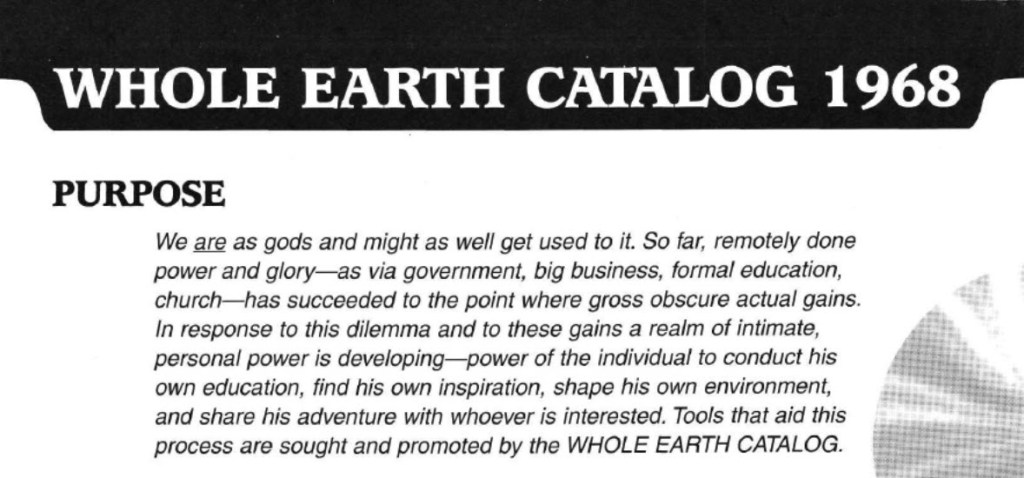
We are as gods and might as well get good at it.
–Stewart Brand

When Stewart Brand birthed the Whole Earth Catalog in 1968, a version of this motto appeared in the introduction to that first issue: “We are as gods and might as well get good at it.”

WEC was an exercise in what we might call Human General Intelligence. It covered literally everything and everyone on earth and in the universe. It was aimed at getting readers—all of us—aware of everything and everyone, so that we could get on an enriched and enlightening learning and acting path of knowledge and ability about anything and anyone.

In a nutshell, that is what AI offers. AI is not “as a god”, though from a certain perspective it may look to some that way. We are “as gods” with it at our command, and not since putting world-destroying weapons in human control has that been clearer.

Think about the last time, or all the times, you used AI. Would you consider that a godlike experience, or was it a matter—not illegitimate, no judgment—of taking an easier and more convenient way to pass a school assignment or complete a work task? Not that there is necessarily anything wrong with that, maybe. But if with AI at your side you might be “as a god”, is that all you plan to do with it?

Note: That first issue begins and ends with two of my greatest inspirations, Buckminster Fuller and the I Ching. It may not be enough to know their Biggest Picture view of life and the universe and our place in it, but it is a start. What would they/do they think of AI?

© 2026 Bob Schwartz
Claude AI (aka Bucky) helps us become great generalists

Whole Earth Catalog

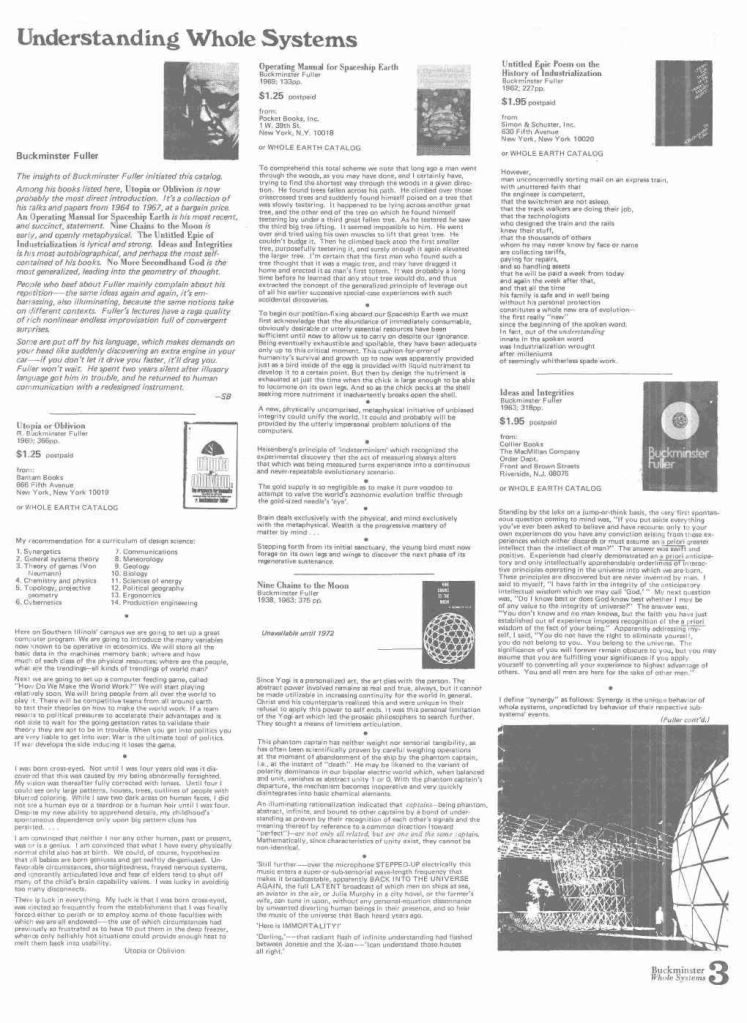
R. Buckminster Fuller (1895-1983)—widely known as Bucky—was a world-changing architect, systems theorist, writer, designer, inventor, philosopher, and futurist. He was a genius and prophet of generalism. He believed that over-specialization narrows us and stands in the way of solving problems and envisioning the future.

When Stewart Brand began publishing the Whole Earth Catalog in the 1960s, he put Fuller’s books on the very first page. “The insights of Buckminster Fuller initiated this catalog,” he wrote. As a mission for the holistic all-encompassing general reach of the catalog Brand said, “We are as gods and might as well get good at it.”

Fuller attributed his big-picture holistic perspective to his service as a naval officer in the early 20th century. At the time, and in some ways still, ships at sea were almost entirely self-sufficient. Those on board had to know about everything and be able to do anything. That is reflected in one of his most famous books, Operating Manual for Spaceship Earth.

Claude and other AI resources can help us become better generalists. The World Wide Web (thank you Tim Berners-Lee) was a major step in that direction. AI is the next step. It is not that Claude can access trillions of words while even the best of us only know thousands. It is that when we are motivated to know more about lots of things—which as gods we should want—we have a new resource to help us be the generalists that we need to be. Now more than ever.

© 2024 by Bob Schwartz

4th of July, Asbury Park (Sandy)

Who’s the boss?

The challenge of being a pop culture maven is that songs, movies and TV shows are regularly running around in your head, just waiting for a hook in the other real world. Then something happens and the connections light up, seemingly by themselves.

As soon as it was certain that the storm would hit the Jersey shore, Bruce Springsteen’s 4th of July, Asbury Park (Sandy) became the involuntary soundtrack. It is from his career-making second album, The Wild, The Innocent & The E Street Shuffle.

It is a sweet and melancholy song, more folk than rock. It seems to be about leaving a girl behind, but as Springsteen has explained, it is about leaving Asbury Park behind:

And me, I just got tired of hangin’ in them dusty arcades, bangin’ them pleasure machines
Chasin’ the factory girls underneath the boardwalk where they all promise to unsnap their jeans
And you know that tilt-a-whirl down on the south beach drag
I got on it last night and my shirt got caught
And they kept me spinning, babe, didn’t think I’d ever get off…

Did you hear the cops finally busted Madame Marie for tellin’ fortunes better than they do
For me this boardwalk life is through, babe
You ought to quit this scene too

All this (Sandy the storm, Sandy the girlfriend, the Jersey shore, Bruce Springsteen) prompted the question: Between events and people, who’s the boss?

The reflexive answer in the face of natural disasters like this is that events are in charge. As true as that may be, the parallel truth is that when people claim dominion, by building boardwalks and impossibly complex cities, people are in charge too.

Stewart Brand’s Whole Earth Catalog was one of the big inspirations in Steve Jobs’ life and career. In the 1969 issue of the Catalog, Brand stated the premise for his project to help people understand whole systems and master the tools to build and maintain them in an enlightened way. As we rebuild and reflect after Sandy, this is worth keeping in the mix:

We are as gods and might as well get good at it.