Bob Schwartz

Tag: Trump

Miniature Rakes: New Symbol of the Resistance and Resurgence…and So Zen

Our story so far: Visiting the site of the California fires, Trump—graduate of the Wharton School of Finance and Forest Management—told officials that the disaster could have been prevented if they “raked the forest floor.” He said he heard this from the Prime Minister of Finland, who replied that he had never told Trump any such thing.

This led to global reaction, including the clever hashtag #RakeAmericaGreatAgain, along with lots of creative images of people with rakes.

Rakes are more than a tool to clean up lawns, or if you are Trump, to prevent forest fires. They are used in Zen gardens to mindfully tend to a blank slate of sand.

Many of us have or have had rakes as items in our landscape tool shed. But displaying a full-size rake inside your home or on your desk is awkward—as is giving a rake as a gift or sending a rake to sympathetic or unsympathetic public servants.

That is where miniature rakes come in. These tiny rakes are not just available as a children’s toy. They are also available to help those who maintain tabletop Zen sand gardens. Best of all, they are inexpensive, as little as $2 apiece.

So buy and display a miniature rake. Put it on your table or desk. Send it as a gift. Rakes may not prevent forest fires, but they are symbols of cleaning up and bringing creative order and design to chaos. All in your hands.

“Will Pittsburgh Shooting Be A Wakeup Call For Jews Who Enable Trump?”

The Forward today includes an opinion piece, Will Pittsburgh Shooting Be A Wakeup Call For Jews Who Enable Trump by Ben Faulding, that ends like this:

Now that Jewish blood has been spilled, will the leaders recognize the threat they’ve been ignoring for so long?

Trump’s behaviors and policies continually contravert practically every core principle of Judaism. But even when white nationalists in Charlottesville directly expressed their anti-Semitism with chants like “Jews will not replace us,” important Jewish supporters and White House staff didn’t object to Trump’s equivocation of “good people on both sides.” We have a transactional president in transactional times, so if ignoring even anti-Semitism is the price you pay for support of Israel, tax benefits, etc., well, that’s the art of the deal.

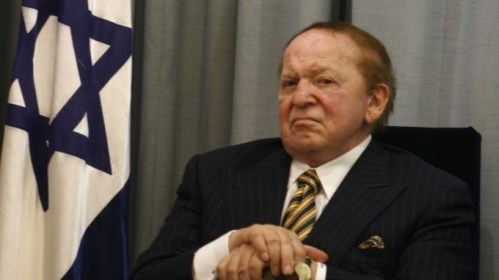
The answer to whether this horror will be a wakeup call is mostly No. Jews who have cast their lot with Trump, from billionaires like Sheldon Adelson on down, either don’t know what Jewish principles actually are or have rationalized their support in relation to those principles. They aren’t asleep so they can’t wake up. They are just not very good Jews, if Jews at all.

The Hopeful But Limited Relief of Having the New Kavanaugh Investigation

It is good news that there will be a new FBI investigation in the Brett Kavanaugh matter. Any movement towards a return to free, open and lawful democracy is welcome.

But before we pop champagne and release balloons, a reality check. Here are some ways the investigation could have little effect on the outcome—in fact, will be designed to have little effect, besides providing cover for vulnerable and/or spineless Republicans.

1. It is a limited investigation. We don’t know the scope, which is being directed by Trump. It could be as narrow as the single incident alleged by Christine Blasey Ford, the incident that was the subject of Thursday’s hearing. This could mean simply talking to her, to Brett Kavanaugh, and to the few people who were there—only one of whom, Mark Judge, is an eyewitness.

Judge has already said that as an effect of his chronic alcoholic blackouts, going back to high school, he has no memory, one way or the other, of the incident. There is no reason he won’t say the same thing to the FBI.

The investigation could be broader. It could include other allegations that have been made. It could include everything that Ford and Kavanaugh testified to during the hearing. It could thus involve Kavanaugh’s claims about his benign behavior, claims that have been refuted by a number of people who knew him in high school and college. It could include all this, but almost certainly will not.

2. Trump controls the report of the investigation. Trump ordered the investigation. His order presumably included a specific scope of investigation for the FBI to follow. Just as importantly, the report of the investigation will go directly to Trump, who can decide how much of the investigation report can be shared and who it can be shared with.

The worst case, which would not be surprising, is that no copies of the report will be distributed. Instead, senators will be allowed to review the report in the White House. They may be allowed to take notes.

All of this—any presidential redaction and any restricted distribution—are part of the desire by some for this investigation to be “confidential”…

3. The investigation is, in some unspecified way, supposed to be “confidential”. Judge has said he wants whatever he says to be confidential. Kavanaugh has indicated he expects it to be confidential. It is unclear what this means functionally. But it is easy to see the case that would be made:

The only reason we are doing this investigation is to further inform the senators responsible for deciding on confirmation. Others, whether other members of Congress or citizens in general, may be curious, but they have no compelling reason to see the detailed report, given that it contains sensitive information.

If that reasoning sounds extreme, that is, extremely suspect, it is. But if you need a basis for it, just look at the “investigation” that went into Kavanaugh in the first place, and look at the history of the Trump administration. No twisted attempt at hiding the truth is too absurd.

The Trump/Cosby/Weinstein Analysis Becomes the Kavanaugh Analysis: Individual Incidents or Pattern of Behavior or Bad Character. Or All of the Above.

We’ve been learning the hard way how it works when people of power, prestige or celebrity are accused of bad things. Individual and isolated incidents are denied or covered up. Even if there is a smattering of proof, this keeps the focus away from the more important issues of patterns of behavior or bad character. In fact, when you bolster with endorsements of “good character”, the impact of the individual incidents is softened, and a pattern of behavior becomes unthinkable.

We have reached the point in the Brett Kavanaugh consideration where individual incidents are being set aside or shot down, just as evidence of a pattern of behavior or bad character is creeping in. That evidence isn’t even new. His high school drinking and debauchery buddy Mark Judge has written in his memoir about drunken exploits with his thinly disguised pal “Bart O’Kavanagh”. Judge will not be questioned, and merely says that he was given to frequent alcoholic blackouts (in high school and for years to come), and so he has no memory of the particular incident. Which begs the question of whether he and Kavanaugh engaged in a pattern of drunken and drugged exploitation of young women—something Judge no doubt remembers, even in an alcoholic haze.

It took years—decades—for the sordid past to catch up with Cosby, Weinstein, and others. Astonishingly, the sordid past still hasn’t caught up with Trump. If you ask Republicans, we have literally days to decide whether Kavanaugh has the character to serve on the Supreme Court. There is evidence that he does not, and it is something that can be determined only by a true due diligence review of the individual incidents, of a pattern of behavior and of character. There is no need to rush to judgment, and every reason to pause.

“That’s Pride F***in’ Wit Ya”: Rod Rosenstein Could Never Figure Out Whether to Follow Self-Interest, Duty or Conscience

All public servants in the Trump era—from Senators and cabinet members on down—have three possible paths to follow:

Follow your self-interest
Follow your duty, to job and to country
Follow your conscience

Many of the highest level people in the government have taken the easy path of least resistance and most gain, and have chosen self-interest, even as they try to disguise it as duty or conscience. But a number of people, many of whom finally left the government—voluntarily or not—have had to wrestle with these choices.

Whatever is happening to Rod Rosenstein, a good public servant, he never seemed to be able to figure out exactly how to be a good public servant in such strange times. He knew he owed a duty to his office and to his country, which meant a duty to his president, but that came in conflict with his conscience.

I have previously cited the movie Pulp Fiction on the question of expedience, and I repeat it here.

At this point in the movie bad boss Marsellus Wallace (Ving Rhames) is convincing aging boxer Butch Coolidge (Bruce Willis) to take a dive:

I think you’re gonna find ­ when all this shit is over and done ­ I think you’re gonna find yourself one smilin’ motherfucker. Thing is Butch, right now you got ability. But painful as it may be, ability don’t last. Now that’s a hard motherfuckin’ fact of life, but it’s a fact of life your ass is gonna hafta git realistic about. This business is filled to the brim with unrealistic motherfuckers who thought their ass aged like wine. Besides, even if you went all the way, what would you be? Feather-weight champion of the world. Who gives a shit? I doubt you can even get a credit card based on that.

Now the night of the fight, you may fell a slight sting, that’s pride fuckin’ wit ya. Fuck pride! Pride only hurts, it never helps. Fight through that shit. ‘Cause a year from now, when you’re kickin’ it in the Caribbean you’re gonna say, “Marsellus Wallace was right.”

Note: For those who haven’t seen Pulp Fiction (why not?), in the end Marsellus Wallace gets his, in the spirit of Quentin Tarantino’s sense of rough and uncertain justice.

Ray of Light: Trump’s Pardoning May Be Like a Slot Machine

The likelihood of any individual being pardoned by Trump will be affected by Trump’s craziness, unreliability and lack of loyalty. It will be like a slot machine. And that may be a good thing for justice and the rule of law.

Even though I have long accepted that Trump would try to pardon almost everyone who is charged or convicted in the course of the investigation, Paul Manafort’s plea agreement to cooperate raises an encouraging insight:

If you were one of the dozens of people who are getting caught in this net, facing possible years in prison, and Trump told you to your face—not just through an intermediary, not just through hints on Twitter—that you could expect a pardon, would you believe him and depend on him to keep his word?

Of course you wouldn’t believe him and depend on him to keep his word. Which means, just like Manafort, you have to hedge your bets. It is possible that if you agree to cooperate, Trump might still pardon you. On the other hand, if you agree to cooperate, Trump might go crazy and refuse to pardon you. And in the worst case, you might stonewall and take your punishment, but because of some crazy voices in Trump’s head, he might still refuse to pardon you. Who knows? With Trump it’s a roll of the dice, a spin of the slots. As a defendant, are you willing to bet ten or twenty years of your life on a Looney Tunes character? I bet not.


Ben Franklin: My University of Pennsylvania Should Revoke Trump’s Diploma

“By the way this idiot Woodward who wrote this book which is all fiction said that I said something like that, but he put it in a crude manner…The concept is true, but the way it was said was very…hey, I went, like, to the best college.”
Trump at a North Dakota rally

Trump self-importantly crows about his degree from Wharton (like all the time), the business school of the University of Pennsylvania in Philadelphia. Trump’s point is that he must be, like, a genius with that Penn degree. Penn, is, like, a very good school that continues to provide its students with an excellent education. Though in some small number of high-profile cases, it appears to be casting pearls before swine.

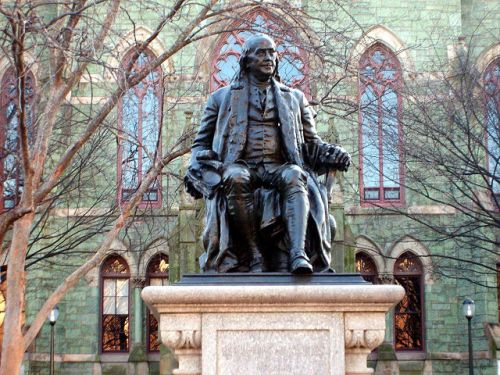
The bigger point is Ben Franklin, credited as founder of the university. Above is a photo of the Ben Franklin statue at the center of campus, in front of College Hall.

Penn has tried to walk a fine line in its relationship with Trump, and with other members of his family who have attended Penn. Just as the sins of the father should not be visited on children, the sins of the alumnus should not be visited on a college. Penn did the best it could, given what it had to work with.

Ben Franklin is having none of it. Among our American founders, he is the most famous for not suffering fools. That’s why he is asking the University of Pennsylvania—his University of Pennsylvania—to revoke Trump’s diploma. That won’t stop Trump from continuing to say he went, like, to the best college, but it will give the best college a way to say: thanks for the compliment and PR, but no thanks. And it will give Ben Franklin a way to stop spinning in his grave, just a few blocks from Independence Hall. Because this is not what he envisioned for the first-ever Penn grad in the White House. Not, like, at all.

The Difficult Realities of Impeaching Trump

Yesterday was an encouraging day for those who hope to see the uncovering and dismantling of the corrupt and un-American Trump enterprise. Trump’s former campaign manager Paul Manafort was convicted; Trump’s former fixer Michael Cohen pled guilty and directly implicated Trump in his criminality. Even the likelihood that Manafort and others who haven’t turned on Trump will be pardoned doesn’t take away from the day’s significance.

This has raised hopes that Trump will be impeached if the Democrats are successful in the midterm elections. Which means—not wanting to burst the rare bright balloon of yesterday’s news—it is time for a reality check.

Let us say that the Democrats win a majority in both houses of Congress.

The impeachment process begins in the House, with hearings and a simple majority passing articles of impeachment. In a Democratic House, that should be no problem.

The trial for removal of a president then takes place in the Senate. If the Democrats do win a majority in the Senate, it will be a small majority at best. Let us say that they have a 53-47 majority. Conviction for impeachment requires a two-thirds majority, which is 67 votes. So 14 Republicans would have to vote to remove the president.

You may think that what we will have learned by then about Trump’s corrupt presidential conduct and fitness for office will finally move Republican Senators to agree to his removal. (As a matter of fact, if you privately asked Republican Senators today whether they would rather have Mike Pence in the White House immediately, the answer would be a unanimous yes.) But not a single thing we have seen indicates that any sitting Republican Senator—that is, those who are not leaving office—is willing to stand up to Trump. Why would we think that we can find 14 or so Republican Senators with the courage to remove him from office, no matter how egregious the evidence?

Okay, enough reality. I would like to be totally wrong about this. Let’s enjoy this moment of hope for American restoration.

The One and Only Question EVERY Republican Candidate Should Be Asked: The Role Model Thing

Republican candidates are going to be asked lots of questions about their attitudes toward Trump, his character and his policies. The answers will be a combination of party-line loyalty, evasion, gibberish or silence.

All those questions should be avoided, or at least not central. There is only one question these Republican candidates should be asked—one that is not hypothetical, one that demands a yes-or-no answer, one that has been asked in public opinion polls but is not (yet) a part of our political discourse:

Do you believe that Donald Trump is a good role model for your children and grandchildren?

We already know that in public opinion polls, many Republicans still say they believe he is. But those respondents are answering a poll; they are not answering publicly as candidates for office.

Any candidate who says they believe that Trump is a good role model for their children or grandchildren should be automatically disqualified for public office. In fact, if I were interviewing people for any job, I might ask the same question, and might reject the job candidates who say “yes” for the same reason: Without going into any of the other obvious character or moral deficiencies, Trump is demonstrably a chronic (some would say pathological) liar.

You can try to defend or explain away certain character or moral problems. But a lie is a lie (the Washington Post counts 4,229 presidential false or misleading statements so far).

So any Republican candidate who says they want their children or grandchildren to “be like Trump” are wishing on their beloved young ones a life marked by, among other shortcomings, telling a constant stream of lies about virtually everything. Are those candidates really the sort of people you want anywhere near your government?

Why Trump Is a Horror Movie and Not a Reality Show

Reality shows dramatize and exaggerate “real” human behavior and situations. People do and say bad, even horrible, things. We may be repulsed, we may find it endearing and entertaining, but when we watch reality shows, we are never scared.

The most frightening horror movies are based on a powerful premise: Within our seemingly ordinary life in our seemingly ordinary world, there is an inconceivable terror lurking. It may emerge at any time without warning. We must be always on our guard because everything that used to seem benign is now menacing. What is worst, on top of the constant uncertainty, is that we have no defense.

That is why when we watch a horror movie, no matter how prepared we think we are, we jump out of our seats anyway. That is why in America, while we long for the benign ordinary, we prepare each day for what is lurking, and still jump when it arrives. That is why Trump is a horror movie and not a reality show.