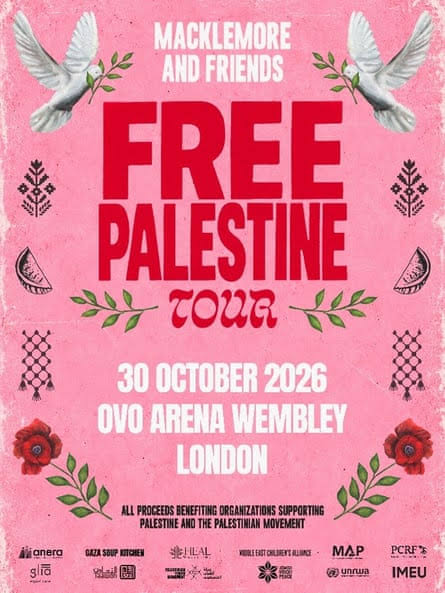
Macklemore announces Free Palestine tour to benefit humanitarian aid organisations Macklemore has announced a “Free Palestine” tour, a series of live shows that will feature the US rapper performing alongside musicians and friends to raise funds for humanitarian causes in Palestine. —Guardian, 24 Sep 2026
If these last couple of weeks have shown us anything, it’s that something has shifted over the last three years. There has been a collective awakening around Palestinian liberation, the power of billionaires that try to censor that call, and what we expect from artists right now.
It’s 2026. Being apolitical during a genocide doesn’t work anymore. People are asking artists to show up, educate themselves and be in community. To use the stage for more than entertainment. To push back when the call for a Free Palestine is met with attempts to silence it.
What happened to me is bigger than one artist or one stage. When the billionaire class can decide which voices are allowed on stage and which ones are too dangerous to hear, everyone should be paying attention.
Because of how quickly all of this has come together, a lot of the conversations, schedules and details are still being worked out. But this is a moment of momentum, and there is work to be done.
–Macklemore announcing the Free Palestine Tour
Macklemore’s tour will begin in Dublin on 26 October. Further dates in Paris (29 October) and London (30 October) have been announced, with North American dates to follow. Fans hoping to get tickets are encouraged to sign up for presale access at macklemore.com.
“I am not complicit.” –Ed Sheeran explaining why he had nothing to do with Macklemore being dropped from his tour.
I won’t here review all the stories of America and Israel in the past few years, particularly since Trump began his second term in January 2025 and Israel began its Gaza response to October 7 in 2023.
Instead, I will focus on the last few days in music. Ed Sheeran (Spotify’s #16 artist in the world with 81 million monthly listeners) is touring major venues. He added Macklemore to the tour. Sheeran agreed, as he does with all supporting acts, that Macklemore could choose his own setlist.
At the first tour stop, Macklemore unsurprisingly had something to say critical of Israel and supporting Palestine. He made a point of speaking directly to Jews in the audience:
“Criticism of Israel, criticism of apartheid, being against genocide in no way is a criticism of you. My message is for peace, love; for all human beings to be treated with dignity, respect and equality.”
Some venues pushed back against Macklemore’s comments. Macklemore was dropped from the tour. It took a day for Sheeran to finally respond:
“His contract is with the promoter, not with me.
“I am appalled by the conflict between Israel and Palestine. The suffering and pain caused on both sides is a human tragedy. There are too many wars across the world causing immeasurable pain, none of which should be tolerated.”
“I am not complicit. I have my personal views on this devastating conflict. Just because I choose not to speak publicly, it doesn’t mean I don’t have them, and it doesn’t mean I don’t care. Nor does it mean I don’t support causes in my own, personal way.”
“There is a reason I do not use my professional platform for politics — my audience includes young people, often children, of all backgrounds. Those who come to my shows do not expect a political forum.”
There is a lot to unpack.
It is conceivable that Sheeran could have taken an extreme stand, refused to go on with the tour unless Macklemore continued. This would have prompted a storm of multi-million-dollar litigation among Sheeran, Macklemore, promoter, venues, and many more (probably the Department of Justice would weigh in). This would have denied fans the enjoyment and denied tour employees the work. In so many ways not a great solution. Though had that happened, we might once again be talking about Gaza and Palestine, which is taking a back seat to other disasters, many made by the current American administration.
Even so, what Sheeran did say is mealy-mouthed at best.
“I am not complicit” echoes down the ages when morality is in question. “Yes, it may be wrong, but no, it’s not my place to do anything about it because I had nothing to do with in the first place.” If you are a student of history’s worst moments, you will recall this as the number one defense/excuse/explanation.
In past days, in coming days, in historical overview, we will see how often we hear some version of “I am not complicit.” So it goes.