Bob Schwartz

Tag: Dada

John Heartfield

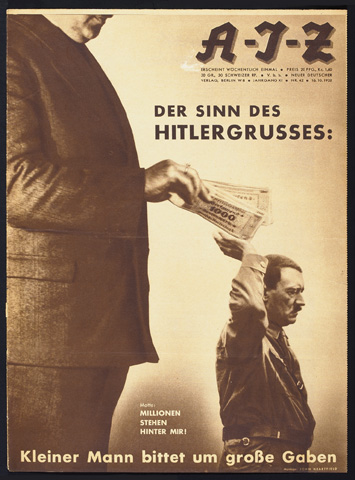
The Meaning of the Hitler Salute: Little Man Asks for Big Gifts (1932), John Heartfield

John Heartfield (1891–1968) was a German artist best known as a pioneer of political photomontage. He was born Helmut Herzfeld in Berlin-Schmargendorf. In 1916, as a protest against German nationalism and anti-British sentiment during World War I, he anglicized his name to John Heartfield.

Heartfield became involved with the Berlin Dada movement after the war, working alongside figures such as George Grosz, Raoul Hausmann, and Hannah Höch. He and Grosz are often credited with helping develop photomontage as a serious artistic and political medium.

He is most famous for the biting anti-Nazi and anti-fascist photomontages he produced during the 1920s and 1930s, many of which appeared on the covers of the workers’ illustrated magazine AIZ (Arbeiter-Illustrierte-Zeitung). These works satirized Hitler, Göring, and the Nazi regime through sharp visual juxtaposition — one of his best-known images depicts Hitler with an X-ray torso revealing a spine of gold coins, captioned to suggest he was funded by big business.

When the Nazis came to power in 1933, Heartfield fled Germany, first to Prague and later to England, continuing his anti-fascist work in exile.
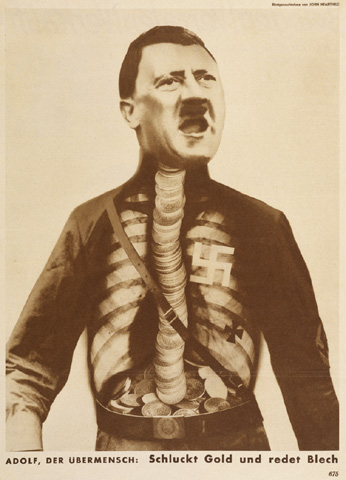
Adolf, the Superman, Swallows Gold and Spouts Tin (1932), John Heartfield
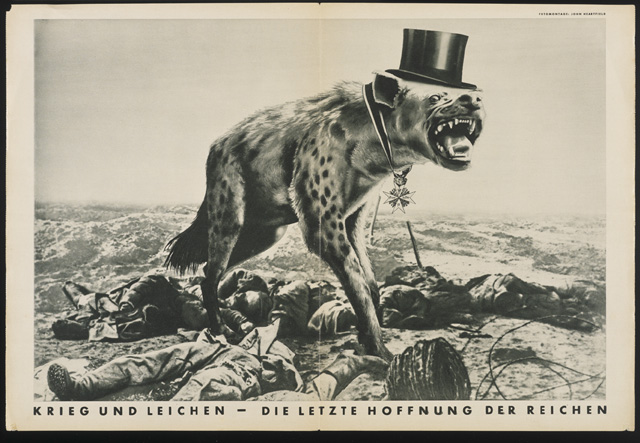
War and Corpses: The Last Hope of the Rich (1932), John Heartfield
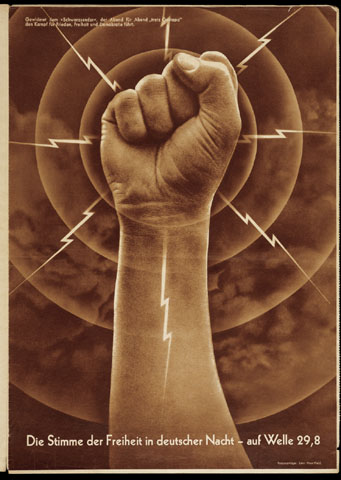
The Voice of Freedom in the German Night on Radio Wave 29.8 (1937), John Heartfield

The surrealism of the presidential artist known as ‘‘⓿

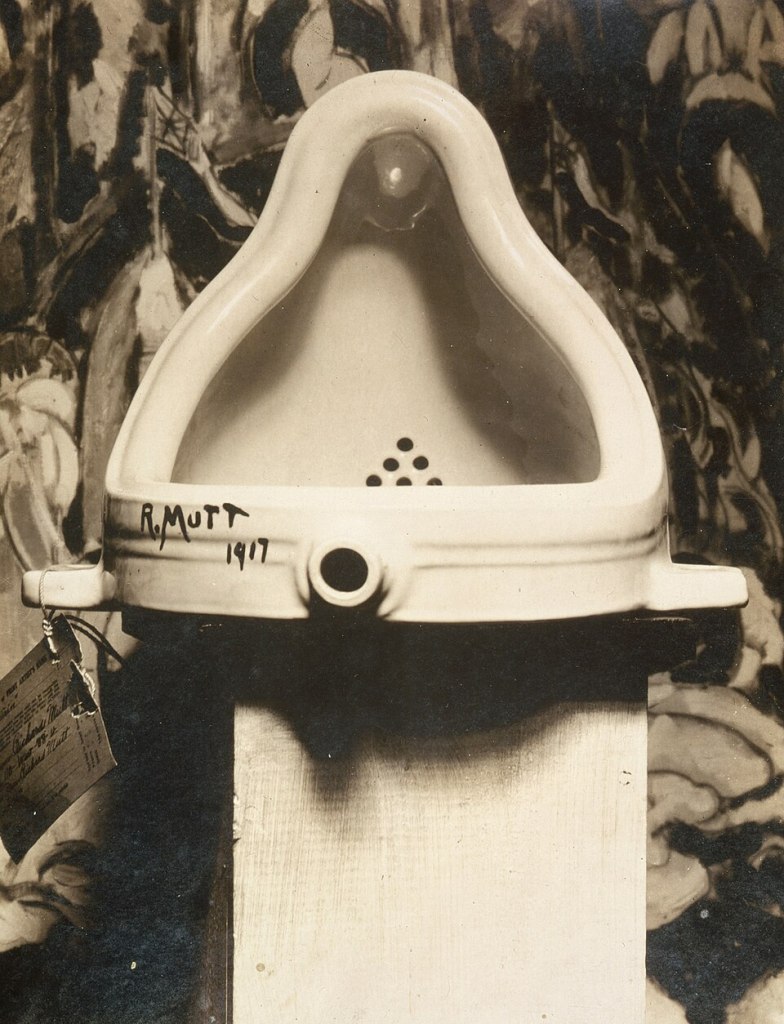
Marcel Duchamp, Fountain (1917)

Dada and Surrealism were significant art movements in the early 20th century. One of the most famous works is Marcel Duchamp’s Fountain* (above), though Duchamp refused to be classified with any of the movements he informed and inspired. These movements also included performances, many of which made no sense then—or now. It was art.

Trying to make sense of the action, speech and thought of the current president defies understanding. Perhaps we have been looking at him through the wrong lens. We think of him as a businessman and currently as the most powerful leader in the world. This has left us shaking our heads. But maybe we are looking at it all wrong.

We may say to ourselves, “This can’t be real!”

Maybe it isn’t real. Maybe it is surreal. Maybe it is the work of an artist so supremely talented that his work and performances go right over our heads.

A beautiful Rose Garden buried in concrete. A giant Reflecting Pool covered with green algae. Every wall in a stately historic mansion decorated in ugly and gaudy gold. Historic texts, a Declaration and a Constitution, burned in front of our eyes. Just a few of the extraordinary works that are still being made.

If all that isn’t cutting edge art, deserving of multiple prizes, I don’t know what is.

* The original Fountain from 1917 is no longer available. Replicas of the original are worth between $2.5 and $5 million. Something for a presidential artist to think about.