Bob Schwartz

Tag: Buddhism

Admonishing Others

Teachings of the Buddha

I found this tiny advice in the small and excellent collection Teachings of the Buddha from Shambhala Publications. These words are now required reading for me every day:

ONE who is about to admonish another must realize within herself or himself five qualities before doing so. [He or she must intend] thus:

“In due season will I speak, not out of season. In truth will I speak, not in falsehood. Gently will I speak, not harshly. To one’s profit will I speak, not to one’s loss. With kindly intent will I speak, not in anger.”

Adapted from the VINAYA PITAKA,
Translated by F. L. Woodward

The Day the Buddha Woke Up

Buddha Comic Bodhi

December 8 is Bodhi Day, the day on which the Buddha’s enlightenment is traditionally celebrated.

The English word “enlightenment” is so packed with meaning that it might be better to just go back to what the Buddha is reported to have said: I am awake.

This is useful because it leads to the two questions: woke up from what and woke up to what?

The Buddha, sitting there under the Bodhi tree, woke up from a journey. Born a royal son, he had fled a life of accidental privilege to answer ultimate questions about suffering and death—the very same questions that consume religious lives of all kinds. He believed that if he tried a, b, and c (such as extreme asceticism), he would discover some secret x, y, and z. There was some kind of magic formula, and all he had to do was learn it. That sort of magic is still at the heart of much of our religion.

He woke up to discover that there was no magic, not in such an instrumental sense. Nothing was different. Suffering and death would not go away, no matter what efforts we make. The best and worst aspects of life would go on, with and without us. Great fortunes would be made and lost. Great structures would be built and then destroyed, by cataclysms natural and human. Love would be here and gone.

But this: He could see something in all of that that made sense of all of that. There is no big plan in which we are players, active or passive, though we could and do make and execute our own little plans. There are just things, relationships between those things, and change, and of all those of a singular piece. We can and do overlay that with all of our very complicated details and distinctions, which is after all a definition of the life we live. But if we discover that underlying existence, we just might choose to live differently. And in that living differently, make change and wake others up. And on and on.

None of that eliminated suffering and death for the Buddha, as it won’t for anyone. He grew old and tired and, legend has it, died from being given spoiled food. He had told his followers what he had discovered, none of which involved magic. It was all about the infinite depth of the ordinary. For him, there was no more a kingdom in the clouds than the kingdom he had left behind when he started his journey. There was just what is. Strive on with diligence, he told those followers at the last.

The Zen Teaching of Homeless Kodo

Zen Teachings of Homeless Kodo

Even if you are not interested in Zen or Buddhism, this is your invitation to discover one of the most fascinating and overlooked figures in 20th century religion.

If you are a student of Zen, and think you have a broad overview of Zen in the last century, you may wonder why you’ve never heard of Kodo Sawaki Roshi (1880-1965), let alone read any of his work. Up to now, circumstances worked against that. But that has changed with the just-published The Zen Teaching of Homeless Kodo from Wisdom Publications. You owe it to yourself to fill that gap.

Lineage is an essential element of Zen, a tracing of the conceptual DNA that reaches back to Bodhidharma, who in the 5th or 6th century BCE legendarily brought Buddhism from India to China. Thus begins the story of Chinese Ch’an (later Japanese Zen) Buddhism.

In the modern Western incarnations of Zen, some lineages are well-known. Arguably the most popular of all teachers in the West is Shunryu Suzuki Roshi, who founded the San Francisco Zen Center. The first collection of his teachings, Zen Mind, Beginner’s Mind, remains the bestselling introduction to Zen practice in English. It is clear and captivating, and it captured many, including me years ago.

Maybe not as well-known, but equally important, is the work of Kosho Uchiyama Roshi. Published at about the same time as Zen Mind, Uchiyama Roshi’s Approach to Zen lacked the design and print sophistication of Suzuki’s book. Instead of Zen Mind’s colorful cover, calligraphy, and fine typesetting, Approach to Zen is plain brown, with simple illustrations hand-drawn by Uchiyama Roshi.

Approach to Zen

Proving that you can’t judge a book by its cover or color, Approach to Zen is an excellent primer on practice and philosophy. It was later expanded into the even more valuable Opening the Hand of Thought: Foundations of Zen Buddhist Practice (where happily a few of the original drawings are kept). If you are Zen-curious, you could do no better than starting with the pair of Zen Mind and Opening the Hand of Thought.

Opening the Hand of Thought

Sawaki Roshi was Uchiyama Roshi’s teacher. Uchiyama Roshi’s best-known student is Shohaku Okumura, whose practice includes being one of the premier translators of Zen texts—now including the work of Sawaki Roshi. In this new book, these three teachers, three points on an extraordinary line, come together.

Zen masters often have complex lives, but more than most, Sawaki Roshi’s story defies quick summary. The emblematic thing to know about his life and teaching is that he was an iconoclast. It is conventional for great teachers to take over a temple, so that they can effectively (and perhaps comfortably) transmit their teachings. Sawaki refused that possibility; he was, as a teacher for decades, without a home.

People call me Homeless Kodo, but I don’t think they particularly intend to disparage me. They say “homeless” probably because I never had a temple or owned a house. Anyway, all human beings without exception are in reality homeless. It’s a mistake to think we have a solid home.

Zen is renowned for straight talk, even when that talk seems to be crooked, wandering around so that the undeniable point remains out of easy reach or reason. In these excerpts, Kodo Sawaki employs the straightest of straight talk—no less philosophically deep than the most puzzling of messages, but as punishing and sometimes sarcastic as a punch in the face.

When people are alone, they’re not so bad. However, when a group forms, paralysis occurs; people become totally foolish and cannot distinguish good from bad. Their minds are numbed by the group. Because of their desire to belong and even to lose themselves, some pay membership fees. Others work on advertising to attract people and intoxicate them for some political, spiritual, or commercial purpose.

I keep some distance from society, not to escape it but to avoid this kind of paralysis. To practice zazen is to become free of this group stupidity.


Some opinions have passed their prime and lost relevance. For instance, when grownups lecture children, they often simply repeat ready-made opinions. They merely say, “Good is good; bad is bad.” When greens go to seed, they become hard and fibrous. They aren’t edible anymore. We should always see things with fresh eyes!

Often people say, “This is valuable!” But what’s really valuable? Nothing. When you die, you have to leave everything behind. Even the national treasures in Kyoto and Nara will sooner or later perish. It’s not a problem even if they all burn down.

Equal to the value of these teachings is the layering of commentary on Sawaki Roshi by his student Uchiyama Roshi and by Uchiyama Roshi’s student Shohaku Okumura. Layered commentary is common not only to Zen, but to many religious and philosophical traditions. Yet this is remarkable for combining erudite exposition about the teachings and Zen with what can only be described as filial respect and affection—that is, love. Though two of the three participants have died, you feel as if you are present for an enlightened three-way conversation among grandfather, father, and son.

You will wish that it would never end. In a sense, it never does or has to. You can take the treasures you find here and incorporate them into your life, your thinking, and, if you are inclined that way, into your practice.

A horse and a cat once discussed the question, “What is happiness?” They couldn’t reach any agreement.


Easter

Gnostic Bible

I am not a Christian, not in any conventional or even unconventional sense. But I have been a student of Christian religion, literature and phenomena for decades. It is part of a religious triangle—or maybe universe—with my native Judaism and my adopted Buddhism.

One of my earliest Christian experiences was reading the Gospel of Thomas, part of the Nag Hammadi Library, a trove of early Christian writings discovered in 1945. That translation of one of the so-called Gnostic Gospels was done by Dr. Marvin Meyer; I did not know that years later I would work with and become friends with him. What I did know on first reading (and on first meeting) was that the late Dr. Meyer was brilliant. (You may well have seen him on many of the History and Discovery Channel type biblical shows.)

For this Easter, I include a selection from the Gospel of Thomas. It is taken from The Gnostic Bible, edited by Dr. Meyer and by the equally-brilliant poet, translator and scholar Willis Barnstone.

The Gospel of Thomas, often called the Fifth Gospel, is a work of sayings and wisdom; there is no action. Some of the sayings are similar to those that appear in the canonical gospels. Others are more assertively cryptic and mysterious, puzzling in the same way that Zen koans are. This section, appropriately for Easter, is about life and death:

11

Yeshua (Jesus) said,
This heaven will pass away
and the one above it will pass away.
The dead are not alive
and the living will not die.
During the days when you ate what is dead
you made it alive.
When you are in the light, what will you do?
On the day when you were one
you became two.
But when you become two, what will you do?

Willis Barnstone’s most recent work is The Restored New Testament, a monumental achievement in which he single-handedly translated the entire NT (including Gnostic Gospels) and provided hundreds of pages of lucid and enlightening commentary. In that book, he offers this wisdom for a modern age:

In the end, all people are people, and no people should ever be classified for whatever reason as less than another. Any marker of sect and theology that distinguishes any people adversely is human and humane error. So the gospels and Apocalypse should not be seen for the momentary and external conflicts they may contain, but rather for their greater universality of spirit in a world desperately poor in coming to terms with human consciousness within the perishable body. Happily, the call to spirit is deep and needs no name, and no divisive emblem. The New Testament is a book of the mind; it is infused with compassion and courage and the great questions of being, death, time, and eternity. For the perceptive reader, spirit eludes name, dogma, and even word to reside in the silence of transcendence.

Beyond Anger: How to Hold On to Your Heart and Your Humanity in the Midst of Injustice

Beyond Anger
The crisis in Ukraine is deepening, and with that lots of thought, opinion, and calls for action. It may seem like the wrong time for self-awareness and contemplation. Enough talk. This is a Nike world, so let’s just do it.

Whether it is about the Russian invasion of Ukraine or about unfairness in our own nation, our desire for justice and aversion to injustice is a good thing. But it can be so powerful and overwhelming that we easily get lost. It isn’t that we shouldn’t act decisively; it’s that in our zeal, we can be confused or overly certain about what the right decision is.

Last summer, in the face of terrible killings in India that had profound implications for Buddhist communities, Shambhala Publications published a free book you can get, Beyond Anger: How to Hold On to Your Heart and Your Humanity in the Midst of Injustice.

The publisher explains:

In July 2013, multiple bombs exploded in Bodh Gaya, India, in and around the holiest Buddhist pilgrimage site, the Mahabodhi temple that marks the spot where the Buddha attained enlightenment. In response, Shambhala Publications offers this free eBook consisting of excerpts from some of our books from a variety of Buddhist traditions that encapsulate values of love and nonviolence, which we can all practice ourselves.

You may not be a Buddhist, or care about Buddhist philosophy. You may or may not be angry about what is going on around the world, or about what some people say about how to solve the problems. You may believe that you have a better way, and you may be right. It’s just that no matter what, a different perspective can always be helpful.

In a section of the book called Conflict Resolution: Anger Is the Problem, The Karmapa, Ogyen Trinley Dorje talks about Global Conflicts, Global Solutions:

When bigger and more powerful nations step in to offer guidance to other nations, many of the same principles apply as when individuals intervene to resolve interpersonal conflicts. A sincere motivation is absolutely key, and on top of that, the intervention must be done with sensitivity and skill.

In this small world we live in, nations coexist interdependently. The actions of one country affect others deeply. Countries with more power have the potential to influence others more. I believe that with this power comes a great deal of responsibility, and that includes the responsibility not to exercise one’s power over others in pursuit of the private interests of one’s own nation….

Before you approve the actions proposed, you should be confident that they are in the best interest not only of your country, but of the world as a whole. To be a responsible, conscious citizen, it is important that you think for yourself, and take universal peace, stability, and well-being into account. Use your discernment and take a stand that serves the whole world, not just one corner of it.

Even when we are sure that the motivation to contribute positively to the well-being of the world is sincere, we also have to scrutinize the means used to pursue that aim. For example, in the name of bringing freedom to other countries, weapons are produced and wars are waged. As powerful countries themselves expand their arsenals and wage more war, the peace and stability of their own country and of the world are both placed at risk.

Again, a pure motivation needs to be applied with wisdom. I feel very strongly that war and fighting are not an effective means to bring about peace or prosperity, stability or freedom. I am certain that history will demonstrate war to be ineffective and counterproductive in the long run.

I have met many people from powerful countries who are deeply unhappy with how their leaders wield their power internationally. This seems especially common when people have failed in their efforts to urge the decision makers to pursue a more compassionate and skillful course. Some of these people become angry at their own governments. In other cases, people direct their anger at the governments of other countries.

If you find yourself angry at any government, please recollect how harmful anger is to yourself and others, and steady yourself with a firm resolve. Make an unwavering commitment to yourself that you will not allow your mind to become perturbed. Be immovable—unshakable from a peaceful state of mind.

Is Pope Francis the Leader of the World?

Pope Francis
The Dalai Lama is the most famous Buddhist in the world. His message is powerful, positive and universal. Even with the huge platform he has, his brand of Tibetan Buddhism is a bit exotic for many people, so still somewhat limited. He is also one of the coolest people on the planet. So as much as a basic Buddhist message would be great for the world at large to take to heart, it isn’t about to happen.

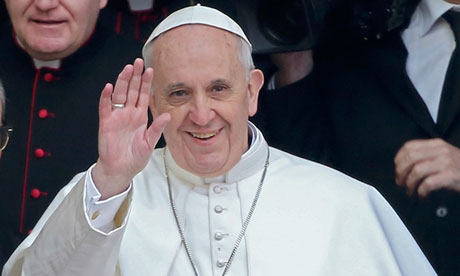
Pope Francis is also an outsized moral leader. He is the head of a church with more than a billion followers. And while there are hundreds of millions of Protestant Christians who question whether that church and its Pope can claim Christian legitimacy—and who find the Catholic Church plenty exotic too—you can’t deny the size and scope of the Pope’s Christian community. And if the Dalai Lama is cool, so is Pope Francis; he was once a bar bouncer, which is something the Dalai Lama can never claim.

The biggest argument for the supreme leadership role of Pope Francis is that he is exactly the right person for the right time, acting and speaking on a very big stage. Two of the major characteristics of the moment are that materialism seems to be failing or failing us and that our changing social universe requires some tricky balance between the old and the new, the absolute and the relative.

Pope Francis gets this and sells this from the very foundations of his faith. He has just had to deny that his is a not a Marxist, but proceeded in the same breath to appreciate the work of those who sincerely act in the name of Marxist ideals. It is not just that he seems to have a vision that synthesizes the original Christian communities with the complicated world two millennia later. He sees in the very institution he is charged with running the embodiment of the problems. If the institutional church, the church membership and the world have lost their way, it is not his job to order them around. Instead he just points to a playbook that is to be taken seriously, not selectively and strategically, and advises to live by and as its example. It’s a choice, one he has made, one he hopes others, from the church hierarchy on out, will make.

Whether the Catholic Church straightens out its affairs, whether disaffected Catholics return, whether new Catholics arrive, whether we are Catholic or Protestant or Jewish or Buddhist is beside the point and beside the Pope’s point. It is about being better and getting better. Pope Francis is not the first to say that, not even the first Pope to say it. But his walking the walk in the world of 2013 is different. These are the times that try people’s souls. We seem to have a world leader willing to make that reality both an ancient and modern quest, a quest that may, in the real and not theological sense, save us all.

Buddha’s Enlightenment Day

Buddha Comic Cover
Known as Bodhi Day, the Buddha’s day of enlightenment is called Rohatsu in Japan and is celebrated there on December 8th.

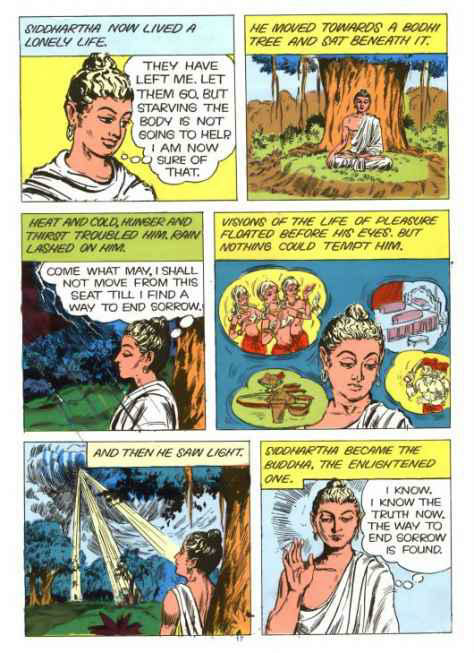
Here is a page from a Buddha comic book illustrating the event. It is published by the Indian company Amar Chitra Katha, which publishes a number of fascinating religious comic books—not only about Hinduism and Buddhism, but about Sikhimism, Zorostrianism and others.

Buddha Comic Enlightenment

In stillness, mind and object merge in realization and go beyond enlightenment. Thus, in the state of receptive samadhi, without disturbing its quality or moving a single particle, you engage the vast buddha activity, the extremely profound and subtle buddha transformation.

Grasses, trees, and lands that are embraced by this way of transformation together radiate a great light and endlessly expound the inconceivable, profound dharma. Grass, trees, and walls bring forth the teaching to all beings, including common people and sages; all beings in response extend this dharma to grass, trees, and walls. Thus, the realm of self-awakening and awakening others invariably holds the mark of realization with nothing lacking, and realization itself is manifested without ceasing for a moment.

This being so, the zazen of even one person at one moment imperceptibly accords with all things and fully resonates through all time. Thus, in the past, future, and present of the limitless universe, this zazen carries on the buddha’s transformation endlessly and timelessly. Each moment of zazen is equally the wholeness of practice, equally the wholeness of realization.

This is so not only while sitting; like a hammer striking emptiness, before and after its exquisite sound permeates everywhere. How can it be limited to this time and space? Myriad beings all manifest original practice, original face; it is impossible to measure. Even if all buddhas of the ten directions, as innumerable as the sands of the Ganges, exert their strength and with the buddha wisdom try to measure the merit of one person’s zazen, they will not be able to fully comprehend it.

Dogen Zenji, On the Endeavor of the Way
Treasury of the True Dharma Eye

Stamping Eid al-Adha


The relationship between American society and Islam is complicated.

At this point in history, there are few sentences that could be more absurdly understated. In so many spheres, that relationship is, to be polite, messed up beyond all reason.

There is a long and growing list of events and phenomena that contribute to and reflect those complications. How the world’s largest or second-largest religion (depending on accounting) became so toxic in the world’s most tolerant democracy is a story still being written. No doubt having a black President whose father was a Muslim, who spent part of his youth in the world’s most Muslim country, and whose middle name is Hussein is the latest part of that.

The Postal Service, out of a sense of decency and diversity and political realities, rushes in where others fear to tread. This is itself a complicated thing.

October 26 is Eid al-Adha (“Feast of the Sacrifice”), the major holiday on the Muslim calendar.

Islam shares many stories with its Abrahamic precursors, Judaism and Christianity, though some of the scripture is added to or modified. So it is with the story of Ibrahim (Abraham) and his son Ishmael (Isaac). Ibrahim and Ishmael are said to have built the Kaaba, the building in Mecca that is the centerpiece of the commanded pilgrimage—the hajj. Ibrahim was also told in a dream to sacrifice his son as a sign of obedience to Allah and, as in the Old Testament, was stopped only at the last moment when Ishmael was replaced by a sacrificial sheep.

Eid al-Adha marks the end of the annual pilgrimage and Ibrahim’s faithful near-sacrifice of his son. (For discussion elsewhere, the question of how this deep and fascinating father-son sacrifice in the Old Testament—see, e.g., Kierkegaard’s Fear and Trembling—is not on the Jewish calendar, but became such a central event of the Christian and Muslim calendars.)

Some think that the Postal Service should not be in the business of commemorating religious holidays and people, given the wall—the admittedly porous wall—between church and state. The Mother Teresa stamp issued in 2010 is just one of those flash points. The Postal Service explains:

Following the announcement of the Mother Teresa stamp, groups such as the Freedom from Religion Foundation objected to the Postal Service’s seeming violation of its own guidelines.

“We received numerous letters saying that we should not be doing religious stamps,” says Terry McCaffrey, manager of stamp development. “But we are honoring her for her humanitarian work, not for being a member of a religious order.”

After all, McCaffrey asks, to what extent should religious inspiration disqualify an otherwise worthy subject?

Over the years, many religious figures have been depicted on stamps in recognition of their contributions to society, independent of their personal motivations or beliefs. Stamp honorees have included Dr. Martin Luther King, Jr., for leading the struggle for civil rights, Father Edward Joseph Flanagan for his work with delinquent and homeless boys, and Padre Félix Varela for his advocacy for the immigrant poor.

Still, the signs of protest for Mother Teresa were stronger than with most stamps.

As for minority religions, the Postal Service shies away (but see Hanukkah below). No Buddhism, for example. Interestingly and somewhat surprisingly, the Postal Service did dip its toe in Mormon waters. In December 2005, it gave a nod to the 200th anniversary of Joseph Smith’s birth, not with a stamp, but with the much less substantial cancellation mark. Note below that the Postal Service did not issue this postcard; that is privately produced. The only government involvement is the cancellation mark. Also notable is that given it was holiday season, this postcard includes a Madonna stamp to go along with the Joseph Smith cancellation.

Holidays provide a little bit of cover for the Postal Service. Instead of unacceptably eliminating Christmas, the Postal Service went to religious inclusiveness and diversity. So we have a Hanukkah stamp for Judaism—even though Hannukah is a relatively minor holiday on the Jewish calendar.

A few years ago, we were offered a Muslim stamp for the Eid feasts:

This stamp commemorates the two most important festivals — or eids — in the Islamic calendar: Eid al-Fitr and Eid al-Adha, and features the Arabic phrase “Eid mubarak” in gold calligraphy on a blue background. Eid mubarak translates literally as “blessed festival,” and can be paraphrased “May your religious holiday be blessed.”

Employing traditional methods and instruments to create this design, calligrapher Mohamed Zakariya of Arlington, VA, working under the direction of Phil Jordan of Falls Church, VA, chose a script known in Arabic as “thuluth” and in Turkish as “sulus.”

As shown above, the Postal Service modified the Eid stamp in 2011, keeping the exquisite calligraphy, changing the color from blue to red, and issuing it as a Forever® stamp:

The U.S. Postal Service® commemorates the two most important festivals — or eids — in the Islamic calendar: Eid al-Fitr and Eid al-Adha. On these days, Muslims wish each other Eid Mubarak, the phrase shown in calligraphy on the stamp. Eid Mubarak translates literally as “blessed festival” and can be paraphrased “May your religious holiday be blessed.” This Eid stamp features gold calligraphy against a reddish background.

Saying that the original Eid stamp was issued “a few years ago” is imprecise. It was actually issued on September 1, 2001—ten days before 9/11. It seems that this small step in the direction of recognition and tolerance got lost in some twisted history that as a country we are still trying to straighten out.

The stamp is available for purchase from the Postal Service. And even if you are not among the 1.7 billion people celebrating Eid al-Adha next week, it is still a beautiful addition to any piece of mail—and a beautiful statement.

Why Compassion Matters


On August 4, in a hospital just a few miles from where this post is being written, John Wise, 66, snuck into the room where his wife Barbara, 65, was lying. They had been married for 45 years. She was suffering, reports indicate, from a triple aneurysm, and her prognosis appears to have been poor. He ended her life, shooting her in the head, though she did not die until the next day. His plan to shoot himself immediately after that was thwarted when his gun jammed. This week, he was charged with aggravated murder and faces life in prison without parole.

This has raised, not for the first or last time, the issue of mercy killing in the face of untreatable illness and declining quality of life. With an aging and ailing population, whether it is our family or ourselves, this goes each passing day from the abstract to the very real.

You can deal with this on an intellectual and practical level, weighing moral and legal issues, determining what you might do or ask others to do under a variety of circumstances. But hearing this story, the most natural thing is to cry. Not out of any failure to resolve those issues, but out of sheer compassion.

Compassion is what matters. All of our spiritual traditions commend it, but maybe none makes it more plainly central than Buddhism. The first truth of Buddhism is the reality of suffering; all else in how we are to live stems from this.

The story is told of a woman whose child had died. She came to the Buddha, who instructed her to visit neighbors and to return with a mustard seed from a house that had not been touched by death. She came back empty handed. This wasn’t to make her feel “better,” which it couldn’t. This was to help her see herself where she was, a living drop in the sea of suffering.

Compassion is more than walking in another’s shoes, more than the Golden Rule, more than “no man is an island.” It is the deepest possible recognition, beyond words, of the need that universal suffering creates. The need to care unconditonally.

If compassion is present in our lives and our politics, whatever we do cannot be completely wrong. If compassion is absent, nothing we do can be right, no matter how good it is meant to seem.

The NBA And The Buddha: Discourse On The Loving Kindness Of The Player Formerly Known As Ron Artest


Just yesterday on an NBA broadcast, former Los Angeles Laker superstar Earvin “Magic” Johnson stumbled over the name of current Laker star Ron “Metta World Peace” Artest. Those quote marks for Artest are imprecise. Magic is not Johnson’s real name; it is simply the nickname accorded to him for his achievements on the court. Metta World Peace is Artest’s legal name, since he changed it in September 2011.

Over the course of his career, the adjective most often used to describe Mr. World Peace is “eccentric.” Whether or not people keep track of these things, he may have had more different numbers than anyone in NBA history; his current number 37 is the number of weeks that Michael Jackson’s Thriller album was at the top of the charts.

Beyond eccentric, he has been involved in a number of infamous altercations. In April, his elbow to the head of Oklahoma City Thunder’s James Harden caused a concussion, and resulted in World Peace’s seven-game suspension. (The speculation that Harden’s beard, which is one of the most splendid in all of sports, may have set World Peace off is unsupported.)

Earvin was dubbed “Magic” for his abilities, following a high school game that featured his triple-double of 36 points, 18 rebounds and 16 assists. NBA player Lloyd Free got the nickname “World” growing up in Brooklyn, because of his skills going to the basket, including his 360-degree turns. In 1981 he made it official by changing his name to World B. Free.

Metta World Peace did not get his name by acclamation. It was presumably chosen to reflect something about the man and the player. World Peace seems pretty obvious. But what about Metta?

Metta is a Pali word used in Buddhism. It means kindness, friendliness or compassion. The text known as the Metta Sutta (The Buddha’s Discourse on Loving-Kindness) is one of the oldest in the Buddhist canon, and is recited daily by many Buddhist monks and lay people. Here is one of many translations of this beautiful and essential work, by Sharon Salzberg:

This is what should be done
By those who are skilled in goodness,
And who know the path of peace:

Let them be able and upright,
Straightforward and gentle in speech,
Humble and not conceited,
Contented and easily satisfied,
Unburdened with duties and frugal in their ways,
Peaceful and calm, and wise and skillful,
Not proud and demanding in nature.

Let them not do the slightest thing
That the wise would later reprove.
Wishing: in gladness and in safety,
May all beings be at ease.

Whatever living beings there may be;
Whether they are weak or strong, omitting none,
The great or the mighty, medium, short or small,
The seen and the unseen,
Those living near and far away,
Those born and to-be-born—
May all beings be at ease!

Let none deceive another,
Or despise any being in any state.

Let none through anger or ill-will
Wish harm upon another.

Even as a mother protects with her life
Her child, her only child,
So with a boundless heart
Should one cherish all living beings;
Radiating kindness over the entire world,
Spreading upward to the skies,
And downward to the depths;
Outward and unbounded,
Freed from hatred and ill-will.

Whether standing or walking, seated or lying down,
Free from drowsiness,
One should sustain this recollection.
This is said to be the sublime abiding.

By not holding to fixed views,
The pure-hearted one, having clarity of vision,
Being freed from all sense desires,
Is not born again into this world.

To move from one branch of Buddhism to another (the Metta Sutta belonging mainly to the Theravada, Zen being part of the Mahayana), it seems we are faced with a Zen koan, a paradox aimed at confounding our thinking into beyond thinking:

How and why would a man known for fits of violent confrontation take the names Metta and World Peace? Is it aspirational, a reminder to him of an ideal to reach or not reach, even as he was inflicting pain? Is it instructional, forcing people to look up and find the Metta Sutta, for the benefit of themselves and all beings? Or is it, as with all koans, never meant or able to be solved, by Ron Artest, Metta World Peace, or anyone?

May all beings be at ease!