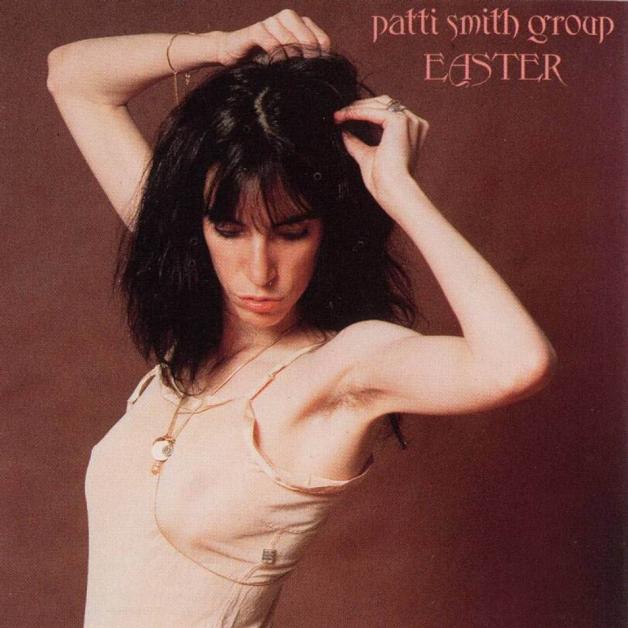
Sometimes it is done with Patti Smith. She (along with Zen masters, along with other musicians like Kurt Cobain) is in the lineage of the Beat Poets, who faced with a crazy world, talked crazy. Or so it seems. Songbird inmates of the asylum. Don’t try to get out; you were never in.
This from Space Monkey on Patti Smith’s Easter:
Space monkey, sign of the time, time Space monkey, so outta line, line Space monkey, sort of divine And he’s mine, mine, oh he’s mine
A stranger comes up to him Hands him an old, rusty Polaroid It starts crumbling in his hands He says, “Oh man, I don’t get the picture This is no picture, this is just, this just a, this just a”
“This is my jack-knife, this is my jack-knife This is my jack-knife, this is my jack”
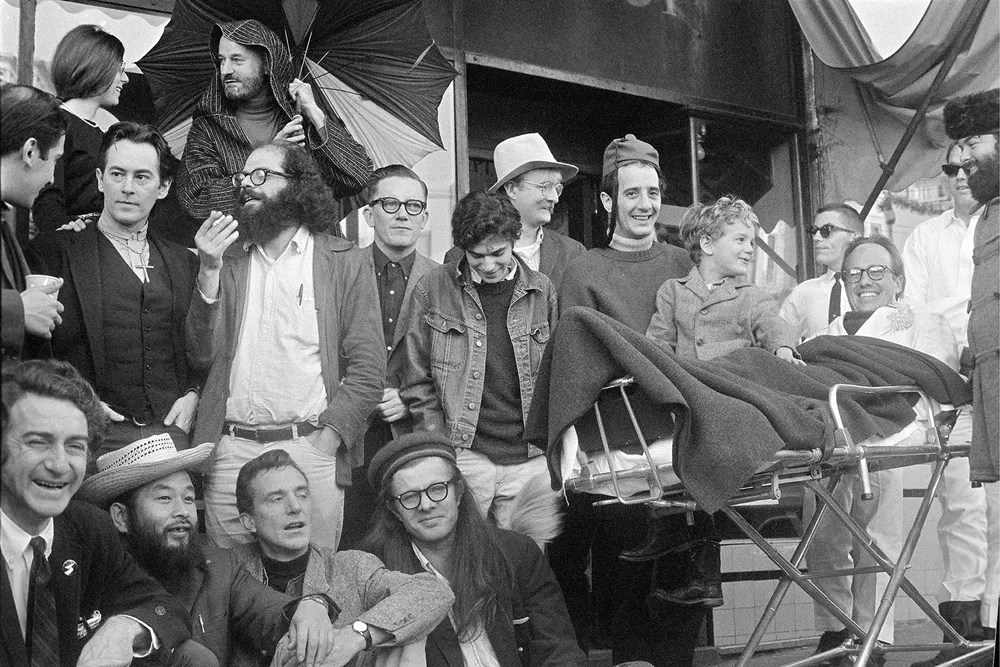
The Last Gathering of the Beats, City Lights Bookstore, San Francisco’s North Beach, December 1965
Pictured: Allen Ginsberg: Poet, left-center, holding a cigarette. Lawrence Ferlinghetti: Poet, publisher, owner of City Lights Bookstore, behind Ginsberg, umbrella. Michael McClure: Poet, standing to the left of Ginsberg, vest and cross necklace. Robert Duncan: Poet, front row toward the center-right, wearing glasses and beret. Richard Brautigan: Poet and writer, toward the right, behind the stretcher, light hat and glasses. Shigeyoshi Murao: Manager of City Lights, seated in the front with wide-brimmed hat.
Note: The title of this post is a version of the title Let’s Get Lost, a jazz standard from the 1940s made famous in the 1950s by legendary West Coast trumpeter and singer Chet Baker. Not exactly a beat guy, but immeasurably cool.
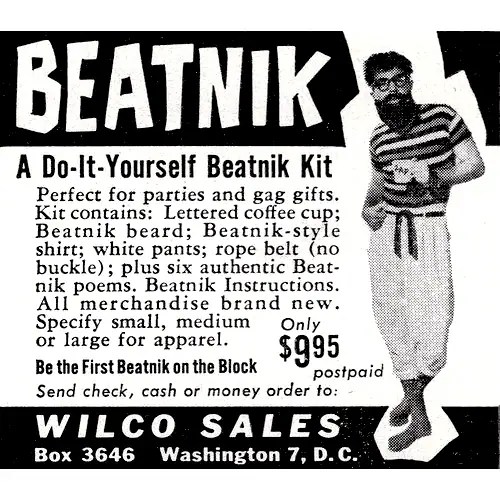
The Beat movement, its heyday in the 1950s and into the 1960s, has been viciously caricatured.
Two things defy and belie this mockery.
First, this was an earnest response to a country and world gone mad. Just years from World War II, Hitler, the spawning of the atomic bomb. Living in an America intent on repressing dissidence and killing attempts to (re)introduce humanity. The beats were the first postwar counterculture, but not the last.
Second, the next counterculture, which included hippies, was also caricatured and mocked (“get a haircut”, “get a job”). This was the natural evolution of the beat counterculture, and there were a number of crossovers. “Freaks” was a term of self-identification that proudly encapsulates what the dominant culture thought of those living and believing differently.
“Let’s get beat” is not a call for cool cats or chicks to grow a beard or learn to play bongos—though beards are again back and playing bongos is fun. It is a reminder that counterculture has a heritage that is just as important as whatever distorted heritage is going to be pushed on us in 2026 as part of the 250th anniversary of America’s declaring its independence. Celebrate the beats, the hippies, the freaks, and all the other cultural free birds. Let’s declare our independence. Let’s get beat!