Translation: Pure and light like God’s angel, In the hand, the sail and flag, Loaded full with blessings The New Year is arriving now!
The New Year 5784 on the Hebrew calendar begins this evening at sundown.
A traditional greeting is l’shana tova tikateivu (May you be inscribed for a good year [in the Book of Life]).
This begins the ten days of the High Holidays, aka the Days of Awe. It ends with Yom Kippur—the Day of Atonement, the Day of Repentance.
Solemnity, introspection and commitment to betterment is paired with wishes for a sweet year. Although it is also considered the birthday of the world, there is no birthday cake. There are candles, and also the tradition of eating apples dipped in honey.
Let us all wish better for ourselves and everyone and, more than that, let us do whatever we can, big or small, to help make better happen.
Over decades—almost a century—this poem has had a “tangled story” in popular culture. For years misattributed, it is in fact the work of Max Ehrmann. It reached peak popularity in the 1960s and 1970s, when it was everywhere. At various times cynics criticized and mocked it as saccharine cliché and counterculture/new age nonsense. On the contrary, it is a simple and accessible statement of pragmatic idealism. “With all its sham, drudgery and broken dreams, it is still a beautiful world. Be cheerful. Strive to be happy.”
Desiderata
Go placidly amid the noise and the haste, and remember what peace there may be in silence. As far as possible, without surrender, be on good terms with all persons.
Speak your truth quietly and clearly; and listen to others, even to the dull and the ignorant; they too have their story.
Avoid loud and aggressive persons; they are vexatious to the spirit. If you compare yourself with others, you may become vain or bitter, for always there will be greater and lesser persons than yourself.
Enjoy your achievements as well as your plans. Keep interested in your own career, however humble; it is a real possession in the changing fortunes of time.
Exercise caution in your business affairs, for the world is full of trickery. But let this not blind you to what virtue there is; many persons strive for high ideals, and everywhere life is full of heroism.
Be yourself. Especially do not feign affection. Neither be cynical about love; for in the face of all aridity and disenchantment, it is as perennial as the grass.
Take kindly the counsel of the years, gracefully surrendering the things of youth.
Nurture strength of spirit to shield you in sudden misfortune. But do not distress yourself with dark imaginings. Many fears are born of fatigue and loneliness.
Beyond a wholesome discipline, be gentle with yourself. You are a child of the universe no less than the trees and the stars; you have a right to be here.
And whether or not it is clear to you, no doubt the universe is unfolding as it should. Therefore be at peace with God, whatever you conceive Him to be. And whatever your labors and aspirations, in the noisy confusion of life, keep peace in your soul. With all its sham, drudgery and broken dreams, it is still a beautiful world. Be cheerful. Strive to be happy.
Tonight begins our preparation for Rosh Hashanah, the Jewish New Year, a period known as Selichot. See one of my previous messages (human written).
This year I’m turning over at least one High Holidays message to Rabbi AI. I asked various AI generators to message about “Selichot”. Two of the texts are below. I could have asked for new messages, but I thought I’d start with Rabbi AI’s first impressions. Turns out Rabbi AI seems to know its Judaica, which is what you’d expect, not because it’s a rabbi but because Rabbi AI knows everything, or at least claims to. Whether Rabbi AI is actually Jewish is a question for another day, or for the ages.
Selichot: Seeking Forgiveness and Divine Mercy
As the days grow shorter and the air turns crisp, we find ourselves on the threshold of a sacred season. The time has come for Selichot, a period of introspection and repentance that prepares our hearts for the upcoming High Holy Days.
Selichot, derived from the Hebrew word “slicha” meaning forgiveness, is a time when we humbly approach the Divine, seeking forgiveness for our transgressions and reflecting on our actions throughout the year. It is a time of deep introspection, a time to examine our deeds, and a time to make amends.
During Selichot, we gather together as a community, joining our voices in prayer and supplication. We recite heartfelt prayers and penitential poems, known as piyutim, that express our remorse and yearning for forgiveness. These ancient words resonate with the struggles and aspirations of our ancestors, connecting us to a rich tapestry of faith and tradition.
In the darkness of the night, we light candles and dim the lights, creating an atmosphere of solemnity and reflection. The haunting melodies of the Selichot prayers fill the air, evoking a sense of awe and humility. We beseech the Divine, acknowledging our shortcomings and expressing our sincere desire to change and grow.
Selichot is not just a time for personal reflection; it is also an opportunity to seek reconciliation with others. We are encouraged to reach out to those we may have wronged, seeking forgiveness and offering our own forgiveness in return. It is a time to mend broken relationships and heal the wounds of the past.
As we recite the Selichot prayers, we are reminded of the boundless mercy and compassion of the Divine. We are reassured that no matter how far we may have strayed, there is always a path back to forgiveness and redemption. Selichot serves as a reminder that we are never alone in our journey towards self-improvement and spiritual growth.
May this season of Selichot be a time of deep reflection and transformation. May we find the strength to confront our shortcomings and the courage to seek forgiveness. May we be granted the mercy and compassion we so earnestly seek, and may we emerge from this sacred season renewed and ready to embrace the blessings of the High Holy Days.
L’shanah tovah u’metukah – May you have a good and sweet year ahead.
ChatGPT 3.5
We gather on this night before Rosh Hashanah to pray selichot and reflect on the coming High Holy Days. This is a time for introspection, for looking deeply within ourselves to identify ways we can improve.
God, you are our creator and judge. In your mercy and compassion, you give us another year to better ourselves and come closer to you. During these Days of Awe, help us rid ourselves of harmful habits and behaviors. Strengthen our yetzer hatov, our good inclination, so we make ethical choices that uplift others.
Forgive us for times we have hurt others with our words or actions. Forgive us for squandering opportunities to do good. Help us learn from our mistakes and resolve to act with greater kindness, patience and understanding going forward.
As we enter the New Year, may we fill our lives with more prayer, learning, charity and acts of lovingkindness. May we build each other up with compassion instead of tearing each other down. And may the coming year bring us and all people comfort, prosperity, good health and peace.
Claude Instant 1.2
Rabbi AI may know its yiddiskeit. But it does not appear to be much of an artist. Or it is a rabbi and an artist far beyond anything we can comprehend.
Above is the first image generated when prompted with “Selichot”. Feel free to use it to help find the meaning of the upcoming holidays. Or of anything and everything.
Shabbat shalom and shana tova. A peaceful Sabbath and a good new year.
I’ve been listening to and reading poems seemingly forever, starting with nursery rhymes. When poetry was assigned in school, standard stuff like Shakespeare and Robert Frost, I liked it.
At some point, particular poets really spoke to me, as they did to other young people. One sign of when a relationship with a poet got serious is when a girlfriend noticed and so bought me a book of their poems for my birthday. I suppose I was wearing that poet on my heart and on my sleeve.
The first of the books I got this way is Collected Poems of Dylan Thomas. That sweet girlfriend is long gone and far way, but I’ve never gotten over Dylan Thomas (why would I?). Lines from these poems still echo in my head from time to time, as recently as this morning: “In my craft or sullen art”.
Who was your first poet crush?
In My Craft or Sullen Art by Dylan Thomas
In my craft or sullen art Exercised in the still night When only the moon rages And the lovers lie abed With all their griefs in their arms, I labour by singing light Not for ambition or bread Or the strut and trade of charms On the ivory stages But for the common wages Of their most secret heart. Not for the proud man apart From the raging moon I write On these spindrift pages Nor for the towering dead With their nightingales and psalms But for the lovers, their arms Round the griefs of the ages, Who pay no praise or wages Nor heed my craft or art.
“No other personality is as old, as well known, or as widely distributed among the tribes as Coyote. He was the figure of paleolithic legend among primitive peoples the world over and, though he survives today in Eurasian and African folktales, it is among native Americans, perhaps, that his character achieves its fullest dimension.
In an essay on the psychological roots of the character, Stanley Diamond likened Coyote to a primitive essence of conjoined good and evil; at a time in the history of man when there was no rigid distinction between good and evil, Coyote was, Carl Jung, one of a number of thinkers intrigued with Coyote, wrote that he was “in his earliest manifestations, a faithful copy of an absolutely undifferentiated human consciousness, corresponding to a psyche that has hardly left the animal level. He is,” continued Jung, “a forerunner of the savior, and like him, God, man and animal at once. He is both subhuman and superhuman, a bestial and divine being.””
Barry Holstun Lopez, Giving Birth to Thunder, Sleeping with His Daughter: Coyote Builds North America
AI
You know.
The smart money is on Coyote. If you are smart, you will try to learn from Coyote instead of AI. Coyote is unmatched in adaptability, no matter what is thrown at it, including constant attempts at extinction. Coyote is not only succesfully aware of and responsive to the environment and itself. It is the environment and itself. Compared to Coyote, AI should be AS—Actual Stupidity. Plus, Coyote talks and sings better than anything.
Book and movie people associate “Bonfire of the Vanities” with the 1987 bestselling novel by Tom Wolfe or with the box office bomb released in 1990 based on the book.
The historic background of “bonfire of the vanities” is explained by Michael Dirda in the Washington Post:
“For approximately four years, from 1494 to 1498, a Dominican monk and preacher was first the conscience, then the virtual king of Florence. His admirers, indeed followers, included the Neoplatonic philosopher Pico della Mirandola, the young Machiavelli and the painter Botticelli. His two greatest enemies were just as eminent: Piero de’ Medici, that feckless son of Lorenzo the Magnificent and heir to his father’s dictatorship of the city, and that charming arch-sensualist Pope Alexander VI, among the most notorious of the notorious Borgias. The simple monk himself would pass into legend as the scourge of the rich and corrupt, a fanatical moralist, an accused heretic and, finally, a martyr.
Nowadays, though, people tend to recognize the name Girolamo Savonarola (1452-1498) chiefly because he instituted the original “bonfire of the vanities.” In 1497, this crusading prior of San Marco (blessed with paintings by Fra Angelico) berated the Florentines over the fripperies they wore, the salacious books they read, the provocative paintings they hung on their walls, the gold and silver jewelry that flashed even in the half-light of the sacred cathedral, all the gaudiness, luxury and lasciviousness of their sinful lives. Away with these snares of the devil! And so, rather than celebrate the last day before Lent with a lewd carnival, Savonarola called for the faithful to cast their “vanities” onto a great pyramid of holy fire. And they did.”
For those with biblical tendencies, vanities are associated with the famous line that opens the Book of Ecclesiastes, known in the Hebrew Bible as Kohelet [Preacher]. In Hebrew:
Hevel, hevel, amar kohelet, hacol havelim.
In the King James version:
Vanity, vanity, says the preacher, all is vanity.
But translation of the Hebrew hevel remains a challenge to modern translators. A number of English words have been proposed including:
Absurd Futile Senseless Meaningless Breath Vapor
Each of these seems related to vanity, but each resonates differently to our ears.
Are we to burn the secular luxuries and distractions that pull us away from the divine, as Savonarola directed?
Or are we to keep those luxuries and distractions around—all of us are human and few of us are ascetics—provided we stay as unattached as possible, realizing that all of it is ephemeral. Like breath. And absurd. Like everything.
Oh, you don’t get me, I’m part of the union You don’t get me, I’m part of the union You don’t get me, I’m part of the union Till the day I die Till the day I die
Plenty of earnest Labor Day messages. Like this and this and this.
How about a song?
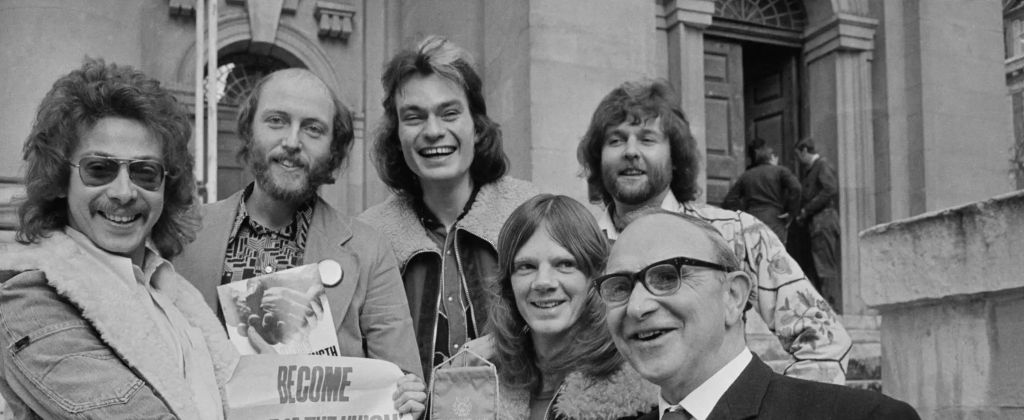
A 1973 song about unions that rose to #2 in the UK pop charts, by an unheralded band you’ve probably never heard of (only 17,000 listeners on Spotify), a song that became an unofficial anthem of the British trade union movement.
Part of the Union by the Strawbs
Now I’m a union man Amazed at what I am I say what I think, that the company stinks Yes I’m a union man
When we meet in the local hall I’ll be voting with them all With a hell of a shout, it’s “Out brothers, out!” And the rise of the factory’s fall
Oh, you don’t get me, I’m part of the union You don’t get me, I’m part of the union You don’t get me, I’m part of the union Till the day I die Till the day I die
Us union men are wise To the lies of the company spies And I don’t get fooled by the factory rules ‘Cause I always read between the lines
And I always get my way If I strike for higher pay When I show my card to the Scotland Yard And this is what I say
Oh, oh, you don’t get me, I’m part of the union You don’t get me, I’m part of the union You don’t get me, I’m part of the union Till the day I die Till the day I die
Before the union did appear My life was half as clear Now I’ve got the power to the working hour And every other day of the year
So though I’m a working man I can ruin the government’s plan And though I’m not hard, the sight of my card Makes me some kind of superman
Oh, oh, oh, you don’t get me, I’m part of the union You don’t get me, I’m part of the union You don’t get me, I’m part of the union Till the day I die Till the day I die
Once steaming hot It shrinks to cold last gulp More bitter less invigorating An afterthought a chore To finish You do
Whether you made it yourself or the effort of others, the coffee before you, once a magic elixir, comes down to a tepid puddle in the cup. Things to do people to see, you gulp it down, barely tasting. So you go.
30 Rock (2006-2013) is an all-time great TV comedy series. Created by Tina Fey, it combines non-stop absurd jokes and characters with sharp points about American society, culture and entertainment.
In the episode Idiots Are People Two (2012), Tracy Jordan (Tracy Morgan), star of the TV show-within-the-show, is found to have performed an offensive stand-up bit. People protest Tracy and the show.
When his boss Liz Lemon (Tina Fey) calls him an idiot, he organizes a protest of the network.
Tracy: Which is why I’m going to do exactly what they did and organize a protest of this network.
Liz: A protest? By whom?
Tracy: By idiots!
A protest crowd gathers in front of NBC headquarters. Tracy addresses them.
Tracy: The so-called idiot community will not be silenced.
Liz: For God’s sake, Tracy.
Tracy: We are legion. We are America. Frat guys, DJs, loud-mouthed old bitches, investment bankers, the tramp-stamped, parrot-heads, anti-vaccination crusaders, and people who won’t shut up about scuba diving. And now celebrity spokesperson, actress Denise Richards.
Denise: That’s right. I’m an idiot. Surprised? Well, I am. For all intensil purposes.
Tracy: Our community is mobilized now, L.L. And we’re not leaving until we’re heard. You can’t ignore us, Liz Lemon. We will be out here every day, misremembering movie quotes. Because as Braveheart said, “you can take our freedom, unless you take our lives.”
Liz and her boss Jack Donaghy (Alec Baldwin) meet.
Jack: I would, however, like to ask you why Tracy is outside cursing this network on a megaphone.
Liz: It’s a good one, Jack. Tracy has organized a protest of NBC by his fellow idiots.
Jack: He what? No, no, no, no, no. We need idiots. You certainly need idiots. Who do you think is watching your show?
Liz: Funky taste-makers?
Jack: Black nerds, Jet Blue passengers who fall asleep with the TV on, pets whose owners have died, and, uh, idiots.