The window faces trees where the morning birds sing. Sitting in meditation, I wonder whether to leave the window open or closed. Will the birds distract? Will they sit with me and I with them? Will they be a sweet soundtrack to incorporate or ignore? Or do I shut them out for silence.
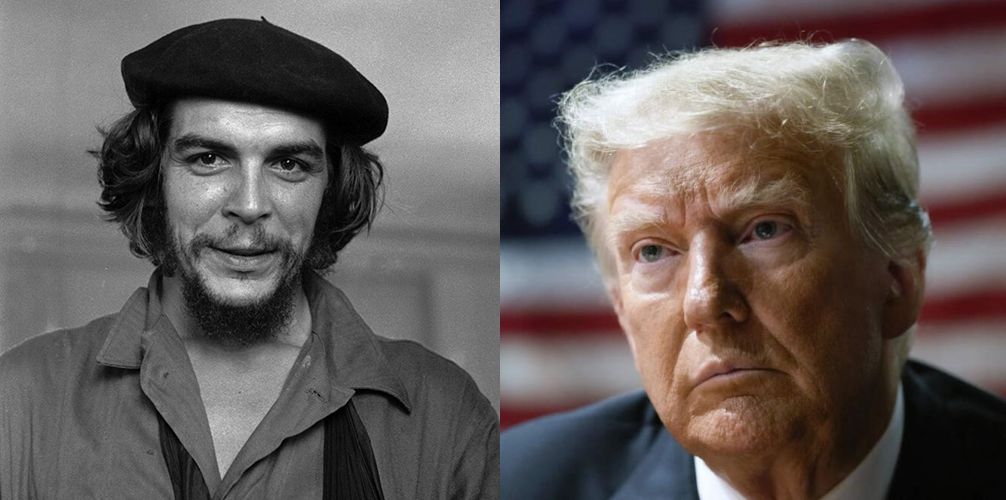
Today is the birthday of Che Guevara. He was a doctor, an intellectual, an idealist and a political revolutionary. History continues to reevaluate him and his life. He was not a saint and his choices of allies and roles have prompted questions. He is a martyr to a cause, certainly killed by U.S.-backed counter-revolutionaries in Bolivia.
He did not mean to become a misunderstood icon, but become one he did. Biographies are plentiful, and you can find them everywhere.
Today is also the birthday of Donald Trump. He is not an intellectual or an idealist, though he may be viewed as some sort of political revolutionary. History is already evaluating him, with a picture that gets darker and less kind every day.
Speaking of pictures, the photo of Che above is not the usual iconic one found on millions of posters, t-shirts, etc. It is one that reflects the soul and vulnerability that we acknowledge in those we admire or at least respect. The photo of Trump speaks for itself.
If you would like to celebrate Che’s birthday, watch The Motorcycle Diaries (2004).
This is it Ah but what is this? This is it Ah but what is this? This is it Ah but what is this? Sweet silly fool Stay silent.
Why would tinkering with Zen bring me to Wittgenstein? Why not?
Mine the treasures of mind deep enough through the earth and, as the old nostrum goes, you will end up in China. Ha!
Kidding. Mine the treasures of mind deep enough and you will find something that is nothing. When you try to describe or picture it, it will look and sound like…everything?
As a younger philosopher Wittgenstein wrote Tractatus Logico-Philosophicus. The final section is much quoted and interpreted:
7 Whereof one cannot speak, thereof one must be silent.
Wittgenstein claimed at the time that he had answered all the questions of philosophy. Later and older, he changed his mind, repudiating some of the things he had said before.
No matter. His endorsement of silent surrender remains.
Except. It is not conventional surrender. Boshan prescribes great doubt through questions. But those who arrogantly pretend to have answers and those who earnestly work for answers both fall short. The final answer is not enough and so not final. Surrender and go on.
“We are like children restlessly sitting at the controls of a locomotive.” Jacob Needleman
The explosion of AI is only the latest phenomenon demonstrating how far behind we as people and as a people are. It is not about having too much or knowing too much. It is not being advanced enough to handle what we increasingly have and know (or think we know).
Both in our civilization and in our personal lives, the growth of knowledge far outstrips the growth of being, endlessly complicating our existence and taking away from us far more than it gives us. In relation to the advances and applications of scientific knowledge, we are like children restlessly sitting at the controls of a locomotive. Without a corresponding growth of inner, moral power, our intellectual power seems now to be carrying us toward disaster—in the form of the catastrophic destruction of the natural world, in the decay of ethical values, in the secrets of biological life falling under the sway of blind commerce or blind superstition, and above all, in the impending worldwide nuclear terror. May we not therefore say, as Plato said 2,500 years ago, that such “knowledge” as we have does not really deserve the label knowledge? Can we listen to him as he tells us that knowledge without virtue can neither bring us good nor show us truth? This is to say that such knowing as we have is not transformational; it does not elevate our level of being and it does not nourish the development of moral power.
It is only the fully developed human being, which means only the fully developed human mind in which the intuition of objective value is an essential component, that can see the world as it really is, and that, through its action upon our instincts and impulses, can lead us toward the capability to act in the service of the Good.
Jacob Needleman Foreword to The Gospel of Thomas: The Gnostic Wisdom of Jesus (2005) by Jean-Yves Leloup
No drug or drink educed The dreams that hung Night to early morning
Adventures and then Knowing she had something to say She said it in bed not plainly but clearly Over Dreadful
Grandma sitting on a sofa Would not believe That we loved her more than any other Simple I said Two of them Three of us
In the audience of a talk show He interrupted with wild claims In the audience I laughed at the absurdity They escorted him away Interviewed then on the radio Making better sense He kept on and I listened His name appeared Just letters and numbers Like a license plate
Every night the blinds are closed. Every morning the blinds are opened.
Will the mountains still be there? Dogen says, “Mountains are mountains and mountains are walking. If you can walk, mountains can walk. Those without eyes to see mountains cannot notice, understand, see, or hear this reality.”
So far, every morning, the mountains are still there. The mountains are still walking.
In this part of the desert, the most common bird, next to the house sparrow, is the Inca Dove, a type of Mourning Dove. They are well known for their cooing call. They are also known for building spring nests around houses, in places that provide relief from the sun. There are ways to discourage this, but we haven’t tried any so far.
A few weeks ago, a nest appeared in an eave, but later fell apart. While it seemed there was not going to be another try, a week ago, seemingly overnight, a nest reappeared with mother and egg.
So for all who grew up in various places with various nests and various mothers, eggs and chicks, Happy Mother’s Day.
An honest estimation of the moral state of our society will disclose: Some are guilty, but all are responsible. Abraham Joshua Heschel
There are so many ways for people to distance themselves from being implicated in human-caused tragedy. For just one example, our American gun genocide.
Some will say they hold the more enlightened views, that they have spoken out, that they have acted out, that they have contributed to the cause, that they have voted for the proper candidates, that they have done all that they could.
Some others will say that there is a greater good, a greater ideology, not to mention the Second Amendment, so any responsibility is neutralized by their superior constitutional position (and their “thoughts and prayers”).
Heschel’s celebrated quote came out of the civil rights era and the still ongoing attempts to ameliorate racism. The point is that we can claim higher ground, criticizing those who obviously take no responsibility, and bemoan that we can do little more, given legal and political realities. But even with the limitations, and even with others shrugging off their glaringly obvious responsibility, they and we share the burden. Whatever the issue, whatever the tragedy.
The prophets’ great contribution to humanity was the discovery of the evil of indifference. One may be decent and sinister, pious and sinful.
The prophet is a person who suffers the harm done to others. Wherever a crime is committed, it is as if the prophet were the victim and the prey. The prophet’s angry words cry…
There are of course many among us whose record in dealing with African Americans and other minority groups is unspotted. However, an honest estimation of the moral state of our society will disclose: Some are guilty, but all are responsible. If we admit that the individual is in some measure conditioned or affected by the public climate of opinion, an individual’s crime discloses society’s corruption.
From The Insecurity of Freedom: Essays on Human Existence by Abraham Joshua Heschel




 Bob Schwartz