Bob Schwartz

I Read Newsweek Today, Oh Boy


If we hold a wake for each print publication that dies or goes digital-only, we’d be drinking all the time (which is not a bad response). Newsweek today announced, in spite of recent protestations, that it was indeed ending publication of its print edition this year.

Volumes have been written about this phenomenon, and more will be on the way. You can read them on your computer, e-reader, or mobile device. In the meantime, an observation.

Print media are in fundamental ways different than their digital counterparts as tools. Not better or worse, just different. This is not the conceit of old-school anachronists who defy the new guard to take the paper magazines or books from their (sooner than later) cold, dead hands. To understand how that could be so, read the increasingly unread Marshall McLuhan. The message of the medium is the message is that each medium is particular in granular ways (not sure if McLuhan would have loved, hated, or wished he had coined that buzzword). Those ways are not just meaningful, they are some of the most important meaning. If you can’t make a long list of conceptual, non-practical ways that identical content is deeply different in paper and digital form, you aren’t thinking hard enough, and you haven’t read McLuhan.

Suffice it to say that in ways that matter, the Newsweek that doesn’t require electrons is different than the one that does, even if the content is the same.

After saying all those important and noble things, a small confession of complicity. There was a time when a mailbox full of top-tier magazines was both a sign and a source of erudition. Many news junkies got their start when their parents subscribed to the newsweeklies—one, two or, if you were lucky, all three. Newsweek, Time and U.S. News and World Report every week, highly anticipated and absorbed cover to cover once they arrived.

The arrival of paper magazines is still a thrill. But one by one, the subscriptions were allowed to dwindle. It wasn’t just access to free and instantaneous alternatives; as far as expense, many print magazines priced themselves ridiculously low. It was like a relationship that lapses and fades, even if you know you might well be better off in keeping it alive. It was just the times, the way of the world.

Maybe Newsweek and other print editions would have lasted if subscribers had been willing to make an effort and work on the relationship. But they didn’t. We may look back and see these print magazines as the ones that got away, but we shouldn’t have let them. Just because it’s the way of the world doesn’t mean it’s for the best.

Romney Needs Women


Mitt Romney’s talking about being handed “binders of women,” a quote from the second Presidential debate, is not on its face all that funny, no matter how much it’s gone viral. But as a signal of a bigger picture, it seems to people meaningful.

In the wonderful depths of Mad Men in dealing with personal and social issues of the 1960s, the very first episode of the Emmy-winning series is on point. The execs at Sterling Cooper are about to meet prospective client Menken’s Department Store. In advance, Don Draper asks whether there are any Jews at the agency, and Roger Sterling laughingly doubts it. But at the meeting, there appears “David Cohen from the Art Department”, a nebbish who Roger has actually dug up from the mailroom.

This probably isn’t exactly how it went when Romney realized that as the new chief executive of Massachusetts state government, it would be appropriate to fill some of the jobs with qualified women. But what people are keying on is that it sounds a little like that. Do we have any women around here who are really qualified for these demanding jobs? Does anybody here know where we start to look for them? Hence, the binders of women.

By 2003, Massachusetts had been known for more than two centuries as the home of extraordinary women. While Abigail Adams was long gone, she should have offered a hint of the possibility that one of the most educated and vital states in America might include women of note and achievement. If you believed that they were actually out there, and weren’t some rare and exotic creature like a unicorn. And if you had a clue where to look—outside the mailroom or the binders.

Presidential Debates Without Tears: Politics Isn’t Beanbag


You can’t expect objective evaluations of the first Presidential debate from either campaign. Republicans want to talk hyperbolically about a victory. Democrats may have candid ideas, but few outside the inner circles will hear them.

The significance of any competition, besides the actual win or loss, is lessons learned. After that first debate, four explanations appear:

The President and his campaign were complacent.
They misread the situation.
They could not strategize or execute effectively.
It was just a bad night.

It was probably a little of all of these. Some will think that last one is just an excuse made by losers, but if you’ve watched competitions of all kinds, sports and otherwise, you’ve seen it. It’s circumstances, it’s the moment. It’s a quantum thing.

Nevertheless, that still leaves the other three as explanations and lessons.

The most significant Republican politician of the last days of the 20th century—yes, that would be Newt Gingrich—said straight out during the halcyon days of the primaries that Mitt Romney was a liar. Whether that was said with admiration or dismay is hard to know.

During that same campaign, Romney observed that “Politics isn’t beanbag.” Detractors then and now focused on the absurdity of this reference to an obscure children’s game. It was like his mentions of trees or the Keystone Cops. Who talks like that, they scoffed.

The focus was on the wrong point of the statement. Strange as Romney may appear to many people, one thing that isn’t strange, and shouldn’t be, is his ambition. Few if any politicians have ever played beanbag, or seen a beanbag match, if that’s what it’s called. But every politician knows about fighting hard, with or without rules.

If a banner saying “Politics isn’t beanbag” isn’t hanging from the wall of the Obama debate headquarters, it should be. Everything the campaign needs to know about Mitt Romney is captured in those three words.

Mitt Romney Too Busy to Answer Questions from Kids

Mitt Romney has refused to appear on Nickelodeon to take questions from kids. He is too busy.

Here is the Hollywood Reporter story:

Mitt Romney Declines Nickelodeon’s Invitation for ‘Kids Pick the President’ Special

One spot Mitt Romney won’t be hitting on the campaign trail: the Nickelodeon studios.

The Republican presidential candidate declined an invitation from the children’s network to participate in its special “Kids Pick the President: The Candidates.” According to a release from Nickelodeon, Romney’s camp said he was unable to fit the taping into his schedule after multiple attempts from the network.

The special, part of Nick News With Linda Ellerbee, gives kids across the country the opportunity to ask questions of each candidate. It premieres at 8 p.m. Oct. 15. On Oct. 22, Nickelodeon will reveal the results of its Kids’ Vote poll, which has correctly predicted the winner of five of the past six presidential elections.

President Barack Obama sat down for a taping in the White House, where he answered questions regarding gun control, jobs, immigration, same-sex marriage, outsourcing, bullying and obesity, as well as light-hearted questions including his most embarrassing moment. (“Running into the wall is par for the course for me,” he says. “I’m running into doors and desks all the time.”)

Romney still will be featured in the special, with producers selecting previously taped clips from the campaign trail in which Romney addresses various issues raised in the kids’ questions.

“By answering kids’ questions directly, candidates show respect for kids,” says Linda Ellerbee in a statement. “We are disappointed that Mitt Romney wouldn’t take the time to answer the questions but are thrilled that President Obama participated in the special.”

Now in its 21st year, Nick News — produced by Lucky Duck Productions — is the longest-running kids news program in television history.

The Presidential Campaign: How Do They Get Away With This Stuff?


The refrain of this Presidential campaign, in the face of the breathtakingly nonsensical and mendacious, should be “How do they get away with this stuff?”

Consider these two related items.

1. In the view of most political scientists and pundits, the single most significant impact of being elected President of the United States is the power to appoint Supreme Court justices.

2. A recent FindLaw.com survey found that only 34 percent of Americans can name any member of the Supreme Court. Only 1 percent could name the entire Court. The percentage who can name any particular justice:

John Roberts – 20%
Antonin Scalia – 16%
Clarence Thomas – 16%
Ruth Bader Ginsburg – 13%
Sonia Sotomayor – 13%
Anthony Kennedy – 10%
Samuel Alito – 5%
Elena Kagan – 4%

Presumably, a number of the people paying attention to the campaign and voting for President are the same people who don’t know the name of a single Supreme Court justice.

That’s how.

The Book On Lying


“Truthfulness can be required even where full truth is out of reach.”

In a season of seeming lies, there is only one book to read.

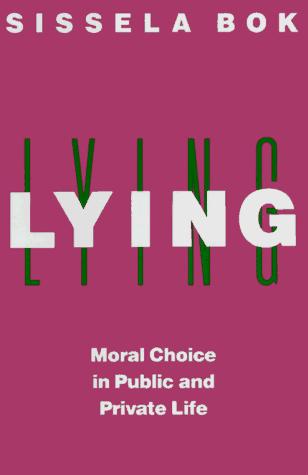
Sissela Bok’s classic Lying: Moral Choice in Public and Private Life (1978) is the essential work on the topic. At the time of its publication, no philosopher had tried to create such a brief, readable and accessible analysis. It has not been done better since.

This book was widely read and debated when it was published in 1978. That’s not surprising. Watergate was still a fresh presence in our public life. Before that crisis, people suspected—even expected—that some politicians were engaged in lying. Discovering the President and his inner circle all engaged in high-level big-scale deception confirmed the worst suspicions.

Bok begins with some fundamentals:

“I shall define as a lie any intentionally deceptive message that is stated….The moral question of whether you are lying or not is not settled by establishing the truth or falsity of what you say. In order to settle this question, we need to know whether you intend your statement to mislead.”

“As dupes we know what as liars we tend to blur—that information can be more or less adequate; that even where no clear lines are drawn, rules and distinction may, in fact, be made; and that truthfulness can be required even where full truth is out of reach.”

“When we undertake to deceive others intentionally, we communicate messages meant to mislead them, meant to make them believe what we ourselves do not believe.”

She analyzes some of the justifications that arise in special circumstances, as when we believe we are justified in lying to liars or lying to enemies:

“Enemies, through their own unfairness, their aggressive acts, or intentions, have forfeited the ordinary right of being dealt with fairly.”

“For the harm from lies to enemies is peculiarly likely to spread because of this very casual way in which enemy-hood is so often bestowed. Most claims that lies to enemies are justified would not then stand up in the face of reasonable scrutiny.”

Bok makes it clear that even when seemingly justified, all lies of all kinds have moral consequences:

“Because lines are so hard to draw, the indiscriminate use of such lies can lead to other deceptive practices. The aggregate harm from a large number of marginally harmful instances may, therefore, be highly undesirable in the end—for liars, those deceived, and honesty and trust more generally. One can’t dismiss lies merely by explaining that they don’t matter. More often than not they do matter, even when looked at in the simple terms of harm and benefit.”

The Goldilocks Test for Phone Size


First things first: You iPhone folks can leave. You have no choice on the size of your smartphone, because Apple has made that choice for you. The iPhone 5 is no wider, but one-half inch longer, than the previous version. Take it or leave it, and millions are taking it.

Android is a whole different world or, as we’ve learned to say, ecosystem. Screens are getting bigger, for optics and utility, and so have the phones. Samsung pushed the limits by creating the Note, half-phone/half-tablet (a “phablet”) with a screen more than five inches in size. Even the same phone may have slightly different dimensions for each carrier. Someone has no doubt charted the dozens of sizes available; it is enough to say that there is probably an optimal size for just about everyone.

But what is optimal? That very practical question arose in the course of handling and comparing two of the most popular and capable Android phones of the past couple of years, the Samsung Galaxy S2 and S3. The S2 is superb, but in almost all respects the S3 is better. The S3 does have a bigger screen, and so is ever so slightly bigger to hold.

Ultimately, the question is not whether size matters; the question is whether it matters to you.

That’s what the Goldilocks test is about. There are three parts, one about style, two about functionality.

The style part requires a mirror. If you are someone who uses a smartphone for voice calls (though fewer now do), hold up the phone to the side of your head. Do you feel that you look cool or silly? Do you feel like a modern version of the 1970s hotshot with a monstrous Motorola Brick pressed to his ear? (see above)

The second part is portability. Without getting stereotypical, this is a divide between women and men. Many women carry their phone in a bag, where up to a point, size doesn’t matter. Men usually carry theirs in a pocket, and depending on which pocket and which clothes, this can be an issue. Jeans and tight pants can be a problem (it is taking unreasonable will power not to paraphrase Mae West: “Is that a phone in your pocket or are you just happy to see me?”)

The final part is the most important: How much does size affect usability? This is where differences in hand size come into play. You want to be able to use a phone with one hand, and that’s going to depend on the hand that’s using it. This is also where the most objective part of the Goldilocks test was formulated.

Put the phone in the palm of your hand. Reach around the middle with your thumb and middle finger. If your fingers touch, you will mostly be comfortable using the phone with one hand. If not, you are on occasion going to find yourself doing some juggling or bringing in the other hand. It’s that simple.

Take the test. You want to be able to say about your phone, as Goldilocks said about beds, as others have said about the height of trees: This one is just right.

What Must Todd Akin Think of Sarah Palin?


What must Todd Akin think of Sarah Palin?

Todd Akin has lots of opinions about the ladies, inside and out. As for the inside, he has apparently been graced with some sort of revelation—dare we call him a prophet?—about a previously undiscovered physiological process whereby a woman’s body “knows” whether a rape is the kind that should or should not allow a resulting pregnancy. He has been asked to write a monograph about this process, profusely illustrated, but he has been otherwise occupied with his race against Senator Claire McCaskill in Missouri. It is a loss for medical science, but maybe he will have lots more time after the election. Citizens and gynecologists can only hope.

His views about the outside of women came clear after his debate with Sen. McCaskill, when he said:

“I think we have a very clear path to victory, and apparently Claire McCaskill thinks we do, too, because she was very aggressive at the debate, which was quite different than it was when she ran against Jim Talent,” Akin said. “She had a confidence and was much more ladylike, but in the debate on Friday she came out swinging, and I think that’s because she feels threatened.”

A review of Sen. McCaskill’s debate performance shows that she was thoughtful, firm, politely aggressive, and unrelenting—which is exactly what you would expect and hope for from a former prosecutor and current United States Senator.

When it comes to men dealing with women in politics—as candidates and voters—there are two ways of looking at it. One is external and pragmatic. Whether those men are saintly idealists or craven devils, women can play a role in their obtaining and maintaining power—given that women have had the vote for almost a century, and have held public office even longer.

The second and more fascinating view involves what’s going on inside—inside the heads of those men. This political season, something that got touched on in the 2008 campaign is now even clearer. It’s something that can be said about some small number of men who have been complicit, as actors or fellow travelers, in what for a while this cycle was called the “war on women”:

They don’t understand women.
They can’t control women, at least not easily.
They fear women, because they don’t understand them and can’t control them.

Keep these in mind and much will make sense.

What doesn’t make sense is what Todd Akin must think of Sarah Palin.

There are a thousand things to say about Sarah Palin, and particularly about her controversial role in the 2008 election. One thing is certain: she does not fit Todd Akin’s idea of “ladylike.” She is happy to be the pitbull with lipstick. Think of a political woman who is ambitious, confident, outspoken, and likely to dismember the man or moose who crosses her. Quick: Is that Sarah Palin or Hillary Clinton? Exactly.

In America, women have failed to reach their deserved heights and presence in many fields. Elective politics, particularly at the national level, is one of them. By definition, the U.S. Senate can’t be the world’s greatest deliberative body, overstuffed as it is with men. And it certainly won’t be enhanced by Todd Akin’s membership; just ask most Republicans who nearly killed him over his “legitimate rape” remarks.

Conservatives worship Margaret Thatcher. Some of them no doubt hold out hope for the love that dared not speak its name, the hope that the obvious affection between Thatcher and Ronald Reagan went all the way, and that one day, not long from now, the offspring of that union will arrive in our political life as a savior.

If it’s a son, that is. If it’s a daughter, we might still have a problem.

While we are playing with ridiculous fantasies, here’s another one. Suppose that instead of Claire McCaskill on an open stage, Todd Akin had to face Maggie Thatcher, Hillary Clinton and Sarah Palin behind closed doors to explain his visionary, man-centric thinking.

It wouldn’t be ladylike, and it would be worth paying to see.

Soylent Green, My Friend, Is People


Mother Jones has already changed the trajectory of the Presidential campaign with the “47%” video. It’s latest video find may not have the same effect, but it is still revealing.

It comes from a promotional Bain Capital CD-ROM from 1998. Along with other artifacts of the Bain culture at the time, it includes a video of Mitt Romney from 1985 explaining the Bain business model:

Bain Capital is an investment partnership which was formed to invest in startup companies and ongoing companies, then to take an active hand in managing them and hopefully, five to eight years later, to harvest them at a significant profit…The fund was formed on September 30th of last year. It’s been about 10 months then. It was formed with $37 million in invested cash. An additional $50 million or so of what I’ll call a call pool, which is money that we can call upon if the deals are large enough that they require more than a $2 or $3 million dollar initial investment. Why in the world did Bain and Company get involved in this kind of a business? We’re not particularly noted for having years and years of experience in financing. Three reasons. We recognized that we had the potential to develop a significant and proprietary flow of business opportunities. Secondly, we had concepts and experience which would allow us to identify potential value and hidden value in a particular investment candidate. And third, we had the consulting resources and management skills and management resources to become actively involved in the companies we invested in to help them realize their potential value.

It’s the “harvest” line that is getting the most attention, presumably because it suggests to some that the companies are viewed primarily as abstract opportunities that are optimized for profit, rather than enterprises that make particular things and where particular people work and build their lives.

Fans of sci-fi movies are burdened by seeing the “real” world through the lens of those films. So this line flashed two iconic and unforgettable scenes.

One is from The Matrix (1999), when we first see the humans being used as living batteries to power the world of the Matrix.

The other is from Soylent Green (1973). In 2022, the desperate population of overcrowded New York City is being kept alive by the nutritional drink Soylent Green. At the end, we learn the dark secret of Soylent Corporation, as screamed by Charlton Heston (spoiler alert): “Soylent Green is people!” Yes, it is processed from the oversupply of corpses.

All this probably has nothing to do with Bain Capital harvesting companies. Somehow, though, “Corporations, my friend, are people!” just got mixed up with “Soylent Green is people!”, Charleston Heston got mixed up with Clint Eastwood and Mitt Romney.

As noted in a post a few days ago, this campaign may not just be threatening to drive us—candidates and voters—mad. It may have done that already.

Victims of the Federalist Laboratories


This morning, a pundit again tried to square the circle by explaining how Mitt Romney can be both the heroic father of Romneycare in Massachusetts and the sworn enemy of Obamacare in the U.S. It goes like this: the states are political/social/economic “laboratories” in which 50 different experiments can produce 50 different solutions. (It isn’t clear why the District of Columbia, Puerto Rico, etc., are not capable of conducting these experiments too.)

This is nonsense. Not as political theory or as Constitutional interpretation. It is nonsense because it makes no sense, or at best, tragic sense.

America’s most notorious state-by-state experiment was slavery. And if an experiment is judged by its results, slavery was in some ways an excellent economic solution for the states that tried it. No matter how much other states tried to convince them that it was flawed, those slavery laboratories kept on operating—right until the time that they were forced to close them down in a bloody war.

This is how experimental laboratories work. Different scientists race to solve essential problems. When one comes up with an effective solution, that doesn’t necessarily stop the others from continuing their work on better answers, or from criticizing competitors. But in the meantime, if the problem is critical, the solution is rolled out widely to relieve the situation, at least until something better comes along.

Let’s say that the Massachusetts laboratory developed a cure for cancer. After some clinical trials, it was deemed worthy to be given to the whole state. The benefit was positive and obvious. One of the developers went out of his way to make a high-profile public case for its success and his role in it.

But the other 49 states said: not so fast. They believed that there was a better solution to cancer, if not right around the corner, then soon. All they needed was more time, and in the meantime, they didn’t want the people of their state subjected to these wild experimental solutions.

That is a much more apt metaphor than merely talking about laboratories in general. Call it what you want—Heritagefoundationcare, Romneycare, Obamacare, Affordable Care Act—we have a proven solution. Standing in the way of it, promising to repeal it, simultaneously owning and disowning it, is unconscionable in the face of knowing that with it, people who are well can be kept well and that people who are sick can get better.

Anyone, from a Presidential candidate on down, who can look at people and tell them that they will just have to suffer a little longer while the political scientists of the 49 states tinker in their laboratories needs to look elsewhere. They need to look at themselves, and see where the real problem is.