Bob Schwartz

Howard Finster on the Day after Washington’s Fake Birthday

Howard Finster - George Washington in Another World

This is about Howard Finster, “Man of Visions”, not strictly about George Washington. But Finster, America’s greatest modern folk/self-taught artist, loved Washington and frequently pictured him (above is Washington in Another World, where Finster believed he would meet the great man one day).

Finster also liked Abraham Lincoln, and some of the artist’s more than 10,000 works featured that former President.

Howard Finster - Abraham from a Penny

Knowing Finster’s biography and back story is interesting and helpful, but looking at his pictures (and there are plenty to be found online) is much more enlightening and uplifting. This is from Artnet:

Howard Finster (American, December 2, 1916–October 22, 2001) was a Modern Folk artist from Summerville, GA. He was one of 13 children raised on a farm, and he attended school only until the sixth grade. Finster’s interest in the gospel began at a Baptist revival when he was just 13 years old. A preacher at age 16, he wrote articles for the local newspaper while giving sermons in churches. In the late 1940s, Finster built his first garden park museum, featuring the exhibit The Inventions of Mankind.

The exhibit was intended to be a representation of all the inventions ever created, and it included a duck pond and a flock of pigeons. In 1961, Finster ran out of space and decided to purchase four additional acres of land in Pennville, GA. This is where he envisioned the Plant Farm Museum, a collection of Garden of Eden-like creations featuring attractions such as The Mirror House, Bible House, and the Folk Art Chapel. Scattered throughout were signs containing Bible verses, because Finster believed that “They stuck in people’s heads better that way.”

Finster did not learn how to paint in a university; instead he was self-taught, and most of his work was inspired by visions. He believed he was sent to Earth to spread the word of God, and he retired from preaching in 1965 to improve his Plant Farm Museum. This lasted until 1976, when he was inspired to paint only sacred art of religious inspiration that was intended to uplift and inspire. These images ranged from Pop icons to religious figures, such as his interpretation of John the Baptist. A year earlier, Finster was featured in Esquire magazine, and was eventually asked to create four paintings for the Library of Congress in 1977, one of which was titled He Could Not Be Hid.

Finster often created images on flat picture planes with Bible verses squeezed in. Each one also included a number because, under God’s direction, he felt he had to generate a total of 5,000 paintings. Finster finished this feat in 1985, but continued to paint until his death in 2001. By then, he had created over 10,000 works of art.

You can think real hard about how we celebrate Washington’s birthday on a day that isn’t his birthday, and how some people mistakenly call it President’s Day, and how we don’t celebrate Lincoln’s birthday at all, despite the fact that he might win an Oscar this year.

Save yourself the trouble. Immerse yourself in the visions of Howard Finster, and everything will make sense to you.


Phone, Wallet, Keys

It would take a million pages just to start talking about the differences between men and women. Here’s just one.

Many of us run through a checklist before leaving home for the day. Whether you are forgetful or just overloaded with thoughts, this is a good way to avoid inconveniences and annoyances.

The simplest checklist in these times is “phone, wallet, keys.” This is elegant and practical. Missing any one of these can be a problem, but the other two can help solve it. Missing all of them is a big problem, with a lot of downside, and nothing up.

In most cases, men have pockets, and they often use these pockets to carry things. And, not coincidentally, three primary things are phone, wallet, keys. The checklist doesn’t have to be mental. A quick self-pat-down does the trick. This can take literally a few seconds, and is minimally invasive.

Women may have pockets, but frequently they do not carry much in them. Many women carry some sort of handbag or shoulder bag for items such as…phone, wallet, keys, and more. They may use the same bag each day or day part, but they also may change bags for style or size.

This makes the morning checklist for women complicated. Even when care is taken to make sure that a bag includes the essential items, there is no true certainty until the contents of the bag is inspected. No pat down is available. And then, there are multiple bags, so at any moment, the phone may be one place, the wallet another, the keys another.

As with all the differences, we can’t over generalize. And we can’t fix—because there’s nothing to fix. We celebrate the way things are, even when—or especially when—that includes the occasional missing essential. As much fun as it might be to pat down your favorite woman, completely aware that her pockets are empty, you make do with a very short and sweet, “Got everything?” Which whether it works or not, does say it all.

Political Speeches As Mass Shout-Outs

Some political audiences still get fired up by pandering platitudes and principles, even if the words are not backed up by any substantive proposals, or by any proposals at all.

This is sometimes punctuated by the occasional mention of a target interest group, just to show that the politico is paying attention to them. Once again, this might not be attached to anything concrete, but it often does the trick.

It is time for this to be taken to the next level.

A really bold and innovative politician could skip the platitudes, principles and proposals. Instead, entire speeches could be built out of the names of places, organization and people. If this sounds too much like reading an atlas, almanac or phone book out loud, without context, that is precisely the idea.

Depending on the crowd, this would be a string of guaranteed cheer and applause phrases. Las Vegas. Wichita. National Rifle Association. Veterans of Foreign Wars. Latinos. Blacks. Women.

This is far from an uncreative exercise. In fact, it is a sort of minimalist poetry, idea and intention reduced to the smallest possible expression. Obviously, there are a few pitfalls, so care must be taken. Saying the word “Nazi” out of context can be trouble; saying it in relation to saying “Jews” may be more or less trouble, without the benefit of further explanation.

All in all, this would be an exciting and enlightening direction for our politics to take. We can stop wondering and fretting about speeches filled with air and little more. The pretense would be gone; speeches could once again be rooted in reality, or at least in one political reality. That reality, which lives alongside the genuine value of getting things done, is the value of getting elected or getting someone else defeated. And then there is the value, if just for a moment, of giving a little harmless recognition to folks who are waiting, maybe quixotically, for much more.

American Experience: Silicon Valley

Silicon Valley
Tech history is our history. As enlightening and fun as it is, it is also more complex than learning about cars and trains and planes, all of which we understand, or can learn to. But transistors, integrated circuits and, ultimately, microprocessors are harder to grasp.

But this is also human history, the intertia of brilliant people at rest and in motion. That’s why the background of these digital days is fascinating, and why the new PBS American Experience documentary Silicon Valley is so enthralling.

You know where Silicon Valley is, what it is, and may have been there. How that agricultural Santa Clara Valley became the center of the world is a story. But the real story is how Robert Noyce, Gordon Moore and Andrew Grove—the godfathers of Intel—and their colleagues, predecessors and competitors changed the way the world worked technically, commercially and socially.

Silicon Valley is that story. It is inspiring, in the way that all risky ventures into the unknown are inspiring. It is also one of the rare worthy arguments for some sort of true American exceptionalism, since there is an inherent sense watching this—as politically incorrect as some may find it—that this is a quintessentially American story. This is what we did, this is what we do.

Silicon Valley is not to be missed.

If We Could See the Children of Sandy Hook

Sandy Hook School
Early in the Iraq War, President Bush tried to block taking pictures of the arrival of the coffins of fallen soldiers at Dover Air Force Base. The proposal was couched as a gesture of respect to the families, but the real point was to shield citizens from the ultimate cost of war.

There are different opinions on the impact of viewing carnage, fictional and real. Does constant exposure immunize us from taking violence seriously? Would we pursue wars so readily, or at least try to better distinguish the necessary from the chosen, if we were bombarded by those images? If we saw footage of the early days of the camps in real time, would we have allowed the Holocaust to proceed?

The images of the children killed at Sandy Hook School in Newtown are blocked from us. This choice is almost beyond argument. We have heard the reaction of those who did witness the aftermath, and even those who have participated in war said that scene was worse. We are protecting the dignity of those lives unlived and respecting the immeasurable grief of the families. Our imaginations are already enough to rend our hearts.

And so instead we have pictures of those children as they are remembered, beautiful angels, joy and potential, and we have the testimony and imploring of their parents. But somehow, this doesn’t seem to be quite enough to stop abstract arguments about the essential value of the Second Amendment, how it must continue unconditioned even by sensible restrictions that meet moral, practical and constitutional muster. First they come for my AR-15, this line goes, and next the deer and the police will be hunting me.

There is a way to end this argument, though for good reasons we will not do it. If we ever get to see the killing field at Sandy Hook, there will be little more talk of a free trade in assault weapons and big ammunition clips. There may be talk, but it will be silenced by a new and more powerful outrage. The NRA might try to keep repeating a mantra that is already falling on more deaf ears, and some of their political operatives will follow. But the vast majority of Americans will move from just saying the right thing to a pollster to demanding that the right thing be done. Now.

If we could, as we won’t, see the children.

Assault Weapons: The Art of the Art of the Possible

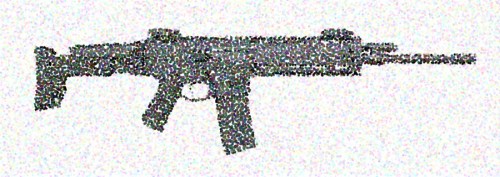
Bushmaster ACR
Watching Joe Biden back off the primacy of an assault weapons ban in the curbing of gun violence—following Senator Diane Feinstein’s introduction of exactly that legislation—is discouraging. And it brings to mind Picasso and Pollock, among others.

Politics is said to be the art of the possible. The motto is roughly “we fight the fights we can win.” Very pragmatic, and there is something to commend pragmatism. That won’t be much comfort, though, when well-meaning politicians have to show up at the next inevitable massacre and solemnly announce that they aimed at the possible, and even then settled for half.

Exactly what kind of art is politics?

Here’s a style of art, the kind everybody finds acceptable and can endorse. Who is going to argue about Rembrandt?

Rembrandt - Self Portrait
Then again, over time there were a number who wanted to argue about and with Rembrandt. By the time the twentieth century rolled around, artists wondered why they had to pay slavish homage to ideas that no longer suited the times. They determined that new ways were not only possible, but that they must be possible.

And so Picasso

Picasso - Les Demoiselles D'Avignon

and Jackson Pollock

Pollock - No. 5
Maybe every progressive politician who is wavering on support for an assault weapons ban needs to visit some museums with modern art; there are plenty in Washington. Then maybe they will discover what real courageous progress is. The possible is limited only by our imagination, spirit and will. That’s the real art.

The Untouchables: No Justice On Wall Street

The Untouchables
This week, PBS Frontline aired a follow-up to its powerful documentary Money, Power & Wall Street, which covered the origins and aftermath of the 2008 financial meltdown. The Untouchables is an equally scathing and disturbing story about the failure of the Justice Department to prosecute any Wall Street executives for fraud, in the wake of their apparently knowing securitization and sale of worthless mortgages.

For those who wonder whether investigative journalism still matters, this happened yesterday:

Lanny Breuer, the head of the DOJ Criminal Division featured in the documentary, resigned. Questions about why criminal prosecutions have taken so long—and whether there will ever be any—linger like a bad odor.

Mary Jo White, a former federal prosecutor, was nominated to be the next chairwoman of the Securities and Exchange Commission. Richard Cordray, another former prosecutor, was renominated to be director of the Consumer Financial Protection Bureau. The president said these nominations would help prevent a financial crash like the one he inherited four years ago.

People say that the new movie Zero Dark Thirty serves as a thought-provoking wake-up call about the role of torture and, ultimately, the effectiveness and judgment of President Obama. It has been said that those who support the president might find the film unnerving.

The Untouchables is much more unnerving, not just in looking at the president, but in looking at Attorney General Holder, at overseers,  and at all the others who seem to be strangely—or not so strangely—beholden to Wall Street.

Watch The Untouchables, then go back and watch Money, Power & Wall Street. Like all great investigative journalism, it is darkly entertaining, and like all unvarnished views of how government works, it is profoundly discouraging. But necessary.

The Real Basics of the Speech

Inaugural Address 2013
Self-congratulation can be unbecoming, even when it is deserved. It can also be unhelpful and even counterproductive.

The immediate aftermath of the election was a storm of emotions for Democrats. It combined exhilaration at winning with relief from avoiding an unthinkable alternative. The first weeks seemed to be filled with a Republican state of denial, to which “elections have consequences and we won” seemed a pretty succinct response.

Then the ice started to break a bit. A few concessions were made, with Republicans implicitly acknowledging that things were different, if not subject to a sea change. Then President Obama delivered his Inaugural address.

Judging by the reaction, for some liberals/progressives, this was the missing second beat of election night. Obama won, and now he was openly announcing where he stood on the supposed left/right divide. Verbal high-fiving, fist-bumping and chest-thumping could be widely heard. The address was pronounced a liberal/progressive triumph.

And looked at one way, it was. But that is a self-limiting analysis, and actually robs the speech of its power, and robs Obama of his vision and careful eloquence.

The speech had three basic points:

These are our shared American principles.
Government works from the bottom up, not the top down.
We have to live in the present not the past.

Labeling that liberal, progressive or otherwise, no matter who is doing the labeling, short-circuits a potentially valuable conversation and possibilities of common ground. The victory lap, even if it is meant to be dispiriting to the presumed opposition, doesn’t help.

Obama supporters say that he was too conciliatory in his first term, that he unwisely—even naively—believed that compromise was possible. Now they see and hear the less yielding partisan they always believed he was.

They are only partly right. Obama will stand more firmly, but if you listen to the speech beyond the specifics you may be happy to have heard, it was all about those three simple points. Set aside the labels and even the initiatives, and just talk about the basics. The challenge Obama set is for those who claim true Americanism to disagree.

Fish and Assault Weapons

Fish Head Bullet Weights
Tomorrow, Barack Obama unveils a series of proposals to curb gun violence. Among them is likely to be a reintroduction of a federal ban on the sale of assault weapons, a ten-year prohibition that expired in 2004. Many are pessimistic, believing that such a measure might pass the Senate, but will certainly not make it through the House.

There is a fair amount of discussion about whether people hunt with assault weapons, and if they do, whether they should. It’s a good question, but not nearly as fascinating as the eccentric question of whether people fish with assault weapons.

The short answer is that up until a few years ago, two states did allow fishing with guns. New York State has since repealed its law, leaving Vermont as the only state where you can legally shoot fish (in a lake, but presumably still not in a barrel—except in the privacy of your own home).

Spring hunting for pike is in fact a Vermont tradition. Here is the law:

Vermont Statutes
Title 10: Conservation and Development
Chapter 111: FISH

§ 4606. Taking fish by unlawful means

…

(e) In Lake Champlain pickerel, northern pike, carp, garfish, bowfin, mullet, shad, suckers, bullhead, and other cull fish may be taken from March 25 to May 25 by shooting and spearing in other than spawning areas designated under section 4140 of this title. For the purposes of this subsection, Lake Champlain includes all connected waters at the same level.

Gun experts do not generally advise shooting in water at all, for the safety of bystanders. But if you do plan to set your sites on Lake Champlain fish, it is likely that assault weapons will still be legal this spring, so nothing other than a sense of fairness, or good sense in general, should be stopping you.

Adorable Animals Instead of Politicians

John Boehner - Golden Retriever Puppies
It’s a hard life for a political junkie. Not because politics is difficult to find these days. To the contrary, it is everywhere, all the time. If politics is the drug, there are dealers literally giving it away—begging you to take it—at millions of media storefronts. It’s like Amsterdam, where women are on display behind glass and drugs flow like water—except that it’s all free.

The problem isn’t supply. The problem is that once you’re hooked, after a while you no longer get the thrill you once did. In fact, you often feel pretty bad. But by that time, it’s too late.

Last year was the best and the worst of times for political junkies. Not only was it an election year; it was an election year like none other. Talking heads couldn’t stop talking and we couldn’t stop listening and retorting. But it didn’t make us feel good. Whether we liked the outcome of the elections or not, we felt icky, cynical, pessimistic. Maybe, we hoped, we could get a break, enjoy some spiritual renewal as we celebrated somebody’s—anybody’s—savior being born, and could start a new year clean.

No such luck. Politically, the year ended at a low point, and with the new year, the chances of climbing out of the gutter seem slim. If political junkies could only distance themselves from these shenanigans (a great word Joe Biden used last week), maybe we could clear our heads a little.

Unfortunately, with so many serious issues at stake, staying away seems unlikely. Instead, here is a radical solution that might just help.

Every time a politician is mentioned or shown, imagine an adorable animal. Nothing fierce, nothing threatening, nothing ugly. Something unbearably cute and irresistible, guaranteed to bring a smile, however fleeting, to your face. (Note: If you think that the politician mentioned is adorable, cute and irresistible, no substitution is necessary.)

This is loosely based on various cognitive therapies, but the truth is that there is no real science behind it. On the other hand, there is nothing to lose either. If you’re addicted to politics, very little is going to lift you up right now. Any way you look at it, there are too many politicians and not enough adorable animals. This is just a small step to redress the balance in your unbalanced life.