Bob Schwartz

Ted Cruz and Joe McCarthy

Ted Cruz - Joe McCarthy
For a while now, virulent anti-Obamaism has looked a lot like the anti-Communist vendetta of McCarthyism in the 1950s. Barack Obama is in fact the scary culmination of the fear that swept the nation fifty years ago. Not only are there Communist infiltrators in government offices; the White House itself is in the hands of a godless liberty-taker—or so it seems to millions.

U.S. Senator Joe McCarthy from Wisconsin did not invent this brand of hate and paranoia. He just perfected it through a combination of extreme showboating, angry rhetoric and, most of all, fear. Nothing could be worse than to be branded an enemy of the state (in McCarthyist terms), which might lead to a loss of a citizen’s reputation, job and career or, more to the point, to a politician’s losing office.

This week, Ted Cruz’s attempt to hog the American stage with his fauxbuster (media are still working on a term for a filibuster that isn’t one) has had a notable effect on some of his Republican Congressional colleagues. Since the 2010 elections, and certainly in the 2012 presidential campaign, there has been a reluctance to publicly break ranks and call an ambitious, self-absorbed blowhard that (e.g., Donald Trump) or a fool a fool (take your pick). In recent days, a few Republican Senators have stopped holding back, realizing that as much as they agree in their opposition to Obama policies, this is not a constructive way to proceed, governmentally or politically. Oklahoma Senator Tom Coburn, a loyal Republican and unassailable conservative, said that it appears that to Cruz and others of that ilk, he is just not conservative enough.

This is the Ted Cruz/Joe McCarthy strategy: if you are not with me, you are against America. To torture a quote from King Louis XIV, “America c’est moi.” (I am America). And if you are not for my definition of America, you are an enemy of the state—even if you purport to be a Republican, even if you are a Senator with many more years than my nine months in the Senate. And if you are an enemy of the state, I and my millions of like-minded Americans will destroy you. That is my mission.

Joe McCarthy’s brief demagogic career ended in ignominy (and ill health from his alcoholism). He went from holding center stage to banishment when more and more of his colleagues and the media stood up to his bullying. It wasn’t that anti-Communism went away; it remained a force for years to come and, as pointed out, lives still even in the post-Cold War era. It was that serious people put up with over-ambitious clowns as long as a common agenda is advanced, but at some point even the threat of losing office takes second place to what’s good for America.

In the end, McCarthyism lost to Americanism. Let’s hope that Cruzism suffers the same fate.

What the GOP Can Learn from Pope Francis

Pope Francis
Pope Francis has turned out to be everything his most idealistic supporters hoped for, and then some. For a bonus trick, he may be able to save the Republican Party—politically speaking.

If you’ve only seen the top-line coverage of his interview with the magazine America, or read some quotes, do read the whole thing. It is a multi-dimensional view of a simultaneously simple and complex leader of an enormous—and enormously controversial—enterprise. We are apparently just beginning to see his skills.

For one thing, he is trying to navigate a sea of reformist and conservative elements, a dynamic that has left the Church in turmoil. He is doing this by something outrageously unlike most of what we see in the “sophisticated” twenty-first century. He is leading by staying true to a bedrock of belief, in word and action, but doing it in a way that is learned, thoughtful, humble and realistic. He is stripping away an accretion of institutional and self-interest extras, genuinely trying to get back to the core that made him a priest and a Pope, that brought so many to the Church, and that so many now see forgotten and hypocritized away.

This is a near miracle, and he may be on his way to doing just that. As a bonus, if the Republican Party is paying attention, it can learn something too. It turns out that unalloyed, unconditioned ideals can be both appealing and moral, including love, compassion, humility, tolerance (see the Beatitudes for a complete list). It isn’t easy to make this work in the real world, and it will be controversial and unpleasing to some, particularly those with extreme views.

The Republican Party is in the same position as the Church. There are some core beliefs that are eminently worthy but are being lost and forgotten in layers of maneuvering, narrow-mindedness, arrogance and hypocrisy. Catholics didn’t like that in the Church, and citizens, including some Republicans, don’t like it in the party.

Right at this moment, there is no Pope Francis on the horizon for the Republicans. This may become more apparent in the next few weeks, as some Republicans continue to exhibit a thoughtless, heartless and unproductive stubbornness that flies in the face of everything the party once stood for. Then again, nobody saw Pope Francis coming either. Let’s hope, for the sake of the nation as an economic, political and moral enterprise, that the Republican Pope Francis comes along very soon.

TMFG: Too Many F***ing Guns

.TMFG

People are dying from politeness about guns.

We are a nation of laws, and especially of constitutions, so we talk and write about the Second Amendment. Rich, smart and safe people debate in really fancy buildings, but nothing gets done about guns. The Naval Shipyard shooting, for example, is supposed to demonstrate problems with our mental health system, or with our veterans affairs system, or with a lack of communication between our law enforcement agencies.

But we are also a nation of plain talk. Just ask Joe Biden and others. So it is time for polite and respectful people to speak openly and plainly. Constitutional arguments and political realities have their place, but so does this: There are too many f***ing guns. That is why and how too many are killed and injured—in our homes, on our streets, in our schools, in our movie theaters, in our military facilities.

Feel free to engage in extended discussion and political action; that is what we do in a democratic society. But sometimes, it can be therapeutic to speak truth to nonsense.

Four words. Four letters. TMFG. If you believe it, say it.

Some Little Truths About Obamacare

Affordable Care Act

You may not want to think or talk about the Affordable Care Act. Who can blame you? Politicos and talking heads are doing enough for all of us.

And yet, October 1 marks the start of people reading the menu of health insurance options and deciding which way to go. Which is why the volume of debate is once again up to 11 and why it is harder than ever, even after all this time, to make sense of any of it.

Previous posts have covered the process: how ACA is based on a Republican proposal, how Republicans ran screaming away from their own proposal, how the Supreme Court narrowly allowed it to proceed, etc. Now is the time to consider the substance and the merits, reluctantly. Reluctant because some kind of truly broad and truly affordable health coverage really is necessary for a civilized, modern and (in some segments) wealthy society, so a critique should not appear to deny that. Reluctant because, under the circumstances, ACA may really be the best we can do, even if that is not saying much.

But here are a few truths.

1. This is the most complicated, Rube Goldberg-like social program in American history. Comparisons to Social Security and Medicare—as in “people were skeptical or opposed to Social Security and now these programs are an integral part of American life”—are inapposite. Think: one concept, one law. That may be oversimplifying, but not much. Social Security was and is a way to create a fund to help older and disabled Americans who can’t help themselves. The way it’s evolved may be complicated and not to all tastes, but the basic concept remains. The same can be said about Medicare.

The single concept of ACA is more elusive, despite the name making clear it is about affordability. Separate from the execution and success in that regard, ACA is also about the reach and availability of coverage. More properly, it might be called the Market-Based Universally Available Affordable Care Act, a name that would hint at its complexity.

2. It may be too complicated to manage. To get to the truth of this, we have to look bigger. Bigger, as in the manageability or not of the American government. The loud complaint from some corners is that the government is “too big.” This is a misplaced critique. The problem is that very big enterprises are very hard to manage effectively. Just shrinking an unoptimally managed enterprise lessens the damage and the cost, but it doesn’t change the fact of ill management. Scientific management tells us that in theory any enterprise of any size can be managed, by discovering or devising the appropriate principles and executing soundly. But there is a cousin to “too big to fail” that is “too big to run.” Maybe the government is that.

Maybe the ACA is that also, too big and too complicated. Which touches back to the idea of its not having one single concept. It seems clear, as it did to the ACA proponents, that so-called universal, single-payer health care would never be accepted in “free market” America. If that wasn’t always clear, the debacle of the Clintoncare proposal, engineered by Hillary during the Clinton administration, put it out of reach for a generation. The only way to get anything, rather than nothing, was to patch together components that were variously consistent with popular ideas, market mechanisms, federalism, healthy business and industry interests, along with political and legal constraints. The wonder isn’t that a combination car/boat/plane gets designed and built. The wonder is that it can drive or float or fly.

3. The American political environment is distrustful, skeptical and toxic. Social Security was born during the worst economic crisis ever. So the building of an historic safety net was fitting. But on top of that, even with virulent opposition, there was a widespread understanding that we were all Americans, and part of that was caring for others, and part of that care was trusting that the government would, within the limits of human fallibility and self-interest, do the right thing.

We can pray for the return of that context, but it isn’t today. Today we have an unprecedented spectacle of a small but powerful segment of the country working desperately, and maybe effectively, to make sure that ACA is repealed or at least fails miserably. The reasons are as complex as the act itself, a bit about the shortcomings of the law, but, not surprisingly, mostly about politics. Proponents find themselves in the position of defending the act, promising to improve it, and trying to make it work—all the while perhaps harboring doubts in the places they can’t talk about that it won’t, not entirely.

Let’s hope it does work, a little. Because American health care is so broken, and for the moment, this is what we’ve got.

Why O.J. Matters

National Enquirer - O.J.

The National Enquirer has dropped an O Bomb:

Shocking bombshell evidence that proves OJ committed double homicide and  where he may have hidden the murder weapon REVEALED!

O.J. SIMPSON is shaken to the core because bombshell evidence that proves he murdered his ex-wife and her friend is hidden in his $500,000 Florida home – and it’s all about to be discovered because the house is headed for the auction block on Oct. 29.

The home has been in foreclosure, and the disgraced football star, now impris­oned in Nevada, is terrified that the new owner will discover the items – the knife used in the gruesome murders and the de­signer shoes that left bloody tracks around his former wife’s lifeless body.

Should anyone care? The families of the murder victims Nicole Brown Simpson and Ron Goldman might. O.J.’s own family might.

Nobody else should, but that doesn’t mean that O.J. doesn’t matter. His sensational and ridiculous 1995 murder trial is as culturally significant as any event of the generation—including Watergate and 9/11. Saying that does not invest it with any substantive importance, the kind that those and other profound events have. The O.J. trial is the birthplace of the modern media era, and practically everything that rational people don’t like about the current environment owes its origins to that.

Half of America watched some part of the trial. The “shocking” acquittal was by the end beside the point. The fact is that tens of millions of Americans, an unforgettable cast of characters (most of whom are now forgotten) and a mammoth of media conspired to make something colossal out of something not nearly as big. (Not entirely forgotten characters though: In an irony-defining development, the late Robert Kardashian was integrally involved in the events and helped defend O.J. In the spirit of making something out of nothing, Kardashian is now best known as the father of Kourtney, Khloe and Kim.)

We have never recovered from the O.J. trial. It represented an unprecedented gap in scale between actuality and the intensity of the coverage received and interest engendered. It was part, maybe the greatest part, of proportion going out the window. And now, no detail is too small or relatively unimportant, no story adequately covered, that more isn’t offered. Much more. Much much more, most of the time to the point of diminishing returns and dying brain cells. Too much is never enough.

And to think it call began with one man’s certain heartless brutality, and a missing weapon and pair of shoes that may now see the light of day.

Laptop Overheating and the State of the World

Laptop Overheating
Overheating is the single greatest source of problems with laptop computers. And before you run away from unwanted geek talk, be aware that it is also a lesson on the state of the world.

If you don’t know about overheating, that probably means that when things go wrong with your laptop, you leave it up to somebody else to make it better, maybe even having an IT department to take care of it, or you replace your laptops once a year, or you chalk up terrible performance and failure to bad luck, or you just throw the damn thing out.

Those of us working on our nth generation of laptops know better: they are frequently baking, and that can’t be good.

To understand overheating, we go back to the prehistoric days of computing, with cavemen searching for wall plugs. Before there were minicomputers or microcomputers (PCs), there was big iron. Giant rooms filled with big boxes, that compared to your smartphone had pretty tiny brains. But it was a wonder at the time. One of the upshots was that these big computers generated a lot of heat; processing is a hot business. So the rooms were equipped with powerful air conditioning to keep the machines cool and healthy.

As computers shrank, new solutions to heating were devised. They had to be. Even as microprocessors got smaller, the heat problems didn’t go away. The more powerful the processor, the hotter it got. Desktop computers solved this with space around the processors—the heat sink—and a fan to blow that heat out of the box. Desktops were usually placed in a space with some air around it, and for the most part (except, for example, with ultra-powerful gaming computers), this worked pretty well.

Laptops changed all this. The laptops didn’t offer much space around the processors. There was a fan, but the vent from it was frequently blocked by the way laptops were used and placed. The final compounding element was the development of very powerful laptop processors. If you had shown a 3rd generation Intel i7 processor to a computer engineer fifty years ago and told them the specs, when they picked themselves off the floor, the first thing they would say is “yeah, but I bet it gets plenty hot!” And they would be right.

This level of heat destroys components, especially processors themselves. An entire cooling pad industry has grown up around the problem, though that is far from a complete solution—even if you stick your pad in the freezer. When you search for suggestions on which laptops are the least likely to overheat, you find that the simple answer is: none of them.

(Funny personal anecdote about overheating—and all true. A very powerful laptop was showing increasing signs of overheating; besides getting blisteringly hot, crashes were more and more frequent, and cool down periods were getting less effective. One morning it simply refused to start up. Putting the whole laptop in the freezer was not an option. Fortunately, it was below freezing outdoors, where it was placed on the deck for an hour and then started there. The damaged components were soon replaced.)

So what, as promised, does this have to do with the state of the world? Technology—maybe progress in general—can take us down some very beneficial roads. But some chronic endemic problems come along for the ride. Our confidence that we can “solve anything” is misplaced. We can create situations with built-in disabilities that leave us helpless, just as we can build millions of genius laptops that can do anything but stay cool.

The Mad Dancers

The Mad Dancers
The Baal Shem Tov is the eighteenth-century founder of the Hasidic movement in Judaism. Jews and non-Jews who know the modern versions of the movement often don’t know much about its beginnings. Some of those contemporary manifestations may seem distant from the original spirit.

We have no writings by the Baal Shem Tov, so we rely on the records of his disciples, and on legends and stories that have come down the years—and that still have a remarkable power to inspire. Their authenticity is not in their being a verbatim record of what was said and what happened. Instead, they are an unmistakable reflection of a unique spiritual figure from any age or faith.

The Baal Shem Tov believed in and lived the direct experience of God everywhere in everything. Study and conventional piety took second place, which made him unpopular with the establishment, and would still today. He thought we should be outdoors in the trees, not indoors at the desks. Living in a divine state of optimism, joy and wonder was the ideal. People who live that way, of course, are remarkably hard to control.

This story is taken from The Golden Mountain (1932) by Meyer Levin.

The Mad Dancers

Already the voices of opponents were raised against the Baal Shem’s teaching, for many
rabbis could not understand his ways. Some said of him that he dishonored the Sabbath with singing and freedom, some said that his ways and the ways of those who followed him and called themselves Chassidim were truly the ways of madmen.

One of the scholars asked of the Baal Shem, “What of the learned rabbis who call this teaching false?”

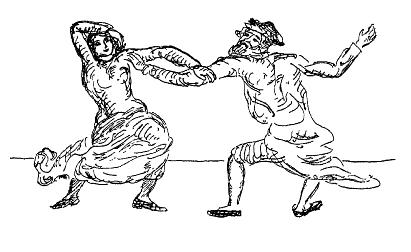
The Baal Shem Tov replied, “Once, in a house, there was a wedding festival. The musicians sat in a corner and played upon their instruments, the guests danced to the music, and were merry, and the house was filled with joy. But a deaf man passed outside the house; he looked in through the window and saw the people whirling about the room, leaping, and throwing about their arms. ‘See how they fling themselves about! ‘ he cried, ‘it is a house filled with madmen! ‘ For he could not hear the music to which they danced.”

Yom Kippur: Beyond the Self

Shofar - Chagall
No sin is so light that it may be overlooked; no sin is so heavy that it may not be repented.
Moses ibn Ezra

A person cannot find redemption until he sees the flaws in his soul, and tries to efface them. Nor can a people be redeemed until it sees the flaws in its soul and tries to efface them. But whether it be a person or a people, whoever shuts out the realization of his flaws is shutting out redemption. We can be redeemed only to the extent which we see ourselves.
Martin Buber

Should we despair of our being unable to retain perfect purity? We should, if perfection were our goal. However, we are not obliged to be perfect once and for all, but only to rise again and again beyond the level of the self.
Abraham Joshua Heschel

Bear in mind that life is short, and that with every passing day you are nearer to the end of your life. Therefore, how can you waste your time on petty quarrels and discords? Restrain your anger, hold your temper in check, and enjoy peace with everyone.
Rabbi Nachman of Breslov

Al Cheit (For Our Sins) is a central prayer of Yom Kippur. It is traditionally recited while beating our hearts for each item on the list.

It is a long list. Few will have committed all of them. Few have escaped committing any. It is just a list of examples. Your experience may vary, and there may be others you might add.

The tradition says that the Book of Life is open during the Ten Days of Awe. When the holy days end with Yom Kippur, the Day of Atonement, when the shofar sounds, the book closes and our lives will have been written for the next year. But the book is always open. This isn’t an inventory of recriminations. It is an opportunity to reflect and, if needed, to make amends. That is how, as Heschel says, “to rise again and again beyond the level of the self.” That is how we write the book.

Al Cheit
For Our Sins

For the sins we have committed through arrogance and selfishness:
For being obsessed with our own concerns,
For choosing rudeness over common courtesy,
For loving our egos.

For the sins we have committed by defrauding others:
For using people in pursuit of our ambitions,
For manipulating the love of others,
For gossiping.

For the sins we have committed through denial and deceit:
For creating theories to rationalize our behavior,
For faking emotions for our own benefit,
For using the sins of others to excuse our own,
For claiming that ends justify the means.

For the sins we have committed through greed and overindulgence:
For using force to maintain our power,
For poisoning our planet,
For remembering the price of things but forgetting their value.

For the sins we have committed through hardening our hearts:
For accepting poverty as inevitable,
For staying silent when we should speak out,
For resenting the young and ignoring the elderly,
For abandoning proper outrage.

For the sins we have committed through hypocrisy:
For condemning in our children the faults we tolerate in ourselves,
For condemning in our parents the faults we tolerate in ourselves,
For neglecting our promises.

For the sins we have committed by narrow-mindedness:
For passing judgment without knowledge,
For denying our baseless hatreds.

For the sins we have committed against You through sex and love:
For confusing love with lust,
For pursuing fleeting pleasure while disregarding lasting hurt,
For withholding affection to control the ones we love.

For all these sins, forgive us, pardon us, grant us atonement.

Yom Kippur: A Serious Day for a Serious Man

A Serious Man
This evening begins Yom Kippur, the Jewish Day of Atonement, the last of the ten Days of Awe that starts a new year. The mood is somber. It is the most serious day on the calendar, a day of fasting and reflection, a day to contemplate the actions and inactions of the year past, and to commit to a better year ahead.

Which is why it is a day to recommend a darkly comic movie.

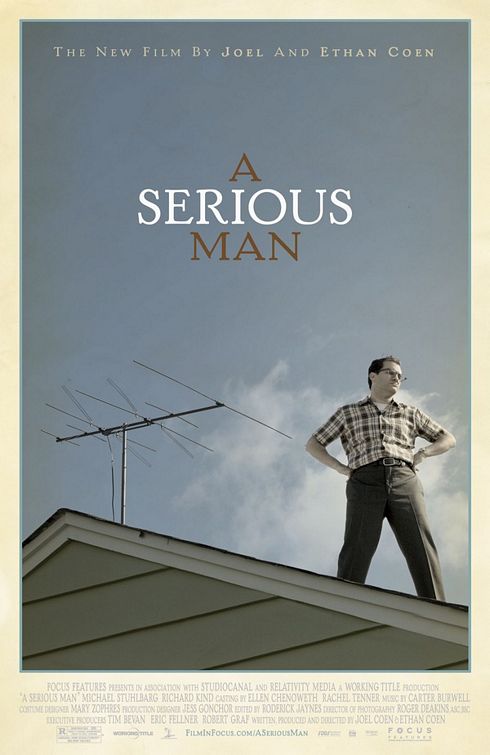
A Serious Man (2009) from Joel and Ethan Coen has never been taken seriously enough (playlist of clips). It was nominated for two major Academy Awards, Best Picture and Best Original Screenplay, but none of the cast members were invited to the festivities until the last week before the event. That is an ironic nod to the movie itself.

Scholars have spent papers—entire careers—explaining why Jews try to be funny and why so many succeed. One of the stock rationales is that Jews are an historically beleaguered people, and the humor is a natural response. Another related thought is that Jewish attempts to make sense of it all have come to nothing, and so absurdity is the only possible answer.

A Serious Man is grounded in those ideas and more. Larry Gopnick is a physics professor in the 1960s. In his academic life, he is up for tenure, a student is trying to bribe him, and even as he lectures on Heisenberg’s Uncertainty Principle, there is a sense that he really doesn’t understand uncertainty at all. Things are worse in his personal life, much worse. As his son prepares for bar mitzvah, Larry discovers that his wife is having an affair with his friend, his brother is caught in a gay bar, his dentist espouses weird mystical tooth theories, and there is a question whether Larry may have a serious health problem.

Larry looks for answers in faith, but the mysterious Rabbi Marshak, the older spiritual head of the congregation, is impossible to see. At the bar mitzvah. Larry’s son Danny, who at the start of the movie had his transistor radio taken away at Hebrew School, goes off to see this rabbi. He finds him in an inner sanctum, where Rabbi Marshak explains it all through the Jefferson Airplane and with a powerfully simple piece of advice:

Marshak is an old man staring at him from behind a bare desktop. His look, eyes magnified by thick glasses, is impossible to read.

Danny creeps to the chair facing the desk. He gingerly sits on the squeaking leather upholstery, self-conscious under Marshak’s stare.

Marshak’s slow, regular, phlegmy mouth-breathing is the only sound in the room. The two stare at each other.

Marshak smacks his lips a couple of times, wetting surfaces in preparation for speech.

Finally:

MARSHAK
When the truth is found. To be lies.

He pauses. He clears his throat.

. . . And all the hope. Within you dies.

Another beat. Danny waits. Marshak stares. He smacks his lips again. He thinks.

. . . Then what?

Danny doesn’t answer. It is unclear whether answer is expected. Quiet.

Marshak clears his throat with a loud and thorough hawking. The hawking abates. Marshak sniffs.

. . . Grace Slick. Marty Balin. Paul Kanta. Jorma. . .somethin.
These are the members of the Airplane.

He nods a couple of times.

. . . Interesting.

He reaches up and slowly opens his desk drawer. He withdraws something. He lays it on the bare desk and pushes it across.

. . . Here.

It is Danny’s radio.

. . . Be a good boy.

The movie closes with a note taken straight from the Book of Job. A tornado approaches. Will it be the voice of God out of the whirlwind? Or will it just be one more inexplicable disaster, one more serious touch of uncertainty?

Who knows? Yom Kippur and every day, listen to Rabbi Marshak: Be a good girl or boy.

Are Presidential Comparisons Odious?

Lydgate - Horse, Sheep and Goose
Comparisons are odious.

This phrase, roughly meaning that comparing people and situations can be unhelpful and counterproductive, is centuries old. It is variously attributed, but as good a source as any seems to be medieval British writer John Lydgate. It comes from his poem The Debate of the Horse, Goose, and Sheep (1436–37).

(For those concerned that this blog just makes stuff up, be assured that scholarly authorities have been consulted. Maura Nolan’s John Lydgate and the Making of Public Culture (2006) was not read in its 290-page entirety, but it was used. Consider this pertinent passage:

Lydgate’s debt to Gower in this passage is obvious; though he has clearly read both Isidore and Higden’s accounts (and possibly Bromyard’s as well), he takes from the Confessio Amantis the notion that the vagaries of Fortune constitute the lesson of the exemplum, a lesson he later directly applies to present-day rulers, ‘‘wise gouernours of euery londe and region’’ (65, lines 25–26). Note: Lydgate makes a similar point in ‘‘The Debate of the Horse, Goose, and Sheep,’’ dated 1436–37 by Pearsall ( John Lydgate (1371–1449), 51), telling his readers that ‘‘thees emperours . . . with ther victories & triumphes’’ (lines 638–39) are subject to Fortune and fall. The political message is explicit: ‘‘Beth war, ye pryncis, your suggettis to despise’’ (line 643). See MacCracken, ed., Minor Poems of John Lydgate, part 2, 539–66)

(Please feel free to show off to your friends and colleagues who wonder if your liberal arts degree, if you have one, is worth anything. Knowing that “In the fifteenth century Lydgate was the most famous poet in England, filling commissions for the court, the aristocracy, and the guilds. He wrote for an elite London readership that was historically very small, but that saw itself as dominating the cultural life of the nation” should impress them.)

About Presidents and odious comparisons: In the many crises of his presidency, including the most recent, President Obama has endured more comparisons than perhaps any other President. Just in the past few days, we have heard about Woodrow Wilson, George W. Bush, Lyndon B. Johnson, Ronald Reagan, Bill Clinton, Jimmy Carter, John F. Kennedy, and in this very blog, Harry Truman.

Comparisons are natural for a few reasons. It is an office that has been held by a relatively small number of people over more than two centuries, and so how you do the job is defined as much by what others did as some sort of abstract definitions and expectations. There is also the flawed logic: the United States is the greatest country in the world, the President is the leader of the United States, therefore the President is the greatest leader in the world. At moments yes, but please check history, the sometimes impossibility of situations, and the nature of imperfection of all powerful humans. Finally, Obama is so unlikely, if not unlike any of his predecessors, that you almost want to jump to comparisons.

My best attempts to find out what the horse, sheep and goose were debating about six centuries ago, and what it has to do with comparisons, have come up empty. So I do have had to make this part up. If the debate was about which one is superior—whether a horse, sheep or goose is better—the answer is elusive and equivocal. This is in no way to cut the current President the slightest bit of slack, as readers of the blog already know. But the presidency is not a single job, even in more stable and simple times, which these are not. So compare away, but don’t let those comparisons obscure clear thinking and distract us with reveries (or lingering antipathies) about this leader or that. That would be odious, in a country and world with odium enough.