Bob Schwartz

Jack Cristil: The Voice of God is Gone

Jack Cristil Biography

There are two ways you might know Jack Cristil, who died this weekend at the age of 88. But maybe not.

If you’re from Mississippi, or an SEC sports fan, you know him as the The Voice of Mississippi State football and basketball for almost sixty years, until his retirement in 2011.

If you are a member of the Tupelo Jewish community, where Jack was an essential part of Temple B’nai Israel for almost that long, you know him, more or less, as The Voice of God. In addition to his leadership roles in the congregation, Jack frequently led services. Most of us have heard clergy and lay people at the pulpit with some memorable voices and presences. Jack stood above them all. That perfectly modulated baritone, driven by his deep and unshakable faith, gave us all the play-by-play for a different sort of game, season after season.

That extraordinary voice would mean nothing without the man behind it—just a trick of vocal cords and breath. But Jack’s mind and heart were even bigger than that voice. Which is why when he spoke on the radio or at services, or in the more intimate setting of a meeting or conversation, you listened. Some people get our attention by the way they say things, and Jack could get anybody’s attention. But others keep our attention because of what they say, and even more, who they are.

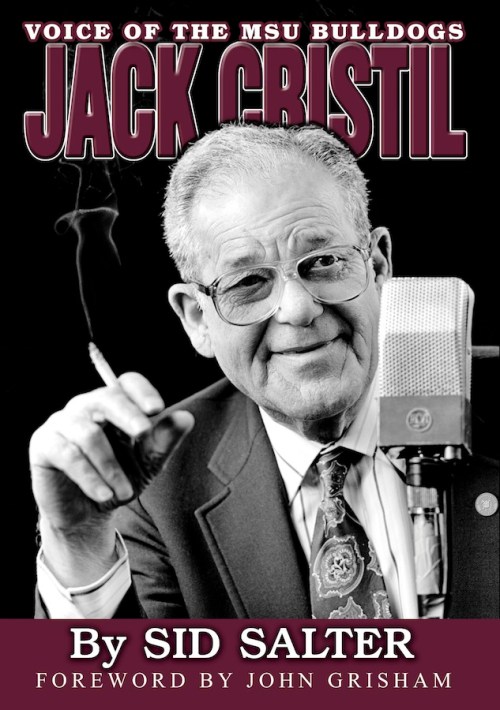
In case you still think that Jack was not so well-known or important, see the above book cover from a biography of him. You may not have heard of Jack or of the author, veteran Mississippi journalist Sid Salter. But the man who wrote the Foreword to Jack’s biography is a little more familiar—a Memphis-based writer named John Grisham.

And if that’s not famous enough, here’s a photo of Jack interviewing Elvis:

Jack Cristil and Elvis

Jack is gone, but anyone who has heard that voice, even once, will hear it forever. One of Jack’s favorite bits in services was to ask the congregation to turn to a particular page in the prayer book and to indicate having done so by being seated. Today, we indicate our love and respect by standing up. We hear you, Jack.

MUJI to Sleep: Minimalist Essential Wonderful Free App

MUJI Waterfall

Japanese retailer MUJI has a free gift for you. A tiny gift that will delight you and transform your phone or tablet into an instrument of wonder. MUJI for Sleep.

MUJI sells minimalist furniture, home goods, apparel, and other personal products—online and in a small number of stores in New York and California.

On their U.S. website, MUJI explains its philosophy:

MUJI is not a brand whose value rests in the frills and “extras” it adds to its products.
MUJI is simplicity – but a simplicity achieved through a complexity of thought and design.
MUJI’s streamlining is the result of the careful elimination and subtraction of gratuitous features and design unrelated to function.
MUJI, the brand, is rational, and free of agenda, doctrine, and “isms.” The MUJI concept derives from us continuously asking, “What is best from an individual’s point of view?”
MUJI aspires to modesty and plainness, the better to adapt and shape itself to the styles, preferences, and practices of as wide a group of people as possible. This is the single most important reason people embrace MUJI.

MUJI sells a successful line of sleep products for travel. Which explains the MUJI to Sleep campaign, featuring their Neck Pillow and the MUJI to Sleep app to go with it.

Simplicity and minimalism hardly describe the app. It has five screens to swipe through, each a different color, each with a brushstroke sketch of a scene, each scene with a flow of continuous sound: a river, a bird, a waterfall, a fire, a forest. There is a timer to keep it running for 30, 60, or 90 minutes. Touch on, touch pause. That’s it. As simple as a flashlight app. And more valuable.

You can fall asleep to MUJI of course, which is what it intends. Or you can play it as background for your activities or non-activities, a sort of aural incense. It will contribute to your life in ways unexpected and wonderful.

The MUJI to Sleep app currently has less than 100,000 downloads on Google Play. It should have millions.

When you have true practice, then valley sounds and colors, mountain colors and sounds, all reveal the eighty-four thousand verses. When you are free from fame, profit, body, and mind, the valleys and mountains are also free. Through the night the valley sounds and mountain colors do and do not actualize the eighty-four thousand verses. When your capacity to talk about valleys and mountains as valleys and mountains is not yet mature, who can see and hear you as valley sounds and mountain colors?

Zen Master Dogen
Treasury of the True Dharma Eye
Valley Sounds, Mountain Colors (1240)

Do Something/Anything about ISIS? Would You Rather Have No Strategy or Bad Strategy?

Just Do It

President Obama candidly admitted that we have no strategy for dealing with ISIS, but that we are developing one.

Maybe too candid for the moment and his leadership position, but still a necessary truth. Necessary because no one on earth has a good strategy for dealing with that or the complex of situations around the world right now. For the religiously inclined, consider that Moses, Jesus, and Mohammed convening in the Situation Room would have a tough time figuring out what to do next, short of calling in the Big Gun and wiping the slate clean and starting again.

This hasn’t stopped Congress from urging a simple solution to this puzzle: do something/anything. This is an all-time irony, given that Congress is currently infamous for doing absolutely nothing, ever, no matter how important the problem and no matter how relatively simple the solution. If a number of the members had a sense of irony, we could all wryly laugh at this, except that their sense of irony is absent, along with a sense of duty, democracy, and Americanism (the real kind, not the fake). Some of these same members do seem to have a sense of justice, John Wayne frontier justice, which is unfortunately out of place in the liquid world of 2014 global politics and insurgency.

A few years ago, some thought that democracy would spread around the oppressed nations like an epidemic, like Arab Spring fever. But chaos is also an opportunistic contagion, and as those on one insurgent or imperialist front look at the other fronts multiplying, they see opportunity and seize it. It doesn’t help that the geography is claustrophobic. If you don’t know it, connect the dots from Iraq to Syria to Israel to Gaza to Egypt, Sudan, and Libya. And that’s just one pole of the current dynamic.

We have been tragically mistaken on strategy in the last three major American wars. One was an abject defeat, the other two—Iraq and Afghanistan—have sort of ended, with an indeterminate outcome, and withdrawal that may or may not last. Let’s pull back from partisan finger-pointing, and just admit that some situations—whether you choose to demur or however you choose to engage—may have outcomes, but may not have solutions.

You can be smart or stupid, fearless or timid, right or wrong, and you can still be overwhelmed by circumstances. That is, there is no “perfect” strategy, especially not with the way things are aligning. So no, you can’t wait for that perfect strategy. But you also shouldn’t rush in with the next idea that comes into your head, especially if that idea comes from some outdated playbook that has already proven itself ineffective in current realities.

“Just do it” sounds great, as long as you spend sufficient time really considering what “it” is and what the consequences and outcomes might be. Oh, and also, you might try being candid, as Obama has been, rather than making stuff up. Like about WMDs. Like about wars that will last weeks and cost nothing. Let’s leave that sort of unhelpful lying to fairy tale tellers like Vladimir Putin, who is not invading Ukraine, and to Putin’s admirers and portrait painters.

We Need a Doctor: Who Hasn’t Seen Jennifer Lawrence’s Breasts or Why We Need Social Therapy

Bohemian Paris of Today

One of the biggest stories of the weekend was the posting of nude photos of Jennifer Lawrence and other female celebs, apparently stolen from their cloud storage accounts. The search activity for these photos almost brought the Internet down.

So in the immediate aftermath, with more to be revealed, what might we learn, besides how these beautiful strangers look without their clothes?

We are no closer than ever to figuring out what we think about privacy, or even what privacy means, especially now.

Digital didn’t create the issue, just heightened it exponentially. Inquiring minds have always wanted to know, and see. Celebrities, some though not all, have used degrees of exposure for publicity—or in some cases to put curious fans off the trail of the truth. Now we have an entire industry of programs about the “real” lives of unknowns, used-to-be-knowns, just-a-little-knowns, and soon-to-be-knowns because they are on a reality show.

Then there is the willingness of many people to chronicle everything. Twitter long ago dropped its signature question, but the most important phrase of the century so far may be “What are you doing?”, which was supposed to be answered in 100 characters or less. It turns out that people are more than willing to talk about what they are doing, what they are thinking, how they are looking, and anything else.

This doesn’t mean people don’t deserve privacy, morally and legally. It’s that line-drawing is now so hard for so many, and that goes along with a certain amount of confusion or even hypocrisy. The same people who searched for these photos or others like it in the past would be fuming if anyone stole their private shots and published them. They might try to rationalize the distinction, but it would be pretty feeble. Yet, not to forgive their double-standard, it is not surprising under the circumstances.

When we are confused about anything, and have difficulty drawing a line, sex makes it worse, clouding our judgment and our actions. Private parts are signifiers of sex, and if the private parts of loved ones or of strangers are arousing, the private parts of the quasi-strangers who are celebrities are positively crazy-making. So it is understandable, if not acceptable. People are only human, or so we say. But that doesn’t mean a little help and discussion—about privacy, about the cloud, about celebrity—might not be valuable. Maybe a little social therapy is in order.

We need a doctor, call us a doctor
We need a doctor, doctor to bring us back to life

(apologies to Dr. Dre, Eminem, and Skylar Gray)

A World Worth Saving

Xul Solar - Puerto Azul

People are justifiably angry, frustrated, and confused when those with all the “advantages” of Western Europe and the United States join violent apocalyptic movements in Iraq, Syria, and elsewhere. But maybe we can learn a little by asking some related questions: Do these fighters believe the world is worth saving? Do your fellow citizens, friends, and neighbors believe it? Do you?

Almost by definition, those who are convinced to join movements aimed at turning the world upside down believe that the world as it is is beyond repair, and that the world as it is is not worth saving.

What might surprise you, if you think about it, is how many of the people around you, people you know, believe exactly the same thing. They don’t go halfway around the world to kill mercilessly to hasten the end of the status quo. But they do believe that this world is irreparably broken, that many other people (maybe even you) are complicit in maintaining and encouraging that disrepair—in feeding the beast—and that nothing short of the quickest possible end to this world will bring them to the rightness of that world.

We don’t talk much about whether this world is worth saving. There are those true believers just mentioned who think there is nothing to talk about, that it is dogmatic and axiomatic that this world is as good as gone. For others, it can be a bunch of words, about how we will make the ultimate sacrifice to preserve “the American way of life” or “freedom,” as if those were so self-evident that discussion would be at best useless and at worst seditious.

We have to talk about it, not just assume or demand the automatic answer “of course it’s worth saving.” One of the reasons we don’t talk about it is that we would have to think about it, and that is not easy or comfortable. We would, among other discomforts, have to admit shortcomings, some very serious.

When we don’t talk, we end up with some people easily persuaded that maybe this world is so broken that we should start creating a different one, even apocalyptically. That’s the bad news, ripped from today’s headlines.

The good news is that if we did talk about whether the world is worth saving, honestly, without dogma, with no “wrong” answers, we would almost certainly conclude that—with some minor and major adjustments—it is. It’s just getting to that conclusion that can be so difficult.

Newark and Detroit: The Long Hot Summer of 1967

Newark 1967

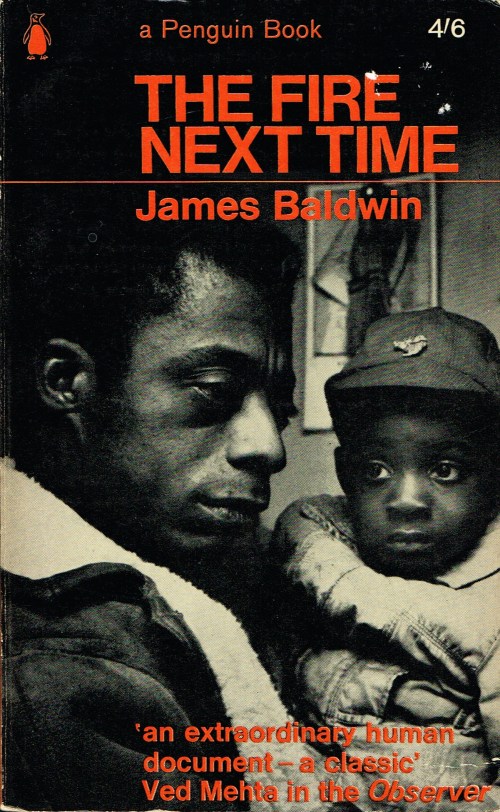
The last post about James Baldwin’s The Fire Next Time (1963) skipped a beat about what happened next. What happened in America was the race riots between 1964 and 1966 (including Watts in Los Angeles), culminating with the so-called Long Hot Summer of 1967. During that summer, among the many cities affected, the two disturbances that stand out are Newark and Detroit.

Baldwin did not overstate any prophetic intention in his book. Instead, he simply opened with this epigraph, from which he took the book’s title:

God gave Noah the rainbow sign,
No more water, the fire next time!

Newark, July 12-17, began with the arrest of a black cabdriver for passing a police car. The riots left 26 dead and hundreds injured.

Detroit, July 23-27, began with a police raid of a black drinking club. The riots left 43 dead, 1,189 injured, over 7,200 arrests, and more than 2,000 buildings destroyed.

There are at least three reasons we don’t hear much or talk much about that summer in the context of Ferguson.

We are abysmally ahistorical. If it isn’t in the latest Twitter feed, it may already be old news. Things that happened forty or fifty years ago might as well be from the Middle Ages.

We want to highlight and not overshadow the clear progress that has been made. Progress to be sure, as reflected in the photo of a black President talking to a black Attorney General about the events in Ferguson.

We are afraid. Afraid that the progress we have made may be as illusory as it is real. Afraid that we solved the easier problems, leaving us with stubborn, intractable ones that are beyond comfortable solutions. Afraid that we may not be as good as we think we are. Mostly afraid that history is TMI, telling us way more than we want to know, showing us images not from the distant past but from tomorrow.

Ferguson and The Fire Next Time

James Baldwin - The Fire Next Time

James Baldwin’s The Fire Next Time may be the best and most eloquent statement of relations between whites and blacks in America ever written. From the publisher:

The appearance of The Fire Next Time in 1963, just as the civil rights movement was exploding across the American South, galvanized the nation and continues to reverberate as perhaps the most prophetic and defining statement ever written of the continuing costs of Americans’ refusal to face their own history. It became a national bestseller, and Baldwin was featured on the cover of Time magazine. Critic Irving Howe said that The Fire Next Time achieved “heights of passionate exhortation unmatched in modern American writing.”

Baldwin was one of the great writers of his or any other American generation. He shouldered the burden of being a triple threat to America of the 1960s—a black man, a brilliant and outspoken intellectual, and gay. This he did with unequaled prose grace, and this work and others are required reading for anyone who wants or claims to be a writer.

The first of the two essays is My Dungeon Shook: Letter to My Nephew on the One Hundredth Anniversary of the Emancipation. Brief and unforgettable, it is a summary of how things are and why his teenage namesake cannot give up and in. It does no justice to this book to excerpt it; it stands as a whole that must be read—not the least of all because with the real progress we have made, we are foolish and destructive to over-measure how far we have come. But here is how the essay closes:

And if the word integration means anything, this is what it means: that we, with love, shall force our brothers to see themselves as they are, to cease fleeing from reality and begin to change it. For this is your home, my friend, do not be driven from it; great men have done great things here, and will again, and we can make America what America must become. It will be hard, James, but you come from sturdy, peasant stock, men who picked cotton and dammed rivers and built railroads, and, in the teeth of the most terrifying odds, achieved an unassailable and monumental dignity. You come from a long line of great poets, some of the greatest poets since Homer. One of them said, “The very time I thought I was lost, My dungeon shook and my chains fell off.”

You know, and I know, that the country is celebrating one hundred years of freedom one hundred years too soon. We cannot be free until they are free. God bless you, James, and Godspeed.

Your uncle,
James

Making No Sense

NASA - Stars

I looked at the stars
Like an astrologer
Saw constellations
Like an astronomer
Saw suns and planets.
I looked again
And saw stars.

The Economist on Israel: Winning the Battle, Losing the War

Economist - Israel and Gaza

If you read the biblical chronicles instead of the newspapers, you know that the Jewish homelands have lived forever from crisis to crisis. In the history of modern Israel, none of that has changed.

When you live in constant crisis, the historical topography can be indistinct—it can be hard to tell which one is bigger than another. But in Israel’s history, Independence in 1948 and the Six Day War in 1967 are epochal. The current Israel-Gaza conflict is still ongoing, but the current crisis of 2014 may join that cohort.

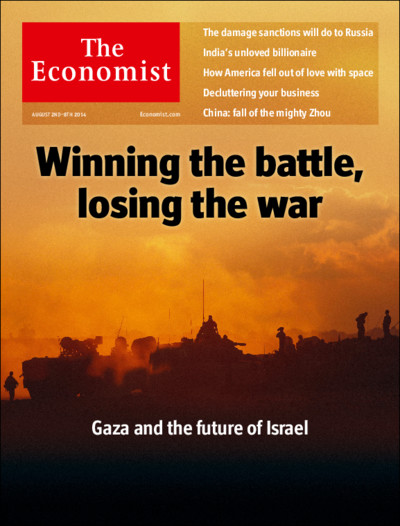
Among the thousands of pieces and millions of words generated over the past few weeks, the new cover story from The Economist, Winning the battle, losing the war is one of best and most even-handed evaluations published about the aftermath of all this.

“Even-handed” and “fair-minded” are hard to find in such a brutal and polarized controversy, and some would say they don’t exist at all. The Economist, for those who don’t know, is one of the most astute and level-headed journals of public affairs in the world. This piece, like others about contested matters, is not without embedded value judgments or opinions. It is just a sharp, worthwhile, and informed point of view that should be heard—even if it is shouted down as somehow biased and mistaken:

For all the blood and misery in Gaza, Mr Netanyahu will soon have a chance to show he has heard the critics. Having won his battle, he could return to the negotiating table, this time with a genuine offer of peace. Every true friend of Israel should press him to do so.

Haftarah for War and Peace: Isaiah

Isaiah

The Jewish scriptural calendar has two parts: a weekly reading from the Torah (the Five Books of Moses) and a weekly reading from the prophets, known as a haftarah.

Today’s reading—Isaiah 1:1-27—is possibly the most special of these haftarot. Isaiah is the most famous and read of all biblical prophets, among Jews and Christians. And today’s reading is the very first chapter of Isaiah. It was written in, about, and for the Jewish kingdoms of the 8th century BCE, which were under threat from without and within.

Whole libraries have been written explaining and interpreting Isaiah. (For those who want a very brief, very readable introduction to these readings, there is no better start than W. Gunther Plaut’s The Haftarah Commentary.) One message is that the form of faith, no matter how punctilious and properly executed, is not enough, never enough. God says:

Trample my courts no more; bringing offerings is futile; incense is an abomination to me. New moon and sabbath and calling of convocation— I cannot endure solemn assemblies with iniquity. Your new moons and your appointed festivals my soul hates; they have become a burden to me, I am weary of bearing them. When you stretch out your hands, I will hide my eyes from you; even though you make many prayers, I will not listen; your hands are full of blood. (Isaiah 1:13-16)

The passage that follows this is one of the best known in the Bible:

Wash yourselves; make yourselves clean; remove the evil of your doings from before my eyes; cease to do evil, learn to do good; seek justice, rescue the oppressed, defend the orphan, plead for the widow. (Isaiah 1:16-17)


Isaiah 1:1-27

1The vision of Isaiah son of Amoz, which he saw concerning Judah and Jerusalem in the days of Uzziah, Jotham, Ahaz, and Hezekiah, kings of Judah.

2Hear, O heavens, and listen, O earth; for the Lord has spoken: I reared children and brought them up, but they have rebelled against me. 3The ox knows its owner, and the donkey its master’s crib; but Israel does not know, my people do not understand. 4Ah, sinful nation, people laden with iniquity, offspring who do evil, children who deal corruptly, who have forsaken the Lord, who have despised the Holy One of Israel, who are utterly estranged! 5Why do you seek further beatings? Why do you continue to rebel? The whole head is sick, and the whole heart faint. 6From the sole of the foot even to the head, there is no soundness in it, but bruises and sores and bleeding wounds; they have not been drained, or bound up, or softened with oil. 7Your country lies desolate, your cities are burned with fire; in your very presence aliens devour your land; it is desolate, as overthrown by foreigners. 8And daughter Zion is left like a booth in a vineyard, like a shelter in a cucumber field, like a besieged city. 9If the Lord of hosts had not left us a few survivors, we would have been like Sodom, and become like Gomorrah.

10Hear the word of the Lord, you rulers of Sodom! Listen to the teaching of our God, you people of Gomorrah! 11What to me is the multitude of your sacrifices? says the Lord; I have had enough of burnt offerings of rams and the fat of fed beasts; I do not delight in the blood of bulls, or of lambs, or of goats. 12When you come to appear before me, who asked this from your hand? Trample my courts no more; 13bringing offerings is futile; incense is an abomination to me. New moon and sabbath and calling of convocation— I cannot endure solemn assemblies with iniquity. 14Your new moons and your appointed festivals my soul hates; they have become a burden to me, I am weary of bearing them. 15When you stretch out your hands, I will hide my eyes from you; even though you make many prayers, I will not listen; your hands are full of blood.

16Wash yourselves; make yourselves clean; remove the evil of your doings from before my eyes; cease to do evil, 17learn to do good; seek justice, rescue the oppressed, defend the orphan, plead for the widow. 18Come now, let us argue it out, says the Lord: though your sins are like scarlet, they shall be like snow; though they are red like crimson, they shall become like wool. 19If you are willing and obedient, you shall eat the good of the land; 20but if you refuse and rebel, you shall be devoured by the sword; for the mouth of the Lord has spoken.

21How the faithful city has become a whore! She that was full of justice, righteousness lodged in her— but now murderers! 22Your silver has become dross, your wine is mixed with water. 23Your princes are rebels and companions of thieves. Everyone loves a bribe and runs after gifts. They do not defend the orphan, and the widow’s cause does not come before them. 24Therefore says the Sovereign, the Lord of hosts, the Mighty One of Israel: Ah, I will pour out my wrath on my enemies, and avenge myself on my foes! 25I will turn my hand against you; I will smelt away your dross as with lye and remove all your alloy. 26And I will restore your judges as at the first, and your counselors as at the beginning. Afterward you shall be called the city of righteousness, the faithful city. 27Zion shall be redeemed by justice, and those in her who repent, by righteousness.