Bob Schwartz

Saturday Night Political Comedy and Science Fiction

Manchurian Candidate

There were two moments of comedy from Saturday night politics, one spontaneous, one planned. And a weird science fiction scene in between.

Comedy. The chaotic opening of the Republican debate was described by Politico as a “train wreck.” But a really funny train wreck:

As Gov. Chris Christie walked out on stage, moderators David Muir and Martha Raddatz called out Dr. Ben Carson. A camera backstage showed Carson starting to walk out, but he stopped himself once he heard the moderators announce the next candidate, Ted Cruz.

Cruz walked out, and Carson stayed put as a stage manager tried to wave Carson on stage. He didn’t move. Donald Trump then walked up next to Carson as his name was called, but also stopped next to Carson.

Marco Rubio was called up next, walking past both Trump and Carson onto the stage, as did Jeb Bush. John Kasich initially didn’t make it out onto the stage at all.

The moderators thought they were done. “Ladies and gentlemen, the Republican candidates.”

But they weren’t. “Dr. Ben Carson, please come out on the stage. He’s standing there, as well. Dr. Carson.

“And Donald Trump,” they added.

Then Carson chimed in. “I can introduce Kasich?”

“Yes, yes, we’re going to introduce Ohio governor John Kasich,” the moderators said.

All that was missing from the botched introductions was the candidates colliding with each other and falling all over the stage. Keystone Cops style (that’s for you, Mitt Romney). This hilarious mess didn’t quite make the endless hours of blah blah that followed tolerable.

Then there was this bit of absolute weirdness at the debate:

Science fiction. Chris Christie attacked Marco Rubio for giving the same canned speech every time, no matter what the question. Rubio responded by giving the exact same speech he had just given. Later in the debate, Rubio did it again, word for word. And then again.

It was like a sci-fi movie where a robot is running for President and the mission is to push him to the point of meltdown. The only way we did know that Rubio was not a robot is that later on he began to sweat. Aha!

Or maybe it was like The Manchurian Candidate, where Christie would show Rubio the Queen of Diamonds from a deck of cards, and Rubio would walk off stage in a hypnotic trance.

Comedy. Bernie Sanders went on Saturday Night Live with his doppelganger Larry David. SNL concocted a bit in which Larry David was the captain of a Titanic-type ship that was sinking. The captain was trying to jump ahead of the women and children getting into the lifeboats. Bernie appeared on deck as a radical immigrant who had had “Enough! Enough!” of the privileged one-percent pushing ordinary people around. The happy ending is that the ship has hit not an iceberg but the Statue of Liberty. Bernie did a charming and self-effacing job of delivering his lines with comic gusto.

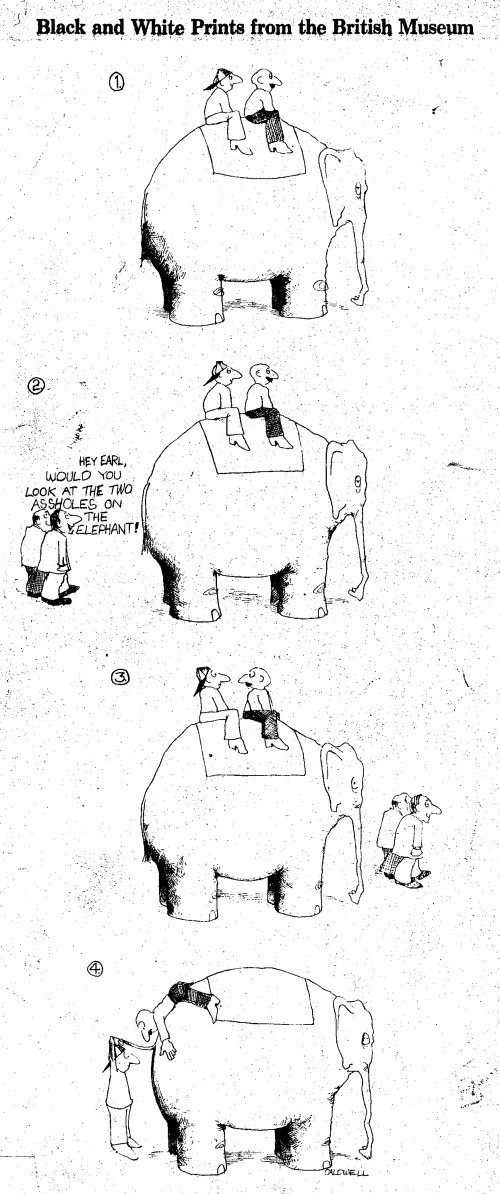
Best Cartoon Ever

Two Guys on an Elephant

Following is the best cartoon I have ever seen. Excuse the low quality, because it is a scan of an old and precious magazine clipping.

You could write a doctoral dissertation on how these four panels work their magic and represent the art and mechanics of humor. Or you could just laugh.

Black and White Prints from the British Museum


Round Trip to Heaven or Hell

If you had a round trip ticket
To heaven or hell,
Bliss or madness,
Sure you would return,
Would have to,
Which would you choose?
Tour over,
Now the common surroundings
Might seem shabby and disappointing or
Simple comfort and sanity a relief.
Conscripted for travel
Or volunteering,
This is what you learned
Gladly or sadly
For the next inevitable journey.

Shepard Fairey: The Art of Political Revolution

Shepard Fairey - Bernie Sanders Concert

Not many people had heard of the artist Shepard Fairey (“Manufacturing Quality Dissent Since 1989”) until he created the Obama “Hope” poster, one of the most famous pieces of art in modern American politics.

Since then, he has been spending his time creating, exhibiting and selling all sorts of provocative and eminently viewable art/propaganda on the beneficial edge of society, politics and culture.

He created the poster above for today’s Bernie Sanders benefit concert in Los Angeles. For those who haven’t looked for a while, or don’t know Shepard’s work, here is a sampling:

End Corruption

Make Art Not War

3fe6ad0d-98bd-49f4-b2d3-851ef7c7a746


Duck Walks Into A Drugstore

I posted one of my favorite jokes more than two years ago. Because I thought we all needed a laugh. In case you weren’t around, here it is again. Because we definitely need a laugh.

Duck walks into a drugstore, asks for some Chap Stick. Guy behind the counter says, “That’ll be fifty-nine cents.” Duck says, “Put it on my bill.”

Next day, the duck walks into the drugstore, asks for a package of condoms. Guy behind the counter says, “Would you like me to put that on your bill?” Duck says, “Hey, what kind of a duck do you think I am?”

Rules for Radicals: A Pragmatic Primer for Realistic Radicals

Rules for Radicals

Saul Alinsky, author of Rules for Radicals: A Pragmatic Primer for Realistic Radicals (1971), is a currently infamous architect of political change, demonized but also mostly unread.

His infamy comes from the revelation that Barack Obama had used Alinsky’s work as a sourcebook for community organizing back in Chicago. That was enough for conservative Obama haters, who took this as just one more sign of Obama’s anti-Americanism. Most of them had never read Alinsky, but were sure he was some sort of scary Commie/enemy of the state type, who in the right kind of America belonged in jail—if he hadn’t already been dead.

Rules for Radicals is none of that. It is instead an articulate and sensible outline for making political change—not by rejecting or blowing up the system or the establishment, but by first accepting the way things and people are and working from there.

As an organizer I start from where the world is, as it is, not as I would like it to be. That we accept the world as it is does not in any sense weaken our desire to change it into what we believe it should be — it is necessary to begin where the world is if we are going to change it to what we think it should be. That means working in the system.

Anything else, Alinsky says, alienates people by going outside their experience. Which is why, for example, he was so opposed to the tactic of burning the American flag as a form of protest.

This failure of many of our younger activists to understand the art of communication has been disastrous. Even the most elementary grasp of the fundamental idea that one communicates within the experience of his audience — and gives full respect to the other’s values — would have ruled out attacks on the American flag. The responsible organizer would have known that it is the establishment that has betrayed the flag while the flag, itself, remains the glorious symbol of America’s hopes and aspirations, and he would have conveyed this message to his audience.

Alinsky cites many political thinkers, giving special attention to the virtues and vices of those behind the American Revolution. Sam Adams, for example, made the case for revolution against the British, but once he was part of the established new regime, opposed rebellions within the new American democracy. This, Alinsky says, is a typical pattern.

Writing in 1971, after decades as an organizer, Alinsky hoped to guide a new generation of young radicals who seemed passionate but relatively rudderless. He laid out the practical lessons of his experience, especially the distinction between the rhetorical radical and the pragmatic radical.

This is the promise and the danger of what Alinsky saw at the time, and in a certain light, might still see today:

The “silent majority,” now, are hurt, bitter, suspicious, feeling rejected and at bay. This sick condition in many ways is as explosive as the current race crisis. Their fears and frustrations at their helplessness are mounting to a point of a political paranoia which can demonize people to turn to the law of survival in the narrowest sense. These emotions can go either to the far right of totalitarianism or forward to Act II of the American Revolution.

John Kasich Will Reunite Pink Floyd

Ohio governor and Republican candidate John Kasich has said that if elected President, he will try to reunite Pink Floyd.

“And if I’m President, I am going to once and for all try to reunite Pink Floyd to come together and play a couple of songs. And since we have so much trouble in America with our finances, I’m going to (ask the band to) start with a little song they created called Money.”

This is obviously meant to announce that Kasich is down with whatever the kids are/were listening to (he said his favorite concert of all time was seeing them on “The Wall” tour). And it is probably better than Marco Rubio’s professing his love for Wu Tang Clan.

The ability to reunite Pink Floyd may not be a qualification to be President. But if he can also resurrect the late great Syd Barrett for the concert, I think we’ve got our new Commander (Concert Promoter) in Chief.

Babel On

Babel On

What is the point and price of
The tower of words and thoughts?

High and fine
To reach higher and finer.

Was God protective,
Jealous even,
Of the secret word
That would reveal all
And make him redundant,
Obsolete, inferior?

Or was it a sign
We couldn’t read
That in the clouds,
On the moon,
Mars, the stars
We would find nothing but ourselves
Still babbling
Traveling
Going nowhere?

Snow White in Iowa

Snow White - Magic Mirror
Hillary Clinton: Magic mirror on the wall, who won the Iowa caucus?

Magic Mirror: Over the seven jeweled hills, beyond the seventh fall, in New Hampshire campaigns Bernie Sanders, the winner in Iowa.

Hillary Clinton: I won Iowa. Bernie Sanders is dead. Behold the results.

Magic Mirror: Bernie Sanders still lives. You failed to vanquish him.

Hillary Clinton: Then I’ve been tricked.

With sincere apologies to Ted Sears, Richard Creedon, Otto Englander, Dick Rickard, Earl Hurd, Merrill De Maris, Dorothy Ann Blank, and Webb Smith, the writers of Disney’s Snow White and the Seven Dwarfs (1937). And to the Brothers Grimm.

Chicago homicides are symptoms and not just in Chicago

Chicago reported the most January homicides since 2000. This is a symptom and not just in Chicago. A number of American cities are seeing similar increases.

This is a symptom of a socio-economic underclass with little hope of moving up on any significant scale. And now for the first time in the post-World War 2 era, we have a socio-economic middle class also seeing and believing that upward movement is beyond expectations and aspirations. This is expressed in the current level of nonpartisan political dissatisfaction.

These symptoms require hard and unsparing self-awareness as a nation. Whatever the underlying conditions are, the treatments being prescribed have not worked. It is dangerous folly to think that just because a person has been relatively healthy over a pretty long time, with the occasional ups and downs, the standard remedies are bound to work for any conditions. Not to mention that some treatments once lauded turned out to be ignorant and deadly. Consider that bloodletting—cutting blood vessels or attaching leeches to extract the disease—was once the height of medicine (and why barber poles are striped red and white).

According to some experts, there is a tiny chance we may fall back into a 2008-style recession. There is also a chance that in some cities we might see a summer of 2016 that looks a little like the hot summers of the 1960s. However small those chances are, we might not want to be waiting around to see if these and other symptoms go away on their own. Sometimes they do. And sometimes they don’t.