Bob Schwartz

Sophie Scholl: “Somebody, after all, had to make a start.”

Readers of Brigitte, the largest women’s magazine in Germany, voted Sophie
Scholl the most important woman of the 20th century.

You probably do not know Sophie Scholl. She was a founder of the White Rose movement, a tiny group of German students who distributed leaflets opposing the Nazi regime. In 1943 she and two others were arrested, tried and immediately executed for treason. At the trial she simply said, “Somebody, after all, had to make a start.”


From A Noble Treason: The Story of Sophie Scholl and the White Rose Revolt Against Hitler:

A young Munich barrister named Leo Samberger opened his mail one morning in February of 1943, and, as he said afterward, he couldn’t believe his eyes. That was a time when every new day seemed to bring some new event to unsettle the nerves or stun the senses. The war, in its fourth year, had made the unexpected routine and the startling commonplace.

Even so, Leo Samberger was shaken when he opened what he thought was a letter but turned out to be a leaflet. It was neatly typed, singlespaced, with no illustration or typographical flourish of any kind. It was a solid block of type that made no more concession to the reader than a page from a textbook. But Leo Samberger caught his breath as he ran his eye down the page. “The day of reckoning has come, the reckoning of German youth with the most detestable tyranny that our people has ever endured. . .”…

With an intensity that broke through every phrase, the leaflet denounced the “corporal of World War I” whose amateur strategy had just cost the German people three hundred thousand of their sons in the bloodbath at Stalingrad. Here the leaflet, in its bitterness, used sardonically the saying that the Ministry of Propaganda had popularized to hail the achievements of Adolf Hitler: “Führer, wir danken Dir!” (Leader, we thank you!).

Then, at the end, came an impassioned call for revolt: “The name of Germany will be disgraced forever unless the German youth rises up, in both atonement and vengeance, to crush its tormentors and to build a new and nobler Europe.”…

The story circulated that some students had been caught scattering leaflets along corridors on the stairway between floors, and in the central hall under its high, domed skylight. The leaflets had been swiftly gathered up and spirited away by custodians before they could spread their corruption among the students. Copies were being closely examined in the rector’s office, to which, again, the Gestapo had been summoned. The names of the perpetrators were not immediately made known, nor was their fate….

Now it became clear why the chief judge of the People’s Court had been hastily flown from Berlin to preside at this trial and why the courtroom was so liberally seeded with representatives of the armed power of the state. The charges that Freisler had read from the indictments were among the gravest that could be brought against a German by his government in wartime.

It appeared from the evidence that the infamous deeds cited by the prosecution had been perpetrated over a period of many months by an organization with the curiously incongruous name of “the White Rose”. Page after page told of the activities of this group that had secretly and subversively produced thousands of leaflets attacking the government and the war effort and circulated them in many different cities, thereby threatening the very survival of the Reich.

Freisler made no pretense of being judicial. He ranted. He bellowed. He encouraged the prosecution and ignored the defense. At his post in the doorway Leo Samberger turned his eyes from the flaming figure on the bench to the defendants. There were three of them. Though he didn’t know them, he recognized their faces from seeing them many times in the concert halls of Munich that he himself frequented. They were college students, young, educated, clean-cut—his own sort. It seemed hardly credible that they were sitting in the dock with a death penalty over their heads as a consequence of what had happened at the university only three days before….

All three maintained their self-possession in a way that won a grudging admiration even in that room, but Sophie made a particular impression. Not only did she stand out as the lone female caught up in these proceedings, but she had an indefinable quality of her own. She was twenty-two years old, dark, and with a curious aura of mingled girlishness and gravity. Now and then during the trial, her brow would crease into a quick, musing frown, which those who knew her would have recognized as characteristic. Even here, in the courtroom with her life at stake, the frown did not signify anxiety or dismay. It meant that she was turning over in her mind a point, an implication, or a shading and weighing it to get it right.

She was wearing a rumpled and rather mannish sort of coat that contributed little to her appearance. She had endured three days of nearly unbroken interrogation in a Gestapo prison, and she looked worn and tired. But her quiet appeal, hovering always between girl and woman, was unimpaired. It was overlaid, now, with a kind of subdued defiance apparent in the cast of her features and the set of her head. Once Roland Freisler, squirming with fury inside his scarlet robe, demanded to know how any German could possibly do what the indictment charged against the trio in the dock. It was Sophie who responded, clearly and coolly:

“Somebody, after all, had to make a start. What we wrote and said is also believed by many others. They just don’t dare to express themselves as we did.”…

As the proceedings wore on, it became obvious that no defense worth the name would be offered. The court-appointed defense attorneys scarcely troubled to conceal their aversion to their task or to disguise their approval of the charges. The verdict itself was never in doubt. Berlin had not sent Roland Freisler winging down to Munich to preside over an acquittal.

Yet there was, as Leo Samberger noted, a pronounced tension in the courtroom as the words were about to be spoken that would, quite literally, cost three young people their heads. Such a thing had never happened before even in a Nazi courtroom. And the words came from the bench as expected: “. . . for the protection of the German people, and of the Reich, in this time of mortal struggle, the Court has only one just verdict open to it on the basis of the evidence: the death penalty. With this sentence the People’s Court demonstrates its solidarity with the fighting troops!”

Even before the auditorium was drained of its gray, black, and brown uniforms, the condemned trio was hurriedly surrounded by a cordon of police, put in manacles, and led away.

The three of them were taken directly from the court to the place of execution, to Stadelheim, on the outskirts of the city. There, that same afternoon, all three were beheaded, the girl, Sophie, going under the guillotine first. It was all done with a speed and brutality that signaled something like panic in high places.
“A Cancer on the Presidency”

“I began by telling the president that there was a cancer growing on the presidency and that if the cancer was not removed the president himself would be killed by it.”
John Dean, counsel to President Nixon

What John Dean knew or should have known, but would not say to Nixon, was that the cancer was not growing on the presidency—it began with and was the presidency.

There are 15 physicians in the current U.S. Congress; 13 are members of the Republican Party. You’d think that above all people, they would be aware of the virulent spread of cancer, in the body and in the body politic. And they would be anxious to do everything they could to heal it and rid the body of it.

The Republican physicians in Congress have refused, as have most Republicans in Congress and other offices. They seem to be in denial, or believe in some kind of magical healing (“he will change”), or in some cases are actually benefiting from the disease, though they rationalize this as being for the good of the American people.

Back in Watergate, Republicans did not have to hear about “a cancer on the presidency” from John Dean. Many or most of them recognized it, and took the measures needed to make it go away. Without them, Nixon would probably have remained president until January 1976, rather than resigning in August 1974. Who knows how far the cancer might have spread by then?

Maybe Republicans will finally do something, but it is not hopeful. Who knows how far the cancer might spread?

A Courage, Conscience and Character Party

I have long said that a third (or fourth) party can’t work in America because of political structure, tradition and history. I may have been wrong.

America has a two-party system, one of the many ways we are “exceptional” compared to the rest of the democratic world, which mostly has some form of a multi-party parliamentary system. As much as our system more or less works, it is now apparent that it works only when it is filled, top to bottom, with people of courage, conscience and character. We know this because for the first time in more than two centuries, courage, conscience and character are in short supply, or at least buried under ambition, greed and who knows what other issues.

And so, I introduce a new kind of third party. The Courage, Conscience and Character Party (aka the People of Principle Party).

There is no policy or ideology litmus test for this party. Of course policy and ideology matter, sometimes a lot, in the particular way things get done. But I now see that in the big picture, these are secondary. Whether one is progressive, conservative, or in between, none of that matters if you are not driven by brave decency. Even if the policy or ideology is not to our liking, or completely anathema, we can at least be inspired by those who publicly demonstrate the qualities of courage, conscience and character.

It is true that wherever you stand politically there are preferred policies that appeal to you and for which you will fight. But it is just as important to be able to point to people—be able to point out those people to our children—and say: Their plans may be wrongheaded and ill-conceived, but I don’t question their honesty, sincerity, decency, empathy, courage, conscience or character. We seem to be taking a break from that possibility, and if it takes another party to get us there, we will be a better country and better people for it.

Pope Francis: Amassing Wealth While Children Die Is ‘Idolatry That Kills’

I am not a Catholic or a Christian, but no major world leader—religious or political—gives me more hope for the possibility of humanity than Pope Francis.

Today’s story as reported by Crux:

Pope says amassing wealth while children die is ‘idolatry that kills’

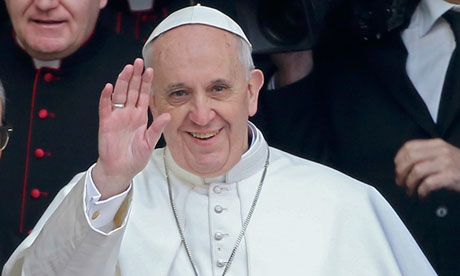
In his homily at morning Mass on Monday, Pope Francis returned to a familiar theme — how amassing wealth, both money and land, while children suffer and die, is a morally unacceptable form of idolatry. There’s an “idolatry that kills,” that makes “human sacrifices” Francis said, by those who are hungry of money, land and wealth, who have “a lot” in front of “hungry children who have no medicine, no education, who are abandoned.”

ROME – During his daily morning Mass on Monday, Pope Francis said there are those in the world who have too much wealth, and their hoarding of money and land in the face of hungry children with no access to medicine or education is the equivalent of making “human sacrifices.”

In times when the media reports “so many calamities, so many injustices,” especially concerning children, Francis sent a “strong” prayer to God, asking him to convert the hearts of men so that they don’t worship “the God of money.”

Francis’s homily, partially reported by Vatican Radio, turned on the Gospel of the day, a passage from the Book of Luke that tells the parable of the rich man for whom, according to the pope, money was his god. The passage, the pontiff said, leads to a reflection of how useless it is to rely on earthly property, emphasizing how much the true treasure is instead one’s relationship with God.

Despite the abundance of his harvest, the man in the parable wanted to expand his storehouses to have even more, in his “fantasy” of “stretching life out,” collecting more goods “to the point of nausea,” not knowing when it’s enough, in an “exasperated consumerism.”

This, Francis said, is the “reality of today,” when many people who live to worship money and make it their god, lead a senseless life.

There’s an “idolatry that kills,” that makes “human sacrifices” Francis said, by those who are hungry of money, land and wealth, who have “a lot” in front of “hungry children who have no medicine, no education, who are abandoned.

“This idolatry causes so many people to starve. We only think of one case: 200,000 Rohingya children in refugee camps,” the pope said, referring to the refugee crisis in Myanmar and Bangladesh. “There are 800,000 people there, 200,000 of whom are children.”

“Our prayer must be strong: Lord, please touch the hearts of these people who worship God, the god of money,” he said. “And also touch my heart, so I don’t fall into this too, so that I can see.”

Green Fall

Green Fall

What fall is this
Green leaves among
The red and gold
Scattered on the grass?
Lay them in designs and pictures
Pile them in mounds
Walking from one to the other
And still they fall.
If wind and winter never come
I will be here every day
Every hour
Wondering about the green leaves.

©

Tolerance in America Grew. Now Racism is on the Rise. The Churches Have Responsibility.

I won’t repeat the news story this morning from a Richmond, Virginia middle school. You can find it. It is enough to say that it is one more story about white American kids and racial intolerance in 2017.

It’s easy to see the advances we’ve made. Many parents look at their children and see genuine color-blindness. Whether this is our doing (maybe a little) or just the social environment, it is heartening to see.

But these days have made clear that racism in America is not gone, at any level, at any age, and may be on the ascendance. Which brings me to institutional religion, the churches and the synagogues.

Institutional religion is by its nature conservative, not politically but philosophically and practically. Holding on is continuity and coherence, moving on can be a kind of letting go.

As the 1950s slid into the civil rights era of the 1960s, churches struggled to keep a balance between the drama of the most idealistic beliefs and the pragmatics of congregational support. It was, in some ways, a repeat of what had happened a century earlier in the fight against slavery. As it was back then, the response for many churches was a bland silence.

But that was not enough for some in the 1960s, as Christian and Jewish leaders took to the pulpits and the streets and almost shamed their congregants into standing up for right. In the long run, it worked, and we can see the progress that has been made.

Yet nothing is forever, especially in the social tides. Every day serves up another story, some very clear, some more subtle, all of them pointing to racists among us, even in Congress, even in middle schools.

Those politicians, those bureaucratic executives, those middle schoolers, many of them claim religious affiliation, many of them attending church or synagogue. Leaders and pastors are not to blame when messages and exhortations of tolerance don’t get through to hard-headed, hard-hearted faithful listeners. But when they don’t speak up at all—pointedly, regularly and loudly—then they are shirking their mission and responsibility. If they see something, they must say something.

Why We Teach The Boy Who Cried ‘Wolf’ Story to the Very Young

Children sometimes lie, and some of us lied as children. It happens. That’s why we teach The Boy Who Cried ‘Wolf’ story early. The simple and useful lesson: There will come a time when it is very important to be believed—to avoid getting eaten by a wolf—and no one will believe you.

Here is the story, as found in Aesop’s Fables, translated by Laura Gibbs:

The Boy Who Cried ‘Wolf’

There was a boy tending the sheep who would continually go up to the embankment and shout, ‘Help, there’s a wolf!’ The farmers would all come running only to find out that what the boy said was not true. Then one day there really was a wolf, but when the boy shouted they didn’t believe him and no one came to his aid. The whole flock was eaten by the wolf. The story shows that this is how liars are rewarded: even if they tell the truth, no one believes them.

Some never learn that lesson, because they always get away with (or think they get away with) lying all the time. Manchild Trump is one of those.

Maybe, just maybe, he is growing to regret no one believing him. In the middle of a distasteful controversy about his failure to deal with the families of fallen soldiers, it is reported that he just told one widow, “He knew what he signed up for.” Trump denies saying this. Most Americans don’t believe him.

It’s not clear that this controversy is “the thing” that politically wounds Trump among his docile and subservient Republican colleagues. But if it is, Trump may finally learn the lesson of the story. Unless, of course, he always thought the story was only about the wolf.

Richard Brautigan

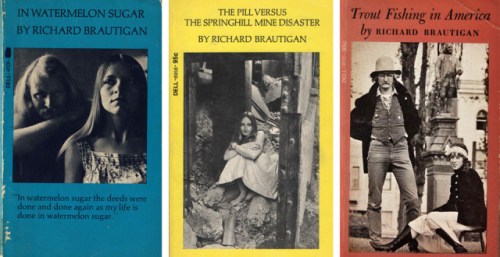
Do you have $10, or whatever that is in your local currency? Buy a copy of this collection of three books by Richard Brautigan (Trout Fishing in America/The Pill Versus the Springhill Mine Disaster/In Watermelon Sugar). Published in 1967 and 1968, one is poetry, the other two are prose so lyrical that they might as well be.

The Poetry Foundation offers a lengthy summary of critical views about Brautigan, including:

Certainly Brautigan’s work, perhaps due in part to his association with West Coast youth movements, generated a multitude of critical comment. Robert Novak wrote in Dictionary of Literary Biography that “Brautigan is commonly seen as the bridge between the Beat Movement of the 1950s and the youth revolution of the 1960s.” A so-called guru of the sixties counterculture, Brautigan wrote of nature, life, and emotion; his unique imagination provided the unusual settings for his themes. Critics frequently compared his work to that of such writers as Thoreau, Hemingway, Barthelme, and Twain.

If you’re one who doesn’t need to hear what others think, just try these books. But you might want to know how the Brautigan story ends:

Brautigan’s critical and commercial success peaked with Trout Fishing in America and began to decline following the 1971 publication of The Abortion: An Historical Romance 1966. Brautigan’s close friend novelist Tom McGuane succinctly summarized the collapse of Brautigan’s career with the observation that “when the 1960’s ended, he was the baby thrown out with the bath water.” Brautigan continued writing throughout the 1970’s, producing such books as Sombrero Fallout and Dreaming of Babylon: A Private Eye Novel 1942, but friends of the author reported he had grown increasingly withdrawn and depressed over his fading career. He apparently committed suicide in September of 1984, but his body was not discovered until October 25th of that year.

There’s a kind of serious creative playfulness that is gravity and yet is anti-gravity. This is that.


The Galilee Hitch-Hiker
Part 1

Baudelaire was
driving a Model A
across Galilee.
He picked up a
hitch-hiker named
Jesus who had
been standing among
a school of fish,
feeding them
pieces of bread.
“Where are you
going?” asked
Jesus, getting
into the front
seat.
“Anywhere, anywhere
out of this world!”
shouted
Baudelaire.
“I’ll go with you
as far as
Golgotha,”
said Jesus.
“I have a
concession
at the carnival
there, and I
must not be
late.”

The American Hotel
Part 2

Baudelaire was sitting
in a doorway with a wino
on San Francisco’s skidrow.
The wino was a million
years old and could remember
dinosaurs.
Baudelaire and the wino
were drinking Petri Muscatel.
“One must always be drunk,”
said Baudelaire.
“I live in the American Hotel,”
said the wino. “And I can
remember dinosaurs.”
“Be you drunken ceaselessly,”
said Baudelaire.

1939
Part 3

Baudelaire used to come
to our house and watch
me grind coffee.
That was in 1939
and we lived in the slums
of Tacoma.
My mother would put
the coffee beans in the grinder.
I was a child
and would turn the handle,
pretending that it was
a hurdy-gurdy,
and Baudelaire would pretend
that he was a monkey,
hopping up and down
and holding out
a tin cup.

The Flowerburgers
Part 4

Baudelaire opened
up a hamburger stand
in San Francisco,
but he put flowers
between the buns.
People would come in
and say, “Give me a
hamburger with plenty
of onions on it.”
Baudelaire would give
them a flowerburger
instead and the people
would say, “What kind
of a hamburger stand
is this?”

The Hour of Eternity
Part 5

“The Chinese
read the time
in the eyes
of cats,”
said Baudelaire
and went into
a jewelry store
on Market Street.
He came out
a few moments
later carrying
a twenty-one
jewel Siamese
cat that he
wore on the
end of a
golden chain.

Salvador Dali
Part 6

“Are you
or aren’t you
going to eat
your soup,
you bloody old
cloud merchant?”
Jeanne Duval
shouted,
hitting Baudelaire
on the back
as he sat
daydreaming
out the window.
Baudelaire was
startled.
Then he laughed
like hell,
waving his spoon
in the air
like a wand
changing the room
into a painting
by Salvador
Dali, changing
the room
into a painting
by Van Gogh.

A Baseball Game
Part 7

Baudelaire went
to a baseball game
and bought a hot dog
and lit up a pipe
of opium.
The New York Yankees
were playing
the Detroit Tigers.
In the fourth inning
an angel committed
suicide by jumping
off a low cloud.
The angel landed
on second base,
causing the
whole infield
to crack like
a huge mirror.
The game was
called on
account of
fear.

I read the news today, oh boy

I get the news I need from the weather report.
Paul Simon, The Only Living Boy in New York.

When my dearest wakes up, she sometimes asks, “Has he broken the world yet?”

Most mornings, I can’t answer. Because most mornings, I avoid the news as long as possible. Not just because it is likely to include some outrageous, if not globally existential, story. Because it is not an improvement on the new day that has begun, with possibilities admittedly ranging from the excellent to the challenging. Sunny, cloudy, stormy.

Sometime after the preliminaries, the news will creep in or barge in. Some of it will matter, some of it will be an invitation to silly diversion or to demonstrate shallow or deep cleverness, including schemes to make things better.

Boker or. Morning of light. Again.

Random Torah: The Continuing Conjunction in Leviticus 9

Today’s Random Torah chapter (Leviticus 9) is helpful for bible students, students of translation, all writers and all lovers of language. All you need to look at is the very first verse.

In Hebrew the first verse is:

וַֽיְהִי֙ בַּיּ֣וֹם הַשְּׁמִינִ֔י קָרָ֣א משֶׁ֔ה לְאַֽהֲרֹ֖ן

(Vayehi bayom hash’mini kara moshe l’aharon)

Two reputable translations render it this way:

On the eighth day Moses called Aaron and his sons (New Jewish Publication Society)

On the eighth day Moses summoned Aaron and his sons (New Revised Standard Version)

But Robert Alter and a number of traditional translations (including the King James) show that something is lost in translation:

And it came to pass on the eighth day, that Moses called Aaron (King James)

Or as Alter has it:

And it happened, on the eighth day, that Moses called to Aaron (Alter, The Five Books of Moses)

Alter notes:

And it happened. This formula (wayehi) is characteristically used to mark the beginning of a unit of narrative.

It is hard to know why so many translations leave this out and jump right into the story (“On the eighth day”). But this omission is more significant than it seems.

Beginning writers are often taught never to start a sentence with a conjunction. Like many rigid rules of writing, it can rob creativity and meaning.

“And” in this verse is what might be called a continuing conjunction. If you are a fan of TV series, you get this. Episodes begin with a “previously on” prologue, followed by the implicit “and now this.” Everything that happened before is still present, and now this is happening.

It’s true that as a writer I have a tendency (sometimes edited out when excessive) to start sentences with conjunctions. And I do recognize the habit. But if it’s good enough for Leviticus, it should be good enough for you or me.