Bob Schwartz

Category: War

Syria and the Fog of Or Else

Fog
Rhetoric is no substitute for reasoning. Or strategy.

President Obama may soon be undertaking a response to Syria’s use of chemical weapons or going to Congress with the case for such a response.

His speculation yesterday that Syrian chemical weapons might end up in an attack on America, therefore implicating our national interest, is far-fetched. But it is a necessary thing to say, given the way that matters have developed.

The U.S. stood by as President Assad brutally attacked his own people so that he could maintain power in Syria. Despite the fact that the U.S. has always tried to steer global events subtly or not so subtly, intervening in the internal strife of sovereign nations is a “red line” that we are reluctant to cross. This doesn’t mean we haven’t crossed it. It just means that if and when we do this, we do our best to make a colorable, principled case for acting under exceptional circumstances.

There are three other reasons why we’ve held back in Syria, now and over the past two years. There is our very shaky track record of Middle East intervention. There is a book-length list of potential consequences of such intervention, starting with a more violent and destabilized Syria and ending with a more violent and destabilized region and world. Finally, we have no express idea of what we want and how we want to accomplish it, without which ill effects are all the more likely if we do choose to act.

Hints of chemical weapons allowed Obama to employ his own red line: no chemical weapons—or else. Because of world history and established international agreement, certain weapons of mass destruction are deemed so out of bounds that action is semi-automatically called for. That is, using chemical weapons trumps sovereignty. The international community might stand by for the internal slaughter of thousands, no matter how inhumane, but it is quasi-obligated to answer when certain civilized conventions come into play. In other words, the chemical weapons would offer a license to act, even if the other inhumanities didn’t

A license to act—if we knew what we could reasonably achieve, if people believe that it is worth losing lives to enforce the ban on chemical weapons, if it is actually about chemical weapons, if acting doesn’t make matters worse, if we knew exactly what we planned to do and how we would deal with all the possible aftermaths. None of which is clear now. None of which is likely to be clear anytime soon.

Welcome to the fog of or else.

Syria and Foreign Incoherence

Red Line
America may not have had a coherent foreign policy since the end of World War II. And the beat goes on.

Incoherence doesn’t mean that there haven’t been successes. It doesn’t mean that other countries have done better in that time. And it doesn’t mean that the era has been an easy one: the world is more complex and diffracted than ever.

Coherence means an open, intelligent discussion about principles, followed by an open, intelligent discussion about taking action or withholding, and about the consequences and aims of the paths we choose or avoid.

Our policy seems to be driven by overwhelming ideology, good intentions and self-interest—none of which are exceptional or indictable, but all of which should be expressed in a much bigger and more sensible and realistic context. We ought to know what we’re about and candidly tell our citizens what we’re about. And when we don’t know what we’re doing—hard as that is to admit—we ought to say so.

Harry Truman was the last President to have a foreign policy named after him, in that case the Truman Doctrine. In 1947 he warned that the U.S. and the free world could not stand for Greece and Turkey falling into Communist hands (though he never used the word Communism):

It is necessary only to glance at a map to realize that the survival and integrity of the Greek nation are of grave importance in a much wider situation. If Greece should fall under the control of an armed minority, the effect upon its neighbor, Turkey, would be immediate and serious. Confusion and disorder might well spread throughout the entire Middle East….

It would be an unspeakable tragedy if these countries, which have struggled so long against overwhelming odds, should lose that victory for which they sacrificed so much. Collapse of free institutions and loss of independence would be disastrous not only for them but for the world. Discouragement and possibly failure would quickly be the lot of neighboring peoples striving to maintain their freedom and independence.

Should we fail to aid Greece and Turkey in this fateful hour, the effect will be far reaching to the West as well as to the East.

March 12, 1947

(A digression: The reason Greece was considered vulnerable to insidious forces in 1947 is that it was broke and falling apart. Presumably, without a Communist threat looming, Greece 2013 is no longer considered as significant.)

That black-and-white view was in some ways a vestige of the black-and-white war we had just finished—and won. But soon after that speech, global gray was the new black-and-white. Empires were crumbling, new nations were being made. In the year of the Truman Doctrine alone, two of the world’s most populous nations changed course: India became independent, Mao won a revolution in China—events representing more than a third of the world population. The following year, the Middle East (and history) came unglued forever with the creation of Israel. We could pretend that all this was part of some simple monolithic history, but that really made no sense.

And yet we proceeded with a dyadic us-versus-them model for decades, mostly inexplicably and unquestioningly. Korea was supposed to stop the Communism; the military result was a bloody stalemate and status quo, the economic result a Chinese hegemon. Vietnam was supposed to stop Communism; we lost the war, and Southeast Asia is a geopolitical hodgepodge. Soviet Communism crumbled, partly because of a changing world and culture, partly because being a Russian non-Communist economic and political oligarch is much more lucrative than being a party apparatchik.

When we were attacked by the Muslim Middle East, our policy was to strike back, just as we had after Pearl Harbor. Never mind that the policy was sixty years old, and that the complexities of the world could not possibly be much affected by those approaches. Sadaam Hussein is dead, and Iraq is descending at some speed into chaos. Afghanistan is or soon will be about where we found it. Osama Bin Laden is dead, but just as with the Taliban, even if Al Qaeda is diminishing, movements with other names are already rising up to take its place.

All that is preface to our incoherence in Syria.

It is easy to see why the chemical weapon “red line” matters and why proving that it has been crossed matters.

The brutality of World War I made us rethink just far we would go and where as a ‘civilized” world we would draw the line. The Geneva Protocol of 1925 prohibits their use. The community of nations has, more or less, stood behind this and its successors.

(Another digression: If the world had considered the real possibility of atomic weapons in this period between the wars, would these also have been put in the same prohibited category as chemical and biological weaons?)

The reason for taking such care about making sure the line is actually crossed of course goes back to Iraq. Having cried wolf so recently, the U.S. could not stand having its credibility questioned, internally or externally, on the issue of weapons of mass destruction.

But as the drumbeat for “doing something” gets louder in the wake of the U.S. now being completely confident that chemical weapons were used by the Assad regime, so many questions are not being asked, and if asked, not discussed or answered.

If we are already confident that thousands are killed, tens of thousands injured, hundreds of thousands displaced, and a nation is being destroyed from inside, why was the imperative waiting for this line at all? There is a global political answer, of course, which is that chemical weapons are a bigger and less assailable common ground upon which most or all can agree. That is indeed a pragmatic strategy, but we also have to talk about moral imperatives, no matter which way the discussion goes.

What exactly can and should we do? And if we do act, what do we expect and hope will be the result? And if we do act, what are the potential consequences?

Our leaders can talk about the red line in Syria, but they should stop pretending that this amounts to coherent and deep consideration. The three questions of actions, expectations and consequences should be the topic that consumes us. If we have principles and doctrines, let’s put them on the table and inspect them and see how aspirational and practical they are. If we believe in sovereignty in some cases but not others, let’s make sure that we know what the cases are and why the distinctions matter. If we do or don’t intervene in foreign political matters or insurrections or civil wars, let’s talk about it and how we act or react.

Instead, what we get are red lines and, in the case of Egypt, the sight of the U.S. being unwilling to call a coup a coup, and otherwise being paralyzed in figuring out what to do or say, so that “subtle” back channel goings on can go on.

Subtle goings on or silence can also may mean that you don’t know what to do or say, or that you don’t want the greater citizenry to hear what you are actually thinking. Maybe our leaders really aren’t very good at being statesmen. Maybe that citizenry isn’t up to the task of having discussions about what we believe, what we can accomplish and what we can’t. The only way to know this is to have it out in the open.

We seem to be more comfortable in the black and white and red line world of the Truman Doctrine. That wasn’t even a true picture of the world seventy years ago, and it definitely isn’t today. Can we talk, without slogans, without the fairy tale that the world of 2013 is a place that will resolve to our political and moral satisfaction soon—or ever? Before we make one more mistake, we have to find out.

Analogies to Egypt

Rosetta Stone

Who doesn’t love analytical analogies—situations past that bear a resemblance to current circumstances and might offer at least a little usable insight.

The current state of Egypt, like many situations in the new global age, is a bit sui generis—a unique thing of its own that we neither know how to classify or handle. For some, it is like going to watch a sports competition where you don’t exactly understand the game, don’t know nearly enough about the teams, and yet are being expected to choose sides—to root for somebody.

Here are a few of what we might call impressionistic analogies: examples from recent history that won’t withstand close scrutiny as directly related scenarios, but do have a certain similarity that at least gives us food for thought.

Iran – The impending release of Mubarek by the military government—ostensibly because the fraud case leading to his arrest would not hold up—brings to mind Iran and the last Shah. The Iranian Revolution of 1979 deposed the Shah and ended the West-friendly dynasty that the U.S. had long supported. One of the small but historically high-profile early incidents was President Jimmy Carter allowing the very ill Shah to seek medical help here in 1980—a factor in the subsequent hostage-taking, that in turn was (just one) of the reasons that Carter was not re-elected.

The U.S. is not alone in having to bet on somebody in turbulent times. Leaders are both real and symbolic in these contests. In Iran, our betting on the Shah—who was like us, who we understood, and who wss not like “them”—has proven disastrous. In the case of Mubarek in Egypt, what we wanted with him all those years was stability and moderation, but when it became apparent during the Arab Spring that we were looking decidedly anti-democratic, we opted to cut him loose and hope for democracy to follow. When that democracy started looking theocratic, possibly militantly so (Muslim Brotherhood), we were very confused and concerned—and so were the remnants of Mubarekism still in or near power. Military and stability or democracy and “adventure”. The Egyptian military made their decision, but we seem unable to decide. Will the military try to re-install Mubarek, or just leave him as a symbol of better days. Do we wish that we had handled Iran better, maybe helping to ease out the Shah and autocratic rule? It probably would not have prevented theocracy, but we didn’t try.

Iraq – Iraq, like Egypt, is another example of wanting to act strategically, while looking like the “good guy” and trying to figure out what a good guy looks like or acts like in these times. We supported Saddam Hussein, we refused to topple him, we toppled him, we executed him. All hell broke loose, and that fire may burn for generations. Whatever our skill at playing a real-world version of Risk globally, our track record in the Middle East is atrocious. At this point, we may want to consider where we stand relative to the historic record of the British and the French. (Note: We seem to have a bizarre predilection for following in their footsteps with little more, or even less, success than they had. See, e.g, Vietnam, Afghanistan, etc.)

Latin America – Our experiences in Latin America may serve as the most interesting of these tenuous analogies. The policy and history is easy to understand. We feared (still do) the incursion of Communism into the continent. We would support just about anybody who promised to keep the threat of socialism/Communism down. This put us in bed with a very bad lot, alliances that have had two lasting impacts. American fingerprints are all over the legacy of some despicable regimes. And now that many of those regimes are in the dustbin of history, residual anti-Americanism lingers on.

None of these alone, or even taken together, may offer much guidance in figuring out what to do in Egypt. Maybe a general lesson is that being powerful is not the same as being smart or being right. Maybe it’s that America is not as powerful as it thinks—back then, or even more so now—in a world it does not fully understand (again, ask the British and the French).

Egypt today is not that different from Egypt two years ago, or Syria now, or Iran or Iraq or Latin America. America has to expressly define and transparently decide how to stack our values and principles. Do we want American-style democracy or are we willing to settle for one of its other versions? Do we want democracy no matter what the results, or are we willing to trade democracy for authoritarian rule? Is authoritarian rule better than democratic or quasi-democratic Islamism, socialism or Communism? What is regional or global stability worth? What is peace worth? What is a Syrian or Egyptian or American life worth? Could billions in Egyptian aid, aside from whether or not we continue or suspend it, be better used to help Americans in an age of sequestration and austerity?

Grown up questions for grownups at the table.

Go Silent on Memorial Day

Go Silent
Iraq and Afghanistan Veterans of America (IAVA) this week launched a new campaign asking all Americans to “Go Silent” this Memorial Day in honor of all those who have made the ultimate sacrifice. The “Go Silent” campaign encourages Americans to pledge at IAVA.org to pause and be silent for a full minute at 12:01 p.m. EDT on Memorial Day, Monday, May 27.

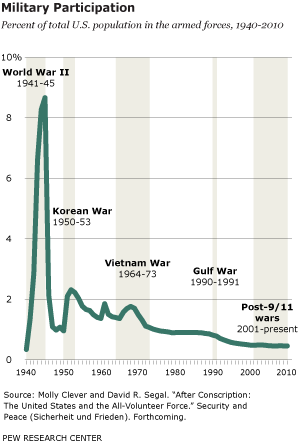
The Pew Research Center has reported extensively on the Military-Civilian Gap:

America’s post-9/11 wars mark the longest period of sustained combat in the nation’s history – and never before has America waged war with so small a share of its population carrying the fight.

Military Participation

For more about IAVA.

To donate to IAVA.

Thank You for Your Service

IAVA
I continue to receive comments from veterans of the recent wars about the post The Tin Anniversary of the Iraq War.  Rather than just reply to each comment, here is what I want to say.

Politics debases our language. Language is a tool, and like all tools, can be used for good, for ill, or for some combination.

In the political context, it is hard to tell whether “thank you for your service” from various politicos is sincere, tactical or, most likely, both. But even if it is meaningful, it sometimes seems like an automatic phrase, much like the obligatory speech close “and God bless the United States of America.” It becomes a cliché.

The Vietnam War is not just a textbook case in modern American history. It is an entire encyclopedia. One of the sorriest lessons was the treatment of returning vets. “Thank you for your service” is something those vets rarely if ever heard. All these years later, they mostly still haven’t.

Here it is, to the veterans and the fallen of our wars, then and now, however essential or popular or ill-conceived the wars may be or have been, and to their families, friends and everyone who has supported them in all ways: Thank you for your service.

In a related note, thanks to the Iraq and Afghanistan Veterans of America (IAVA) for keeping the veterans of our longest wars out front and in our faces. Among our “never agains” should be never again asking Americans to sacrifice so gravely, then thanking them loudly or not at all, and then putting them at the back of the line. These people are not political props or calendar items, because every day is Veterans Day and Memorial Day.

Thank you.

The Iraq War and the Ryan Budget: A Modest Proposal

Paul Ryan Budget
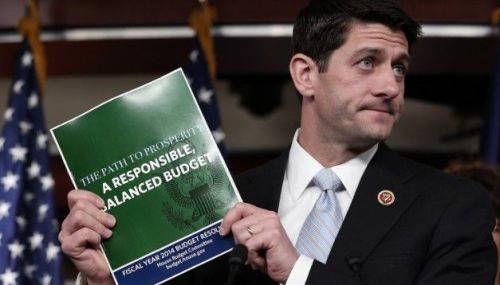
We have two budget crises. One is the budget itself, which is clearly in need of work to make concrete our priorities and the willingness of citizens to support those priorities in the form of taxes. The second crisis is political dysfunction, where real and constructive talk about those priorities and that support is transformed and devolved into useless politalk. One way that uselessness is hidden is by obfuscation and throwing around lots of numbers, details, and core American principles.

Simplify, simplify.

We just marked the 10th anniversary of the Iraq War. There is going to be disagreement about many aspects of that war for generations.

But there is consensus on two things.

The war was financially expensive. How expensive is another matter of contention. The Costs of War Project pegs it at a few trillion dollars, give or take. So how expensive? Very expensive.

The war was not paid for. More precisely, the war was paid for by debt, not by taxes. The United States had never done this before. There are two perfectly good reasons to ask Americans to pay for and sacrifice for wars. Wars are expensive. And taxing for war asks all citizens at all economic levels to make real sacrifice, even if they or their loved ones are not in harm’s way. As a political matter, when the sacrifice outweighs support for the war, there may be pressure to question or even end the war.

It is uncontested that George W. Bush and Congress did not ask for that sacrifice. Without arguing about how that happened, it is the fact. There is no argument about the result. In the midst of this massive borrowing to pay for the war, the economy fell down, and is still having trouble getting up.

With a sense of humility, and standing in the shadow of today’s esteemed Congress, here is a simple and modest proposal.

1. Agree on the financial cost of the Iraq War. For purposes of discussion, let’s say $3 trillion, though it is certainly more.

2. Agree to taxes that will generate that amount of revenue, not a cent more or less. That revenue would then be spent on all the important things that would otherwise be underfunded or unfunded, including every possible entitlement for veterans.

3. Once that money is raised and spent, taxes will revert to the earlier levels, and some members of Congress can go back to babbling, bickering and posturing.

Simple, maybe even naïve. Certainly too naive for the sophisticated politicians who are busy building a budgetary hall of mirrors that only they can navigate, where they think they can hide themselves and some simple, inconvenient truths.

The Tin Anniversary of the Iraq War

Tin CupTin is the traditional gift to mark a 10th wedding anniversary, just as it is silver for the 25th and gold for the 50th. There is no tradition about the anniversaries of wars, so tin will have to do.

All wars are controversial, whatever the split in support (80/20, 20/80, 50/50, rarely true 100% support), whatever the rationale, whatever the price. Every American war has had its naysayers, contemporary with combat and in the rear view mirror of history. World War II came close to consensus, although even there questions are still raised about whether we were late getting in and whether the unprecedented brutal way we got out was necessary.

This paragraph was going to include a bunch of numbers about the Iraq War. But you are going to find those numbers everywhere: how many of our personnel served, how many were killed and wounded, how many civilians were killed and wounded, how much it cost in dollars. Those numbers are meant to demonstrate the price paid, in, as they say, blood and treasure. Here it is in brief: the price was staggeringly high.

And next is something surprisingly good to say about the Vietnam War. If we learned nothing else from that nation-dividing conflict, we learned this: whatever we believe about a war, we can never, ever, ever take anything away from the service of those who fight.

Some people miss an important point when they argue that we have to justify a war after the fact so that those who suffered won’t have suffered “in vain”. It is the exact opposite. When a war turns out in hindsight to present real questions about why, those who fought are maybe more our most loyal heroes, especially in a volunteer army. They didn’t answer a call to defeat some cosmic embodiment of evil (e.g., Hitler); they just loyally answered a call to serve. They deserve all we can give them (which, by the way, includes world-class medical care).

In August 2002 I sent an e-mail to some U.S. Senators, including Bob Graham of Florida and Robert Byrd of West Virginia. Both of them were skeptical about the rush to war, and both—particularly Byrd—believed that the role of Congress was being ignored.

This is an excerpt from that e-mail It is not here to reveal some astute analysis or prescience. Lots of people knew or suspected that something was wrong. It is just here as an artifact of a moment that led us to the anniversary today.

Sent August 29, 2002

Congress has the constitutional power to make war, which includes careful deliberation and action if necessary.

In the case of Iraq, you and Congress should assert that power immediately and clearly. Congress has previously allowed that power to erode in the face of political pressure, and now faces an administration that is using an atmosphere of fear (that it has intentionally or inadvertently helped create) to dare Congress to defy its claimed authority.

When you do exercise that power, as I hope you will, it should be more than a rubber stamp. The President seems to have a simplistic and maybe, with all due respect, a simple-minded view of world affairs. The role he is carving out for the U.S. as the world’s sheriff may be right in a moral sense, but is possibly disastrous in the world of the 21st century. Which evildoer is next on the list; which town is he planning to clean up?

This isn’t High Noon or The Magnificent Seven. We have been lucky in Afghanistan, though I expect things will fall apart there within the next year or so. The destabilization of Iraq, especially in the face of global disdain for our actions, could be much more costly.

Finally, I believe that the President’s strange game of hide-the-ball regarding his plans for Iraq (in the guise of not telegraphing our strategy) is wreaking havoc with our economic confidence. Anybody with any economic insight knows that things are much worse than anyone is willing to talk about, restraining such talk in the hope that consumers and businesses will regain lost faith in the future. There is no way that an attack on Iraq can help that situation, and a thousand ways it can and will hurt.

For the record, when the Iraq War Resolution did pass Congress in October 2002, Byrd, Graham and a total of 23 Senators (21 Democrats, 1 Republican, 1 Independent) voted against it. Of those, only a handful are still in the Senate: Barbara Boxer, Dick Durbin, Carl Levin, Barbara Mikulski, Patty Murray, Jack Reed, Debbie Stabenow and Ron Wyden. It has been more than ten years, so choice and death have taken the rest of them. One who did vote for it who is no longer in the Senate is John Kerry, who became Secretary of State after the “official” end of the Iraq War, and who, between the vote for the war and the end of it, ran for President.

It’s a funny old world.

The Rubicon and the Pillar: If We Pass This Little Bridge


The Lives of the Twelve Caesars
By Suetonius

XXXI.

…The lights going out, he [Julius Caesar] lost his way, and wandered about a long time, until at length, by the help of a guide, whom he found towards daybreak, he proceeded on foot through some narrow paths, and again reached the road. Coming up with his troops on the banks of the Rubicon, which was the boundary of his province, he halted for a while, and, revolving in his mind the importance of the step he was on the point of taking, he turned to those about him, and said: “We may still retreat; but if we pass this little bridge, nothing is left for us but to fight it out in arms.”

XXXII.

While he was thus hesitating, the following incident occurred. A person remarkable for his noble mien and graceful aspect, appeared close at hand, sitting and playing upon a pipe. When, not only the shepherds, but a number of soldiers also flocked from their posts to listen to him, and some trumpeters among them, he snatched a trumpet from one of them, ran to the river with it, and sounding the advance with a piercing blast, crossed to the other side. Upon this, Caesar exclaimed, “Let us go whither the omens of the Gods and the iniquity of our enemies call us. The die is now cast.”